Fact-checked against the underlying research, September 2026.
“Tell me about yourself” isn’t a biography request. It’s a compression test. In the first ninety seconds, the interviewer scores three things they never say out loud: does your history map to this role, does your career read as one coherent story, and can you prioritize under pressure. Most advice optimizes none of the three — it optimizes chronology instead.
TL;DR
- Snap competence judgments formed during pre-interview small talk correlate with final interview scores at r = .42 and predict real internship offers at r = .22 [ESTABLISHED] (Barrick, Swider & Stewart, 2010). Both are raw, uncorrected correlations — measurement error in interview ratings typically attenuates observed relationships, so the underlying effect is plausibly larger, not smaller, than the reported number.
- The hidden rubric: role-relevance, narrative coherence, compression discipline. The present–past–future formula scores none of them.
- Replace it with Claim → Through-line → Proof Pair → Bridge.
- Five failure modes recur — and prepared candidates fall into them more, not less.
- Structured interviews shrink the opening-impression effect. They don’t erase it [PROBABLE].
What’s Actually Being Scored
Three sub-questions hide inside this one. Role-relevance: can you translate your history into value for this specific job? Trajectory coherence: does your career read as a causal chain, or a series of accidents? Compression discipline: can you prioritize without being told a time limit? A senior candidate who lists a decade of work without connecting any of it to this team’s problems has, functionally, said nothing.
This isn’t folklore. Interviewers form confident impressions from mere seconds of exposure [ESTABLISHED] (Ambady & Rosenthal, 1992), and those early impressions demonstrably shape final scores and real offers, not just gut feel (Barrick, Swider & Stewart, 2010; Swider, Barrick & Harris, 2016). Left without your own causal story, interviewers build one anyway — researchers call this “sensemaking,” and it’s fluent enough that in one study, adding an unstructured interview on top of solid background data made GPA predictions worse, dropping accuracy from r = .61 to r = .31 [ESTABLISHED] (Dana, Dawes & Peterson, 2013). Every sentence that isn’t diagnostic for this role dilutes the sentences that are. Rambling isn’t neutral — it’s subtractive.
The Five Failure Modes
Nearly every weak answer is one of these — and it’s disproportionately the prepared candidates who produce them, because these are rehearsed failures:
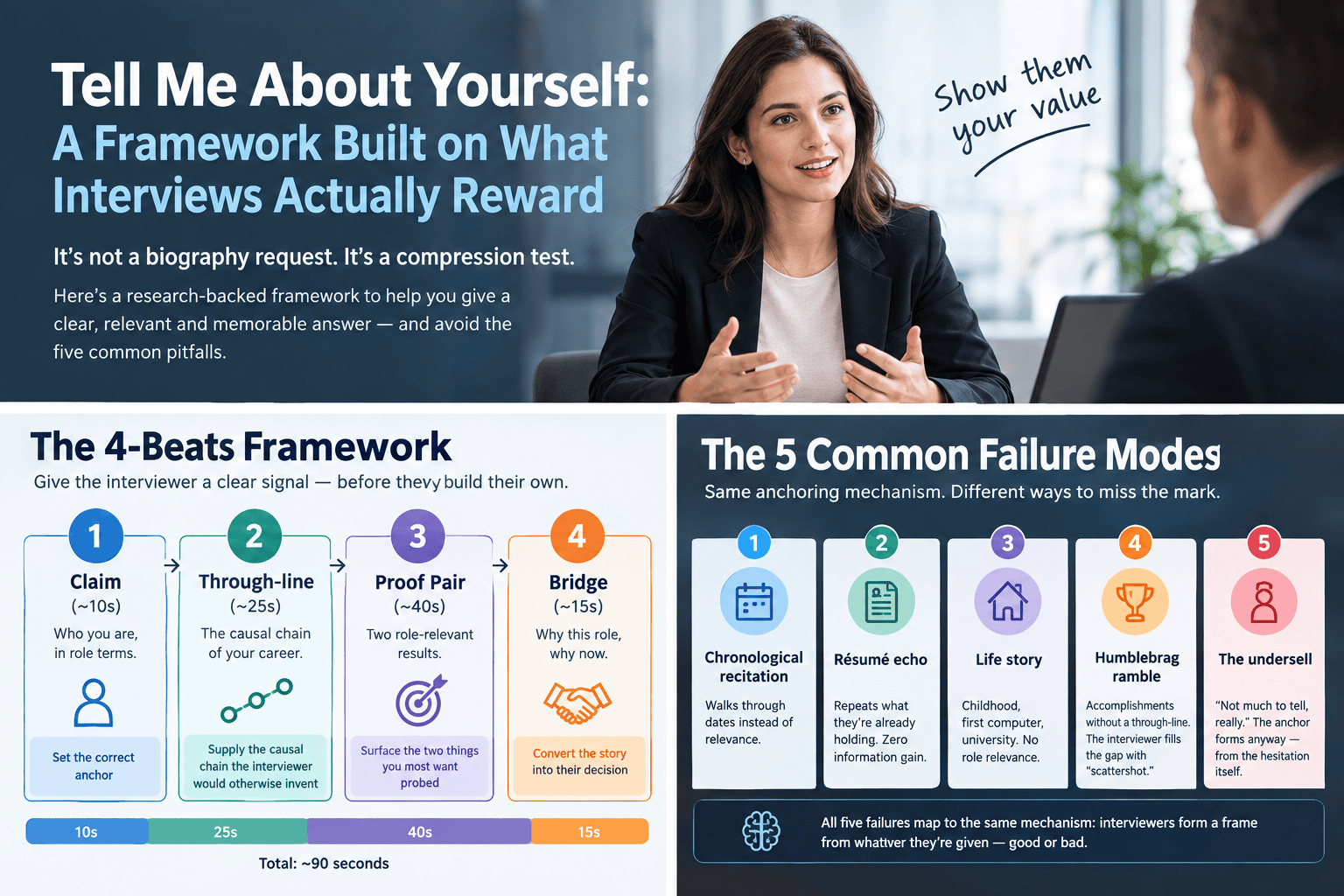
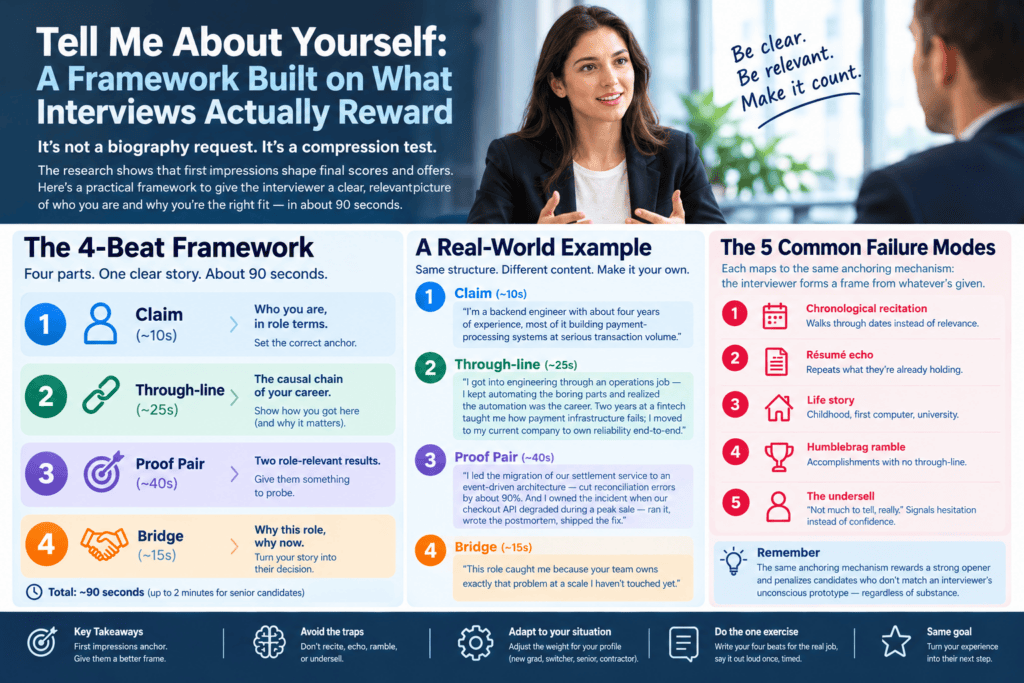
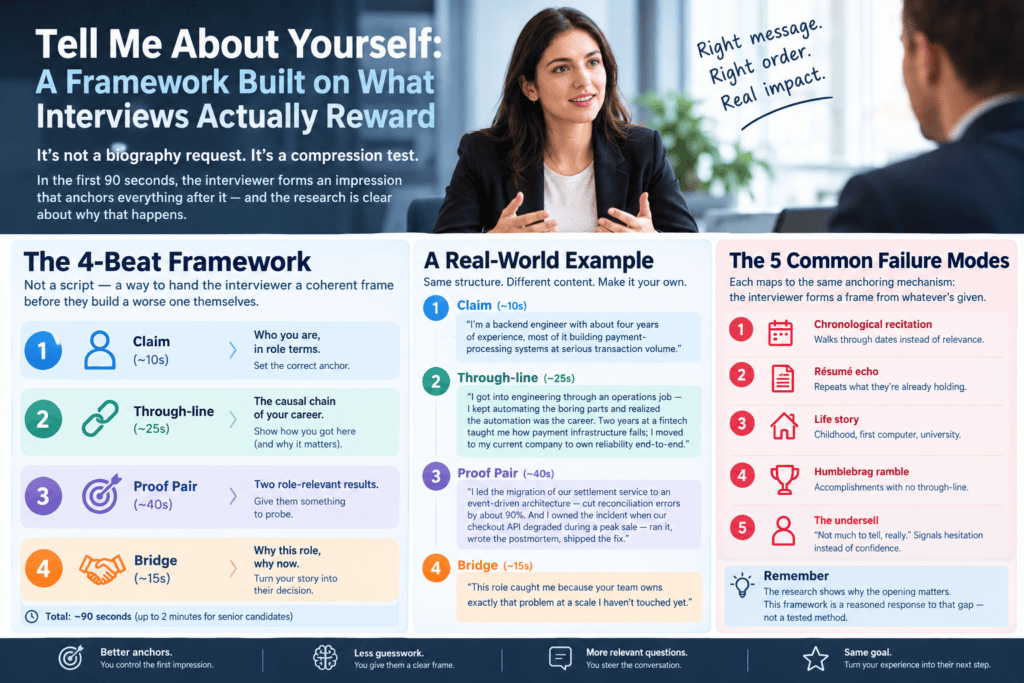
- Chronological recitation — walks through dates instead of relevance, anchoring the interviewer on your least relevant experience first.
- Résumé echo — repeats what they’re already holding. Zero information gain, and it signals you have nothing to add to the paper version of you.
- Life story — childhood, first computer, university. Maximum dilution; the anchor forms around content that has nothing to do with the role.
- Humblebrag ramble — accomplishments with no through-line. No causal chain means the interviewer’s sensemaking fills the gap, usually with “scattershot.”
- The undersell — “not much to tell, really.” In the absence of a confident frame, the anchor still forms — from the hesitation itself.
The Fix: Claim → Through-line → Proof Pair → Bridge
Four beats, each scoring one of the hidden criteria above. Not a script — a compression codec for your career.
Role-relevance → Claim (~10s)Trajectory coherence → Through-line (~25s)Role-relevance → Proof Pair (~40s)Role-relevance → Bridge (~15s)The split isn’t arbitrary, though it is editorial judgment rather than a measured constant [SPECULATIVE]. The claim and bridge are one sentence of positioning each — they don’t need more time to do their job. The through-line needs just enough room to make the causal chain visible without sliding into chronology. The proof pair gets the most time because it’s the material an interviewer actually probes: whatever you spend the most time on is what the rest of the conversation orbits, so it should be the two things you most want to be asked about.
| Beat | Time | Job | Prevents |
|---|---|---|---|
| Claim | ~10s | Set the correct anchor | Undersell, life story |
| Through-line | ~25s | Pre-empt bad narratives | Chronological recitation |
| Proof pair | ~40s | Surface your two best probes | Résumé echo, ramble |
| Bridge | ~15s | Convert story into their decision | Aimless ending |
Tune it by interviewer type: a recruiter screen wants a legible claim and a concrete bridge; an engineering-loop interviewer wants you through the proof pair fast so they can get to technical questions.
A Worked Example
Steal the skeleton. Never the sentences. Copy the mechanism, not the wording — generic phrasing is its own tell, and interviewers compare notes more often than candidates assume. This is a composite, not a real person.
“I’m a backend engineer with about four years of experience, most of it building payment-processing systems at serious transaction volume. (Claim.)
I got into engineering through an operations job — I kept automating the boring parts and eventually realized the automation was the career. Two years at a fintech taught me how payment infrastructure fails; I moved to my current company to own reliability end-to-end. (Through-line — each move explained by intent, no dates.)
Two things matter here. I led the migration of our settlement service to an event-driven architecture — cut reconciliation errors by about 90% and taught me what idempotent design actually costs. And I owned the incident when our checkout API degraded during a peak sale — ran it, wrote the postmortem, shipped the fix. (Proof pair — outcome, scale, personal contribution.)
This role caught me because your team owns exactly that problem at a scale I haven’t touched yet.” (Bridge — one sentence.)
Adapting to Your Situation
Same four beats, different weight distribution. Copying a template built for a different career shape is its own failure mode.
| Profile | What shifts |
|---|---|
| Career switcher | Through-line carries the weight; claim reframes old experience in new vocabulary. |
| New grad | Proof pair becomes projects and internships; claim leans on fundamentals. |
| Senior / staff | Proof pair shifts from “what I built” to “what I made possible.” |
| Contractor | Through-line frames engagement variety as a chosen mode, not instability. |
What Could Be Wrong With This Advice
Honest boundaries, because this has them. An r of .22 between first impressions and offers is meaningful across thousands of interviews and close to irrelevant in any single one — a strong loop can recover from a shaky opener, and a polished opener won’t rescue a failed system-design round [PROBABLE]. Structured processes with identical questions and independent scoring shrink the effect but don’t erase it (Levashina et al., 2014; Swider, Barrick & Harris, 2016).
Unpopular opinion: rehearsing more than twice makes your answer worse, not better. Past that point you’re not fixing content, you’re adding visible polish — and a visibly rehearsed answer reads as performance, triggering the same skepticism it’s trying to avoid.
And the same anchoring mechanism that rewards a strong opener penalizes candidates who don’t match an interviewer’s unconscious prototype — accent, background, non-traditional path — regardless of substance. That’s a documented bias in the process, not a justification for it.
The One Rehearsal That Matters
Before every interview, write your four beats fresh against that company’s actual job description, and say them out loud once, timed. Not a memorized script — a compression exercise that forces you to decide which two accomplishments deserve to steer the rest of the conversation. It’s the only question in the interview where you control 100% of the material before a word is asked. Use it before the interviewer’s sensemaking engine writes the wrong story for you.
FAQ
How long should the answer be?
About 90 seconds. Two minutes at most for a senior candidate with more scope to cover. Past that, you’re diluting your best material with content nobody’s scoring.
Should I memorize it word for word?
No. Internalize the four beats, not a script. A visibly memorized answer reads as performance, which is its own failure mode.
Can I mention hobbies or personal life?
Only if it does real work for relevance, coherence, or the bridge. Otherwise it’s dilution — no different from an irrelevant work story.
Does this work outside technical interviews?
Yes. Relevance, coherence, and compression get scored in any interview. Only the proof pair’s content changes.
What if they say “walk me through your resume” instead?
Same scoring, different wording. Same four beats — just adjust the claim to acknowledge their phrasing.
I’m a new grad with no full-time experience — what changes?
The proof pair shifts to projects and internships. The claim leans on fundamentals and trajectory instead of tenure.
About This Piece
Tom Morgan is a staff byline covering technical hiring and interview prep. This piece synthesizes the peer-reviewed research listed below with patterns observed across technical hiring loops; the worked example is a composite built to illustrate the mechanism, not one interviewer’s proprietary case data. Published September 2026.
Sources
- Barrick, M. R., Swider, B. W., & Stewart, G. L. (2010). Initial evaluations in the interview: Relationships with subsequent interviewer evaluations and employment offers. Journal of Applied Psychology, 95(6), 1163–1172. https://doi.org/10.1037/a0019918
- Swider, B. W., Barrick, M. R., & Harris, T. B. (2016). Initial impressions: What they are, what they are not, and how they influence structured interview outcomes. Journal of Applied Psychology, 101(5), 625–638. https://doi.org/10.1037/apl0000077
- Dana, J., Dawes, R., & Peterson, N. (2013). Belief in the unstructured interview: The persistence of an illusion. Judgment and Decision Making, 8(5), 512–520. https://journal.sjdm.org/12/121130a/jdm121130a.html
- Ambady, N., & Rosenthal, R. (1992). Thin slices of expressive behavior as predictors of interpersonal consequences: A meta-analysis. Psychological Bulletin, 111(2), 256–274. https://doi.org/10.1037/0033-2909.111.2.256
- Levashina, J., Hartwell, C. J., Morgeson, F. P., & Campion, M. A. (2014). The structured employment interview: Narrative and quantitative review of the research literature. Personnel Psychology, 67(1), 241–293. https://doi.org/10.1111/peps.12052