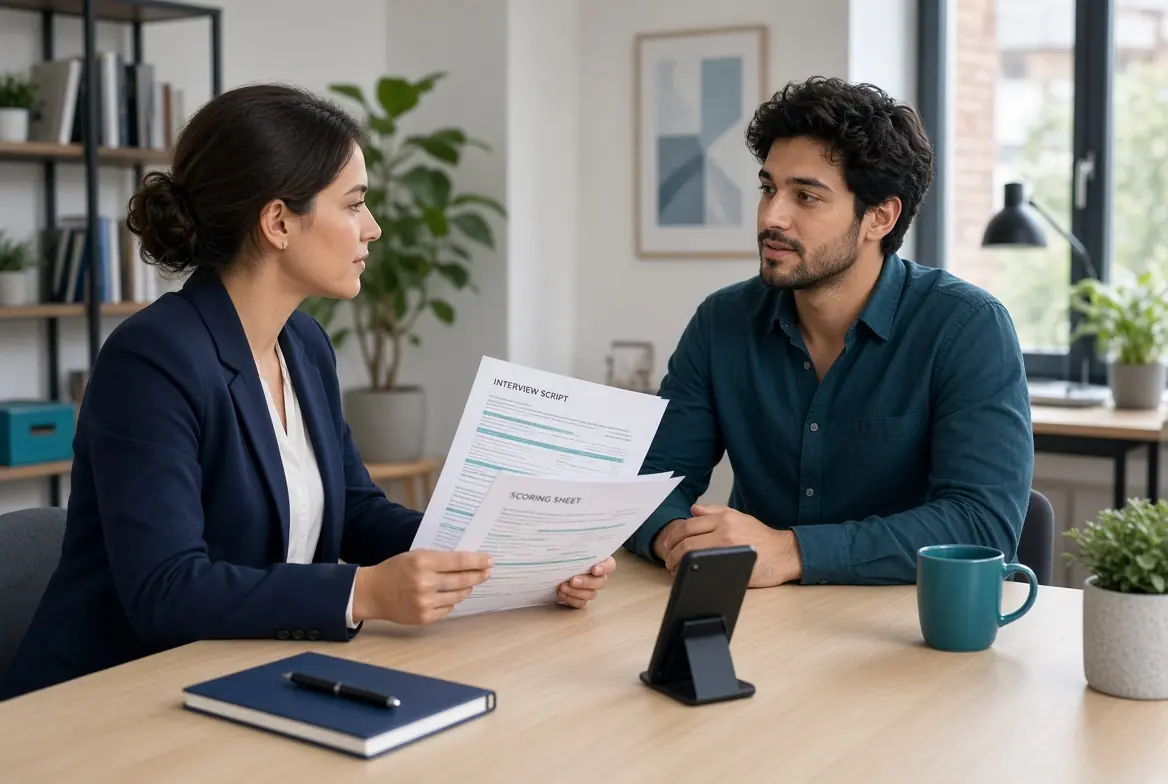
Give your friend a written script—fixed questions, pre-written follow-ups, and a 1–5 scoring sheet—then record a 30-minute session, score it silently before anyone speaks, choose two fixes, and immediately re-ask your weakest question. Structure is the point: structured interviews predict job performance better than casual chats (a 2022 meta-analysis put the correlations at about .42 versus .19), and a script stops a friendly friend from turning rehearsal into conversation.
TL;DR
- Script the friend, not only the questions. Fixed questions in a fixed order, at most two written follow-ups each, and a rubric the friend fills in silently.
- Copy the real setting. Same medium as the real interview (video, phone or in person), about 30 minutes, recorded on your own device.
- Debrief on the answers, not on you. Compare scores, pick two fixes, and re-take your weakest question before you leave the chair.
- Know what’s proven. Structure and specific feedback have research behind them. Friend-run sessions themselves haven’t been tested against alternatives.
The friend is the weak link, not the questions
Picture the usual version. Your friend searches “common interview questions,” reads you a handful, nods along, and finishes with “Honestly, that was great.” You feel better. Your answers haven’t changed.
The weakness is structural. Psychologists have described people’s reluctance to deliver bad news since Rosen and Tesser named it the “MUM effect” in 1970, and the U.S. Office of Personnel Management (OPM) guide to structured interviews (2008) lists leniency, rating everyone high regardless of performance, among the common rating errors interviewers should be trained to recognize. An untrained friend who wants you to feel good is exposed to both. That is an inference, not a measured “friend effect,” but it is a safe one to design around.
So skip the search for a blunter friend and change the job instead. Take judgment out of their hands and give them a procedure: ask these questions, in this order, with these follow-ups, and write a number against this rubric. Employers call that a structured interview, and the same OPM guide says federal agencies are encouraged to use one. In a 2022 meta-analysis in the Journal of Applied Psychology (Sackett and colleagues), structured interviews had the highest average validity of the hiring methods reviewed: about .42, against about .19 for unstructured ones. “Validity” here means the correlation between interview scores and later job performance, not a hit rate, and it varied widely between studies (roughly plus or minus .24, in the authors’ follow-up paper). The older 1998 estimates from Schmidt and Hunter were higher for both, .51 and .38. The size of the gap is disputed. Its direction isn’t.
One caution belongs up front: that research concerns hiring, not practice. No study found for this article tests a scripted friend against an improvising one. The case for the script is built from parts that have been studied (structure, specific feedback, rehearsing in the format you’ll face), and the sections below flag which parts are evidence and which are design choices.
Build the pack first (about 20 minutes)
- Choose four to six competencies from the job posting. OPM’s guide says a structured interview typically covers four to six. Read the posting’s verbs (coordinate, negotiate, analyze, escalate) and turn each into something you’d expect them to test.
- Write six questions. Five behavioral (they ask what you did: “Tell me about a time…”) and one situational (a hypothetical: “Suppose…”), the two formats OPM defines. The script below has ready-made versions.
- Let your friend write two wildcards. Questions you’ve read in advance are rehearsal; questions you haven’t are a test, and a session needs some of each. Your friend writes two more behavioral questions from the posting and keeps them hidden.
- Hand over the pack: the script, the rubric, a timer, and three lines from the posting. Leave out your résumé. OPM tells interviewers not to consult résumés mid-interview because it can color ratings. Your friend’s version of that problem is memory, so the rule is score only what’s said aloud.
- Match the medium. If the real interview is on video, rehearse on the same platform. The evidence is contested: a 2016 meta-analysis of 12 studies (Blacksmith and colleagues) found lower interviewer ratings in technology-mediated interviews (d = −.41, a moderate effect), while a 2026 meta-analysis of 24 studies in Current Psychology (Moon, Park and Park) found essentially no average difference (ρ = −.01) and wide variation. Neither shows that rehearsing on the medium closes a gap, but one study summarized in the 2026 paper found no anxiety difference when participants knew the technology, so familiarity is cheap insurance.
- Record it. Use your own device, tell your friend, and delete the file afterward. Recording isn’t magic: in the MIT trial discussed below, reviewing video without feedback produced no significant gain. Watch it with the rubric open.
One session, six moves
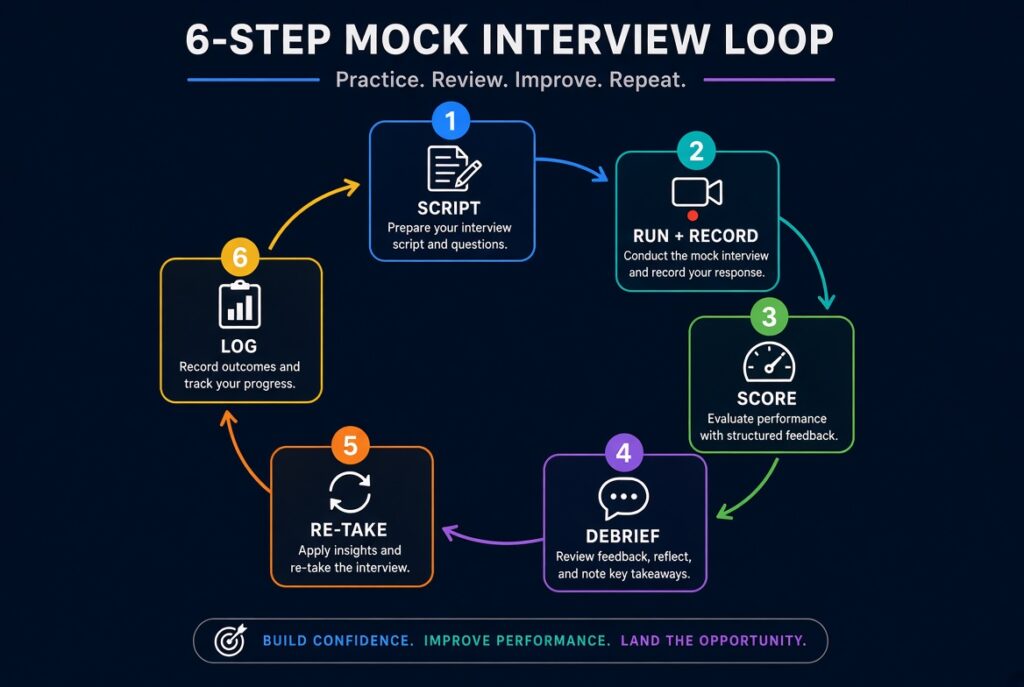
Every session runs the same six moves in the same order. The last one feeds the next script, which makes it a loop rather than a one-off.
The session loop. The log from move 6 becomes the input to the next script.
Two moves deserve a defense. Scoring (move 3) happens before anyone talks so neither of you can bend a number toward the other’s reaction; OPM’s guidance for panels uses the same rule, with each rater scoring alone before discussion. The re-take (move 5) is a design choice with no direct test in interview research: it turns feedback into behavior while the correction is still fresh.
| Segment | Minutes | Friend’s job |
|---|---|---|
| Pre-brief and recording check | 3 | Read the pre-brief aloud |
| Interview | 30 | Ask, probe, stay neutral, take notes |
| Silent scoring | 5 | Finish scores; you score yourself |
| Debrief | 10 | Compare scores, name two fixes |
| Re-take | 5 | Re-ask your weakest question |
| Log | 2 | Record scores, fixes, next date |
| Total | 55 |
These durations are working assumptions, not research findings.
The script, word for word
Before recording: the friend’s pre-brief
“For the next thirty minutes I’m the interviewer, not your friend. I’ll ask the same questions in the same order and follow up when an answer stays vague. I won’t say ‘great’ or ‘good’ until we debrief. If you’re still talking at two and a half minutes, I’ll cut in and ask for the result. I’m scoring as we go, and I won’t share scores until you’ve scored yourself. Ready?”
Opening (2 minutes)
“Thanks for coming in. Did you find us all right? (On video: “Thanks for joining. Can you hear me okay?”) I’m Sam, I lead the [team]. We’ll take about half an hour: some questions on your background, a few scenarios, and time at the end for yours. Anything you’d like to ask before we start?”
Chat for a couple of minutes about anything except the job, and don’t skip it. In a study of internship candidates (Barrick, Swider and Stewart, 2010), impressions formed during a 2–3 minute rapport phase correlated with final interviewer ratings (r = .42) and internship offers (r = .22), and carried over even to an interviewer who skipped the small talk. The finding is correlational, and OPM lists relying on first impressions as an interviewer mistake, so it proves neither that small talk wins offers nor that interviewers should behave this way. It does show the first minutes count toward what gets scored, which is reason enough to rehearse them.
The question set
Questions 2 to 7 are scored; 1, 8 and 9 get notes only. The friend uses at most two probes per question, identical from session to session, following OPM’s advice to fix the range of probing in advance. When a question-specific probe doesn’t fit, draw from this bank, which mirrors the situation, action and outcome probes in OPM’s guide: “What was your part, specifically?” · “What did you do next?” · “How did it turn out, and how do you know?” · “Can you put a number or a name on that?” · “What would you do differently?”
| Friend asks | Probes if vague | A strong answer contains |
|---|---|---|
| 1. Opener (3 min): “Walk me through your background and what brought you to this role.” | “Which part of that matters most for this job?” | A point of view in the first sentence, ending at this role instead of reciting titles |
| 2. Initiative: “Tell me about a time you took on something nobody asked you to.” | “Why you, and not someone else?” / “What happened as a result?” | A named situation, your own decisions, an outcome someone else could confirm |
| 3. Wildcard A (friend-written): “The posting mentions [skill]. Tell me about the hardest [skill task] you’ve handled.” | “What made it hard?” / “What would you do differently?” | Hands-on detail, not a definition of the skill |
| 4. Conflict: “Tell me about a disagreement with a colleague over how something should be done. What happened?” | “What did they say?” / “How did it end?” | The other person’s view described fairly, your own move, a resolution or a clear lesson |
| 5. Failure: “Tell me about a project that didn’t go the way you planned.” | “When did you first notice?” / “What do you do differently now?” | Ownership without excuses, plus a specific change since |
| 6. Situational: “Suppose two stakeholders give you conflicting priorities on the same day. What would you do?” | “What’s the first thing you’d do?” / “What if both insist it’s urgent?” | Concrete steps in order, what you’d need to find out, how you’d explain the trade-off |
| 7. Wildcard B (friend-written): any other behavioral question from the posting | Bank probes | As in question 2 |
| 8. Motivation (2 min): “Why this role, and why us?” | “What else about it appeals to you?” | Specifics from the posting, not flattery |
| 9. Your turn (2 min): “What questions do you have for me?” | None | Questions the careers page couldn’t answer, including one on what success looks like in year one |
The cut-in line, at 2:30: “Let me pause you there. What was the result?” The 2:30 cap is a practice heuristic, not a research-derived number.
Closing
“That’s everything I have. Thanks; we’ll be in touch.” (Friend drops the role.) “Okay, stop the recording. Don’t say anything about it yet. We both score first.”
The scoring sheet: a rubric your friend can use
Score each answer to questions 2–7 within ten seconds of it ending, and jot one quote as evidence. OPM’s guide asks for a common scale with at least three labeled levels and suggests five to seven overall. This one labels 1, 3 and 5 and leaves 2 and 4 as in-betweens.
| Score | What the answer contained |
|---|---|
| 1 | No real example, or a hypothetical dressed up as one (“I usually…”) |
| 3 | A real example and your own actions, but no result, or a result nobody could check |
| 5 | A real example, your own decisions, and a checkable result (a number, a decision, a named outcome), inside the time cap and tied to the target role |
Three rules for the friend:
- Score only what was said aloud. You know the story behind the answer; a real interviewer doesn’t.
- Rate the answer, not the person, and use the whole scale. OPM names leniency and central tendency (middling scores for everyone) as rating errors. A 2 isn’t rude. It’s information.
- No quote, no score. OPM wants ratings supported by notes containing actual examples, and one line per answer is enough.
Add three yes/no delivery checks per answer: opened with a one-sentence headline; finished without a cut-in; ended on the result. These are practice prompts, not validated predictors, so swap them for whatever your real interview demands. The maximum total is 30 (six answers, five points each). There’s no validated pass mark for a homemade rubric, so use the total to compare your own sessions, not to declare yourself ready.
The debrief decides whether any of this works
Feedback isn’t automatically helpful. A 1996 meta-analysis by Kluger and DeNisi pooled 607 effect sizes (23,663 observations): feedback improved performance on average (d = .41, a moderate effect), yet more than a third of feedback interventions made performance worse. The pattern that fit best was attention: the more a message pulled focus toward the person and away from the task, the less it helped. The literature isn’t interview-specific, so treat what follows as inference. It still yields the debrief’s first rule: talk about the answer, never the candidate. “The result never came up” is task feedback. “You seemed nervous” isn’t.
Interview-specific evidence points the same way, thinly. In a randomized trial of 90 MIT undergraduates (Hoque and colleagues, 2013), only the group that practiced with an automated interviewer and then reviewed video alongside specific behavior feedback (smiles, eye contact, vocal variety, filler words) was rated significantly better by human experts a week later. Reviewing video without feedback, or watching advice videos, changed nothing significant. A 2008 Clemson master’s thesis (n = 102) found the same ordering, from lowest ratings to highest: no practice, practice only, self-feedback, counselor feedback. But its overall test missed significance (p = .15), and only a trend test cleared the bar. Neither study involved a friend.
The debrief, in order:
- Scores first. Each of you writes a 1–5 for questions 2–7 before speaking.
- Compare. Friend: “Where we’re two or more points apart, we start there.” A gap isn’t an argument about who’s right; it shows where your self-assessment runs generous or harsh.
- Use task language. For each weak answer, the friend says: “What I heard was [the example]. What I didn’t hear was [the missing piece].” Trait words (nervous, confident, natural) stay out.
- Choose two fixes. Friend: “Which two changes would move the most scores?” Two is what you can rehearse in five minutes; the number is a design choice.
- Re-take the weakest question. Start a new recording. The friend re-asks it word for word, you answer with both fixes applied, and the friend re-scores.
- Log it. Write the date, six scores, and two fixes. Later that day, rewatch only your two lowest answers (about ten minutes), pausing where the missing piece belonged. Open the next session by checking whether last time’s fixes show up.
In later sessions, re-ask a sibling question instead: same competency, different scenario. The same question tests whether one answer improved. A sibling tests whether the skill did.
What a friend can’t judge, and how to patch it
Content accuracy. A friend outside your field can judge structure, specificity and clarity, but not whether a technical claim is right. OPM lists “not knowing the job” as a classic interviewing mistake, because interviewers fill the gap with personal opinion. Patch it by writing two or three content checkpoints per question, the facts a strong answer must contain, and handing them over in advance. For coding, case or portfolio interviews, use someone from the field for that portion; this script covers the behavioral and situational part.
Panels. For a panel interview, recruit two friends and have each score alone before comparing, the same independence rule OPM uses for panels.
Memorized answers. After three runs of the same questions, the wildcards and sibling questions tell you more than the scores do. Answers that improve on known questions and collapse on new ones haven’t improved.
A friend who breaks character. If laughter or coaching intrudes mid-answer, restart that question instead of carrying on.
No friend available. The script works alone with a recording and a delayed self-score, but nothing checks your scores. Career-services offices and coaches offer human feedback. AI role-play tools can follow the same script, though nothing in the sources reviewed compares them head-to-head with a friend or a coach.
Severe interview anxiety. If it interferes with daily life, a counselor or clinician is a better first call than a friend with a stopwatch.
What the evidence supports, and what it doesn’t
| Claim | Best evidence found | How far to trust it |
|---|---|---|
| Structured interviews predict job performance better than unstructured ones | Sackett et al., 2022 meta-analysis (about .42 vs .19); older estimates .51 vs .38 | Strong for hiring; silent on practice |
| Feedback helps on average but can backfire | Kluger and DeNisi, 1996 (607 effect sizes; over a third negative) | Strong, but not interview-specific |
| Practice plus specific feedback beats practice alone | MIT randomized trial (n = 90); Clemson thesis (n = 102, trend only) | Suggestive: small lab studies, no friends |
| The first minutes influence ratings | Barrick et al., 2010 (internship candidates) | Moderate; correlational |
| Video changes interviewer ratings | Blacksmith et al., 2016 (d = −.41) vs Moon et al., 2026 (ρ = −.01) | Contested |
| Friend-run mock interviews work | None found in the sources reviewed | Unknown; the script is inference from the rows above |
Two more gaps are worth stating. Earlier reviews of interview coaching, as summarized in the Clemson thesis, found no consistent benefit from practice alone. And the sources reviewed for this article did not identify an ideal number of sessions, so distrust any rule that claims one. A workable stopping rule comes from your own log: keep running sessions until the same two fixes stop appearing.
Your next step
Tonight, choose four competencies from the posting, write your six questions, and send your friend this page with the pre-brief and rubric highlighted. Book 55 minutes, and book the second session before the first, so the log has somewhere to go.
Sources and figures last checked September 2026.