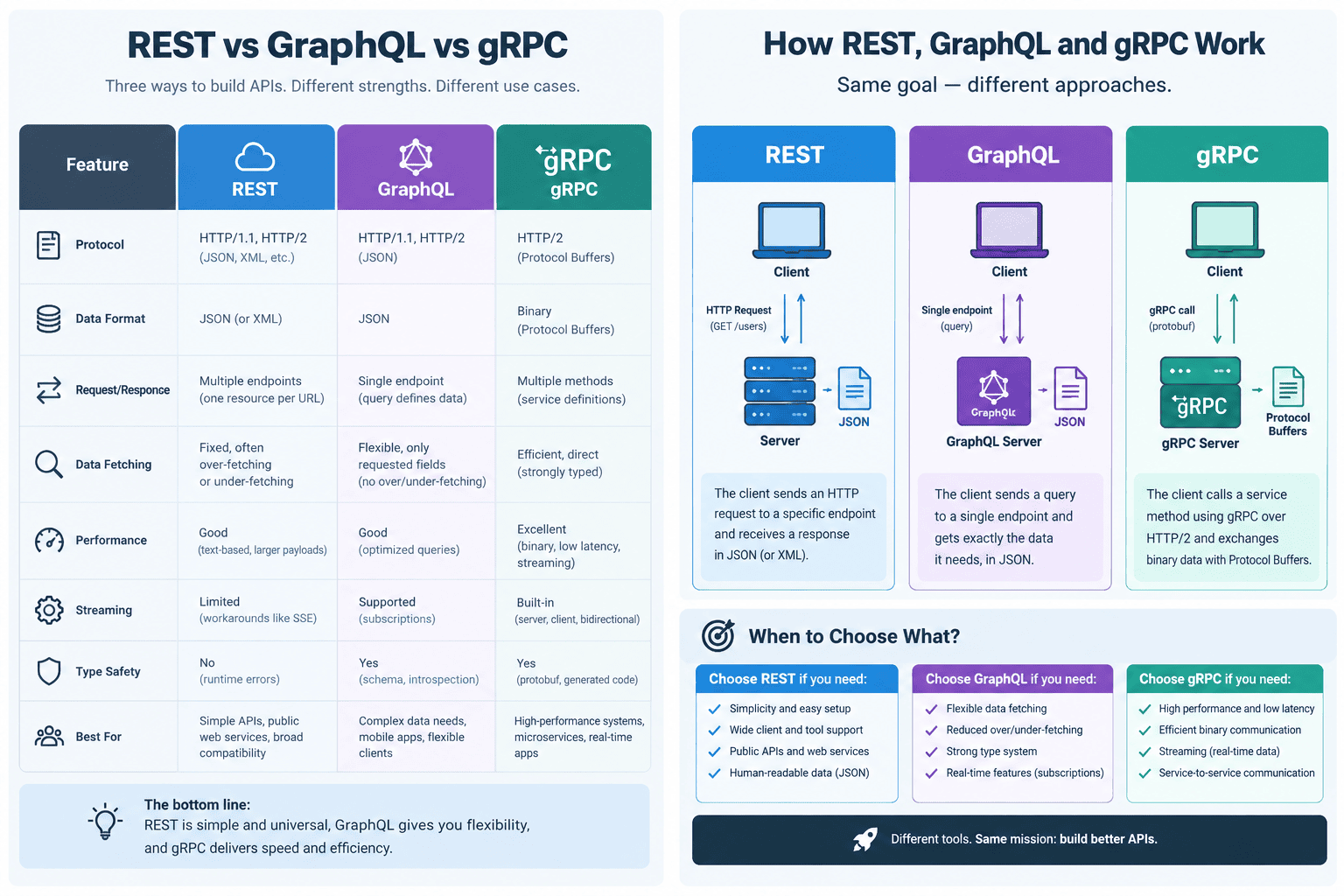
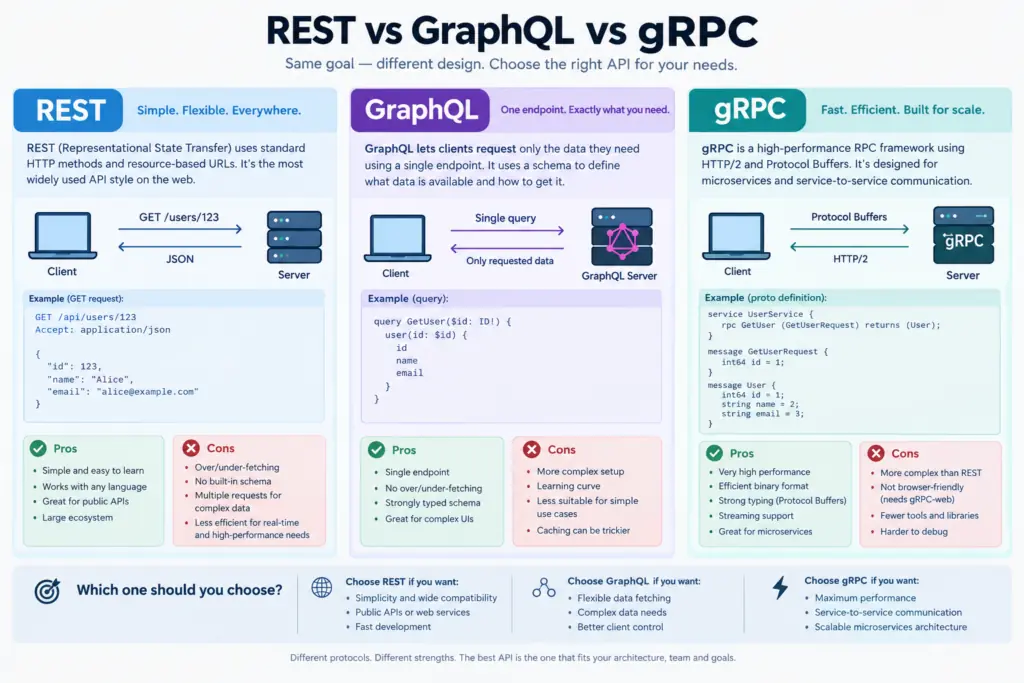
Direct answer: Learn REST first. It is the only one of the three whose skills carry over to the other two, and it is what you will meet most often at work. After that, pick by role: GraphQL if you build client-facing products, gRPC if you build service-to-service backends.
Meta description: REST, GraphQL, or gRPC first? A learning-order guide based on what each style teaches you, where each breaks, and which to pick second. Updated October 2026.
Suggested slug: /rest-vs-graphql-vs-grpc-learn-first
Most “REST vs GraphQL vs gRPC” posts compare features. That answers a question a beginner doesn’t have yet. The useful question is which style teaches you the most per hour spent, and which failure modes you should understand before meeting the others.
I think REST is the right first choice. The reason is not that REST is best. REST’s own weaknesses are what make the other two make sense.
What the numbers say, and what they don’t
The best recent adoption data comes from Postman’s 2025 State of the API report, a survey of more than 5,700 developers, architects and executives. It puts REST at 93%, webhooks at 50%, WebSockets at 35% and GraphQL at 33%. Respondents could pick several styles, so the figures overlap. A team using GraphQL to serve its frontend almost certainly also exposes REST somewhere. postman
Two cautions:
- This is a vendor survey, not a census. Postman’s audience skews toward people who test and document HTTP APIs, which probably inflates REST and GraphQL relative to, say, internal gRPC meshes. Treat it as direction, not market share.
- I can’t give you a clean 2025 gRPC figure. The report’s prose doesn’t state one. Earlier editions did: gRPC was 6.9% in 2020, and 11% in 2022, which Postman linked to gRPC being used for internal microservices and GraphQL for stitching together disparate data sources. One aggregator quotes 14% for 2025 and another quotes 11%. I’d rather leave the number out than pick one. postmanpostman
GraphQL’s trend is easier to read. It went from 22.5% in 2020 to 29% in 2023 to 33% in 2025. That is steady growth, not displacement. As of the Postman archive checked for this article, the 2025 edition is still the latest, so no newer Postman figure exists. postmangetpostman
Three styles, three answers to “who decides the shape of the data?”
This is the framing I’d use instead of a feature table.
| REST | GraphQL | gRPC | |
|---|---|---|---|
| Who decides the response shape | The server, per endpoint | The client, per query | The contract file (.proto), fixed per method |
| Core abstraction | Resources + HTTP verbs | A typed graph + one query language | Remote procedures + typed messages |
| Wire format | Usually JSON over HTTP | JSON, usually over a single HTTP endpoint | Protocol Buffers (binary) over HTTP/2 |
| Native in browsers | Yes | Yes | No, needs gRPC-Web and a proxy |
| Best-fit caller | Anyone | Frontends with varied data needs | Other services you control |
Every row follows from that first one. Once you see it, the rest of each style’s design looks inevitable.
Why REST goes first: it teaches the thing the other two build on
REST over HTTP forces you to learn status codes, headers, GET caching, idempotency, pagination, and token auth. Those apply to GraphQL too. The two don’t just share a transport: most GraphQL servers sit behind the same gateways, CDNs, and auth layers as REST. A GraphQL developer who has never learned HTTP caching will not understand why their API is hard to cache.
gRPC also depends on HTTP knowledge, in a roundabout way. It moves its final status into HTTP/2 trailers. Browsers can’t use those directly, which is the whole reason gRPC-Web exists. Kreya’s technical write-up explains that gRPC-Web works around this by moving the trailers into the HTTP body. Without a firm grip on what HTTP normally does, none of that makes sense. kreya
REST is also the easiest of the three to debug. You can inspect it with curl and a browser tab, which makes it the cheapest style to be wrong in while learning.
REST’s real weakness is the best argument for learning the other two
Take a profile screen that needs a user, their 20 latest posts, and the comments on each post. These are illustrative inputs, not data from a real system.
Naive REST: one call for the user, one for the posts list, then one comments call per post. That is 1 + 1 + 20 = 22 requests. You can fix it by adding a purpose-built endpoint, which works but means a backend change every time a screen changes.
GraphQL: the client sends one query for the whole shape. That is 1 request, and the network problem goes away. The cost moves to the server. A naive resolver implementation fetches each post’s comments separately, which is the same 22 database queries hidden behind one HTTP call. Batching with a DataLoader-style pattern brings it down to roughly 3 (user, posts, comments for all posts). GraphQL doesn’t remove the N+1 problem. It moves it from the network to the resolver layer, where it is harder for a newcomer to see.
I’m not citing a speed multiple for REST versus GraphQL. The figures floating around come from single-stack blog benchmarks, and I couldn’t trace them to a reproducible primary source. The mechanism above is the reliable part.
That is the sequencing argument. Learn REST first, and you feel the over-fetching and under-fetching pain that GraphQL addresses. Learn GraphQL first, and you can adopt it without knowing the problem it solves, so you’ll pay its costs without noticing them.
Where each style fails
REST
- Endpoint sprawl as screens multiply.
- No built-in contract. You need OpenAPI discipline to get one. Postman’s 2025 data shows contract testing at only 17%, which suggests many REST teams don’t have an enforced contract at all. postman
GraphQL
- Caching is harder. Queries typically go through a single
POSTendpoint, so standard HTTP caches and CDNs don’t help by default. Persisted queries andGET-based queries can restore some of it, but that is extra machinery. - Many servers return HTTP 200 even when a query fails, with errors inside the response body, so generic HTTP monitoring can miss real failures. Newer response-format conventions change this, so check what your server does.
- A client can write an expensive query. Production use needs depth and cost limits.
gRPC
- Browsers can’t speak it natively. Microsoft’s ASP.NET Core documentation states that gRPC-Web browser clients can’t call client-streaming or bidirectional-streaming methods, and recommends sticking to unary and server-streaming. microsoft
- You need a proxy such as Envoy or server-side gRPC-Web support.
- Binary payloads are harder to inspect. Tools like
grpcurland server reflection help, but nothing matches REST’s open-in-a-browser simplicity.
A fourth failure is human: a team adopts the wrong style for its skills. A small team with no one experienced in GraphQL schema design can end up with a mess that REST would have avoided.
A change-safety rule per style that tutorials skip
Every style needs a different discipline for evolving the API without breaking callers:
- REST: adding a field is safe. Removing or renaming one breaks clients silently. Postman’s 2025 report found only 26% use semantic versioning, so most teams can’t tell consumers how big a change is. postman
- GraphQL: you deprecate with the
@deprecateddirective and watch field usage before removing anything. The schema makes this visible in a way REST doesn’t. - gRPC / Protobuf: never reuse a field number once it has shipped. Reusing one makes old and new clients misread each other’s data, with no error raised.
If you learn only one habit per style, learn these.
My non-obvious claim: pick the second style by who calls you
Most coverage frames this as a three-way contest. It isn’t one. The three styles mostly serve different callers:
- Calls come from browsers and mobile apps you ship, and screens change weekly: GraphQL earns its complexity.
- Calls come from other backend services you control: gRPC’s strict contracts, streaming and deadlines earn the tooling cost.
- Calls come from third parties: REST. Strangers can’t be assumed to have a gRPC toolchain or GraphQL fluency, and an HTTP+JSON API is the lowest-friction thing to hand them. The 93% figure partly reflects this.
This also explains why “which will win” is the wrong question. The Postman data shows REST dominant and GraphQL growing at the same time, because they answer different questions.
A learning order that follows from this
- REST, about two weeks. Build a small CRUD API with proper status codes, pagination and token auth. Add an OpenAPI spec and a contract test. That last step puts you ahead of most teams, per the 17% figure above.
- Deliberately feel the pain. Build a client screen that needs data from three endpoints. Count the requests and look at what you’re discarding from each response.
- Pick one of:
- GraphQL if you’re frontend-leaning. Build the same screen with one query, then deliberately cause an N+1 and fix it with batching.
- gRPC if you’re backend-leaning. Write a, generate a client and server, and try a server-streaming method. Then try calling it from a browser to meet the gRPC-Web constraint yourself.
- Learn the third later. You’ll find it much easier with the first two in hand.
If this order doesn’t fit: if your job is already built on gRPC, such as an internal service mesh, learn gRPC first. REST knowledge will still help you, but your day-to-day pain will be in Protobuf and deadlines.
One more thing: AI agents change the contract question
Postman’s 2025 report states that only 24% of developers design APIs with AI agents in mind, and that agents need predictable schemas, typed errors, and clear behavioral rules. This is a vendor claim about vendor survey data, so weigh it accordingly. The direction is plausible though: a machine caller benefits from a machine-readable contract. That favors GraphQL’s introspectable schema, gRPC’s .proto files, and a well-maintained OpenAPI spec for REST. It reinforces the general advice: whichever style you learn first, learn to write the contract down. postman
Next step: build the three-endpoint profile screen above in REST this week and count the calls. That number tells you more about which second style you need than any comparison table.
EDITORIAL QA REPORT
- A.5 / D.4: Draft reads like a reference manual with too much protocol detail. Cut it to the mechanisms the reader needs to choose a learning order.
- C.1 / C.2 / C.5: Dropped the 34x and 50% REST-versus-GraphQL benchmark figures and the “10x lower latency” gRPC claim. I could not trace them to reproducible primary sources. Replaced them with a labeled illustrative calculation (22 vs 1 requests, plus the N+1 batching case).
- C.3 / C.4: Conflicting 2025 gRPC adoption figures (11% and 14%) could not be reconciled with the report’s prose. Left the 2025 gRPC number out and used the verified 2020 and 2022 values.
- D.8 / M.4: Confirmed the 2025 Postman report is still the latest edition on the archive page, so the adoption figures are current as of October 2026.
- J.6: No internal links inserted. I have no verified URLs for your sites. Add 2–4 contextual links manually.
- M.6: The “REST dominant while GraphQL grows” reading is labeled as analysis, not as a finding of the survey.