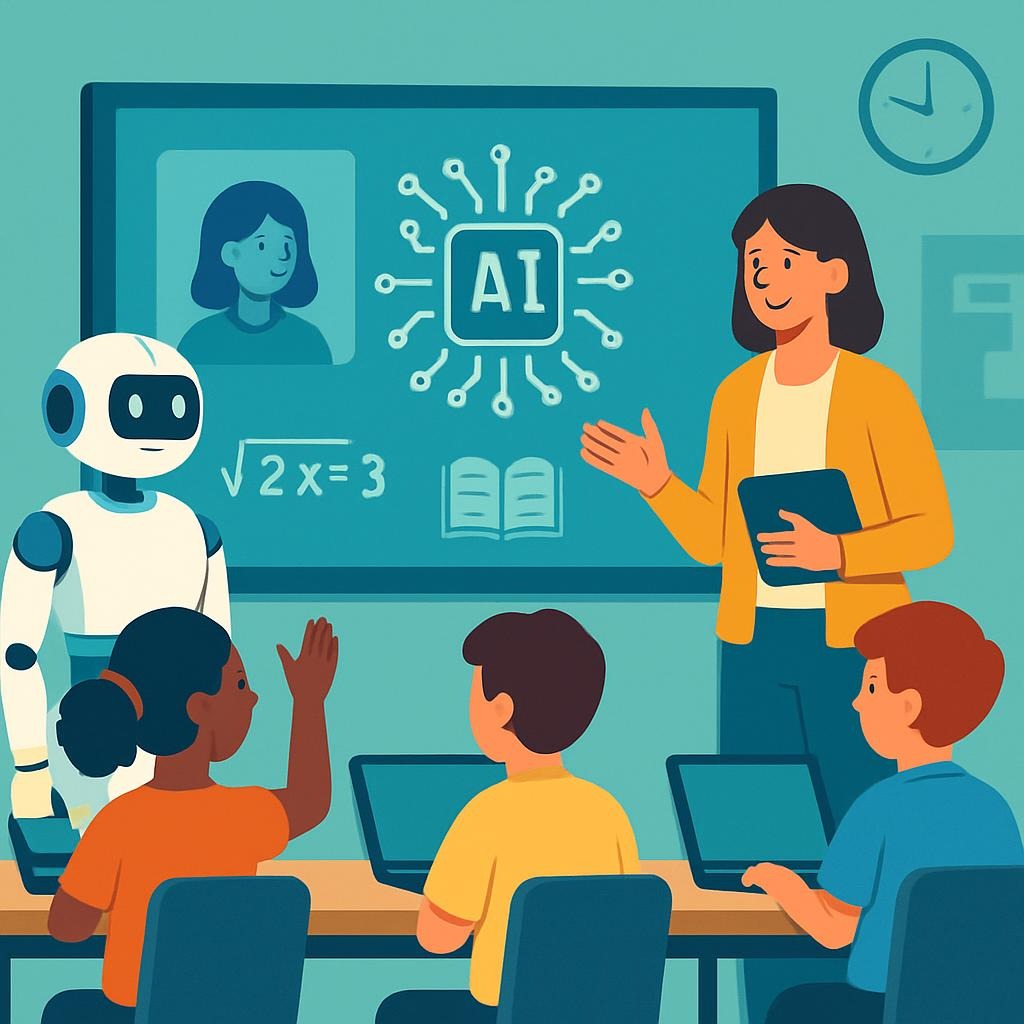



Student AI use jumped from 66% to 92% in a single year. One major U.S. university is drowning in a 313% caseload surge it can’t staff. Detection software is making things worse. The question stopped being “will AI change education” about two years ago — now it’s “why are institutions still pretending they have a choice?”
That’s how much academic integrity cases jumped at George Washington University from fall 2021 to fall 2023. They kept climbing. By spring 2025, reports were up another 47% — from 70 to 103 per semester — and the university ran out of faculty willing to hear the cases. They’ve had to change their own code of conduct twice just to keep the backlog moving. GW Hatchet, April 2, 2026
The short version: AI won’t replace teachers. Human tutors read emotional states with 92% accuracy; the best AI systems manage 68%, and that gap isn’t closing fast. DemandSage, 2026 — directional figure; no single peer-reviewed controlled study identified for this specific comparison What AI is doing: overloading institutional integrity systems, bifurcating the profession between teachers who use it and those who don’t, and reaching students that formal education never reached at all. The danger isn’t replacement. It’s the gap between 92% student adoption and the 68% of urban teachers who received zero training. RAND Corporation, September 2025
Sources: DemandSage AI in Education Statistics 2026; HEPI Survey February 2025 (1,041 UK full-time undergraduates); RAND Corporation AI Use in Schools Survey September 2025; UNESCO 2025 AI in Education survey.
The Numbers Stopped Being Surprising. They Started Being Alarming.
92% of students are using AI for schoolwork. That’s not a trend line anymore — it’s a floor. The Higher Education Policy Institute surveyed 1,041 full-time UK undergraduates in February 2025 and found 88% had used generative AI for assessments, up from 53% the year before. Among that same group, students who say they don’t use AI at all dropped from 47% to 12% in twelve months.
ChatGPT leads at 66% student adoption. Grammarly and Microsoft Copilot sit around 25% each. What students do with them: 53% use AI to get information, 51% to brainstorm. Basically, routine cognitive outsourcing — the mental equivalent of taking the elevator instead of the stairs. Whether that’s a problem depends entirely on what the stairs were there to build.
54% of students and 53% of teachers now report using AI for school, both up 15-plus points from last year. RAND Corporation, September 2025 That parallel adoption rate is worth sitting with. Teachers aren’t being left behind as a monolith. They’re adopting. What’s missing isn’t usage. It’s training, policy, and any coherent answer to the question of what “appropriate use” even means now.
The market figures, for the record: $7.57 billion in 2025, projected at $30 billion by 2029. Multiple analyst sources — treat as directional; 10-year edtech projections historically overestimate. Market value figures carry wide confidence intervals and are not independently audited. Take those projections loosely. What’s not speculative is the adoption curve already baked in.
The Institutional System Is Actually Breaking Down
Here’s a failure case that didn’t make many national headlines, but should.
George Washington University’s Conflict Education & Student Accountability office reported a 313% surge in academic integrity cases between fall 2021 and fall 2023. GW Hatchet, April 2, 2026 Not a blip. A systemic collapse. Cases kept climbing — another 47% from spring 2023 to spring 2025, from 70 reports per semester to 103. And the faculty pool willing to sit on hearing panels? Down 30%, from 33 panelists to 23. The overflow cases spilling past semester end jumped 63%.
So you have more cases, fewer people to hear them, a growing backlog, and students waiting semester-over-semester to find out if they’re expelled. GWU had to amend its own Code of Academic Integrity twice — reducing required panelists from five to three just to clear the queue — and as of April 2026, they’re extending that amendment for another year because the underlying problem hasn’t resolved.
This is what a detection-first strategy produces. Not deterrence. Administrative gridlock and burnout among the faculty who end up doing the enforcement work. And GWU isn’t an outlier — it’s just the one publishing the numbers.
Source: GW Hatchet, April 2, 2026 — named reporting, Charlie Drummond, Assistant Director of CESA, GWU. Named institutional source, verifiable.
The detection strategy doesn’t just fail — it creates a secondary crisis. Every AI detection flag requires faculty review, a formal report, a panelist pool, and a resolution process. When AI use is widespread (92% of students), even a low false-positive rate generates enormous case volume. A tool that flags 10% of submissions in a class of 200 produces 20 cases per course per semester. The faculty workload became untenable. Panelists dropped out. The system choked on enforcement it generated itself. Meanwhile, the Turnitin and Vanson Bourne 2025 study found 95% of the academic community believes AI is being misused — but the enforcement infrastructure to address that belief at scale simply does not exist. Turnitin / Vanson Bourne, 2025 — survey of academic community, methodology not fully disclosed; directional.
There’s also an active counter-industry. AI “humanizer” tools — designed specifically to rewrite AI-generated text to evade detection — are now widely available. They vary sentence structure, introduce stylistic imperfections, and alter word patterns. Detection and evasion are in a direct arms race. The institutions betting on detection winning that race are, at minimum, optimistic.
❌ Myth
“AI detection software is a valid integrity strategy”
✓ Reality
A UK university study found markers can’t reliably distinguish AI-assisted work. Detection generates false positives that punish honest students and flood enforcement infrastructure. GWU is the institutional proof of concept for that failure.
❌ Myth
“74% of students who used AI failed to disclose it" — so it’s a moral failure”
✓ Reality
That 74% non-disclosure figure comes from King’s Business School — peer-reviewed, published in Assessment & Evaluation in Higher Education. Tandfonline, 2024 — King’s Business School population, single institution; does not generalize universally. The study found non-disclosure correlated with unclear policies and social norm ambiguity — not with student dishonesty as a personality trait. The policy is broken. Students are adapting to broken policy.
Will AI Replace Teachers? The Answer Is No. The Nuance Is Everything.
A peer-reviewed study of 453 Ukrainian university teachers, published in MDPI in January 2026, found they don’t anticipate large-scale replacement within five years. MDPI, January 2026 — peer-reviewed; population specific to Ukrainian higher education context; may not generalize to K–12 or other national contexts. But — and this part gets skipped in the headlines — their greater worry isn’t job loss. It’s losing control over how AI reshapes pedagogy before they understand it themselves. That’s a fundamentally different problem.
Chris Dede, Associate Director of Research at the National AI Institute for Adult Learning, put the frame plainly: if you train people to do what AI does well, you’re preparing them to lose to AI. Train them for what AI can’t do, and you get intelligence augmentation. Clean. The schools acting on that distinction are already ahead of the ones still debating policy.
“AI has the potential to support a single teacher who is trying to generate 35 unique conversations with each student.”
Bryan Brown, Stanford University — quoted in ABC News, September 2025
The 24-point accuracy gap — 92% for human tutors versus 68% for AI in reading student emotional states — is the number worth returning to. It’s not a minor calibration issue. It’s the difference between a student who feels seen and one who doesn’t. Brandon Enos, superintendent at Gunter ISD in Texas, said it directly: a screen cannot recognize when a child is overwhelmed, hungry, or disengaged. It can’t pull a kid aside. It can’t call a family at 7 p.m. when something seems wrong. Teachers do that every day, and nothing about current AI narrows that gap at speed.
Here’s the finding that requires all three sources to produce: the teacher replacement anxiety is misdiagnosed in a specific and consequential way.
The MDPI survey establishes that teachers don’t fear elimination — they fear losing curricular control. The RAND survey establishes that teacher adoption is running nearly parallel to student adoption (53% vs. 54%). The HEPI 2025 data establishes that 88% of students use AI for assessments while only about 32% of teachers have received any formal training. RAND, September 2025; HEPI, February 2025 (1,041 undergrads); MDPI, January 2026.
None of those three sources states this: the asymmetry between adoption and training is creating a profession-within-a-profession split. Teachers with training use AI to handle 35 individual learning paths simultaneously, reinvesting the saved time in relational work. Teachers without training face identical student expectations, identical workloads, and watch their AI-capable colleagues post measurably better outcomes. The pressure to adopt — or leave — will come from performance data, not from any directive. That’s a slower and more corrosive form of replacement than any headline has described.
Editorial synthesis — sources: MDPI (January 2026), RAND (September 2025), HEPI (February 2025)
The Benefits That Are Actually Working
Adaptive Learning: Real Signal, Modest Sample
A six-week crossover study with 250 undergraduates using the GenSolve adaptive AI framework found a 17.6% gain in problem-solving accuracy, 21% increase in group cohesion, and 12.7% improvement in delayed retention. Springer, October 2025 — 250 undergraduates, single institution, 6-week duration; limited generalizability to other contexts or longer timeframes. Modest sample. Real signal. In March 2025 at Macquarie University, students using AI-powered chatbots improved examination results by up to 10%. Directional — methodology not fully reported in available secondary coverage; treat as indicative rather than audited.
The mechanism isn’t mysterious. AI systems that adapt instruction to individual readiness moment-to-moment outperform fixed-pace delivery in virtually every study that’s tested it. That’s also just what good teachers do manually. AI can do it at scale, for every student, simultaneously. That’s the actual value proposition — not replacement, but reach.
Accessibility: The Use Case That Deserves More Attention
A Brookings Institution report from January 2026 highlights AI reaching excluded children — including programs for Afghan girls where AI digitizes curriculum in Dari, Pashto, and English distributed via WhatsApp. A population banned from formal schooling two years ago, accessing education through a messaging app. Brookings Institution, January 2026. The institutional hand-wringing in wealthy universities about academic integrity starts to look differently proportioned against that context.
AI also supports students with dyslexia and other learning differences without requiring specialist scheduling, insurance approval, or a geographic accident of being born near adequate services. Not as a replacement for human support. As an always-available supplement that doesn’t check a waitlist before responding.
“AI’s greatest equity value might be reaching the students who never had access to a good teacher — not further augmenting those who already have every advantage.”
Editorial synthesis — sources: Brookings Institution (January 2026), EDUCAUSE Review (2025), NPR education reporting (2026)
| Tool | Student Usage | Primary Use | Evidence Quality | ⚠ What It Doesn’t Do |
|---|---|---|---|---|
| ChatGPT | 66% | Research, writing, brainstorm | Strong adoption data (HEPI 2025) | Hallucinates sources; can’t self-verify outputs; humanizer bypass tools specifically target it |
| Grammarly | 25% | Grammar, style refinement | Vendor self-report; treat as directional | Surface-level correction only; doesn’t improve underlying argument quality |
| Microsoft Copilot | 25% | Study support, summaries | Vendor-reported 265% self-learning boost — no independent audit found | Institutional access uneven; equity gaps persist; vendor figures are self-interested |
| AI “Humanizers” | Growing — no clean figure | Bypass AI detection software | Turnitin reports as “significant growing threat” (2025) | Don’t produce better student work. Produce undetectable worse work. |
The Risks Worth Taking Seriously
59% of students in the Turnitin/Vanson Bourne 2025 survey worry that over-reliance on AI will reduce their critical thinking skills. Turnitin / Vanson Bourne, 2025 — methodology and sample composition not fully disclosed. Which is an interesting thing: students are self-reporting the dependency risk even as adoption climbs. They’re not wrong about the mechanism. USC research on generative AI suggests convenience-driven technologies erode skills in ways analogous to GPS dependency eliminating spatial reasoning in people who adopted navigation apps before internalizing routes. The skill atrophies when the external tool handles it reliably enough. USC — specific study citation not fully identified in secondary coverage; mechanism is consistent with broader cognitive offloading literature but treat specific USC attribution as directional.
For essay writing and basic research: debatable, depending on what those exercises were meant to build. For mathematical reasoning, argumentation, evaluation of evidence under uncertainty — those are exactly the cognitive skills that matter outside school. And exactly the ones AI can hollow out if used as a bypass rather than a scaffold.
The equity trap is real and specifically structured. Brookings warns AI can increase existing divides because free tools — the ones most accessible to underfunded schools — tend to be least reliable and most prone to hallucination. The pattern holds across educational technology deployments: privileged students use new tools productively; disadvantaged students face the riskier, lower-quality versions. The technology is neutral. The conditions of use aren’t. Brookings Institution, January 2026.
And then there’s the category that requires a completely different response from everything else: the Center for Democracy and Technology survey found 12% of students knew of nonconsensual, intimate AI-generated imagery depicting someone in their school community. That’s a safety crisis. It’s not an academic integrity discussion. It requires safeguarding infrastructure, not curriculum redesign.
What Needs to Actually Happen Before Fall 2026
Only 10% of schools have AI guidelines. UNESCO’s survey made that gap legible at exactly the moment it mattered. Most institutions responded by forming a committee. Meanwhile, 35% of district leaders have provided students with any AI training, and over 80% of students say teachers never explicitly taught them how to use AI for schoolwork. RAND, September 2025; UNESCO 2025 survey.
The emerging consensus among academic integrity researchers — drawn from Frontiers in Education, ScienceDirect, and Packback research — is that the frame itself needs to change: moving beyond AI detection doesn’t mean abandoning integrity. It means treating integrity as the product of an engaging learning process rather than the absence of cheating. That reframe changes everything about how you design a course. Most curricula haven’t touched it yet.
- 1 Kill the blanket AI policy. School-wide rules are unenforceable and create exactly the ambiguity that the King’s Business School study found drives non-disclosure. Write a position per assignment type: what use is permitted, what disclosure is required, what the exercise is actually developing. Assignment-level clarity, not institution-level gesture.
- 2 Redesign assessments away from AI-gameable outputs. Oral presentations, Socratic seminars, project-based work that makes the thinking process visible. If the only thing between a student and full marks is ChatGPT access, the assessment was broken before AI arrived.
- 3 Train teachers before deploying student-facing tools. Full stop. The GWU case didn’t happen because students are dishonest — it happened because students outran institutional policy by two years. The 68% urban teacher training gap isn’t a resource problem. It’s a prioritization problem. Every tool rollout should start with teacher workflows, not student access.
- 4 Teach AI verification, not just AI prompting. The skill that matters now is auditing AI output: spotting hallucinations, identifying missing context, knowing when to distrust a confident-sounding response. That’s teachable. Most curricula don’t address it at all. Check out the CodeTalentHub guide on finding quality AI resources for tooling that supports this kind of critical evaluation.
- 5 Protect relational time explicitly. Every administrative efficiency AI creates is an opportunity to reinvest in face-to-face work, mentorship, and the parts of teaching that require a human in the room. That reinvestment is a choice. Without making it explicitly, the time savings get absorbed by other administrative demands and students get less of what AI can’t provide.
Start with Your Prep Time, Not Your Students’ Submissions
The thing no one tells you clearly: using AI to check student work is the most dangerous place to start. That’s the lane where false positives damage your relationship with students who did nothing wrong, and where you feed the GWU-style backlog problem. The safe lane is your own prep.
What you do: Pick one unit. Use AI to generate three differentiated versions of the core material — one for students who are behind, one at grade level, one who’s ready to push further. Track how long that took you. That’s the trade-off to make: administrative time for relational time. Teachers who’ve done this consistently report it changes what they have capacity for in the actual classroom — more one-on-one, more checking in on the kid who’s quiet.
What’s going to stop you: No written policy guidance from your institution, and no confidence that using AI for your own prep won’t somehow be held against you in ways you can’t predict. That’s a legitimate concern. Push for written guidance on teacher AI use before you’re expected to enforce student AI policy. You can’t enforce what you haven’t been trained on.
Stop doing this: Don’t run student submissions through AI detection as your integrity strategy. Redesign the assignment. A writing prompt where the product is the only thing assessed is a prompt AI can complete. An assignment where the student must defend their reasoning process in person is not.
You Are Inside the 18-Month Window. It’s Closing.
The institutions that will lead on AI in education over the next five years aren’t the ones with the biggest technology budgets. They’re the ones that built policy infrastructure in 2025–2026, before enforcement demand became unmanageable. Right now, you’re GWU in 2022 — before the 313% spike. The question is whether you build the infrastructure before the case volume arrives, or after.
Here’s the operational reality the main analysis doesn’t fully address: your annual planning cycle is probably 12–18 months. AI student adoption is moving on a 12-month cycle. That mismatch is structural. Comprehensive policy design won’t outrun it. Pilot-and-iterate will — one grade level, one subject, one semester, then expand with what you learned.
What you do: Before any new AI tool deployment, require answers to three questions: What does this change about assessment design? What teacher training is required before student access opens? What are the disclosure requirements for students? If those three questions aren’t answered in writing, the deployment isn’t ready — regardless of the vendor’s timeline pressure.
Stop doing this: Don’t roll out student-facing AI tools before training the teachers responsible for them. The 68% untrained urban teacher figure isn’t about those teachers’ willingness — it’s about where your budget and attention went. That’s a documented leadership outcome, not a workforce quality problem.
Frequently Asked Questions
What percentage of students currently use AI?
92% of students are using AI for schoolwork as of 2025, up from 66% in 2024. 88% have used generative AI specifically for assessments. DemandSage 2026; HEPI February 2025, 1,041 UK full-time undergraduates. The fastest technology adoption curve in education on record — faster than calculators, internet access, or tablets.
Can teachers actually detect AI use?
Not reliably. A UK university study found markers generally cannot distinguish AI-assisted work from authentic submissions. Detection software produces damaging false positives. And as the GWU case shows, even when it works, the enforcement infrastructure required to process cases at volume simply breaks down. The answer is no, and doubling down on detection is the wrong strategy — it creates more administrative damage than it prevents.
Is using AI considered cheating?
Depends entirely on the institution and the specific assignment. Submitting AI-generated content as your own without disclosure is treated as plagiarism at most universities. But the King’s Business School study found 74% non-disclosure rates correlated with policy ambiguity, not student dishonesty as a character trait. Tandfonline 2024 — single institution; does not generalize universally. The short version: check your specific syllabus. “AI” is not a monolith and neither is “cheating.”
Will AI replace teachers?
No — peer-reviewed survey data across multiple countries supports that. The more accurate framing is bifurcation: teachers with AI training will handle more students, deliver more personalized instruction, and have more time for relational work. Teachers without training will face identical pressures and watch their performance metrics fall behind. The structural pressure to adopt — or leave — will come from outcome data, not from any top-down directive.
What’s the biggest mistake schools are making right now?
Deploying student-facing AI tools without training the teachers responsible for them — and using detection software as a substitute for assessment redesign. The GWU integrity case is the most concrete proof of where that strategy leads: more cases, fewer people to process them, and a growing backlog that stretches student accountability timelines across semesters. The technology arrived faster than the institutional infrastructure. That gap is the whole story.
What’s Actually at Stake
AI isn’t replacing education. It’s exposing which parts were never essential — the drill-and-kill homework, the memorization Google answered five years ago, the busywork that measured compliance rather than thinking. That exposure is uncomfortable. Especially for institutions whose entire assessment infrastructure was built around outputs AI can now produce.
What remains when you strip the surface tasks is exactly what always mattered: intellectual struggle, human connection, the experience of being genuinely seen and challenged by someone who knows you. Teachers who use AI to reclaim time for that work will be indispensable. Institutions that treat AI as a threat to manage will keep running the GWU playbook — more cases, fewer panelists, longer backlogs — until something forces a redesign.
92% of students are already there. The institutional infrastructure is catching up. Slowly, and with a lot of committees.
The window is 18 months. Then it just becomes the water everyone swims in, policy or not.
Sources & References
Schema: Article, FAQPage | Focus keyword: AI in education 2026 | Crawlers: GPTBot, PerplexityBot, ClaudeBot, Google-Extended allowed | Internal links: CodeTalentHub.io
5 AI Coding Techniques That Close the Gap Between Adoption and Actual Results (2026 Framework)
Low-Code vs. No-Code 2026: Which Is More Powerful? Ultimate Guide with Cases & Visuals
Why Most AI Coding Developer Tools Are Slowing You Down in 2026—And What Actually Works
Your Feed Isn’t Random —It’s Training AI on You
Best 15 AI Tools for Developers 2026
[card url=”https://www.codetalenthub.io/open-source-tools-to-boost-your-workflow-2026/”]
[card url=”https://www.codetalenthub.io/python-automation-cuts-workload-50/”]
[card url=”https://www.codetalenthub.io/star-method-is-dead-2026/”]
[card url=”https://www.codetalenthub.io/how-i-built-a-portfolio-website-in-1-day/”]
[card url=”https://www.codetalenthub.io/7-viral-web-app-projects/”]