Freelance Economy · June 2026
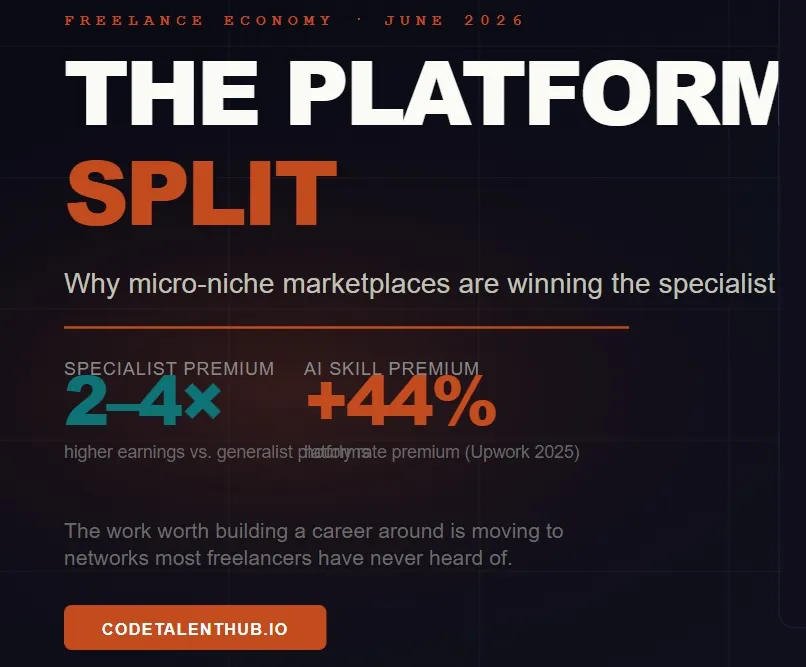
Upwork has 841,000 active clients and a race to the bottom. Meanwhile, the specialist platforms nobody outside their niche has heard of are paying developers $200/hr and finance writers $6,000/month. The structural reason for this gap is hiding in plain sight.
There’s a category of freelance platform that Upwork’s investor presentations do not acknowledge. They run on invite-only pipelines, screened talent pools, and client rosters that include Fortune 500 procurement teams who will not touch open marketplaces. Freelancers on these platforms do not bid. They get matched. And they earn, on the low end, twice what the median Upwork specialist makes in the same skill set.
These are micro-niche platforms — the operational opposite of a generalist marketplace — and 2026 is the year the evidence for their structural advantage finally stopped being anecdotal.
This piece maps that evidence. It explains the economic mechanism that makes specialist platforms premium by design. It names the platforms you should know by vertical. And it argues something the mainstream freelance advice industry still resists: the correct question is not “which platform has the most jobs?” It’s “which platform has the clients who value what I actually do?”
The Collapse of the Middle Ground
Two things happened simultaneously between 2023 and 2025 that permanently altered the economics of generalist freelance platforms.
First, generative AI eliminated the low end of the commodity market. Clients who used to hire someone for $15 to write a product description now have tools for that. The bottom of the freelance market didn’t shrink gradually — it collapsed, and everyone who had built income at that level was forced upward into a more competitive tier without the positioning to compete there.
Second, the survivors of that compression arrived at Upwork and Fiverr at exactly the moment those platforms became algorithmically hostile to new entrants. Both platforms now reward volume and recency in their ranking systems, not quality signals. A highly specialized developer with six verified projects competes against a generalist with sixty average reviews. The algorithm, in most categories, favors the generalist.
“Fiverr, Upwork, and their siblings have matured into race-to-the-bottom ecosystems where algorithms reward volume and recency, not quality.”
— Chizurum Chidimma Enyinnaya, Medium, March 2026The result is predictable: mid-to-senior specialists with deep expertise in AI/ML, legal tech, fintech, healthcare, or enterprise architecture find the return on time invested in generalist platforms declining sharply. Meanwhile, a different category of platform has been quietly building infrastructure for exactly these people — and the clients willing to pay for them.
Fig. 1 — Niche platform growth and AI skill premiums outpace generalist gross services volume growth. Sources: Upwork Q3 2025 earnings; Mordor Intelligence 2026; Mediabistro 2026.
What “Micro-Niche” Actually Means (and What It Doesn’t)
The term gets used imprecisely. A micro-niche platform is not simply a smaller platform. It is a platform built around a defined professional vertical — with matching logic, vetting standards, client expectations, and pricing norms all calibrated to that vertical’s specific requirements.
Toptal is not a micro-niche platform. It covers developers, designers, and finance professionals across many domains — it is a premium generalist network. Lemon.io, which vets exclusively for developers with startup-compatible skills and English-language communication, is closer. A.Team, which assembles cross-functional product squads with AI/ML specialization, is closer still. ClearVoice, which manages vetted content strategists and writers for brand-side marketing departments, is a micro-niche platform for content. Codeable, which connects WordPress developers exclusively with businesses needing WordPress work, is as micro-niche as the category gets.
On a generalist platform, a fintech developer and a WordPress plugin builder compete in the same search results. On a micro-niche platform, the client already knows what they need and has self-selected into a pool of people who do exactly that. The competitive universe shrinks; the pricing floor rises.
This matters because the mechanism of premium pricing on niche platforms is not scarcity alone — it is matched intent. When a client on Codeable posts a WordPress project, they are not comparing WordPress developers to React developers to PHP generalists. They are choosing between WordPress specialists. The price conversation starts at a different baseline.
The Earnings Gap Is Not Small
The data on this is now consistent enough to stop calling it a trend. Upwork’s own 2025 annual data confirmed that freelancers working on AI-related projects earned 44% more per hour than those on non-AI projects on the same platform. When you move to AI-specialist niche platforms like Toptal’s AI/ML network or A.Team, the gap widens further.
Finance and legal writing illustrates the pattern sharply. On general platforms, content work races toward $0.05/word. Fintech writers who moved to specialist platforms reported earning $0.95/word — nearly a 20× difference. White paper specialists in financial services now command $6,000+ per month. Medical writers charge $60–$150/hour. The niche is not just a positioning strategy. It is a pricing architecture.
Fig. 2 — Rate comparisons are mid-range estimates based on publicly available data from Upwork, Fastlancer, Mediabistro, and Lilach Bullock (2025–2026). Individual rates vary significantly by geography, portfolio, and client relationship.
The Jobbers.io Skills Demand Index for 2026 makes the economic logic explicit: specialists earn 2–4× their generalist equivalents but face higher income volatility. The practical implication is that the specialist path rewards anyone who can build a repeatable pipeline — which is exactly what micro-niche platforms are designed to create.
The Platform Landscape, Mapped by Vertical
The mistake most freelancers make is treating platform selection as a binary: Upwork or Fiverr. In 2026, that’s like choosing between two grocery chains when you need a specific ingredient that’s only sold at a specialty supplier. Here are the platforms worth knowing by vertical.
Toptal AI/ML Network & A.Team
Toptal’s AI specialists tier targets senior ML, deep learning, and applied AI engineers using the same top-3% vetting model. A.Team builds cross-functional product squads with AI focus. Both serve enterprise-level clients and neither takes commissions from freelancers.
Lemon.io & Arc.dev
Lemon.io vets exclusively for startup-compatible developers with strong English communication. Arc.dev uses AI-assisted matching across 450,000 vetted developers, designers, and marketers — with personalized support that reduces client screening time significantly.
Codeable
The most disciplined micro-niche platform in tech. Covers exclusively WordPress work. Clients post, specialists apply, and the platform maintains a curated network with strict quality standards. No race-to-bottom bidding. The entire competitive universe is WordPress expertise.
Working Not Working & Contra
Working Not Working serves senior creative talent — art directors, CCOs, brand strategists — for agencies and in-house teams. Contra operates a zero-commission portfolio network focused on product, design, and development with optional payment processing fees only.
ClearVoice & SolidGigs (curated)
ClearVoice manages vetted content strategists and writers for brand marketing departments, with fintech and finance among its highest-paying categories. Finance and fintech writers on these platforms average $73,000/year vs. $30,000 on generalist platforms.
CryptoJobsList & Braintrust
Braintrust operates on blockchain infrastructure where freelancers keep 100% of earnings — clients pay in BTRST tokens. It has served Porsche and Nestlé for tech and design roles. CryptoJobsList is the default marketplace for Web3 smart contract and DeFi work.
One pattern appears across every vertical: the highest-performing niche platforms charge freelancers little to nothing. The business model inverts — clients pay a markup or subscription, not the specialist. This is not coincidence. It is how you attract the caliber of talent that justifies the premium clients pay.
Why the Big Platforms Can’t Copy This
The natural question is why Upwork or Fiverr don’t simply launch niche sub-platforms and replicate the model. They have tried. Fiverr Pro is the most serious attempt — a vetted tier with higher prices and curated professionals. The results have been mixed, and the structural reason is revealing.
Generalist platforms have two conflicting incentives. Their primary revenue driver is transaction volume at scale — they need millions of gigs at $15–200 to generate meaningful GMV. But a genuine micro-niche platform requires the opposite: fewer transactions, longer engagement cycles, and pricing that would represent a small fraction of total platform volume. Building a truly specialized network inside a generalist platform means allocating matching logic, vetting resources, and client education to a segment that will never represent more than 3–5% of total GMV.
The 2026 market structure report from Jobbers.io estimated a “barbell” future for the industry: 3–5 large generalist platforms capturing volume, plus 50–100 successful niche platforms capturing the premium. That projection is already becoming visible in the data. Upwork holds 40.7% of platform-mediated freelance market GMV — a dominant position. But niche platforms are reporting growth rates that make Upwork’s 2% gross services volume growth in Q3 2025 look like a mature market experiencing slow consolidation.
Fig. 3 — Directional projection of freelance platform market structure. GMV = Gross Merchandise Value mediated through platforms. Source: Jobbers.io Market Share Report 2026.
The Fee Inversion Nobody Talks About
Here is the part of this story that most comparison articles bury in a footnote.
Upwork charges freelancers 20% on the first $500 with any new client, then 10% ongoing. Fiverr charges a flat 20% on every transaction. These are not small numbers. On a $10,000 month at Upwork, you’re losing $1,500–$2,000 to platform fees depending on your client mix.
Toptal, Arc.dev, A.Team, Braintrust, Contra, and Jobbers charge freelancers zero. Some charge a small fixed fee per contract. The premium specialist network model generates revenue from clients, not from taxing specialists’ output. This is not a marketing gimmick — it is a structural commitment to attracting talent caliber that commands the fees that clients will pay.
| Platform | Type | Freelancer Fee | Screening | Best For |
|---|---|---|---|---|
| Upwork | Generalist | 10–20% | None | Volume, early-career |
| Fiverr / Fiverr Pro | Generalist | 20% flat | Pro tier only | Packaged gig services |
| Toptal (AI/ML, Dev, Finance) | Premium Niche | 0% | Top 3% only | Senior tech, finance experts |
| Arc.dev | Niche | 0% | Vetting + AI matching | Remote dev, design, marketing |
| Lemon.io | Niche | 0% | Strict startup-fit screen | Startup-facing developers |
| Braintrust | Zero-commission | 0% | Community + review | Tech/design, Web3-native |
| Contra | Zero-commission | 0% (fees for payment processing only) | Portfolio-based | Creative, product, dev portfolios |
| Codeable | Micro-niche | 17.5% (reducing) | WordPress expertise only | WordPress specialists exclusively |
| A.Team | Niche | 0% | Invite / referral | AI product teams, enterprise |
| ClearVoice | Micro-niche | Managed (no commission) | Content specialization | Fintech, brand, strategic content |
The practical implication: if you bill $120,000 a year through Upwork at the 10% tier (meaning you’ve already paid 20% on all new client work), you lose $12,000+ annually to platform fees. The same output on a zero-commission specialist network costs you nothing in fees. The delta funds a software seat, a marketing budget, or simply stays in your pocket.
The T-Shaped Trap — and How to Avoid It
Every strategic advice column in 2026 tells freelancers to build T-shaped skills: deep in one vertical, broad enough to hold a conversation in adjacent ones. That advice is not wrong, but it misdiagnoses the actual barrier most specialists face.
The barrier is not skill. It’s positioning.
A developer who is genuinely expert in React and Node.js, who has shipped three production applications in fintech, will not discover Codeable or A.Team or Lemon.io through search. These platforms do not spend money on Google Ads. Their growth is referral-driven, community-driven, or partnership-driven. The clients who use them are sophisticated buyers who found the platform through their own network. The freelancers who succeed on them were recommended by another freelancer who was already there.
“My highest-paying, longest-term clients came through platforms where we built relationships without algorithm interference.”
— Sophia, senior developer, via Jobbers.io AI Platform Survey 2026This is the practical implication of micro-niche platform economics that the data doesn’t capture: you have to be findable before you can be found. That means having a public signal — a GitHub history, a content track record, a domain-specific portfolio, a presence on CodeTalentHub or similar specialist communities — that someone inside a niche network can reference when vouching for you.
Specialists who build that public presence before they need the platform do significantly better than those who apply cold. The vetting on most premium niche platforms is not purely algorithmic — it is heavily influenced by what a reviewer finds when they search your name outside the platform.
What the AI Disruption Actually Means for Platform Selection
There is a version of the “AI is taking freelance work” narrative that is both true and misleading. It is true that commodity work — content at scale, routine code, boilerplate design — has been compressed severely by AI tools. It is misleading because it implies this compression is evenly distributed across the freelance economy.
It is not. AI-resistant work clusters in exactly the verticals where micro-niche platforms are strongest: legal accuracy and regulatory compliance (where errors carry liability), medical and clinical content (where domain expertise has no AI substitute yet), financial modeling under fiduciary context, enterprise security architecture, and novel AI/ML engineering itself — where demand is outrunning supply by a margin that specialist platforms are struggling to close.
The verticals most disrupted by AI tools are generating the highest demand for human specialists who understand those tools deeply. AI automation consultants on specialist networks are billing $75–$200/hour precisely because the clients who need AI integrations are the same clients who cannot afford to get it wrong.
Jobbers.io’s 2026 skills index flagged AI/ML as showing 71% demand growth on specialist platforms year-over-year. Cybersecurity hit 109% demand growth — almost entirely through vetted and specialist networks, not open marketplaces. The clients buying these services are enterprise procurement teams, not startup founders posting $500 projects on Upwork.
This is not a coincidence. The highest-stakes technical work goes through the highest-trust platforms. And trust, in this context, means vetting, verifiable track records, and a network that penalizes bad behavior because its reputation depends on it.
Three Signals That Tell You It’s Time to Leave the Generalist Platform
Not everyone should be on a micro-niche platform. If you’re in the first twelve months of freelancing, the volume and feedback loops on Upwork or Fiverr are genuinely useful. The signal-to-noise problems hurt you less when you’re building baseline credibility.
But there are three signals that suggest the cost-benefit calculation has shifted:
1. You’re winning on price, not quality. If the projects you’re closing are the ones where you bid lowest, your platform is working against you. Micro-niche platforms structurally prevent this by eliminating open bidding in most cases.
2. Your best clients found you outside the platform. Referrals, LinkedIn outreach, conference contacts — if the clients you actually enjoy working with came from somewhere other than your profile, you’re maintaining the profile to keep your stats up, not because it’s delivering value.
3. You spend more time on proposals than on work. Upwork’s algorithms reward proposal volume and recency. If you’re submitting 20 proposals to win 1 project, and the project rate doesn’t justify that overhead, the unit economics have broken down. Most specialist niche platforms either eliminate proposals entirely (you’re matched) or have dramatically shorter shortlists (5 applicants, not 200).
If two or three of those apply to you, the transition cost to a specialist platform is lower than it appears. Most allow you to apply or request vetting while maintaining your existing platform presence. The realistic transition timeline is 3–6 months to first project on a curated network — faster if you have a verifiable public portfolio and a referral from someone already inside.
The Uncomfortable Implication
If the argument here is correct — that micro-niche platforms structurally generate better outcomes for specialists — then the mainstream freelance advice industry has been optimizing for the wrong metric for years. “Build your Upwork profile,” “get your first 5 reviews,” “hit 90% Job Success Score” — these are tactics that make sense inside the generalist marketplace ecosystem. They do not translate to the platforms where the best work actually lives.
The specialists earning $150/hour on A.Team did not get there by gaming Upwork’s algorithm. They got there by building a domain-specific track record that a human reviewer inside a gated network recognized as worth bringing in. That track record is portable. The Upwork Job Success Score is not.
The market split is real, and it will accelerate. Generalist platforms will continue serving an enormous volume of work. But the work that commands the prices worth building a career around is increasingly moving to networks most freelancers have never heard of — because those networks were never designed to be discovered by anyone who hadn’t already earned the right to be there.
That’s the actual barrier. Not skill. Not platform fees. Discoverability inside a community you haven’t yet joined.
Build the Track Record That Gets You In
CodeTalentHub is a specialist resource for developers and technical freelancers navigating the niche platform transition — from portfolio positioning to vetting prep for elite networks.
Explore CodeTalentHub →Sources & further reading: All rate data and market figures are mid-2026 estimates from public sources including Mordor Intelligence (Freelance Platforms Market Report, Feb 2026), Grand View Research (Freelance Platforms Market 2026), Upwork Q3 2025 Earnings Report, Mediabistro Freelance Writing Survey (Mar 2026), Jobbers.io Freelance Platform Market Share Report (Feb 2026), Jobbers.io Skills Demand Index (Feb 2026), and Fastlancer Platform Guide (Jun 2026). All figures should be treated as directional indicators; individual results vary significantly.
External references: Mordor Intelligence Freelance Platforms Report · Upwork Investor Relations · Mediabistro Freelance Resources · Jobbers.io Market Share Report 2026