

Remote Work · Expert Communities
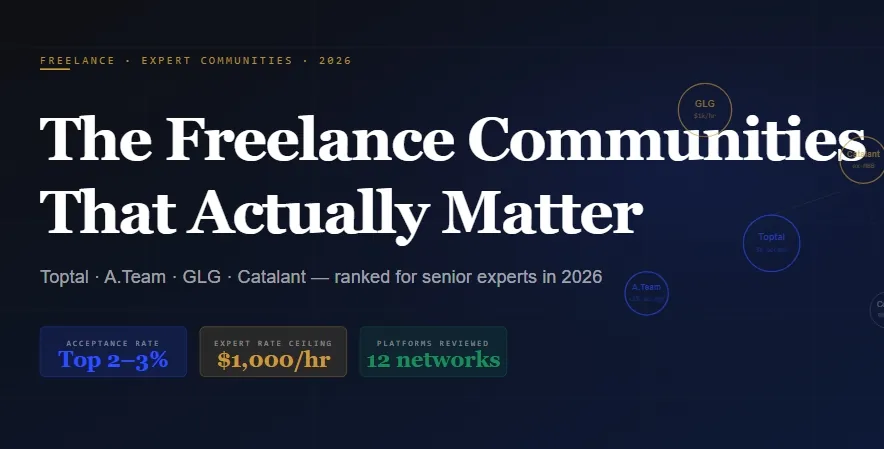
You’re not looking for your first gig. You’re looking for $150/hr clients, genuine peers, and work that doesn’t insult your résumé. This is a map of where those people actually congregate — and what it really costs to get in.
Most “best freelance community” articles are written by people who’ve never needed to charge a premium rate and get it. They lead with Upwork. They end with a Fiverr coupon. You’re not going to find that here.
This is for the developer who cleared six figures last year and wants to stop racing to the bottom on proposals. The ex-McKinsey consultant who went independent in 2024 and is still figuring out where serious projects live. The senior product designer who’s excellent but invisible because she’s on the wrong platforms.
There’s a genuine tiering problem in the freelance world that almost nobody talks about honestly: the communities that are easy to join are usually the ones worth joining least. The ones with the best work are designed to resist entry. Understanding that tension is the whole game.
The Tier Problem Nobody Names
Here’s the honest version: most communities that call themselves “for experts” don’t actually filter for expertise. They filter for payment willingness. You pay $99/month, you’re in. The “expert community” is everyone who could afford the subscription.
Real expert-tier filtering happens in one of two ways. Either a platform runs you through a gauntlet — technical screens, live challenges, credential checks — and rejects 97% of applicants. Or it’s credential-signal-based: you used to work at McKinsey, your GitHub shows FAANG contributions, your LinkedIn shows the right pedigree. Both work, but they select for different things, and knowing which game you’re playing changes your strategy entirely.
A note on the fee math: Platforms that take 10–20% commission sound cheap until you run the numbers. At $150/hr over 1,000 billable hours per year, that’s $15,000–$30,000 you’re handing to the platform annually. For senior freelancers, fee structure is a strategy decision, not a footnote.
The Elite Platforms: What “Top 3%” Actually Means
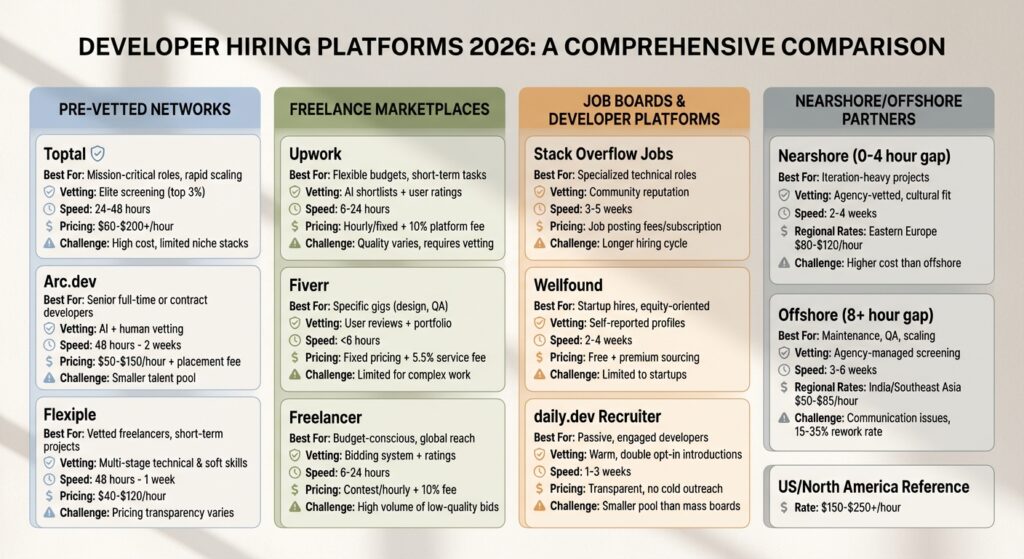
Toptal’s five-stage vetting process takes 5–8 weeks: English assessment, technical interview, a live coding or design challenge, a test project, and final review. The majority fail at the technical interview stage. If you pass, you get zero commission on your earnings — but Toptal sets the client-facing rate, not you, and they take an undisclosed margin on top.
The platform expanded in 2026 to include marketing and product management tracks alongside the established dev/design/finance lanes. It added live project simulations to the screening process. Average verified freelancer income sits around $105K/year; senior developers and finance experts frequently earn $150K–$250K+.
The honest drawback: you’re trading rate autonomy for access. You know what the client pays, but not what Toptal pockets. For some that’s fine. For others, it’s an ongoing source of friction — particularly when they suspect they’re underpriced relative to the platform’s margin.
A.Team’s acceptance threshold is below 2%, making it more selective than Toptal in raw percentage terms. The difference is what they screen for: five dimensions including technical depth, communication, portfolio quality, a panel review, and culture fit. They want senior engineers and AI architects who can operate as embedded builders, not contractors.
The model skews toward longer engagements — most “missions” (their word for engagements) run 12 to 18 months. You can run multiple simultaneously, and you set your own rate with no platform commission. Payment runs twice monthly on a Net-15 cycle. There’s a dedicated track for AI engineers in 2026, which has become their fastest-growing segment given enterprise demand for AI implementation talent.
The community dimension is real, not decorative. Members report meaningful peer connections, internal referral channels, and access to off-platform project opportunities that come through the network. That secondary value is harder to quantify but consistently mentioned by members who’ve been in for more than a year.
“The communities designed to be easy to join are usually the ones worth joining least. The ones with the best work are built to resist entry.”
Expert Networks: The $500/Hr Phone Call Economy
This is the layer of the freelance world that most people outside finance and strategy consulting don’t know exists. Expert networks are not platforms where you take on projects. They’re platforms where you take 30–60 minute calls and get paid rates that would make Upwork freelancers do a double-take.
GLG is the oldest and largest expert network in the world, founded in 1998. Its clients are primarily investment managers, hedge funds, private equity firms, and management consultants who need rapid access to domain experts — people who can speak credibly about a specific niche, market, or technology without an NDA-protected employer conflict.
The mechanics: GLG contacts you about a project, you set your rate (they offer a calculator that tends to anchor you low — their internal guidance divides estimated salary by 2,000 hours, which is usually below market for expert-level work), and you do a structured call. Most calls run 30–60 minutes. High-demand specialists command $500+ per call routinely. Former C-level executives and narrow-niche researchers can legitimately charge $1,000 for a single hour.
The caveat worth naming: GLG is notorious for pushing rates down during negotiation. They’re also known to shop the same project to multiple networks, so you may find AlphaSights offering more for the same call. Compliance training is required before your first engagement — there are real legal rules about what you can and can’t share, especially if you’re still employed.
Catalant sits at the overlap of expert network and consulting marketplace. Its talent pool is predominantly former McKinsey, Bain, BCG, and Big Four professionals who’ve gone independent — plus senior executives and specialized strategists. Vetting is credential-oriented rather than skills-test-based: verified employment history, reference checks, Big Three pedigree signals.
Projects tend to be short-duration, fixed-fee strategy engagements rather than hourly implementations. A two-week market entry analysis for a Fortune 500 client, scoped and priced as a deliverable. The engagement type suits former consultants whose natural unit of work is a project, not a billing period. Client base skews heavily Fortune 500; Catalant has invested significantly in enterprise procurement infrastructure.
If you’re a senior developer or engineer, this isn’t your platform. If you’re a former strategy consultant or C-level executive who just went independent in 2024 or 2025 and still has strong Big Three credentials, this is where peers at your level actually are.
Peer Communities: Where Referrals Actually Happen
The best freelance client I ever spoke to about this — a financial modeler who’d been independent for six years — told me he hadn’t applied for a single job in four years. Everything came through two Slack communities and one Discord server. None of them had “expert” in their name. All of them had sharp people with standards.
Peer communities function differently from platforms. There’s no guarantee of work, no escrow, no dispute resolution. What they provide is a network dense enough that opportunities emerge laterally — someone posts they need a recommendation, you’ve been visible and helpful for eight months, your name comes up. That’s the entire mechanism, and it works at a surprisingly high rate for patient, consistently contributing members.
Contra — The Zero-Fee Positioning
Contra launched its zero-commission model before competitors took it seriously, and by 2026 it has grown to 2M+ freelancers with a meaningful mid-to-senior tier. The 2026 update added team project tooling (hire multiple freelancers on one project), Stripe-integrated payments, and a premium tier for client-side features. It’s not a peer community in the Discord/Slack sense — it’s a platform — but the zero-fee model changes the community dynamics in subtle ways. There’s less race-to-the-bottom pressure because margin compression isn’t baked into the incentive structure.
For senior freelancers with an existing portfolio and a few strong client reviews, Contra has become a useful secondary channel — somewhere between LinkedIn’s organic referral network and the high-vetting rigidity of Toptal. We’ve compared Contra and Toptal head-to-head in detail for technical freelancers specifically; the calculus shifts significantly based on how established your reputation already is.
LinkedIn’s Quiet 2026 Upgrade
LinkedIn isn’t a community in any organic sense — it’s a distribution channel for professional visibility. But in 2026 it became meaningfully more useful for freelancers: project milestone tracking, escrow payments, and AI-matched job alerts were integrated into the platform. Premium subscribers now get priority placement in freelancer search results.
The data point that matters: LinkedIn freelancers report average project values of $5,000–$25,000, with consultants and strategists at the high end. That’s not the hourly rate that GLG or Toptal produce, but the deal economics are different — you’re typically closing longer projects with less ongoing competition. Referral dynamics also work better on LinkedIn because the social proof infrastructure is native to the platform.
The Expert Network Second Tier: AlphaSights and Guidepoint
GLG is the household name, but AlphaSights and Guidepoint serve overlapping markets with sometimes better rate dynamics. Industry insiders note that the same project gets shopped across multiple networks, which means registering with AlphaSights alongside GLG is additive rather than competitive. Setting your rate differently across networks is a legitimate strategy — you may find one network accepts a rate that another tried to negotiate down.
Typical AlphaSights rates for mid-level domain experts run $300–$600/hr based on available 2026 data, with the rate ceiling tied to niche specificity and demand urgency. If the fund needs someone who’s worked inside a particular factory segment, in a particular geography, in the past three years — that person can charge accordingly.
Match by Specialty, Not by Platform Name
| If you are a… | Primary community | Secondary channel | Expert network to join |
|---|---|---|---|
| Senior software engineer (8+ yrs) | A.Team or Toptal | Gun.io (top 10% acceptance) | GLG (tech sector calls) |
| Ex-MBB / strategy consultant | Catalant | LinkedIn for visibility | GLG + AlphaSights both |
| Product manager / designer | Toptal (expanded 2026) | Contra (zero-fee) | Guidepoint (product calls) |
| Finance / fintech expert | Toptal finance track | Catalant (if senior exec) | GLG (strongest ROI) |
| AI / ML engineer | A.Team AI track | CodeTalentHub | Expert360 (if APAC) |
| Creative director / brand strategist | Dribbble (selective) | Contra | Less relevant |
| Scientific / academic expert | Kolabtree | — | GLG (high demand) |
Where CodeTalentHub Fits This Landscape
Codetalenthub.io is built for a specific gap: technical freelancers who are too senior for Upwork’s dynamics and haven’t yet built the enterprise client network to work fully direct. It sits between the zero-vetting open marketplaces and the multi-week gauntlet of Toptal’s screening — a vetted but accessible environment specifically for developers and tech specialists.
For AI engineers particularly, the platform’s positioning in 2026 aligns well with a market that has more demand than Toptal and A.Team can absorb. When two platforms accepting under 3% of applicants still have enterprise clients waiting, the mid-tier vetted market has room. If you’re a senior developer evaluating options before investing weeks into Toptal’s screen, CodeTalentHub’s application process is worth running in parallel — not instead of, but alongside.
The parallel application strategy: Most platform applications are non-exclusive and non-committal. Running Toptal and A.Team applications simultaneously while building presence on Contra and LinkedIn costs nothing except preparation time. The platforms that accept you fastest often have the most useful immediate signal about where your profile currently ranks.
How to Actually Prepare for Elite Vetting
Toptal’s five-stage process takes 5–8 weeks of serious preparation time according to candidates who’ve documented their experience. The highest failure rate is at the technical interview stage, not the English assessment. The live coding/design challenge is the second-highest dropout. This matters for preparation sequencing.
- Six weeks before applying to Toptal or A.Team: Rebuild your portfolio around outcomes, not process. Not “built a React dashboard” — “reduced client reporting time by 4 hours/week for a logistics firm with 200 users.” Interviewers are enterprise-oriented; they think in business impact.
- Four weeks out: Run timed algorithm sessions daily if you’re a developer. Toptal’s live challenge runs 90 minutes with a real human observing. Silence under pressure is visible.
- Two weeks out: Prepare your rate narrative. What do you charge, why, and what precedent supports it? Platforms that let you set rates (A.Team, Contra) will ask this implicitly through the market response to your profile.
- Immediately, regardless of platform: Register with GLG and AlphaSights. The call opportunities come when they come — there’s no preparation sprint, and the income can run in parallel with any platform engagement.
The Honest Numbers on What Each Type Generates
I’ve seen enough income reports across these platforms to offer what I think is a calibrated estimate, not a promise. These are composite figures based on publicly reported averages and practitioner accounts as of mid-2026:
| Platform / Channel | Avg. verified freelancer income | Hours required | Time to first dollar |
|---|---|---|---|
| Toptal (accepted developer) | ~$105K/yr median | Full-time or project basis | Days after placement |
| A.Team (mission engagement) | $120K–$250K/yr range | 10–40 hrs/week | 1–3 weeks after match |
| Catalant (strategy project) | Varies by project scope | Project-based | 2–6 weeks |
| GLG (active consultant) | $3K–$15K/yr (part-time) | Few hours/month | 2–8 weeks first call |
| LinkedIn (inbound consulting) | $5K–$25K per project | Self-determined | Network-dependent |
| Contra (zero-fee) | Portfolio-dependent | Self-determined | Profile-dependent |
The GLG number looks modest until you remember it’s for a few hours per month maximum, in parallel with everything else. The best performers in expert networks are typically already billing $200K+ through primary channels — GLG is incremental income for marginal time. Treating it as a primary income source is a category error.
The trap worth naming explicitly: Some freelancers spend months crafting profiles across six platforms while billing zero hours. Platform strategy is real, but it’s not a substitute for the work that builds the portfolio that gets you accepted in the first place. If you’re currently at $50/hr on Upwork, the path to Toptal acceptance runs through client outcomes and case studies, not application strategy.
What “Community” Actually Delivers at the Expert Level
The question worth asking about any community: does it generate referrals, or does it generate good conversation? Both have value, but they’re different products.
In practice, the communities that reliably generate referrals for senior freelancers share three traits: they have a reputation enforcement mechanism (real names, public profiles, verified credentials), they have a shared professional identity tight enough that “she’s one of us” carries meaning, and they have a density of senior buyers — not just senior sellers.
Most Slack communities, Discord servers, and even expensive paid mastermind groups fail the third criterion. They’re full of people looking for work, not people giving it. The exception is communities that have been running long enough to have natural authority asymmetry — some members become known as the person who refers work, not just the person who needs it. Getting to that position requires 18+ months of consistent, genuinely useful participation. There is no shortcut that doesn’t register as fake.
The platforms in this guide — particularly A.Team and Toptal — have solved this by making the community a byproduct of a meritocratic filter rather than the entry ticket. You’re not buying community; you’re earning membership. That’s a different dynamic, and it’s why the referral networks inside these platforms are more valuable than most people price them.
For technical talent specifically, the overlap between CodeTalentHub’s expert network and direct-hire client relationships is worth exploring as a complementary channel to platform-based work — particularly for those who want to build toward fully direct client relationships over a 2–3 year arc.
Everything I’ve written about platform strategy will look dated by Q2 2027. AI-assisted matching is being implemented at every layer of these platforms, and the human vetting layers that currently differentiate Toptal from Upwork may compress faster than most freelancers expect. The question is whether the relationship capital you build now survives that compression — and in every cycle I’ve seen, it does.