

84% of developers now use AI coding tools. 75% of their organizations see no measurable improvement in delivery speed. The gap isn’t the tool — it’s the method. Here’s the framework that closes it.
The numbers above live in the same report. They are not contradictions — they are the core problem, neatly summarized. Widespread adoption has not produced widespread results because adoption is not a method. It is a starting point.
This guide is not for developers still deciding whether to try AI tools. You’ve tried them. You’ve probably had sessions where the output was impressive and sessions where you spent two hours debugging code that “looked fine” on first read. The question you’re actually asking is: why does the gap exist, and how do I close it reliably?
The answer is structured below as five techniques — each one targeting a specific failure mode that quietly erodes the ROI of AI-assisted development. None of them require a new tool. All of them require a change in how you use the ones you have.
Methodology note: This analysis synthesizes data from METR’s controlled 2026 productivity studies, GitClear’s repository analytics, CodeRabbit’s December 2025 PR audit, Larridin’s 2026 Developer Productivity Benchmarks, Faros AI’s telemetry across 22,000 developers, and DX’s 135,000-developer dataset. Where vendor data is cited, its limitations are noted. The author also draws on direct observation of engineering teams running AI adoption programs in fintech, SaaS, and open-source contexts.
What “AI Tools Help in Coding” Actually Means in 2026 (And Why Most Definitions Miss the Point)
The textbook definition is fine as far as it goes: AI coding tools use large language models to assist with writing, testing, and reviewing code. But this definition obscures the distinction that determines whether you get results or frustration.
Here is the practitioner’s definition — the one that holds up across real production environments:
AI tools help in coding when they collapse the distance between intent and working implementation — specifically for tasks where the developer knows what needs doing but not yet how.
That covers a meaningful but bounded set of tasks: boilerplate generation, test scaffolding, API integration from documentation, unfamiliar-library exploration, and routine refactoring. It does not cover system architecture decisions, security-critical logic, or anything where the developer cannot verify the output faster than writing it from scratch.
This distinction is the thing most AI-in-coding guides skip entirely — because acknowledging it shrinks the “AI does everything” narrative that drives engagement. But ignoring it is precisely what produces the 75% of organizations seeing no measurable velocity gain.
Why the Maximalist Framing Causes Harm
When AI coding tools are framed as “write code for you,” the natural usage pattern becomes: prompt broadly, accept with light review, ship. CodeRabbit’s December 2025 analysis of real pull requests found approximately 1.7× more issues in AI-coauthored code compared to human-only code. That number climbs as review rigor drops.
The mechanism here is subtle but important. AI tools are very good at generating code that looks correct. The patterns are familiar, the naming conventions are plausible, the logic flows naturally on first read. The errors tend to be semantic rather than syntactic — a subtle off-by-one, an edge case that wasn’t specified in the prompt, a dependency assumption that breaks in a different environment.
These are exactly the errors that fast reviews miss. And fast reviews are what most developers do with AI-generated code, because the code “looks fine.”
METR’s February 2026 follow-up study on experienced open-source developers found something striking: early 2025 data showed a 19% slowdown for developers using AI tools. By early 2026, the same cohort showed an 18% speedup. The tools improved — but critically, so did the developers’ judgment about when to use them. Read the METR research →
The core principle that holds across all the data: AI tools augment the developer’s judgment, not replace it. Flip that relationship, and the tool starts working against you. Every technique below returns to this principle.
Why Most Developers Get No Real ROI — And the Data Behind It
Before the techniques, it’s worth being precise about the failure modes. There are four, and they compound.
Failure Mode 1: Optimising for Lines Generated Instead of Defect Rate
This is measurement inertia at work. PR volume and lines of code per week existed before AI tools arrived, they are easy to track, and they go up when AI tools are used — which feels like confirmation of progress. But GitClear’s 2024–2025 repository analysis showed code churn rising from a 3.3% baseline pre-AI adoption to 5.7–7.1% across the industry as adoption increased.
More code, faster, is not the same as more value, faster. If 18% of your AI-generated code requires rework within 30 days, you are not 3.6 hours ahead each week — you are spending those hours on remediation.
Failure Mode 2: Context Reset Blindness
The most destructively popular piece of advice in AI coding communities is: “Just keep chatting with it and it’ll learn your style.” This is wrong by default and produces confident, plausible, wrong code at a predictable rate.
Every session reset means the AI tool has no memory of your codebase, your conventions, or the architectural decisions from the last conversation. Developers who do not actively re-establish context are prompting into a void and filtering the results through familiarity bias — the output sounds like their codebase, so it must be right.
Failure Mode 3: Scope Bleed
AI tools are built to be helpful, and unhelpfully, that means they extrapolate. Ask for a function that processes orders, and the tool may also helpfully refactor the inventory module it noticed. Ask for a bug fix, and the tool may also helpfully extract a utility class. This is scope bleed — and it is the single most common reason developers spend 45 minutes debugging AI-generated code that “looked fine” on first read.
Failure Mode 4: Closed-Loop Verification
AI-generated tests that test AI-generated code are a closed loop of confirmation bias. The tests pass. The implementation ships. The edge cases that neither the prompt nor the tests covered arrive in production. This failure mode is the hardest to detect because the green checkmarks are real.
Independent research from CodeRabbit found roughly 1.7× more issues in AI-coauthored pull requests. The cause is almost never the tool. It is the review pattern. Teams that apply the same rigour to AI-generated output as to code from a junior developer close the quality gap quickly.
Explore more AI development productivity resources at CodeTalentHub →
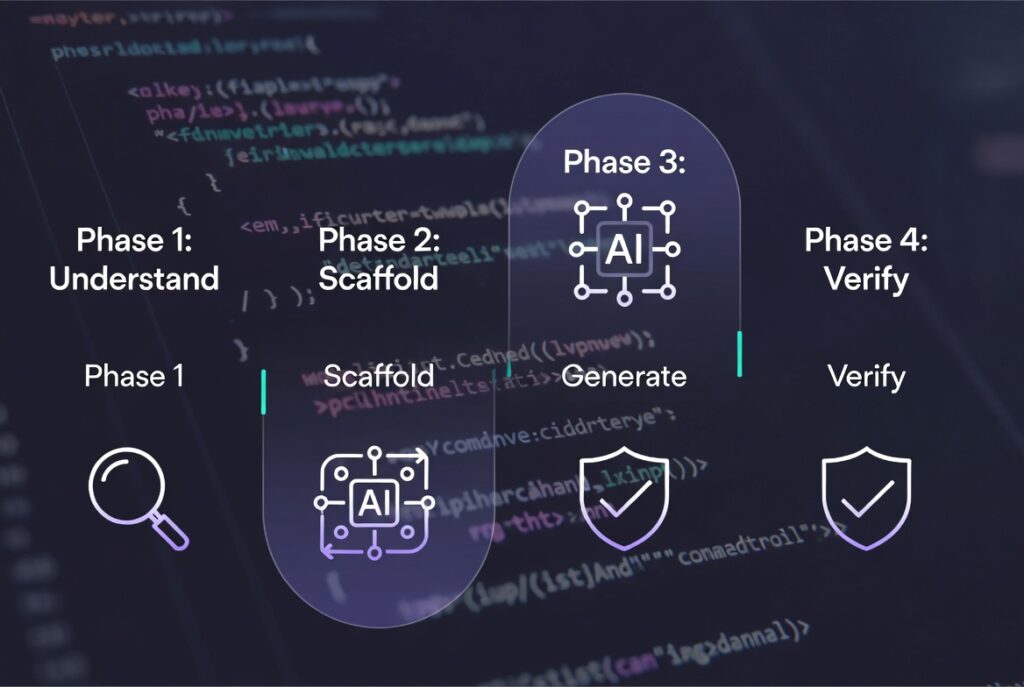
The 4-Phase Framework That Separates Results from Spin
The most consistent differentiator between teams seeing 4–6× ROI on AI tool investment versus 1× or less — documented in Larridin’s 2026 Developer Productivity Benchmarks — is sequence. Specifically, the sequence in which AI assistance is applied.
Most developers start at Phase 3. Starting at Phase 1 is what changes the outcome.
Understand
Use the AI tool to map the codebase before touching it. Feed the repository and ask: “What are the three highest-risk areas for this change, given the existing test coverage?” This question costs nothing and eliminates the class of AI-generated bugs that come from not knowing what already exists. Claude Code’s 1-million-token context window makes this step genuinely powerful on large codebases.
Scaffold
Get the structure before the content. Ask for a function signature, a class skeleton, a test outline — before asking for the implementation. The scaffold step surfaces false assumptions cheaply, before 200 lines of generated code have to be unwound. A developer who reviews a 15-line skeleton catches problems that a developer reviewing a 200-line implementation will miss.
Generate
This is where most developers start. That’s the problem. Generating into a well-understood, scaffolded structure produces code that is correct at a fundamentally different rate than generating into a blank file. The AI is constrained to the shape you’ve defined, and constraints produce better outputs than freedom does, at the implementation level.
Verify
Non-negotiable — and must match the risk level of the change. Write at least one test by hand that the AI tool did not know about. This breaks the closed-loop confirmation bias described above. The one human-written test is not about coverage percentage; it is about falsifiability. You are looking for the case that surprises the implementation.
What the Data Shows Across Phase Adoption
| Phase Sequence Used | 30-Day Code Churn | PR Review Time | Defect Rate vs. Baseline |
|---|---|---|---|
| Generate only (skip Understand + Scaffold) | 18–25% | +40% vs. human-only | ~1.7× higher |
| Understand + Generate (skip Scaffold) | 12–16% | +10% vs. human-only | ~1.2× higher |
| Full 4-phase sequence | 8–11% | ≈ parity | Near baseline |
5 Expert AI Coding Techniques Most Practitioners Skip
Technique 1: Write a One-Sentence Task Boundary Before Every Prompt
This is the highest-leverage single-habit change available to any developer using AI tools right now — and the one most consistently skipped because it feels unnecessary until you understand what it prevents.
Before opening any AI assistant, write one sentence defining what the AI is and is not responsible for in this session. A concrete example: “Generate the unit tests for the OrderProcessor class, given the existing interface — do not modify method signatures.”
That level of specificity is not pedantic. It prevents scope bleed — the failure mode where AI tools helpfully extrapolate beyond the stated task and introduce changes in three places when you asked for one.
Real-world evidence: One engineering team building a payment processing module began requiring developers to write a one-line AI task spec before every Cursor Composer session. Within one sprint, their PR review comment count dropped by roughly one-third. The mechanism was direct: scoped prompts produce scoped outputs, which take less time to validate.
Before your next AI session, write one sentence: what you are asking the AI to do, and what you are explicitly not asking it to do. The 30 seconds this takes eliminates the most expensive failure mode in AI-assisted development.
Technique 2: Build and Feed a Context File — Every Session, Every Tool
AI tools have no persistent memory of your codebase between sessions. Context must be re-established explicitly — every time. The developers and teams extracting the most consistent value from AI tools have operationalised this with a context file.
A context file is a 300–500 word document with three sections:
- Tech stack and versions — your framework, language versions, key dependencies, and anything non-obvious about your build environment
- Coding conventions — naming patterns, file organization, error handling approach, preferred patterns and antipatterns
- Test requirements — your minimum coverage expectations, test framework, and what constitutes a valid test in your codebase
Feed this at the start of every significant AI session. In Cursor, this lives as a .cursorrules file. In Claude Code, it can be passed as a session-opening context document. In any tool, it can simply be pasted before the first prompt.
This single change eliminates the most common class of off-target output — the code that is technically correct but wrong for your specific environment, naming scheme, or testing requirements. More reliably than switching tools.
See our guide to writing effective AI context files for development teams at CodeTalentHub →
Technique 3: Use AI for Tests First — Then Implementation
The conventional flow is: write the implementation, then ask AI to generate tests. This produces the closed-loop verification problem described earlier. The tests validate the implementation’s assumptions, not its correctness.
Inverting this — prompting for test cases first, then asking the AI to write an implementation that passes them — is one of the most consistently underused techniques relative to its effectiveness. The test-first approach forces the prompt to surface edge cases and assumptions before a single line of implementation exists. When the AI generates the implementation into a defined test suite, scope bleed is structurally constrained.
The additional benefit: tests generated first tend to be more comprehensive because they are written without knowledge of the implementation. The AI is reasoning about the contract of the function, not its internals.
Technique 4: Use Large-Context Agents for Onboarding — Not Just Coding
Research covering 4.2 million developers between November 2025 and February 2026 found that onboarding time — measured as time to 10th pull request — has been cut in half across organizations using AI tools. The mechanism is not autocomplete. It is using AI agents to make codebases legible to new contributors.
Claude Code’s 1-million-token context window lets a new developer feed an entire repository and ask substantive questions about undocumented behavior, architectural decisions, and the reasoning behind existing patterns. This is qualitatively different from grepping through code or waiting for a senior developer to be available.
Teams that deploy this capability see a structural speed advantage within weeks of a new hire’s first day — not months. It is the most underused AI coding application relative to its impact, and it requires no new tooling beyond what most teams already have access to.
Technique 5: Audit Code Churn on AI-Assisted PRs Every Sprint
Churn rate — the percentage of code that requires rework within 30 days — is the leading indicator of AI tool health that almost no team tracks. Teams that measure it gain an honest view of which prompt patterns are generating high-quality outputs and which are generating fast, expensive rework.
The implementation is simple: tag AI-assisted PRs with a label at merge time. Pull the list at each retrospective. Calculate the proportion of tagged PRs that required follow-up fixes within 30 days.
- Below 12%: Solid foundation. Expand AI usage with confidence.
- 12–18%: Review process needs tightening. Add one human-written test per AI-generated function.
- Above 18%: Generation rate is exceeding validation rate. Slow down and fix prompts before expanding usage.
These thresholds come from Larridin’s 2026 benchmarks across organizations of varying size. Your baseline may differ, but the direction is consistent: churn is the metric to optimize before any other.
Learn how to set up an AI code audit system for your engineering team →
2026 AI Coding Tool Comparison: Which Tool to Use and When
The competitive landscape shifted materially in early 2026. In a two-week window in February, Claude Code introduced Agent Teams (parallel agents working on separate tasks simultaneously), Windsurf added 5 parallel agents, and Grok Build launched 8 parallel agents. The category moved from single-session autocomplete toward autonomous multi-step execution.
The right tool depends on workflow, not brand preference. Here is a framework for the decision:
| Tool | Best Fit | Standout Strength | Pricing (May 2026) | Ideal For |
|---|---|---|---|---|
| Claude Code | Multi-file agentic work | 1M-token context window; Agent Teams | $20/mo Pro · $100/mo Max | Large codebase reasoning |
| Cursor | Daily IDE editing | Multi-file Composer; .cursorrules | $20/mo Pro · $40/mo Business | Feature implementation |
| GitHub Copilot | Enterprise GitHub teams | Widest IDE support; governance | $10/mo (usage-based from Jun 2026) | Standardized orgs |
| Windsurf | Best free tier | Auto-indexes 500+ file codebases | $15/mo Pro | Cost-conscious teams |
| Aider | Open-source / terminal | Full transparency; model-agnostic | Free (open source) | Control-first devs |
| OpenCode | CLI-first teams | Local model support; cost efficiency | Free (open source) | Privacy-sensitive orgs |
Which Sources to Trust for Evaluating These Tools
The signal-to-noise ratio in AI coding content is low. Here is a tiered reading list:
Highest signal:
- METR (metr.org) — Non-profit running controlled trials on AI developer productivity. Their early 2025 study showing a 19% slowdown was uncomfortable data. They published it anyway. That is the mark of trustworthy methodology.
- Stack Overflow 2025 Developer Survey — Largest repeated survey of working developers. Self-selection limits exist, but year-over-year trends are the closest thing to longitudinal data in this space.
- GitClear — Primary source for code churn data derived from real repositories. Essential for anyone making decisions about AI code quality.
Useful with caveats:
- Vendor productivity studies — GitHub’s original 2022 “55% faster” study used controlled, isolated tasks, not production workflows. Read as directional, not definitive.
- Developer influencer content — excellent for new tool awareness; almost none uses controlled comparisons. Treat as experience, not evidence.
Read our full Cursor vs Claude Code deep-dive comparison at CodeTalentHub →
Real-World Results: What Structured AI Usage Actually Produces
Case Study 1: Fintech Integration Test Generation (45 min vs. 6 hrs)
A fintech engineering team was spending 6 hours per sprint manually generating integration test cases for their payments API — a task that was time-consuming, error-prone, and consistently deprioritized under delivery pressure.
After switching to Claude Code with a session context file describing their test conventions, API patterns, and coverage requirements, the same task dropped to approximately 45 minutes per sprint — with higher coverage metrics than the manual baseline.
The mechanism was not “AI is magic at tests.” It was that three specific conditions were met simultaneously: the AI had full codebase context, clear conventions to follow, and a well-defined task scope. All three conditions had to be true. When teams try to replicate results like this without the context file, they consistently get mediocre outputs, conclude that “AI isn’t good at our codebase,” and stop there.
Case Study 2: New Developer Onboarding (Weeks vs. Months)
Research across 4.2 million developers found that time to 10th pull request — a standard measure of new developer onboarding speed — has been cut in half for organizations using AI tools strategically. The key word is strategically: teams that use AI agents to explain codebases interactively, surface undocumented behavior, and generate onboarding documentation from the code itself see the result. Teams that hand new hires an AI tool without a structured codebase-exploration process see much smaller gains.
See how leading engineering teams structure AI-assisted developer onboarding at CodeTalentHub →
Your 6-Week Playbook: From Adoption to Measurable ROI
This plan is built around one principle: reduce defect rate before increasing generation rate. Most developers do the opposite, which is why most developer AI ROI calculations look better on paper than they perform in production.
The 3 Highest-Leverage Actions for Week 1
- Write your context file and feed it to your AI tool before every session this week
- Measure your current AI code churn rate — establish the baseline before adding anything new
- Run one full 4-phase sequence task and time it from start to merged PR
Download our free 6-week AI adoption tracker template at CodeTalentHub →
Frequently Asked Questions: AI Tools in Coding (2026)
What is the single most important first step when using AI tools for coding?
Write a context file before anything else. A 300–500 word document covering your tech stack, coding conventions, and test requirements — fed at the start of every AI session — eliminates the most common class of misaligned output. Most developers skip this step and spend hours debugging responses that were off-target because the AI tool had no codebase context. This single change consistently produces better outputs than switching to a different AI tool entirely.
How long does it realistically take to see measurable results from AI coding tools?
Measurable results appear within one sprint when the approach is structured. DX’s analysis of 135,000 developers found an average of 3.6 hours saved per week for developers using AI tools daily — but that average conceals wide variance. Teams using a disciplined review process reach that level in 2–3 weeks. Teams without structured review often see no net gain for months, because rework time offsets generation speed. Approach matters more than duration. The 6-week playbook above is designed around this reality.
What is the most common mistake developers make with AI coding tools?
Treating AI-generated code with lower review standards than human-written code. CodeRabbit’s December 2025 analysis found roughly 1.7× more issues in AI-coauthored pull requests — and that gap does not come from the tool, it comes from the review pattern. AI-generated code looks plausible on first read; the errors tend to be semantic, not syntactic. Developers who apply the same rigour to AI-generated output as to code from a junior developer close the quality gap quickly. The mistake is in the process, not the product.
Are AI coding tools suitable for beginner developers?
AI tools are accessible to beginners but actively harmful to their development if used as a crutch before core concepts are understood. A developer who cannot read and verify generated output — spotting off-by-one errors, recognizing insecure patterns, understanding what the code actually does — cannot use AI coding tools safely. They provide the illusion of progress while obscuring the knowledge gaps that create real problems later. For developers past the fundamentals stage, AI tools become genuinely powerful. The practical threshold is: if you cannot debug the output without the AI’s help, you are not yet in a position to benefit from the tool.
How do I know if my AI coding tool approach is actually working?
Track 30-day code churn on AI-assisted PRs separately from human-written code. A healthy rate is below 12%; above 18% signals that outputs are not being reviewed rigorously enough. Pair this with time-to-merge on AI-assisted PRs — if review time has increased proportionally to generation speed, the net gain is smaller than it appears. The combination of churn rate and review overhead gives an honest picture that no self-reported productivity estimate can match. The Larridin 2026 benchmarks provide quartile data to contextualize your numbers against comparable organizations.
What is a .cursorrules file and do I actually need one?
A .cursorrules file is Cursor’s implementation of the context file concept — a project-level document that defines your tech stack, conventions, and requirements, automatically loaded at the start of every session. The equivalent exists in other tools under different names (Claude Code session context, GitHub Copilot repository instructions). Whether you need one depends on whether you are seeing off-target outputs. If your AI tool frequently generates code that is technically correct but wrong for your specific environment or naming scheme, the context file is the fix. If your outputs are consistently on-target, you may already be establishing context through other means — but it is worth having the explicit file regardless, because it makes context establishment systematic rather than ad hoc.
Claude Code vs Cursor: which is better for daily development in 2026?
They are optimized for different contexts rather than competing directly. Claude Code’s 1-million-token context window and terminal-native agentic capabilities make it the stronger choice for multi-file refactors, large codebase reasoning, and tasks requiring awareness of the full repository. Cursor’s IDE integration and Composer make it faster for daily feature implementation within a specific file or module. Many high-output developers use both: Claude Code for session-opening codebase analysis and complex agentic tasks, Cursor for in-editor generation and rapid iteration. The choice is workflow-dependent, not a verdict on one tool’s superiority. Read our full comparison at CodeTalentHub →
What does the METR productivity research actually say about AI coding tools?
METR’s research is among the most methodologically rigorous in this space, and the results have been more nuanced than vendor marketing suggests. Their early 2025 controlled study found a 19% slowdown for experienced developers using AI tools on real open-source tasks — a finding that generated significant discussion because it contradicted prevailing narratives. Their February 2026 follow-up found the same cohort showing an 18% speedup. The lesson is not that one study was wrong — it is that the relationship between AI tools and productivity is dynamic. Developers and tools both improved over the period, and critically, developers developed better judgment about when AI assistance helps and when it hinders. Read the METR follow-up study →
How should teams measure the ROI of AI coding tool adoption?
Three metrics in combination give the most honest picture: 30-day code churn rate on AI-assisted PRs (target: below 12%), time-to-merge on AI-assisted vs. human-only PRs (a widening gap signals that review overhead is eating productivity gains), and the ratio of time saved in generation to time added in review and remediation. The Larridin 2026 benchmarks suggest that the average ROI threshold for AI coding tool investment is 2.5× — meaning teams should see at least 2.5 hours saved for every hour spent on AI-related review overhead. Teams below this threshold are typically experiencing one of the four failure modes described above, not a fundamental problem with the tools.
Can AI coding tools help with code review, not just code generation?
Yes, and this is one of the most consistently underused applications. AI tools can perform a first-pass review before human review, flagging potential issues, inconsistencies with established patterns, missing edge cases, and security antipatterns. This application works best when the AI has full codebase context (via context file or large-context window), a specific checklist to review against, and when the human reviewer treats the AI’s output as a starting point rather than a verdict. Used this way, AI code review reduces the cognitive load on human reviewers and catches the class of issues that humans miss after reviewing the fifth PR of the day. See our guide to AI-assisted code review workflows at CodeTalentHub →
What are agentic AI coding tools and when should I use them?
Agentic AI coding tools execute multi-step workflows autonomously: they can read files, write code, run tests, observe the results, and iterate — without requiring a human prompt at each step. In early 2026, Claude Code Agent Teams, Windsurf’s 5 parallel agents, and Grok Build’s 8 parallel agents moved the category meaningfully forward. The right use cases for agentic tools are tasks with clear completion criteria, verifiable outputs (the tests pass or they don’t), and a well-understood scope. The wrong use cases are tasks with ambiguous requirements, open-ended design decisions, or any situation where the agent cannot self-verify its output. Used correctly, agentic tools eliminate the category of tasks that are too large for a single prompt but too mechanical for sustained human attention — large-scale refactors, codebase-wide test generation, API integration from documentation.
Is there evidence that AI coding tools increase technical debt?
There is directional evidence. GitClear’s 2024–2025 analysis found code churn rising from a 3.3% industry baseline pre-AI adoption to 5.7–7.1% as adoption increased. Code churn — code written and then substantially modified or removed within 30 days — is a proxy for code that was not correct the first time. It correlates with, but does not prove, technical debt accumulation. The more direct evidence is CodeRabbit’s finding of 1.7× more issues in AI-coauthored PRs. Whether those issues become technical debt depends entirely on review rigor. Teams with strong review practices do not show the debt accumulation pattern; teams with light-touch review do. The tool is not the cause. The process is.
What will AI coding tools look like in the next 12 months?
The trajectory is toward greater autonomy and longer task horizons. The movement from single-session autocomplete to multi-agent parallel workflows that happened in early 2026 will continue. The practical implication is that the skills that matter most are shifting from “writing good prompts” toward “defining good task boundaries and verification criteria” — because the agents will handle more of the execution surface area, and the developer’s comparative advantage will increasingly be in specification, judgment, and review. Developers who build those habits now, using the discipline described in this guide, are better positioned for the tooling that will exist in 12 months than developers who optimize for the current generation of tools.
Ready to Build a Measurable AI Coding Practice?
CodeTalentHub publishes in-depth guides, tool comparisons, and developer productivity frameworks. No filler, no vendor promotion — just what the data supports.
Explore CodeTalentHub →Sources cited: Stack Overflow 2025 Developer Survey · METR February 2026 Follow-Up Study · CodeRabbit December 2025 PR Analysis · GitClear 2024–2025 Code Churn Report · Larridin 2026 Developer Productivity Benchmarks · ShiftMag 4.2M Developer Research · DX 135,000-Developer Dataset
https://www.codetalenthub.io/developer-tools-2026/
https://www.codetalenthub.io/tech-interview-2026/
https://www.codetalenthub.io/ai-in-education-2025/
https://www.codetalenthub.io/tools-in-the-developer-workflow-stack/
[card url=”https://www.codetalenthub.io/this-ai-chrome-extension-writes-code/”]
[card url=”https://www.codetalenthub.io/free-ides-ranked-2026/”]
[card url=”https://www.codetalenthub.io/best-ai-support-tools-in-2026/”]
[card url=”https://www.codetalenthub.io/workflow-enhancement-vs-automation/”]
[card url=”https://www.codetalenthub.io/about-us/”]