
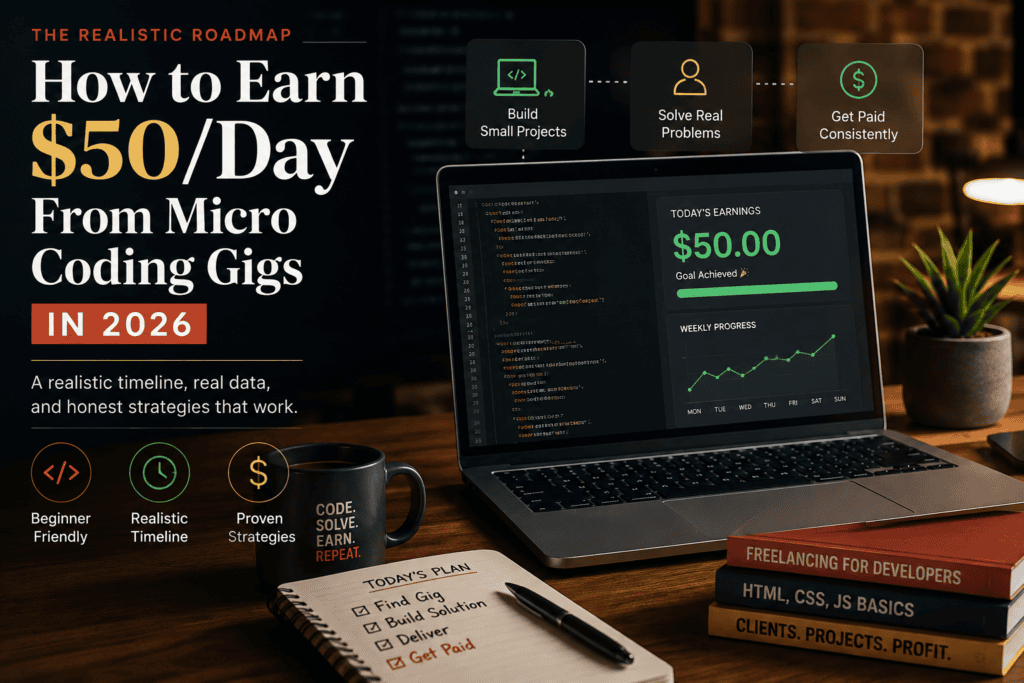
How to Earn $50/Day From Micro Coding Gigs in 2026: The Realistic Timeline
The math looks simple. The reality is harder. Here’s what the “make money coding” crowd won’t tell you — failure rates, platform economics, and why AI changed the game in ways no one fully predicted.
Two to three small coding tasks. Fifty dollars. Done before dinner. That’s the pitch.
At beginner rates — call it $15–25 an hour — you need about 2–3.5 hours of actual billable work to hit that number. Factor in the unbilled time — proposals, client back-and-forth, revisions that weren’t in the original scope — and you’re looking at 4–5 hours of total daily effort. That’s not passive income. That’s a second job with an unpredictable schedule.
Here’s what nobody upfront tells you: 70% of Fiverr freelancers earn under $100 a month, and 96.3% earn under $500 a month. The global freelance market hit $1.5 trillion in 2024 according to Upwork’s Freelance Forward report, but that aggregate number masks brutal platform dynamics stacked hard against newcomers. Gross market size and individual take-home are different animals — and 2026 added a new wrinkle: Fiverr’s own Q2 2026 earnings report confirmed that AI is actively shrinking demand for exactly the kind of low-value, transactional gigs beginners have historically relied on to get started.
This guide is not a fantasy. It’s the realistic path to $50/day — including the failure statistics, the platform economics, and the skills that actually move the needle. Use the calculator below to see what your specific hours-and-rate combination actually nets after platform fees, then read on for the timeline, the platform breakdown, and the one thing that complicates the whole picture: AI tools that help you go faster also go faster for everyone else.
“70% of Fiverr sellers never hit $100 a month. You beat those odds through specialization, not volume.”
Editorial synthesis — sources: Skillademia/GrabOn Fiverr Statistics (2026), DemandSage Upwork Statistics (2026)Calculate Your Realistic Income
Move the sliders to match your actual hours and rate. The math updates live, after real platform fees — not the number the platform’s landing page shows you.
The Failure Statistics Nobody Mentions
The uncomfortable numbers first. If you understand why most people fail, you can avoid those traps — or at least see them coming.
- 70% of Fiverr sellers earn under $100/month; 96.3% earn under $500/month — Skillademia / GrabOn Fiverr Statistics, updated August 2026 Tier 2 — aggregated from platform data; treat as directional
- Only 1% of Fiverr sellers reach $2,000+/month — the threshold for meaningful income replacement — same source
- Fiverr's own Q2 2026 revenue fell 10% year-over-year to $97.8 million, which the company attributed directly to AI eroding demand for low-value, transactional gigs — Self Employed, reporting on Fiverr's Q2 2026 earnings Tier 1 — company-reported earnings
- Average time to first Upwork client: 3–6 weeks for new accounts with zero reviews — DemandSage Upwork Statistics 2026
- Proposal-to-hire ratio: 3–5% for entry-level developers on saturated platforms — DemandSage, 2026
- 1 in 800 Upwork freelancers makes over $1,000/month — DemandSage, based on 2020 Upwork data; treat as structural baseline, not current rate ⚠ Vintage: 2020 data — market has grown, but so has competition
These numbers don't mean you won't make it. They mean the approach matters. The freelancers who reach $50/day share specific traits — they specialize early, treat first gigs as paid training, and build systems for efficiency rather than spraying proposals at anything that moves.
The case for micro coding gigs gets harder in 2026, not easier — and the platforms are now saying so in their own earnings calls. Upwork's Future Workforce Index 2026, published in July 2026, found that freelancers who incorporate AI into their work earn 34% more per hour than those who don't. That sounds good until you read the second half of the finding: the premium isn't evenly distributed. Low-complexity AI-execution work is growing in volume but losing pricing power, while complex, judgment-heavy AI-augmented work saw earnings jump 45% year-over-year over the same period. The floor isn't rising for beginners doing simple, repeatable tasks. It's rising for people who already combine AI tools with domain expertise clients can't easily replicate. If you start today without building AI tools into your workflow from day one — and without moving toward tasks that require actual judgment, not just execution — you're competing on price against people who don't need to. Tier 1 — Upwork Future Workforce Index 2026, based on a 2,400-person survey plus marketplace platform data
Real Case Studies: What $50/Day Actually Looks Like
Theory is cheap. None of these three started at $50/day. All took 2–6 months. Early gigs were priced below market deliberately — buying reviews, not income.
"I combined AI tools with my editing skills. The key was not relying 100% on AI — clients can tell when content is pure AI."
"A lot of these prospective clients are first-time business owners. They've never dealt with a big fancy attorney who's going to confuse them with hundreds of dollars in fees."
"Underrated gigs are a goldmine. Keep your pricing low. Many clients are willing to give new freelancers a chance, especially if you're upfront and eager to grow."
None started at $50/day. All deliberately underpriced early work to build review velocity. The income curve is not linear — it's flat for months, then climbs when reviews unlock algorithmic visibility. Derrick's jump from $180 to $5,000 between months 1 and 3 wasn't luck; it was the review threshold kicking in. That's the actual mechanism. Price for reviews first. Income follows.

Platform Economics: Your Real Take-Home
A $50 gig isn't $50 in your pocket. Here's the actual math across the main platforms — and the stuff they don't advertise. Use the calculator above with each platform's fee to see how it plays out for your specific hours and rate.
What You Keep From a $100 Gig
Fiverr's algorithm suppresses new sellers. Without external traffic or 50+ reviews, your gigs won't rank in search. That "start selling in minutes" pitch ignores the 3–6 month runway most new sellers need before the algorithm works for them, not against them.
Upwork's "Connects" cost real money. At $0.15 each, a single proposal requires 4–16 connects ($0.60–$2.40). At a 5% win rate, expect $12–48 in connect costs per successful hire. That's a hidden tax on your time before you've earned a dollar.
Codeable (WordPress-specific) advertises $80–120/hour rates. Application approval rate: estimated 2–5%. Not a beginner platform.
10 Micro Coding Gigs Beginners Can Actually Complete
Ranked by beginner accessibility. Each shares three traits: well-defined scope, completable in 30–90 minutes, learnable in days rather than months. That last part matters — you're not starting a career here, you're starting a gig.
Want a deeper breakdown of which skills translate to freelance income? See our skill-to-income map at CodeTalentHub.
Looking to build these skills fast without a degree? CodeTalentHub's learning paths cover most of these in structured tracks under 8 weeks.
Skills That Pay: Ramp Time vs. Earning Potential
Not all skills translate equally to micro gig income. Prioritize based on demand and ramp time. The fastest dollar is CSS debugging — you can start doing paid work inside two weeks. The highest ceiling is Python, but you're looking at 4–8 weeks before you're competitive.
CSS / HTML Debugging
Google Apps Script
No-Code Tools (Zapier / Make)
Python Basics + Libraries
SQL Basics
Web Scraping (Python)
Upwork's Future Workforce Index 2026 — a survey of 2,400 U.S. skilled workers combined with marketplace platform data, published July 2026 — found AI-fluent freelancers earn 34% more per hour than those who aren't using AI. Skilled freelancing itself jumped from 28% to 38% of the knowledge workforce in a single year, and Upwork's separate In-Demand Skills report (February 2026) found that AI-referencing skills grew 109% year-over-year, roughly 4.7x the growth rate of other in-demand skills.
Here's the mechanism nobody explains clearly: AI compresses delivery time, not just for you but for your competitors. If you're not using GitHub Copilot, Claude, or ChatGPT to accelerate delivery, you're competing against developers who complete the same task in a third the time — and can quote a third of your price while matching your margin. Fiverr's own Q2 2026 earnings confirm the other side of this: the company's marketplace revenue fell 15.5% year-over-year as AI eroded exactly the low-value, transactional gig category beginners have relied on.
What survives AI commoditization: tasks requiring client-specific context (understanding their exact setup), live debugging (AI can't access production environments), and integration work connecting real systems with real data. Upwork's data backs this directly — complex, judgment-heavy AI-augmented work saw earnings rise 45% year-over-year, even as simple AI-execution work lost pricing power. Specialize there. See our AI tools guide for freelancers →

Month-by-Month: What to Actually Expect
Most guides show best-case scenarios. Here's what actually happens when a beginner starts micro gigs in 2026 — including the flat months nobody talks about.
Realistic Income Progression
The Micro Gigs Starter Checklist
Every step from this guide — Week 1 setup through Month 6 rate increases — as a printable, one-page checklist. No fluff, just the boxes to check in order.
Platform setup + portfolio samples
3–5 sample projects showing specific gig types. GitHub repos, Notion pages, screenshot walkthroughs. You don't need clients yet — you need proof of work.
Below-market work, deliberately priced for reviews
Take work you'd normally quote at $40 and charge $15. You're buying reviews, not income. Five positive reviews unlock a different algorithm than zero reviews. That's not a bug — it's the business model.
Find your reliable gig type + first repeat client
One gig type you can complete faster than you quote. One client who comes back. These two things together change the math. Specialization is not a personality trait — it's a survival strategy.
Rate increases + referrals emerging
Every 10 reviews, test a rate increase. Not on existing clients — on new ones. If it doesn't stick, you learn where the market ceiling is. If it does, you've just raised your hourly without working more hours.
Direct clients + $50/day becomes routine
Every platform gig should become a direct relationship. That's how you escape platform dependency — and the 10–20% fee cut. At this stage, $50/day is not the ceiling. It's where the foundation is solid enough to build something bigger.
Where to Find Gigs When Platforms Saturate
Platform saturation is real. Alternative channels convert better because there's less competition, and clients in these spaces are often looking for a real person, not the cheapest bidder.
Reddit: r/forhire, r/slavelabour (ironic name, legitimate micro tasks), r/WordPress, r/webdev. Lower volume, less competition. Post when you have five reviews and a specific offer.
Discord communities: Developer servers, niche software communities (Notion, Airtable, specific SaaS tools). Clients trust community members over cold proposals. Being genuinely helpful in the community first is not optional — it's the entry fee.
Facebook Groups: "WordPress Help," "Shopify Entrepreneurs," industry-specific groups. Lower sophistication, but buyers are real. Response rates are often better than Upwork for small jobs.
Indie hacker communities: Indie Hackers, HackerNews "Who's Hiring" threads. Founders building MVPs need affordable, fast technical help. They're not looking for agencies. They're looking for people who can get something done by Thursday.
Local business outreach: The competitive advantage nobody online ever uses. Small businesses near you often prefer a local, reachable freelancer. Walk in. Email the owner directly. Boring. Works.
For a detailed comparison of which platforms work best for each gig type, see our platform matchmaker guide at CodeTalentHub.
Platform Economics at a Glance
Not every platform fits every gig type. Filter the table below by the skill you're actually offering to see which platforms are worth your first proposal.
Tap a skill to see which platforms actually see demand for it — the table filters live.
| Platform | Fee Structure | Your Take on $100 | Best For | ⚠ Adversarial Reality |
|---|---|---|---|---|
| Fiverr | 20% flat | $80 | Productized, fixed-price gigs — CSS fixes, Python scripts, SQL cleanup | Algorithm suppresses new sellers; 50+ reviews needed before organic traffic. Q2 2026 marketplace revenue fell 15.5% YoY as AI ate low-value gig volume — the entry tier is shrinking, not growing. |
| Upwork | 10% flat (simplified 2024) | $90 | Ongoing relationships, hourly work — Python automation, SQL reporting | Connects cost $0.15 each. At 5% win rate: $12–48 in connects per hire. Factor this into your actual margins. |
| PeoplePerHour | 20% (first £350) | $80 | UK/EU clients — WordPress/CSS work for European small businesses | Approval process is slower. UK client base is geographically limited. Less useful if you're not in a similar timezone. |
| Freelancer.com | 10% or $5 (whichever is more) | $90 | Budget projects, volume gigs — Sheets automation, scraping | Race-to-bottom pricing is endemic. Price competition is severe. Hard to hold rates above market here. |
| Direct clients | ~3% (payment processor only) | $97 | Referrals, repeat work — any skill, once you have reviews to point to | No platform escrow protection. Require 50% upfront from new clients. Collection risk is real on small jobs. |
What This Means For You, Specifically
Start Stupid Simple. Stay There Longer Than You Think.
The trap is trying to learn everything before starting. You don't need Python and SQL and CSS and APIs. You need one gig type you can complete in under an hour. Pick CSS debugging or Google Sheets automation — both ramp in under two weeks, both have real demand, both are specific enough to write a coherent Fiverr gig description for.
What you do: Build three sample projects this week. Not tomorrow, not after you finish the course. This week. Post one Fiverr gig at a price that makes you slightly uncomfortable because it's too low. That discomfort is the review-buying budget. See our first-gig setup guide →
Here's what's going to stop you: The gap between learning and earning feels enormous, so people keep learning instead of starting. After two weeks of CSS, you know enough to fix 80% of WordPress layout complaints. You do not know everything. Start anyway.
Stop doing this: Spending week three taking another course instead of sending your first proposal. You don't have a knowledge problem. You have a proposal-sent problem. One sent proposal teaches more than ten more hours of tutorials.
The 2–3 Hours After Work Playbook
The math works differently when you have a salary. You're not replacing income — you're building a margin. That means you can afford to be more selective about gig types and more patient about the review-building phase, because you're not watching a bank account drain while you wait.
What you do: Weekend batching works better than weeknight grinding. Two focused Saturday hours beats five scattered weeknight sessions. Pick one platform, one gig type, and commit to 90 days. The first gig review is the only milestone that matters in month one. Everything else is setup. Budget overhead: factor in the 10–20% platform fee and actual self-employment tax implications before celebrating a $100 gig. Our freelance tax primer covers this.
Here's what's going to stop you: Burnout. A 2-hour freelance session after a 9-hour workday is not sustainable at week six. Build a specific stopping time. The gig still needs to be there in month three when the reviews start mattering.
Stop doing this: Treating every gig as a standalone transaction. Every platform client should end with: "I also take on work directly — here's how to reach me." That's how the 10–20% platform fee eventually disappears from your economics. Not immediately. Month four, minimum. But start planting it early.

FAQ
The 6–18 Month Outlook
The micro gig economy isn't shrinking as a whole — but its composition is changing fast. Freelancers generated $1.5 trillion in 2024 and 48% of CEOs reported plans to increase freelance hiring in Upwork's Freelance Forward report. Skilled freelancing jumped from 28% to 38% of the U.S. knowledge workforce in a single year, per Upwork's July 2026 Future Workforce Index. Businesses increasingly prefer fractional technical help over full-time hires for small, well-scoped tasks. That's a structural shift, not a trend cycle — but it's also increasingly a shift toward AI-fluent freelancers specifically, not freelancers in general.
For beginners, $50/day is an achievable milestone — not a ceiling. The developers who get there treat micro gigs as a business: they build efficiency systems, position for differentiation, and turn every platform client into a direct relationship.
The developers who fail approach gigs like lottery tickets. Random proposals, no specialization, price-only competition. That's the path to being in the 70% earning under $100 a month — a group that Fiverr's own 2026 earnings suggest is not shrinking on its own.
Start with one gig type you can complete confidently. Build five reviews. Raise your rates. Find your first direct client. The rest follows from those four things — but those four things require doing them in order, not simultaneously.
The complicating reality from earlier in this piece stands: AI raises the floor for everyone, including you. Build the tools into your workflow from day one or compete on price forever.
For a structured path through all of this — skills, platforms, tools, and income milestones — CodeTalentHub's freelance starter track covers it end to end.
"Every platform gig should become a direct relationship. That's how you escape platform dependency — and recover the 10–20% you've been giving away."
Editorial synthesis — sources: Upwork Freelance Forward (2024), Upwork Future Workforce Index (Jul 2026), Skillademia/GrabOn Fiverr Statistics (2026), DemandSage Upwork Statistics (2026)