

Freelance Job Boards · Industry Guide · June 2026
Most freelance platform guides list the same six names in the same order. This one starts from a different question: given your industry, your rates, and what kind of clients you actually want — which board moves the needle, and which one quietly takes 20% of your year?
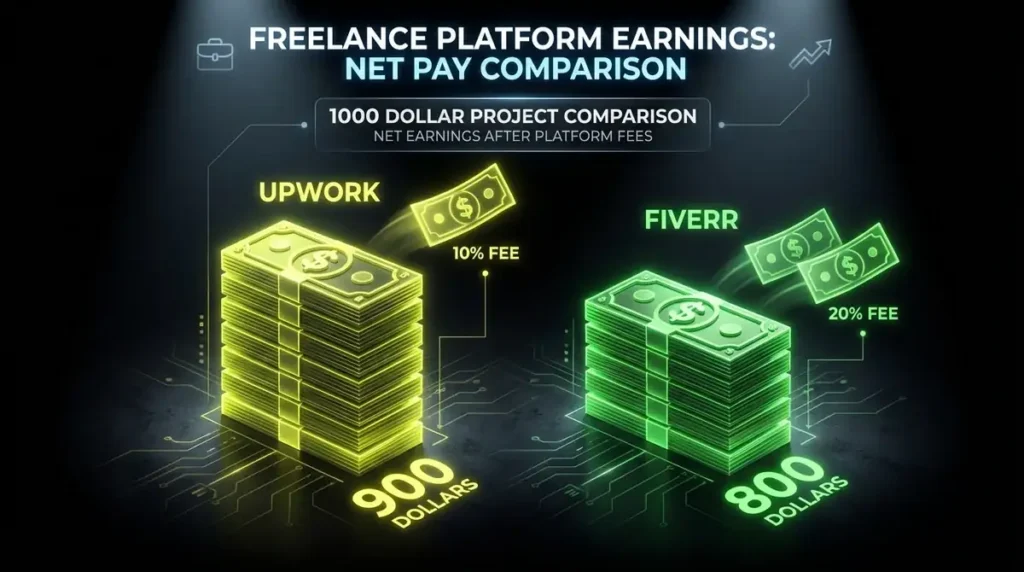
On $60,000 in annual freelance earnings, a 20% platform commission costs you $12,000. That’s not a rounding error — that’s a month and a half of work handed back to the platform. Most freelance “best boards” lists never mention this. They list Upwork first because Upwork has the most jobs. They’re not wrong. They’re also not answering the right question.
The right question isn’t “which platform has the most gigs?” It’s “which platform, given my specific industry and experience level, produces the best ratio of client quality to time invested to take-home pay?” Those are three completely different answers for a senior developer versus a freelance paralegal versus a B2B content writer.
What follows is an industry-by-industry breakdown of where the actual work is in mid-2026 — with real fee structures, honest assessments of vetting quality, and a few platforms I’d quietly steer people away from despite their name recognition.
The Math Nobody Shows You First
Before the industry-by-industry breakdown, a frame that makes all the platform choices clearer.
The fee chart above carries an implication most guides skip: platforms with zero freelancer fees aren’t charity. Contra and Jobbers.io charge clients instead, typically 8–10% on top of the project rate. This means your listed rate is what you take home — but clients may push back on the effective cost. The model works best when you’re experienced enough to justify premium rates clients can’t find elsewhere at similar terms.
Toptal is a different structure again: freelancers pay zero fees, but Toptal charges clients a significant markup — reportedly 30–50% on top of the agreed rate. The client cost is high; the freelancer experience is clean. You clear your screen rate, every time, with no bidding and no proposals.
Industry 01 — Software & Technology
Tech & Software Development
The developer market in 2026 is simultaneously the most competitive and the most stratified of any freelance category. Mid-level generalist developers face brutal proposal volumes on open platforms. Senior specialists in React, Python, mobile, or security architecture have more inbound demand than they can handle — but only if they’re on platforms where clients are shopping for expertise, not price.
The math for senior developers is hard to argue with: you keep 100% of your stated rate, clients include Motorola, Airbnb, and major fintechs, and you never write a proposal again after passing screening. The screening itself is genuinely brutal — roughly 3% acceptance rate, spanning an English evaluation, timed algorithm tests, a live interview, and a paid test project. The failure hold is several months.
Worth attempting if you have a demonstrable track record at senior or staff level. Not worth the screening anxiety if you’re still building fundamentals — Toptal clients expect someone who can own a technical decision, not execute a ticket.
Less famous than Toptal, more accessible than A.Team, and consistently mentioned by mid-senior developers as producing higher-quality matches than Upwork without the proposal grind. Gun.io focuses specifically on developers — no designers, no marketers — which means clients arrive knowing what they need and have budget allocated. Freelancers pay no fees; Gun.io earns from clients.
Screening is rigorous but faster than Toptal, and rejection doesn’t carry a multi-month lockout. If Toptal’s process feels like a stretch, Gun.io is the sensible next step up from Upwork’s bidding environment.
Arc positions itself as remote-first developer talent, with clients predominantly in North America and Europe. Strong in React, Node, Python, and mobile. Less deep than Toptal in enterprise client scale, but considerably faster to get active and visible. Matching is algorithm-assisted; you’re surfaced to clients rather than browsing listings.
Focused on matching vetted CEE, LatAm, and UK developers with startups and SMBs. The client profile is different from Toptal — you’re more likely to be the sole developer on a product than a specialist on an enterprise team. Rates are strong relative to competition volume, and client introductions reportedly arrive within days of matching, not weeks.
Still the largest client pool on earth for tech freelancers — 18 million registered freelancers, 841,000 active clients, 97%+ payment success rate. The proposal environment for generalist development work is genuinely brutal in 2026, with 15–40 proposals per job being typical. The platform’s Job Success Score (JSS) algorithm gives 25–30% weight to your score — this creates a vicious cycle where early reputation is hard to build and critical to maintain.
Where Upwork still makes sense: very specific technical niches (e.g., Shopify app development, Salesforce administration, specific API integrations) where the client pool is large and the specialist pool is thin. In these cases, you can command rates that outpace the fee haircut.
Industry 02 — Design & Creative
Design & Creative
Design freelancing in 2026 has a specific problem: the volume of AI-generated work submitted through open contest platforms has degraded contest-based income considerably. On 99designs, multiple client reviews now specifically call out AI-submitted entries as a frustration — the client asked for original design thinking and got Midjourney outputs passed off as work.
The implication for serious designers is a shift toward platforms that vet talent and toward inbound models where your portfolio does the selling. Here’s how the major options break down.
Industry 03 — Writing & Content
Writing & Content
Writing is where the platform economics get most brutal. The AI content wave has flooded every open platform with $5-per-article proposals, and it’s genuinely changed what the midrange looks like. Generalist content writing on Upwork or Fiverr in 2026 is a race to the bottom in most categories. The exception — and it’s a real one — is niche specialization.
As of mid-2026, writers specializing in AI, cybersecurity, and SaaS niches command rates comparable to or exceeding traditional high-value categories like legal and financial writing. Writers in the general content category who haven’t moved into a defensible niche are facing real rate compression that no platform change will fix.
Curated freelance writing jobs aggregated and filtered for quality — the membership fee buys access to a pre-screened listing set that removes the garbage. Works best for writers targeting mid-to-high-range digital publications, SaaS companies, and B2B content. The pool is smaller than Indeed or LinkedIn, but the average quality of posting is considerably higher.
The longevity of ProBlogger’s job board (running since 2006) has made it a default listing spot for digital publishers, online magazines, and content-first brands. Quality varies widely — you’ll find $0.05/word blog posts alongside $500+ per-article B2B gigs. The search and filter interface is minimal, meaning you’ll spend time screening. Worth checking weekly if you’re targeting digital editorial rather than agency/brand work.
Clearvoice positions itself between a marketplace and an agency — brands use Clearvoice to manage content production at scale, and writers get matched based on demonstrated expertise rather than pitching. The inbound model means no bidding. Portfolio quality and niche clarity drive match frequency. Strong for writers in SaaS, tech, and marketing verticals.
Not a job board. But consistently the highest-value channel for writers with a defined niche and a track record. The most durable writing income in 2026 doesn’t come from job boards at all — it comes from content directors who find you via a well-optimized LinkedIn profile or a published article they’ve already read. LinkedIn as a discovery layer, combined with a direct Calendly link and a simple rate card, removes platform fees entirely. Takes longer to build. Worth building.
Industry 04 — Finance & Business Consulting
Finance & Business Consulting
Finance freelancing occupies a specific tension: the work requires credentials and trust in a way that makes anonymous marketplace platforms awkward. A CFO-level engagement or a financial modeling project for a Series B startup isn’t something a company finds through Fiverr — and if they do, that’s the first signal something’s off.
Industry 05 — Legal & Compliance
Legal & Compliance
Legal freelancing has a structural constraint that makes it genuinely different from every other category on this list: bar admission. Most substantive legal work can only be performed by licensed attorneys in a specific jurisdiction, which creates a natural floor on competition that other fields don’t have. The platforms that work for legal freelancers reflect this.
Axiom pioneered the alternative legal services model and remains the largest. Attorneys work on defined client engagements — typically Fortune 500 or PE-backed companies — on a flexible basis. Axiom handles business development, compliance, and malpractice insurance. The trade-off is that Axiom takes a substantial margin on your rate (the specifics aren’t published, but estimates from attorney communities put it at 30–50%). The upside: zero business development effort, blue-chip clients, and a way to exit Big Law hours without exiting Big Law clients.
Lawclerk connects attorneys with law firms that need project-based support — brief writing, research, document review, contract drafting. The client is almost always a practicing attorney or firm rather than a corporation. This means the work is substantive and supervised, which suits attorneys who want to freelance but aren’t ready to take on direct client responsibility. Strong for mid-level attorneys building freelance income alongside another practice.
UpCounsel targets small and mid-sized businesses needing on-demand legal help — contracts, IP, employment, business formation. The clients are not Fortune 500 (that’s Axiom territory), but the volume is higher and the matter types are diverse. Works well for attorneys who want varied work and don’t need to specialize immediately. Rate pressure exists, but the platform’s client verification reduces the worst bid-war dynamics.
Industry 06 — Marketing & Growth
Marketing & Growth
Marketing freelancing is the most fragmented category. “Marketing” covers everything from $15/hour social media scheduling to $300/hour fractional CMO strategy, and the platforms reflect this chaos. The best boards for marketing work depend almost entirely on which tier of marketing you occupy.
Full Fee Comparison Table
Every number below reflects mid-2026 published rates. “Blended” rates on sliding-scale platforms assume a mix of new and established client relationships.
| Platform | Freelancer Fee | Client Fee | Vetting | Best For |
|---|---|---|---|---|
| Toptal | 0% | 30–50% markup | 5-stage, top 3% | Senior dev / finance / design |
| Gun.io | 0% | Client-side fee | Technical screening | Mid-senior developers |
| Arc.dev | 0% | Client-side fee | Algorithm + review | Remote developers |
| Contra | 0% | ~8–10% | Portfolio review | Designers, developers, creators |
| Braintrust | 0% | Client-side fee | Application review | Tech professionals |
| Jobbers.io | 0% | ~8–10% | Minimal | Generalists, low-fee priority |
| Guru | 8.95% | Client-side fee | None | Mid-range projects, lower fees than Upwork |
| PeoplePerHour | 15% → 3.5% | Client-side fee | None | UK/EU freelancers, marketing/design |
| Legiit | ~8% | Client-side fee | Service review | SEO/digital marketing |
| Upwork | 20% → 10% → 5% | 3–5% | None (reputation-based) | All categories; highest volume |
| Fiverr | 20% flat | 5.5% + $2 <$40 | None (Fiverr Pro: vetted) | Packaged/gig services; inbound model |
| Freelancer.com | ~15% | 3% | None | High-volume, lower-rate projects |
| 99designs | 20% (contest win) | Posting fee | Level system | Graphic designers (direct projects only) |
The Multi-Platform Reality
The most durable freelance income structures in 2026 don’t rely on one platform. Platform risk is real: policy changes, algorithm shifts, and fee increases can materially change your income with no warning. But diversification doesn’t mean being active on 12 boards — that’s just scattered effort with the same platform dependency.
The practical approach: anchor on a zero-fee vetted platform as your primary income source, maintain active presence on the niche board most aligned with your specialty, and keep an open marketplace profile updated but not primary. When work slows on Layer 1, Layer 2 fills gaps. Layer 3 is a backstop, not a strategy.
The single most reliable long-term move — and the one almost no platform guide will tell you because it doesn’t involve platforms — is building direct client relationships off-platform. A client who pays you directly, through your own invoicing, pays 0% to anyone but you. The platforms are useful for discovery. They’re not a business model.
A Few That Don’t Earn Their Entry Cost
Two that appear on almost every “best boards” list and consistently disappoint in practice:
Every platform on this list will have exceptions in both directions. Some developers thrive on Upwork’s volume because they found a niche thin enough that they never compete on price. Some senior consultants get nothing from Toptal because their portfolio doesn’t translate well to their screening criteria.
The variables that matter most aren’t which board — they’re: What is your specific specialty? What is your rate target? Do you want inbound or outbound? Are you willing to invest 6–12 months building platform reputation, or do you need income in the next 8 weeks? Those answers determine your platform stack more reliably than any list ranking.
What this map gives you: a faster starting point than reading 30 platform homepages. The research is done. The fee math is done. The rest is knowing which tier of each industry you’re actually operating in — and choosing accordingly.
For Tech Talent Specifically
If you’re a developer or technical professional evaluating where to place your availability in 2026, the sourcing model matters as much as the platform. CodeTalentHub operates outside the standard marketplace bid-war model — connecting vetted technical professionals with clients who’ve bypassed the large platforms specifically to avoid the quality signal degradation that comes with open marketplaces. Worth comparing against Gun.io and Toptal on how matches are made and what client quality looks like on arrival.