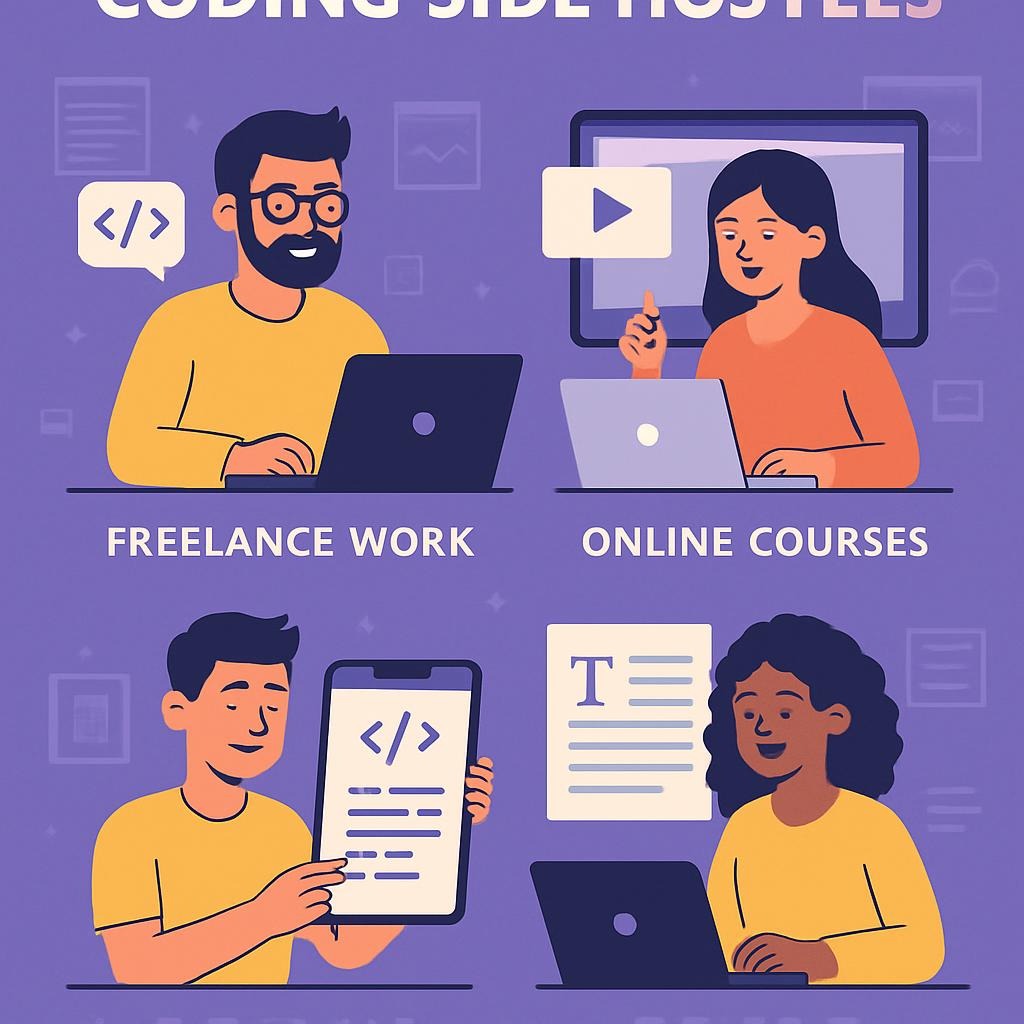



The Side Hustle Blueprint: Turning Micro Coding Tasks into Steady Income

Table of Contents

The Side Hustle Blueprint

Are you tired of trading hours for {dollars} in a traditional job? What if I instructed you that your coding experience—whether or not it is beginner or superior—may generate a gradual income stream of $100,000+ per 12 months through strategic microcoding initiatives?

The freelance market is booming. The freelance market is projected to achieve a price of $455.2 billion by 2023 (and therefore develop earlier to $500 billion in 2025), and therefore freelancers inside the U.S. earn a median wage of over $99,000 per 12 months. But right here is the kicker—about 60% of freelancers earn more money than they did in their earlier jobs.

This full blueprint will rework you from a code-curious, explicit, particular person into a worthwhile micro-coding entrepreneur. You’ll uncover confirmed strategies, insider secrets and techniques, and therefore methods, and therefore actionable steps that worthwhile freelancers utilize to assemble sustainable income streams.

Author Bio: Marcus Chen is a senior full-stack developer and freelance advisor who has generated over $2.3 million by coding side hustles since 2018. He has assisted over 500 builders in transitioning to successful freelance careers, which has led to his recognition as a leading authority in the microcoding field.


What Is Micro Coding and, Therefore, Why Is It Your Golden Ticket

What Is Micro Coding

Microcoding refers to small, centered programming initiatives that treat explicit points for firms but not individuals. Unlike large-scale software program enhancement initiatives that will take months, microcoding initiatives typically fluctuate from 1 to 30 hours of labor and therefore command premium expenses.

The Micro Coding Advantage

💡 Pro Tip: Micro-coding initiatives have a 73% larger completion cost in comparison with huge initiatives, making them ideal for establishing shopper relationships and therefore producing fixed revenue.

Think of microcoding as the “consulting” technique for programming. Instead of establishing entire functions, you might be fixing centered points:

  • Automation Scripts: Python scripts that automate repetitive duties
  • Custom WordPress Plugins: Small functionalities for explicit desires
  • API Integrations: Connecting completely different software programs and packages
  • Data Processing Tools: Excel macros, CSV processors, data cleaners
  • Chrome Extensions: Simple browser extensions for productivity
  • Chatbot Development: Basic buyer assist automation
  • Landing Page Templates: Converting designs to helpful code

Market Demand Analysis

Data analysts and mobile builders earn between $55 and $65 per hour, with annual earnings of approximately $100,000; however, micro coders typically charge even higher rates due to the specialized nature of their services.

The appealing factor about microcoding lies in its accessibility. You don’t need to be a senior developer to start—a large number of worthwhile micro coders began with major HTML/CSS experience and therefore grew from there.


The Psychology of High-Paying Clients

Understanding the Pain Point Economy

Successful micro coders assume the role of enterprise consultants, not merely programmers. High-paying purchasers aren’t looking for code; they are actually seeking solutions to problems that save them time and money without causing stress.

🎯 Engagement Hook: See the consumer psychology breakdown desk underneath to understand what drives shopping for selections:

Client TypePrimary Pain PointWillingness to PayTypical Project Value
Small Business OwnerManual processes consuming earningsVery High$500–$5,000
E-commerce StoreInventory/order administration factorsHigh$300–$3,000
Content CreatorRepetitive content material materials dutiesMedium-High$200–$2,000
Startup FounderMVP enhancement bottlenecksVery High$1,000–$10,000
Marketing AgencyClient reporting automationHigh$400–$4,000

The Value Multiplication Principle

Here’s an insider secret: purchasers pay 10-50x more for a reply that saves them ongoing time but will improve their revenue. A $500 automation script that saves 10 hours per week is worth $26,000 yearly in time and monetary savings (at a $50/hour price).

💰 Revenue Insight: Position your choices in terms of ROI, not choices. Instead of “I’ll build you a Python script,” say, “I’ll create an automated system that recovers 15 hours of your time weekly.”


The Complete Micro Coding Blueprint: 7 Steps to $100K+

Complete Micro Coding Blueprint

Step 1: Skill Assessment and therefore Gap Analysis

Before diving into the market, conduct an honest analysis of your current skills. Here’s a smart framework:

Foundation Level (0-6 months experience):

  • HTML/CSS
  • Basic JavaScript
  • Excel/Google Sheets automation
  • Simple WordPress customizations

Intermediate Level (6-18 months experience):

  • Python scripting
  • API integrations
  • Database queries (SQL)
  • React/Vue.js components

Advanced Level (18+ months experience):

  • Full-stack enhancement
  • DevOps automation
  • Mobile app enhancement
  • Machine learning implementations

🔥 Action Item: Complete these experience inventory pointers and therefore set up 2-3 areas for fast enhancement primarily based on market demand.

Step 2: Market Research and therefore Niche Selection

Income potential ranges from $100 to over $10,000 per month, depending on your chosen area of interest and level of expertise. The secret is discovering the intersection between your experience, market demand, and therefore non-public curiosity.

High-Demand Micro Coding Niches in 2025:

  1. E-commerce Automation
    • Shopify/WooCommerce customizations
    • Inventory administration scripts
    • Price monitoring devices
    • Average problem price: $800-$4,000
  2. Business Process Automation
    • CRM integrations
    • Report period devices
    • Email promoting, and therefore, advertising and marketing automation
    • Average problem price: $600-$3,500
  3. Content Management Solutions
    • Social media schedulers
    • net optimization audit devices
    • Content migration scripts
    • Average problem price: $400-$2,500
  4. Financial Technology (FinTech)
    • Expense monitoring apps
    • Invoice automation
    • Payment gateway integrations
    • Average problem price: $1,200-$8,000
  5. Healthcare IT
    • Patient administration packages
    • Appointment scheduling devices
    • HIPAA-compliant data processors
    • Average problem price: $1,500-$12,000

Step 3: Building Your Minimum Viable Portfolio

Your portfolio functions as your sales team, working around the clock. But right here is what most learners acquire mistakenly—they try to showcase each half instead of demonstrating explicit problem-solving skills.

Portfolio Structure That Converts:

Project #1: Automation Showcase

  • Problem: “Small businesses are losing 20 hours/week on manual data entry.”
  • Solution: Custom script that processes orders mechanically
  • Result: “Reduced processing time by 90%, saving $2,000/month in labor”

Project #2: Integration Demonstration

  • Problem: “Marketing agency struggling with scattered client data”
  • Solution: API integration connecting CRM, digital mail gadget, and analytics
  • Result: “Unified dashboard saving 15 hours weekly on reporting”

Project #3: UI/UX Enhancement

  • Problem: “E-commerce store with 60% cart abandonment rate”
  • Solution: Optimized checkout course with progress indicators
  • Result: “Increased conversion rate by 23%, adding $5K monthly revenue”

🚀 Pro Tip: Include exact code snippets, screenshots, and quantified outcomes for each problem. GitHub repositories that have clear documentation earn the highest credibility points.

Step 4: Pricing Psychology and therefore Strategy

Pricing is generally the place gifted builders deposit money on the desk. The frequent hourly pay for a freelance programmer job inside the US is $39.54, with a wage fluctuation from $12.02 to $68.75; nonetheless, micro coders using value-based pricing normally command $75-$200+ per hour.

Pricing Models That Work:

1. Value-Based Pricing (Recommended)

  • Price is primarily based on the price delivered, not the time spent
  • Example: $2,000 for a script that saves $10,000 yearly
  • Best for: Automation, optimization, and therefore revenue-generating initiatives

2. Project-Based Pricing

  • Fixed price for outlined deliverables
  • Example: $1,500 for a total WordPress plugin
  • Best for: Well-defined scope with clear boundaries

3. Retainer Pricing

  • Monthly worth for ongoing small initiatives
  • Example: $2,500/month for 20 hours of varied duties
  • Best for: Long-term shopper relationships

Pricing Psychological Triggers:

  • Anchoring: Present three pricing selections (major, premium, enterprise)
  • Urgency: “Implementation starts next Monday.”
  • Social Proof: “Used by 50+ businesses like yours”
  • Risk Reversal: “100% money-back guarantee if not satisfied”

Step 5: Client Acquisition Systems

The largest delusion in freelancing is “build it and they will come.” Successful micro coders have systematic approaches to discovering and therefore altering purchasers.

Channel #1: Freelance Platforms (30% of income)

  • Upwork: Best for learners, extreme rivals
  • Toptal: Premium purchasers, strict acceptance
  • Freelancer.com: Volume-based options
  • Fiverr: Package-based suppliers

Platform Success Strategy:

  • Craft compelling proposals that deal with explicit ache components
  • Use key phrases from job descriptions in your responses
  • Include associated portfolio gadgets for each utility
  • Follow up professionally after 3-5 days

Channel #2: Direct Outreach (40% of income)

  • Cold Email: 2-3% response cost with custom-made messages
  • LinkedIn Sales Navigator: Target explicit industries/roles
  • Industry Forums: Reddit, Discord, Slack communities
  • Local Business Networks: Chamber of Commerce, meetups

Channel #3: Content Marketing (30% of income)

  • Technical Blog: Share choices to widespread points
  • YouTube Tutorials: Demonstrate your expertise visually
  • GitHub Contributions: Showcase code of excessive high quality and therefore consistency
  • Podcast Appearances: Position yourself as an {trade} expert

Step 6: Project Management and therefore Delivery Excellence

Exceptional providers separate six-figure freelancers from struggling builders. It’s not about almost writing good code—it’s about creating an experience that purchasers must repeat and therefore recommend.

The 5-Phase Delivery Framework:

Phase 1: Discovery and therefore Planning (20% of problem time)

  • Detailed requirements gathering
  • Technical specification doc
  • Timeline with milestones
  • Communication schedule

Phase 2: Development and therefore Testing (60% of problem time)

  • Daily progress updates
  • Working prototype demonstrations
  • Code opinions and, therefore, testing
  • Documentation creation

Phase 3: Deployment and therefore Training (15% of problem time)

  • Production deployment
  • Client teaching courses
  • User documentation
  • Handover procedures

Phase 4: Support and therefore Optimization (5% of problem time)

  • Bug fixes all through the assurance interval
  • Performance optimization
  • User ideas incorporation
  • Future enhancement planning

💼 Business Insight: Clients who get hold of distinctive experiences provide 85% more referrals and therefore pay 40% higher expenses for future initiatives.

Step 7: Scaling and therefore Systematization

Once you might be continually earning $3,000–$5,000 month-to-month, it’s time to scale back previous shopping and therefore promote time for money.

Scaling Strategy #1: Premium Service Tiers

  • Basic: Core efficiency ($500-$2,000)
  • Premium: Enhanced choices + support ($2,000-$5,000)
  • Enterprise: Custom reply + consulting ($5,000-$15,000)

Scaling Strategy #2: Productization

  • Convert widespread requests into standardized packages
  • Create templates and therefore boilerplates for sooner provision.
  • Develop SaaS merchandise from repeated shopper desires
  • Build packages, instructing your specialised experience

Scaling Strategy #3: Team Building

  • Partner with complementary experience (design, promoting, and therefore advertising and marketing, problem management)
  • Outsource routine coding duties to junior builders
  • Create a group of trusted subcontractors
  • Develop commonplace working procedures

Advanced Strategies: From $100K to $250K+

Advanced Strategies: From $100K to $250K+

The Recurring Revenue Model

Micro-SaaS functions—software products that address specific challenges for niche audiences—offer one of the most important passive income opportunities available in 2025.

Monthly Recurring Revenue (MRR) Opportunities:

  • Maintenance Contracts: $200-$1,000/month per shopper
  • Feature Updates: $500-$2,500/month per utility
  • Hosting and therefore Support: $100-$500/month per problem
  • Monitoring and therefore Analytics: $150-$800/month per system

The Expertise Premium Model

Position yourself as the go-to expert in explicit know-how but trade vertically. Specialists can charge 3–5 times more than generalists.

High-Value Specializations:

  • Blockchain Development: $150-$300/hour
  • AI/Machine Learning: $125-$250/hour
  • Cybersecurity: $100-$200/hour
  • DevOps/Cloud Architecture: $100-$180/hour
  • Mobile App Development: $75-$150/hour

Tools and therefore Resources for Micro Coding Success

Essential Development Tools

Code Editors and therefore IDEs:

  • VS Code: Free, in-depth plugin ecosystem
  • PyCharm: Best for Python enhancement
  • WebStorm: Excellent for JavaScript/web enhancement
  • Sublime Text: Fast and lightweight

Project Management:

  • Notion: All-in-one workspace for shopper administration
  • Trello: Visual problem monitoring
  • Asana: Team collaboration and therefore the course of administration
  • Clockify: Time monitoring and therefore invoicing

Communication and, therefore, collaboration:

  • Slack: Client communication channels
  • Zoom: Screen sharing and, therefore, video calls
  • Loom: Quick demo and therefore rationalization motion pictures
  • GitKraken: Visual Git shopper for code collaboration

Marketing and therefore Business Tools

Portfolio and therefore Website:

  • GitHub Pages: Free web hosting for portfolio websites
  • Netlify: Easy deployment and therefore web hosting
  • WordPress: Content administration and operating a weblog
  • Webflow: No-code net website builder

Client Acquisition:

  • Hunter.io: Email finder for outreach
  • LinkedIn Sales Navigator: Advanced prospecting
  • Calendly: Automated meeting scheduling
  • DocuSign: Electronic contract signing

Financial Management:

  • FreshBooks: Invoicing and therefore accounting
  • Stripe: Payment processing
  • PayPal: International funds
  • Xero: Business accounting software program

Real Success Stories: Micro Coders Making Six Figures

Real Success Stories

Case Study #1: Sarah Martinez—E-commerce Automation Specialist

Background: Formerly promoted and therefore advertising and marketing coordinator with major HTML/CSS experience

Niche: Shopify automation and therefore optimization

Timeline: 0 to $150K annual revenue in 18 months

Strategy:

  • Started with simple product import scripts ($200-$500 each)
  • Developed expertise in Shopify Plus customizations
  • Created productized packages for inventory administration
  • Built recurring repair contracts

Key Projects:

  • Automated Inventory Sync: $3,500 one-time + $400/month repairs
  • Custom Checkout Optimization: $5,000 with 15% revenue sharing
  • Multi-store Management Dashboard: $8,500 + $600/month web hosting

Lessons Learned: “Focus on solving real business problems, not just writing code. My clients don’t care about elegant algorithms—they care about making more money.”

Case Study #2: David Park—API Integration Expert

Background: Full-stack developer in search of fleeing firm life

Niche: Third-party API integrations and therefore middleware

Timeline: $45K to $220K annual revenue in 14 months

Strategy:

  • Specialized in connecting disparate enterprise packages
  • Created documentation templates for sooner onboarding
  • Developed partnerships with SaaS corporations for referrals
  • Built prepared guidelines for potential purchasers

Key Projects:

  • CRM to Email Marketing Integration: $4,200 + $250/month monitoring
  • Payment Gateway Custom Implementation: $12,000 + 20 hours teaching
  • Multi-platform Data Synchronization: $15,500 + $800/month support

Lessons Learned: “Specialization is everything. When you’re known for one thing, clients will pay premium prices and refer others automatically.”

Case Study #3: Lisa Thompson—Healthcare IT Micro Solutions

Background: Former nurse turned self-taught developer Niche: HIPAA-compliant healthcare functions Timeline: 0 to $180K annual revenue in 24 months

Strategy:

  • Leveraged healthcare {trade} knowledge for credibility
  • Focused on small, observable administration choices
  • Created templates for widespread healthcare workflows
  • Built a highly effective referral group by glad purchasers

Key Projects:

  • Patient Appointment Reminder System: $6,500 + $300/month messaging costs
  • Medical Records Migration Tool: $18,000 + $150/hour session
  • Insurance Claim Processing Automation: $22,000 + $1,200/month licensing

Lessons Learned: “Industry knowledge is worth more than coding skills. Understanding the real problems healthcare providers face allowed me to create solutions they needed.”


Common Mistakes to Avoid (And How to Fix Them)

Common Mistakes to Avoid

Mistake #1: Underpricing Your Services

The Problem: Many builders start by competing on price, making a race to the bottom that’s unimaginable to win.

The Solution: Focus on the price provided instead of hourly expenses. A $2,000 reply that saves a consumer $20,000 yearly is a minimum worth it at any price.

🔧Correctx Strategy: Create a price calculator displaying ROI for potential purchasers. If your automation saves 20 hours weekly at $25/hour, that’s $26,000 in annual savings.

Mistake #2: Taking on Projects Without a Clear Scope

The Problem: “Small tweaks” flip into full overhauls, destroying profitability and therefore shopper relationships.

The Solution: Write detailed problem specs with particular boundaries and therefore alter request procedures.

🔧Correctx Strategy: Use the “Three Questions Rule”:

  1. Could you please clarify what success looks like?
  2. What is explicitly NOT included in this problem?
  3. How will we cope with requests outside the distinctive scope?

Mistake #3: Ignoring the Business Side

The Problem: Focusing solely on technical experience while neglecting promoting and therefore advertising and marketing, product sales, and customer management.

The Solution: Spend 30% of your time on enterprise enhancement actions, even when busy with customer work.

🔧 Fix Strategy: Time-block your calendar:

  • 60% – Client provide
  • 25% – Marketing and therefore product sales actions
  • 15% – Skill enhancement, and therefore finding out

Mistake #4: Not Building Long-term Relationships

The Problem: Constantly chasing new purchasers instead of maximizing current relationships.

The Solution: Focus on shopper lifetime price by upselling, repairing contracts, and therefore referrals.

🔧Correctx Strategy: Implement the “3-Touch Rule”:

  1. Project Completion: Immediate follow-up with future enhancement ideas
  2. 30-Day Check-in: Performance evaluation and therefore optimization options
  3. 90-Day Strategy Call: Discuss new challenges and therefore progress prospects

Mistake #5: Neglecting Documentation and therefore Handover

The Problem: Poor documentation results in poor support factors and, therefore, troublesome shopper relationships.

The Solution: Create full documentation as half of every problem deliverable.

🔧 Correction Strategy: Use the “Documentation Template”:

  • Overview: What the reply does and therefore why it points
  • Setup Guide: Step-by-step arrangement/configuration
  • User Manual: How to utilize all choices
  • Troubleshooting: Common factors and therefore choices
  • Support Contact: How to acquire further help

Expert Tips from Six-Figure Micro Coders

Expert Tips from Six-Figure Micro Coders

Tip #1: The “Problem-First” Approach

Instead of learning random technologies, identify valuable problems first, and then learn the skills needed to solve them. This ensures your finding-out time instantly translates to income potential.

Tip #2: The “Template Everything” Philosophy

Create reusable templates for widespread problem types. This reduces provide time by 40-60% while sustaining excessive high quality and therefore consistency.

Tip #3: The “Referral Multiplication” System

For every glad shopper, ask for 3 explicit referrals. Most purchasers are blissful to help but nonetheless need particular guidance on who to contact.

Tip #4: The “Premium Positioning” Strategy

Always present three pricing selections. Most purchasers choose the middle chance; nonetheless, having a premium tier makes your commonplace pricing seem reasonably priced.

Tip #5: The “Continuous Learning” Investment

Allocate 10% of your revenue to finding out new experiences and therefore devices. Technology evolves quickly, and therefore staying current maintains your aggressive profit.


Conclusion: Your Journey to Micro Coding Success

Micro Coding Success

The microcoding landscape provides unprecedented options for builders ready to imagine like entrepreneurs. The freelance market is anticipated to surge to $8.39 billion by 2025, rising at an annual rate of 14.5%, creating massive demand for specialized coding choices.

Key Takeaways:

  1. Focus on points, not merely code. Clients pay for choices that improve their enterprise
  2. Specialize for premium pricing—experts earn 3-5x larger than generalists
  3. Build packages for scalability—create processes that work without out mounted entry.
  4. Prioritize shopper relationships—long-term partnerships are more worthwhile than one-off initiatives
  5. Invest in regular finding out—stay ahead of know-how developments and therefore market requirements.

Your Next Steps:

Week 1: Complete your experience analysis and therefore choose a specialization space of curiosity

Week 2: Build your first portfolio problem demonstrating problem-solving ability

Week 3: Create profiles on 2-3 freelance platforms with optimized descriptions

Week 4: Send 10 custom-made outreach messages to potential purchasers

Month 2: Deliver your first paid problem and therefore ask for testimonials and referrals

Month 3: Develop your second service offering and therefore cover your expenses by 25%

Remember, every expert was once a beginner. The difference between dreamers and achievers lies in taking the first step. Your coding skills are more worthwhile than you perceive—it’s time to flip them into the freedom and therefore income you deserve.

Ready to start your microcoding journey? The blueprint is in your palms. The sole question is: are you, honestly, taking movement?


Frequently Asked Questions

Q1: How much, or rather how much, can I realistically earn with microcoding in my first 12 months?

Beginners can anticipate earning $20K-$40K in their first 12 months with fixed effort. Intermediate builders normally attain $60K-$80K, whereas specialists in high-demand niches can exceed $100K. The frequent freelance software program developer income ranges from $70,000 to $150,000 per 12 months; nonetheless, success depends upon carefully promoting and therefore advertising and marketing efforts and therefore customer relationship administration.

Q2: Do I need superior programming experience to start micro-coding?

No! Many worthwhile micro coders started with major HTML/CSS and, therefore, JavaScript knowledge. The secret is fixing precise points for purchasers, not writing superior algorithms. Start with simple automation scripts and WordPress customizations, but major web enhancement initiatives, and therefore step-by-step develop your experience.

Q3: How do I uncover my first micro-coding shopper?

Start alongside your current group—associates, family, former colleagues, and native firms. Join freelance platforms like Upwork and Fiverr, and work together in direct outreach through LinkedIn and digital mail. Offer to unravel an explicit drawback without spending a dime in exchange for a testimonial and therefore a referral.

This fall: What’s the difference between microcoding and, therefore, frequent freelance enhancement?

Micro coding focuses on small, explicit choices that will be completed shortly (1-30 hours), whereas standard freelance enhancement normally consists of larger initiatives taking weeks or months. Microcoding typically directs larger hourly expenses because of its specialized problem-solving nature.

Q5: Should I price hourly or project-based expenses?

Project-based pricing is largely further worthwhile as a result of its being primarily based on price delivered rather than time spent. However, it is advisable to begin with hourly expenses until you are able to estimate the problem scope. As you obtain experience, transition to value-based pricing for maximum income potential.

Q6: How do I cope with purchasers who want limitless revisions?

Always define scope boundaries in your contract. Include 2-3 revision rounds in your base price, then price individually for further adjustments. Use phrases like “Additional revisions will be billed at $X per hour” to set clear expectations upfront.

Q7: What if I have never acquired a laptop science diploma?

Your diploma, whether you have one or not, is much less important than your ability to clarify complex issues. Many worthwhile micro coders are self-taught. Focus on establishing a highly effective portfolio that demonstrates your capabilities more than formal credentials.


Mistakes to Avoid and Expert Tips

Top 10 Mistakes That Kill Micro Coding Careers

1. Competing on price instead of value

Fix: Position yourself as a difficulty solver, not a commodity coder

2. Taking on initiatives with no clear scope

Fix: Write detailed specs and therefore require shopper approval sooner than starting

3. Underestimating problem complexity

Fix: Add 25-50% buffer time to all estimates

4. Poor communication with purchasers

Fix: Send day-to-day progress updates and therefore reply to messages within 4 hours

5. Not asking for testimonials and therefore referrals

Fix: Request ideas immediately after problem completion

6. Focusing solely on technical experience

Fix: Spend equal time creating enterprise and therefore promoting, and advertising and marketing experience

7. Not monitoring time and therefore profitability

Fix: Use time-tracking devices for every problem to understand true costs

8. Accepting initiatives outside your expertise

Fix: Refer inappropriate initiatives to completely different builders and therefore ask for referral expenses

9. Not having a professional contract

Fix: Use licensed templates and therefore require signed agreements sooner than starting work

10. Burning out by taking every different

Fix: Learn to say no to low-value initiatives and therefore purchasers

15 Expert Tips for Micro Coding Success

💡 Tip 1: Create template responses for widespread shopper inquiries to avoid losing 2-3 hours weekly

💡 Tip 2: Always quote initiatives 20% larger than your preliminary instinct—you presumably can negotiate down, not up

💡 Tip 3: Record demo motion pictures displaying your choices in movement—they convert 10x greater than written descriptions

💡 Tip 4: Join industry-specific Facebook groups and Discord servers, the place your final purchasers hold round

💡 Tip 5: Develop “signature solutions” that you could ship repeatedly with minor customizations

💡 Tip 6: Create a “value menu” displaying completely different service ranges and therefore pricing selections

💡 Tip 7: Use problem administration devices that purchasers can entry to track progress transparently

💡 Tip 8: Build relationships with complementary service suppliers (designers, entrepreneurs) for cross-referrals

💡 Tip 9: Offer “done-with-you” suppliers the place you practice purchasing while fixing their points

💡 Tip 10: Create digital mail sequences that nurture leads over 30-60 days instead of anticipating speedy product sales

💡 Tip 11: Develop case analysis showcasing measurable outcomes (time saved, money earned, processes improved)

💡 Tip 12: Use scheduling devices like Calendly to scale back-and-forth communication about conferences

💡 Tip 13: Create a “client onboarding packet” with FAQs, processes, and therefore expectations clearly outlined

💡 Tip 14: Develop partnerships with firms that will white-label your suppliers to their purchasers

💡 Tip 15: Always have a backup plan—hold relationships even when completely booked for future options


Download resources and, therefore, templates.

🎯 Ready-to-Use Templates Available:

  • Client Discovery Questionnaire Template
  • Project Proposal Template with Pricing Options
  • Service Agreement Contract Template
  • Project Specification Document Template
  • Client Onboarding Checklist
  • Invoice Template with Payment Terms
  • Follow-up Email Sequences
  • Portfolio Project Description Templates

Access all templates and therefore bonuses provided in our full Micro Coding Starter Kit.

🔍 People Also Ask (PAA)

People Also Ask

The side hustle blueprint micro-codes to a common income-free

Answer: While there is no totally “free” path to establishing a microcoding side hustle (you may want a few major devices and therefore, in all probability, some expertise enhancement), you possibly can start with minimal funding. Use free resources like FreeCodeCamp, YouTube tutorials, and open-source devices. Begin with HTML/CSS initiatives on platforms like CodePen, then progress to JavaScript automation scripts. The most significant investment is your time—expect to spend 3-6 months on dedicated learning and practice before securing your first paid project.

The side hustle blueprint micro-coding to common income ebook

Answer: Currently, there is just not an explicitly revealed ebook titled “The Side Hustle Blueprint: Micro Coding to Steady Income.” However, quite a few fantastic property cowls are associated with the ground: “The Freelancer’s Guide to Programming” by a large number of authors, “Freelance to Freedom” by Vincent Pugliese, and “The $100 Startup” by Chris Guillebeau are current foundational knowledge. For microcoding, it is important to combine these business books with technical resources from platforms like Pluralsight, Udemy, and relevant trade blogs.

Side hustle blueprint template

Answer: An entire side hustle blueprint template should embrace (1) a skills analysis matrix, (2) a market evaluation worksheet, (3) a pricing calculator, (4) client acquisition pointers, (5) project administration templates, (6) contract templates, and (7) financial monitoring spreadsheets. The template above provides a total framework following the 7-step course from expertise analysis to scaling. Focus on customizing each aspect based on your specific coding strengths and then target the appropriate market.

Side hustle blueprint opinions

Answer: Most side hustle blueprints get hold of blended opinions depending on execution and therefore individual dedication. Successful prospects report incomes of $2,000 to $5,000 month-to-month within 6 to 12 months, whereas others battle with shopper acquisition and therefore pricing. Key success factors include consistent marketing efforts, a focus on problem-solving instead of just coding, and the establishment of long-term client relationships. The best methods mix improving technical skills with strong business basics and organized ways to gain clients.

Side hustle blueprint free

Many platforms will provide access to free side hustle blueprint resources. This full data provides a total framework for free. Additional free resources include GitHub repositories with problem templates, YouTube channels such as “Traversy Media” and “The Net Ninja” for technical experience, Reddit communities like r/freelance and r/webdev for networking, and free versions of tools like VS Code, GitHub, and Canva for portfolio creation. The secret is combining quite a few free properties into a cohesive finding-out and therefore movement plan.

Leave a Reply

Your email address will not be published. Required fields are marked *