
The definitive, data-verified ranking of tools that actually move the needle — tested, updated April 2026.
Two hundred and fifty resumes hit a hiring manager’s inbox for every corporate job posting that goes live in 2026. An automated tracking system deletes 75% before any human sees them. Of the survivors, only 2–3% receive interview invitations. This is not discouragement — it’s motivation. Because the candidates clearing that filter aren’t necessarily the most qualified. They’re the most prepared.
Here’s the uncomfortable math from BambooHR’s freshly published 2026 state-of-hiring report: applicants per posting have nearly doubled — from roughly 46 in 2021 to 95 in 2025, with no sign of easing. Meanwhile, the hiring rate has fallen from 4.5% to 2.8%. If you’re relying on a polished resume alone, you’re bringing a knife to a gunfight.
The good news? Free AI tools have quietly democratized interview coaching. What used to cost $150–$300 per session with a career coach is now available around the clock at zero cost — if you know which platforms actually deliver results and which ones just collect your email address. This guide cuts through the noise with verified tool data, a no-fluff comparison framework, and role-specific strategy built for 2026 hiring realities.
🎯 Key Takeaways
- Corporate job postings now average 250 applicants; entry-level roles see 400+ (BambooHR, 2026)
- Only 2–3% of applicants receive interview invitations — preparation is the differentiator, not credentials alone
- Google Interview Warmup remains the best completely free starting point with no data retention
- Pramp (now Exponent) provides the most realistic human-pressure simulation for tech roles
- Combining 2–3 tools strategically — AI feedback + peer practice + research — consistently outperforms single-tool prep
- Using AI assistance during live interviews is ethically indefensible and risks offer rescission; use these tools for practice only
▸ ATS Resume Tips 2026 ▸ 50 Behavioral Interview Questions ▸ How to Negotiate Your Salary
Why Interview Practice Matters More Than Ever in 2026
The 2026 hiring funnel has compressed at precisely the moment when automation made it easier to apply to jobs. Ghost applications — postings that never result in a hire — now pollute job boards. Companies are averaging 42% more interview rounds per hire than in 2021. The window to impress a human interviewer has narrowed while the competition has widened.
Three factors make structured practice non-negotiable right now:
AI-assisted ATS screening is eliminating candidates faster and earlier than ever. By the time a human sees your resume, you’re already in the top quartile — which means the interview is where the real competition happens, and it’s not forgiving of stumbles.
Behavioral interviews now dominate most hiring pipelines. The STAR method (Situation, Task, Action, Result) is the expected framework — yet most unpracticed candidates ramble through answers without structure, losing the interviewer inside 90 seconds.
Interview anxiety is measurable and addressable. Research consistently shows that repetition under simulated pressure conditions reduces cortisol-driven cognitive disruption. In plain English: practicing makes the real interview feel like practice. You’ve already faced the scary questions.
The 10 Best Free Interview Practice Tools (Ranked for 2026)
Ranked by verified free-tier access, feedback quality, and demonstrated usefulness across role types. Pricing and features verified April 2026.
1. Google Interview Warmup
100% Free ForeverBest for: Tech career changers, Google Career Certificate graduates, anyone starting from zero
The gold standard for free interview prep hasn’t changed — it’s still the cleanest, most accessible starting point available. Built by Google’s Grow with Google initiative, this browser-based tool uses AI speech-to-text to transcribe spoken answers in real time, then surfaces insights: job-related terms you used (or missed), repetitive phrases, and talking point coverage.
One important nuance the original post glossed over: AI is not used to generate questions — every question was created by industry experts. This is actually a feature, not a limitation. It means the questions reflect real interview patterns rather than algorithmically generated prompts that miss cultural context. The tool covers data analytics, digital marketing, e-commerce, IT support, project management, UX design, and a general track.
Google also recently noted that Gemini Live (via the Gemini mobile app) can now simulate real-time conversational interview practice — an under-discussed upgrade that turns Google’s ecosystem into a more powerful prep stack than most people realize.
✓ Strengths
- Completely free, no account required
- Zero data retention — total privacy
- Works in any browser, no install
- Expert-created questions, not AI-generated
- Gemini Live integration for conversational sim
✗ Limitations
- Only 6–7 defined career fields
- No video or body language analysis
- No progress tracking across sessions
- Feedback is insight-based, not scored
2. Pramp / Exponent
Free Credits MonthlyBest for: Software engineers, product managers targeting FAANG-tier roles
Important 2026 update: Pramp has fully migrated to Exponent. If you had a Pramp account, you’ll need to link it to an Exponent account to continue. The core mechanics remain the same — peer-to-peer video mock interviews where you take turns as interviewer and interviewee — but Exponent has added AI-graded rubric scoring for behavioral, PM, system design, and data science interviews delivered as auto-transcripts after each session.
The human element is what distinguishes this platform from everything AI-only. You cannot fully replicate the cognitive pressure of a live video call with an AI chatbot. Pramp/Exponent does. The daily schedule is structured (Product Management: 2 AM, 8 AM, 12 PM, 6 PM Pacific; Data Structures & Algorithms: every two hours from 8 AM to midnight), which means you can book a practice session that fits your prep timeline.
✓ Strengths
- Authentic human pressure simulation
- AI rubric grading + peer feedback
- Built-in shared code editor for technical rounds
- Covers DS&A, system design, PM, behavioral
✗ Limitations
- Requires scheduling around session times
- Match quality varies
- Free credits limited; full access requires membership
- Pramp account linking required for migration
3. ChatGPT / Claude / Gemini (Free Tiers)
Generous Free TierBest for: Any role, maximum customization, STAR coaching at scale
Underutilized and underrated. General-purpose large language models are the most versatile interview prep tool available — they just require you to know how to prompt them effectively. The killer feature: paste a real job description and say “Act as the hiring manager for this role. Ask me behavioral questions one at a time. After each answer, score it using STAR and push back on vague responses.” That simulation quality is indistinguishable from a $200/hour coaching session for many question types.
Prompting tip for maximum value: Add “Don’t accept my first answer. Ask a follow-up question that probes the weakest part of my STAR response.” This mirrors the pressure technique senior interviewers use to separate prepared candidates from rehearsed ones.
✓ Strengths
- Works for literally any role or company
- Available 24/7, unlimited sessions
- Customizable to any persona or pressure level
- Can analyze your answers and rewrite them
✗ Limitations
- No voice/video analysis
- Quality depends heavily on your prompting skill
- No built-in progress tracking
4. Interviewing.io
AI Practice Unlimited · Human Sessions LimitedBest for: Developers seeking credible FAANG feedback loops
The most credible human feedback loop in the free-to-access ecosystem. Anonymous interviewers from Google, Meta, and Amazon conduct coding and system design sessions with detailed professional feedback. The AI Interviewer mode offers 200+ problems with unlimited free access — an excellent way to build reps before investing in a live session.
One honest note: the free human sessions are genuinely limited, and the platform’s value proposition skews heavily toward senior engineers targeting top-tier FAANG. If you’re a mid-level developer or a non-technical candidate, the AI-only mode may be sufficient and the cost-benefit of the platform’s premium tier becomes harder to justify.
✓ Strengths
- Real feedback from working FAANG engineers
- Unlimited AI practice (200+ problems)
- Coding + system design + behavioral coverage
✗ Limitations
- Human sessions are sharply limited on free tier
- Primarily technical; minimal support for non-tech roles
5. Yoodli
5 Free Sessions / MonthBest for: Candidates with delivery issues — filler words, pacing, nervous energy
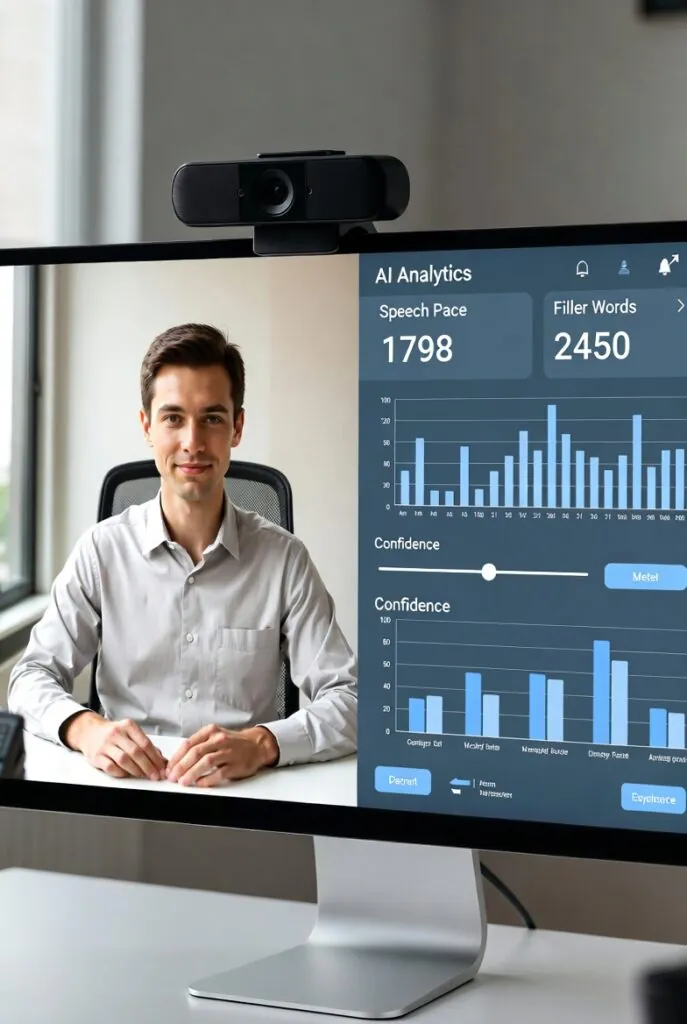
Yoodli’s value proposition is narrow but genuine: it’s the best tool available for diagnosing and correcting how you speak, not just what you say. Real-time analysis of filler word frequency, speech pace, facial expression cues, and nonverbal signals during video practice. Used by both Google and Toastmasters International as a coaching tool — that institutional endorsement carries weight.
The five free sessions monthly is genuinely limiting if you’re in heavy prep mode, but strategic use works: run one session per week to track a single metric (e.g., “um/uh” count per minute) rather than trying to fix everything simultaneously. Progress is measurable in ways that purely content-focused tools can’t replicate.
✓ Strengths
- Best-in-class speech analytics
- Filler word, pacing, and nonverbal feedback
- Measurable improvement tracking
- University partnerships offer institutional free access
✗ Limitations
- 5 free sessions per month — limiting in peak prep
- Less focus on answer content quality
6. Huru AI
Free Trial (Full Feature Access)Best for: Job board-integrated practice directly from LinkedIn or Indeed listings
Huru’s differentiating feature is elegant: a Chrome extension that converts any active job listing on LinkedIn, Indeed, ZipRecruiter, or Glassdoor into a tailored mock interview in one click. Instead of practicing generic questions, you’re practicing the questions most likely to arise for the exact role you’re applying for. The 20,000+ question library, multilingual support, and body language analysis round out a surprisingly deep platform for a free trial.
The free trial gives full feature access including video feedback — which means savvy candidates can complete a structured prep sprint before being nudged toward the paid plan. Some users have reported occasional bugs with LinkedIn import due to platform API changes; using the Chrome extension on Indeed tends to be more reliable.
✓ Strengths
- One-click job-to-interview generation from listings
- 20,000+ question library across industries
- Body language + delivery analysis
- Multilingual support
✗ Limitations
- LinkedIn import occasionally buggy
- Full access requires paid plan after trial
7. FreeMockInterview.com
100% FreeBest for: Entry-to-mid level candidates wanting broad practice across 133+ job profiles
A genuinely free platform (no credit card, no hidden cost) covering 133 job profiles including Software Engineer, Data Analyst, Product Manager, and more. The tool uses speech recognition for live practice and provides instant feedback, drawing on questions reportedly used by top companies. With 25,000+ users, it’s a legitimate option for candidates who want variety without commitment.
The platform’s research claims “3x more likely to succeed” with mock interviews — a self-reported figure that should be read with appropriate skepticism. What’s verifiable is the breadth of role coverage and the zero-cost access, which makes it a solid supplemental tool alongside a primary platform.
✓ Strengths
- Truly free, no signup friction
- 133+ job profiles with speech recognition
- Instant feedback on structure and delivery
✗ Limitations
- Self-reported efficacy statistics
- Less sophisticated than dedicated paid tools
8. Big Interview
Free via 700+ UniversitiesBest for: Students and recent graduates with institutional access
If your university partners with Big Interview — and over 700 do, including Ivy League institutions — this is arguably the most comprehensive free resource on this list. The platform’s 170 video lessons and 10,000+ practice questions represent a structured curriculum, not just a practice tool. STAR templates, a resume builder, and video mock interview modules are included.
The catch is real: without institutional access, the platform costs $75–$299 per month. Check your university’s career services portal before paying. Google Career Certificate graduates may also qualify for free access through that program. For anyone who has institutional access and isn’t using it, this is leaving significant value on the table.
✓ Strengths
- Most comprehensive curriculum on this list
- 10,000+ questions across industries
- Video lessons + structured STAR training
- Free via 700+ universities
✗ Limitations
- Requires institutional access (unavailable otherwise for most)
- $75–$299/month without institutional access
9. Final Round AI
1 Free Full InterviewBest for: Candidates wanting advanced AI analysis across 100+ industries
Highly rated (4.8/5 on G2 from 1,200+ reviews) and genuinely capable — Final Round AI’s mock interview quality, real-time scoring, and 29-language support are best-in-class for AI-only platforms. The free tier is thin (one full interview), but valuable as a calibration session before investing in a paid plan or supplementing with free tools.
An important ethical note that deserves plain language, not a footnote: Final Round AI markets a live “copilot” feature that provides real-time prompts during actual job interviews. Using this feature in real interviews is not a gray area — it’s deceptive, violates the trust of the hiring process, and risks permanent offer rescission if discovered. Several employers now explicitly prohibit AI assistance during live sessions. Use Final Round AI for practice exclusively.
✓ Strengths
- Industry-leading AI feedback quality
- 29 languages supported
- Detailed session transcripts and analytics
- Strong G2 rating from verified users
✗ Limitations
- Only 1 free interview — very limited trial
- Live copilot feature ethically off-limits in real interviews
- Full value requires paid subscription
10. Glassdoor Interview Questions
100% FreeBest for: Company-specific question research before any interview
Not a simulator. Not an AI coach. But arguably the most underused preparation resource available. Glassdoor’s database contains actual questions reported by real candidates at specific companies — which means you can walk into an interview knowing the three questions that consistently appear in that company’s process, the difficulty ratings attached to them, and whether the role requires whiteboarding or behavioral depth.
The optimal workflow: Use Glassdoor to identify 8–12 real questions from your target company, then feed them into ChatGPT or Claude with the prompt “Practice these specific questions with me using the STAR method and push back on weak answers.” That combination — real questions from Glassdoor, AI coaching from a free LLM — replicates what a career coach would charge $400+ to provide.
✓ Strengths
- Real questions from actual interview experiences
- Company-specific with difficulty ratings
- Completely free, no limit on access
✗ Limitations
- No active practice or AI feedback
- Some questions may be outdated depending on company
Side-by-Side Comparison Table
| Tool | Free Access | AI Feedback | Video/Voice | Human Practice | Best Role Fit |
|---|---|---|---|---|---|
| Google Interview Warmup | Unlimited | ✓ | Voice only | ✗ | Tech / General |
| Pramp / Exponent | Monthly credits | ✓ (rubric) | ✓ Video | ✓ Peer | FAANG / Tech |
| ChatGPT / Claude / Gemini | Generous | ✓ | ✗ | ✗ | Any Role |
| Interviewing.io | AI unlimited | ✓ | ✓ Video | Limited free | Developers |
| Yoodli | 5/month | ✓ | ✓ Video | ✗ | Any (speech focus) |
| Huru AI | Trial (full access) | ✓ | ✓ Video | ✗ | Job board users |
| FreeMockInterview | Unlimited | ✓ | Voice | ✗ | Entry-Mid Level |
| Big Interview | Via university | ✓ | ✓ Video | ✗ | Students |
| Final Round AI | 1 interview | ✓ | ✓ | ✗ | Multi-industry |
| Glassdoor Q&A | Unlimited | ✗ | ✗ | ✗ | Pre-interview research |
Which Tool Stack Fits Your Situation?
There is no single correct answer — the right stack depends on your role, timeline, and the specific weakness you need to address. Here’s a verified framework, not a generic matrix.
🖥 Software Engineers
Technical + Behavioral
- Glassdoor → research target company’s actual questions
- Interviewing.io → AI practice for DS&A + system design
- Pramp/Exponent → live pressure simulation
- Google Warmup → behavioral warm-up
🔄 Career Changers
New Field Confidence
- Google Interview Warmup → build field-specific vocabulary
- Claude/ChatGPT → persona-based practice for new role
- Yoodli → fix delivery before delivery habits become a crutch
- Big Interview → if university access available
💼 General Business / Non-Tech
Behavioral Mastery
- Glassdoor → company-specific question research
- ChatGPT/Claude → STAR coaching with targeted pushback
- FreeMockInterview → 133+ profiles, zero cost
- Yoodli → delivery polish
🎓 Students / Recent Grads
Institutional Advantage
- Big Interview → check university access first
- Pramp/Exponent → peer practice with other students
- Google Warmup → foundation building
- Huru → job-listing-specific prep before each application
The STAR Method: Your Secret Weapon Against Unprepared Competitors
Behavioral interviews dominate 2026 hiring because they’re predictively valid — past behavior under specific conditions is a reliable indicator of future behavior. The STAR method is the expected response structure, and interviewers can tell in 20 seconds whether you know it or not.
Most candidates think they know STAR. Most do it wrong. The most common failure: spending 80% of the answer on Situation and Task (the setup), and rushing the Action and Result (the actual proof of competence). Here is the corrected time allocation:
“The single most common failure I see in behavioral interviews is that candidates spend all their time setting the scene and forget to prove they actually solved the problem. Action should take 50% of your STAR answer — that’s where your competence lives.” — Commonly cited principle from career coaching frameworks used in executive hiring
Use any AI tool (ChatGPT, Claude, Gemini) to practice this framework: describe a real situation from your career history, let the AI identify which component you under-developed, and iterate until all four components are tight. Ten sessions of this is worth more than a month of reading interview tips.
Frequently Asked Questions
What is the single best completely free interview practice tool in 2026?
For most candidates, Google Interview Warmup is the strongest completely free starting point — unlimited sessions, no account required, zero data retention, and AI feedback on job-specific questions created by industry experts. For technical candidates targeting FAANG, the combination of Interviewing.io’s unlimited AI practice mode and FreeMockInterview provides more depth for DS&A and system design specifically.
How many practice sessions should I complete before a high-stakes interview?
The research-backed guidance is 8–12 sessions for a high-stakes opportunity: 3–4 behavioral STAR practice rounds, 2–3 technical or role-specific sessions if applicable, 2–3 question-specific sessions using actual questions from Glassdoor for your target company, and 1–2 full-length mock interview simulations under time pressure. The goal isn’t to memorize answers — it’s to make the cognitive effort of structuring responses feel automatic rather than effortful.
Is it ethical to use AI assistance during a live interview?
No. Using AI tools during preparation is universally accepted and encouraged. Using real-time AI prompts or assistance during a live interview is deceptive to the hiring organization and a breach of the implicit trust that makes interviewing function as a selection mechanism. Many employers now explicitly prohibit this and use detection methods to identify it. Several platforms market “copilot” features for live use — avoid them in that context regardless of how they’re framed.
AI feedback vs. peer feedback — which is better?
They measure different things, so this is a false choice. AI excels at objective, measurable elements: filler word frequency, answer structure, STAR component coverage, pacing, vocabulary alignment with job descriptions. Human peer feedback — through Pramp/Exponent or informal practice — assesses authenticity, emotional resonance, whether your energy translates across a video call, and the nuanced judgment that hiring managers actually exercise. The strongest preparation combines both.
Do interview practice tools actually improve offer rates?
The causal evidence is strong on mechanism (practice under simulated pressure reduces cognitive load during the real interview, improving structure and recall) even where specific platform efficacy claims should be read with skepticism. Self-reported statistics from platforms like Final Round AI and Yoodli should not be taken as independent research. What is well-established: structured practice improves answer organization, reduces filler word usage, and builds the familiarity that prevents answer blanks under pressure. These are observable, measurable improvements.
Which tools work best for non-technical roles?
Google Interview Warmup covers marketing, project management, and UX. FreeMockInterview covers 133+ profiles including business analyst, HR specialist, and sales roles. ChatGPT/Claude are role-agnostic and arguably the most versatile for non-technical preparation when prompted effectively. Yoodli is equally valuable for non-technical candidates since delivery quality matters even more in client-facing or leadership roles where communication is the primary performance signal.
The Verdict: Stop Applying. Start Preparing.
The uncomfortable truth about the 2026 job market is this: most candidates are optimizing for the wrong variable. Sending 200 applications does not fix a broken interview conversion rate. If you’re getting interviews and not getting offers — or not getting past the screening stage — the problem isn’t the volume of applications. It’s preparation quality.
Google Interview Warmup is your first stop: free, private, frictionless. Add Pramp/Exponent for the pressure of a live human. Feed Glassdoor questions into Claude or ChatGPT for company-specific STAR practice. Spend one Yoodli session diagnosing your delivery. That four-tool stack costs nothing, takes less than a week to build, and addresses every dimension of interview performance.
The market is crowded at the application stage. It’s far less crowded at the preparation stage. Start there.
Start Free Practice Now →Sources & References
- BambooHR, State of Hiring 2026 — Applicants per posting data, hiring rate, 72M+ applications analyzed (Published April 2026)
- HiringThing, 2025 Job Application Statistics — Average time-to-hire: 42 days; 0.1–2% application success rate (December 2025)
- ResuTrack, How Many Job Applications to Get an Interview — 2026 Data — 2.4% of applicants reach interview stage; 250 avg. per corporate posting (February 2026)
- WifiTalents, Job Application Data Reports 2026 — 250 avg. resumes per corporate posting; 7.4-second recruiter review; 2–3% interview rate (February 2026)
- Zippia, How Many Applications Does It Take to Get a Job in 2026 — 100–200 applications per offer; BLS-sourced data (January 2026)
- Google Grow, Interview Warmup — Platform documentation, privacy methodology, question creation process (Accessed April 2026)
- Exponent (formerly Pramp), Mock Interview Practice — Session schedules, AI rubric grading, Pramp migration details (Accessed April 2026)
- Huru.ai — Platform features, question library size, Chrome extension details (Accessed April 2026)
- FreeMockInterview.com — 133+ profiles, 25,000+ users, speech recognition features (Accessed April 2026)
- Interview Sidekick, Best AI Interview Prep Tools in 2026 — Comparative tool analysis (February 2026)
Editorial note: This guide reflects independent research and publicly available platform data as of April 5, 2026. No affiliate relationships or paid placements influenced rankings or recommendations. Platform features, free-tier limits, and pricing are subject to change; verify current terms directly with each platform before relying on them for preparation planning.
I Did 10 Mock Interviews in 2026—Here’s What I Learned
Meta’s AI-Enabled Coding Interview: What We Actually Know (Oct 2025 – Jan 2026)
Best Mock Interview Tools and Hacks 2026: Free & Paid Platforms Compared
Top 5 Mock Interview Platforms That Actually Work (2026)
The STAR Method Is Dead in 2026: Ultimate Guide to Modern Interview Frameworks
Nail Your Next Tech Interview with These Mock Tricks in 2026
[card url=”https://www.codetalenthub.io/best-ai-resume-builders/”]
[card url=”https://www.codetalenthub.io/tech-interview-2026/”]
[card url=”https://www.codetalenthub.io/how-i-built-a-portfolio-website-in-1-day/”]
[card url=”https://www.codetalenthub.io/tech-resumes-in-2026/”]
[card url=”https://www.codetalenthub.io/2025-tech-portfolio-mastery-guide/”]
[card url=”https://www.codetalenthub.io/no-code-tools/”]