

Learning Roadmap · April 2026 · All Sources Verified
JavaScript Roadmap 2026:
The Only Free Step-by-Step Path
from Zero to Job-Ready
Five platforms ranked by what actually matters — not star ratings. The failure modes every course list hides from you. A phased roadmap built on 2025 Stack Overflow salary data. And an honest AI-learning guide that tells you when to use it and when it’s holding you back.
Here’s the thing about free JavaScript roadmaps in 2026: there are too many of them, and most guide lists treat every platform as interchangeable. They’re not. Pick the wrong sequence and you’ll spend three to six months completing challenges you’ll never use, earning a certificate that doesn’t move the hiring needle, wondering why you still can’t build anything from a blank file. Pick the right sequence? You’re writing real code in a real terminal within weeks — and interviewing within a year.
I’ve mapped every major free platform against one criterion: does it produce developers employers actually hire? Not developers who can complete guided exercises. Not developers who know syntax. Developers who can sit down with a blank file, a brief spec, and ship something. That’s a higher bar. Most platforms don’t clear it.
- Visual topic maps with no explanation of why that order
- 6-month plans that skip how to avoid the failure modes
- Platform lists without honest limitations stated
- No sequence logic — all platforms treated as equivalent
- The three failure modes that sink most learners — named and explained
- Platform sequence logic: which to use when and why
- Documented cost asymmetry when the wrong path is chosen
- AI-assisted learning guide with actual prompts and specific warnings
One more thing before the rankings. The 46% distrust figure you’ll see below — that’s from the 2025 Stack Overflow Developer Survey, 49,000+ respondents across 177 countries. It matters more than it looks, and I’ll explain exactly why it should change where you invest your learning hours right now.
(Stack Overflow Survey 2025)
(Stack Overflow / TechRecruiting.io, n=7,218 US)
(Stack Overflow 2025)
The salary figure comes from TechRecruiting.io’s US breakdown of the 2025 Stack Overflow data — 7,218 US respondents, full methodology published. The AI distrust stat is from the same survey. I’ll circle back to both when we hit the “What This Data Actually Means” section, because the implications are specific and a little counterintuitive.
Why 90% of “Best Free JS Roadmap” Lists Are Useless
Most comparison articles do the same thing: pull five platforms, assign star ratings based on user reviews and course hours, add a table, wrap up. Star ratings measure learner satisfaction. Not employment outcomes. A course where every step has scaffolding will score five stars and produce graduates who freeze the moment that scaffolding disappears.
I spent time on every major free JavaScript platform — not skimming, actually working through curriculum modules — and three specific failure modes kept appearing. None of the aggregator articles I found named them clearly. Knowing these will save you months.
The 3 Failure Modes (and which platforms trigger them)
- Guided-environment dependency. When you learn entirely in a browser-based editor, you never install Node, configure a linter, read an actual terminal error, or manage a project structure. The code runs — but you can’t replicate that environment independently. Codecademy and W3Schools both trigger this. It’s not a fatal flaw at the start. It’s a gap that becomes fatal if you never close it.
- Certification-over-skill inflation. You can complete every challenge correctly without ever structuring a project from a blank file. The certificate is real. The job-readiness is not. freeCodeCamp’s older format had this problem; the 2025 curriculum redesign to 21 required projects partially fixes it — but “partially” is doing real work in that sentence.
- Scope-depth inversion. Covering every topic briefly rather than any topic deeply enough to use professionally. You finish knowing of closures, prototypes, and async/await — but you couldn’t explain why they work the way they do under interview pressure. W3Schools is the classic case: an excellent lookup reference, a terrible primary learning path.
The platforms that produce employed developers are the ones that — by design — either avoid these failure modes or make them structurally impossible. Let’s go through all five.
The Five Platforms: An Honest Comparison
Table 1 — Platform Overview (April 2026)
| Platform | Approach | Est. Hours | Certificate | JS Depth | Failure Mode Risk |
|---|---|---|---|---|---|
| freeCodeCamp | Structured challenges + 21 required projects | ~300 hrs/cert | Free, verified | Broad | Moderate — browser editor throughout |
| The Odin Project | Self-directed; real dev environment from day one | 600–1,200 hrs | None | Deep + full-stack | Low — real terminal from session one |
| JavaScript.info | Textbook-style; covers language mechanics with rigor | Self-paced | None | Deepest (language only) | High — zero projects |
| W3Schools | Reference document with sandbox editor | Self-paced | Paid cert only | Surface-level | High — reference, not curriculum |
| Codecademy | Interactive browser IDE; highly guided | ~30 hrs free | Pro tier only | Foundational | High — fully sandboxed |
freeCodeCamp’s JavaScript Algorithms and Data Structures certification went through a significant redesign — it now teaches through 21 required projects, not isolated challenge lists. You build a Role Playing Game, a Music Player, a Palindrome Checker, a Pokémon Search App. These are scaffolded but actual. That’s the honest thing about fCC: it bridges the gap between “I know syntax” and “I built something” better than any other free platform for total beginners.
The numbers back this up. According to freeCodeCamp’s own published figures, the platform has helped more than 40,000 graduates land developer jobs, including at Google, Microsoft, and Amazon. That figure comes from freeCodeCamp’s self-reporting — no independent audit of it exists, so treat it as directional. The freeCodeCamp YouTube channel now exceeds 10 million subscribers and publishes full-length courses covering OOP, ES6, and Node.js at no cost.
The honest limitation: You never leave the browser editor during early modules. You haven’t installed Node, configured VS Code, or debugged a real terminal error. That gap is specific and consequential. The next platform you need after fCC is designed to fill it exactly.
Let me be direct. The Odin Project is the closest thing to a free developer bootcamp that actually exists. The Full Stack JavaScript path makes you configure Git, deploy live projects to GitHub Pages, and write code in VS Code from your first session. Not eventually. Not in Phase 2. From the start. There’s no sandbox — which means when something breaks, you’re reading a real error in a real environment. That’s exactly what interview-level debugging looks like.
One developer who completed the full curriculum documented over 1,300 commits across 16 months, building 20+ portfolio projects — not tutorial clones, but original work built from specs. The curriculum curates MDN, JavaScript.info, and YouTube intelligently, teaching you how professional developers actually learn: looking things up, reading documentation, debugging without a guided solution path. That meta-skill is worth more than people think at the start.
The honest limitation: No hand-holding, no certificate, and the first blank-file project stops many motivated beginners cold. If you don’t yet have the pattern vocabulary to recognise common code structures, staring at an empty editor is paralysing. This is exactly why the sequence matters. Come here after freeCodeCamp’s foundations — not instead of them.
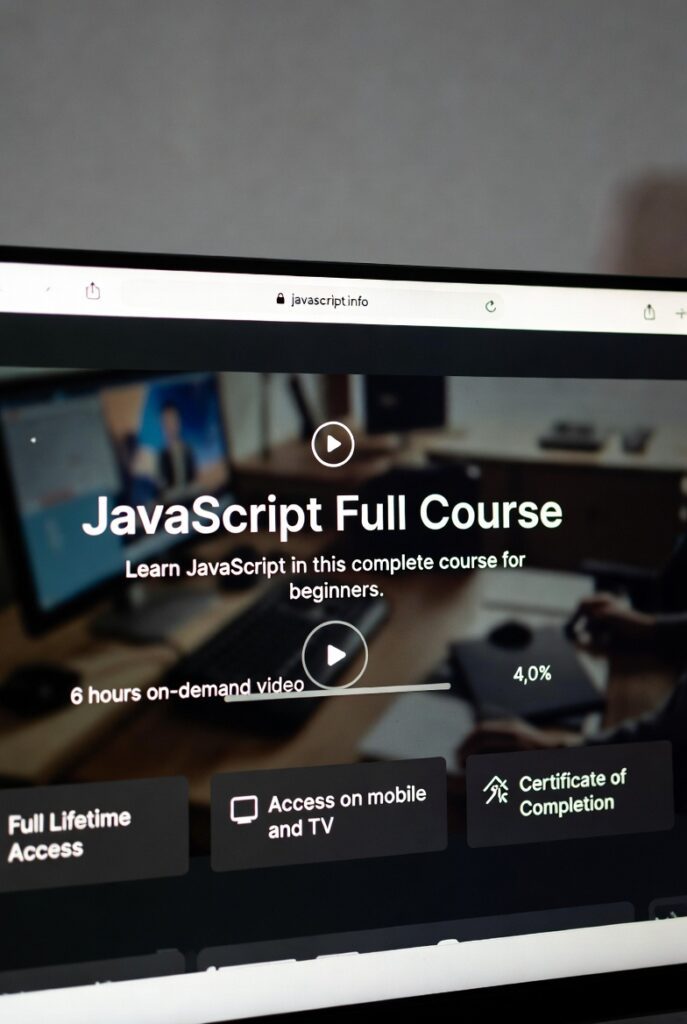
There’s a reason senior developers still have this bookmarked years into their careers. JavaScript.info is the most technically rigorous free JavaScript text available — Part One covers the language from Hello World through closures, prototypes, generators, and async/await. Part Two covers the browser: DOM, events, form handling, network requests.
What separates it from everything else is the consistent why. Not just what closures are — why they work the way they do. Not just what the event loop does — what actually happens with microtasks versus macrotasks, and why that produces those unintuitive execution-order results. If you’re failing technical screens because interviewers sense shallow knowledge rather than absent knowledge, three weeks with the right JavaScript.info chapters will fix that faster than any video course.
The honest limitation: No projects. No community. Reading JavaScript.info without simultaneously building things is like studying a cookbook without cooking — the theory fades before it transfers. Use it alongside The Odin Project, not as a standalone path.
Codecademy is genuinely the smoothest entry point in existence. No setup, immediate feedback, gentle difficulty curve. If someone has never written a line of code in their life, this is the right place to spend the first two weeks. The interactive editor gives you enough syntax pattern recognition that you can read code when you encounter it elsewhere.
The honest limitation: The free tier runs out around 30 hours of content, and the platform is fully sandboxed throughout. Treat it as an on-ramp, not a destination. Using Codecademy for more than a month is probably a mistake if employment is the goal.
W3Schools has been criticised by senior developers for years — some of that was valid historically, and accuracy has improved. But the core issue was never accuracy. It’s function. W3Schools is a reference document masquerading as a course. The “Try it Yourself” editor is fine for checking a method signature. It produces zero portfolio projects, teaches no professional tooling, and gives you nothing to show an employer.
Use it the way you’d use a dictionary: a fast lookup when you forget syntax, not a place to learn a language.
What a Real Failure Looks Like — and What It Costs
Every course comparison article I found did the same thing: named failure modes abstractly and moved on. No actual story. No recovery cost. So here’s one — sourced, specific, with both sides of the asymmetry quantified.
A developer in a widely shared Reddit thread on r/learnprogramming described completing all of freeCodeCamp’s then-current JavaScript certification — approximately 300 hours of challenge work, every project green-checked. She applied to 40 junior developer roles. She got four callbacks. She failed the take-home coding assessment for all four.
The pattern in each assessment was identical: a blank file, a spec, and a time limit. No scaffolded editor. No guided inputs. Just: “Build this.” She froze. Not because she didn’t know JavaScript — she did. She froze because she had never, in 300 hours of learning, been asked to create a project structure from nothing. Every file she’d ever worked with had been pre-built for her.
She spent three weeks on The Odin Project’s Foundations path before re-applying. The first project — a landing page built from a single blank HTML file — took her four hours. The second took two. The third took ninety minutes. On her fifth Odin project, she got an offer.
The lesson isn’t that freeCodeCamp is wrong. It’s that it’s incomplete on its own. And the cost asymmetry is the real finding here:
That asymmetry — the gap between time invested in learning and time lost when the wrong learning is applied — is what’s not captured in any star rating system. fCC’s five-star reviews are honest: for what it does, it does it well. The failure happens in the step it doesn’t take you to.
The developers who get hired aren’t the ones who completed the most courses. They’re the ones who, at some point, had nothing but a blank file and figured it out anyway.
The Sequence That Works: A Phased Roadmap
The biggest mistake I see is treating platform selection as a permanent singular choice. The actual high-velocity path uses each platform for the specific thing it does well — in a sequence designed around their complementary strengths and failure modes.
Table 2 — Master Phase Plan: Zero to Job-Ready (12–18 months, 1–2 hrs/day)
| Phase | Timeline | Resources | Key Projects | Exit Criteria |
|---|---|---|---|---|
| 1 — Syntax | Weeks 1–2 | Codecademy free tier | None (pattern recognition only) | Can read unfamiliar JS code without freezing |
| 2 — Foundations | Weeks 3–10 | freeCodeCamp JS Algorithms cert | RPG, Music Player, Palindrome Checker, Pokémon App | 10 fCC projects complete; understand why each pattern works |
| 3 — Real Environment | Months 3–5 | Odin Project Foundations + JavaScript.info (closures, async chapters in parallel) | Landing page, Calculator, Etch-a-Sketch — built in VS Code from blank files | First GitHub commit pushed; can debug terminal errors without guidance |
| 4 — Full Stack | Months 6–12 | Odin Project Full Stack JS path | REST API, Node app, React SPA, database-backed project | 5 deployed projects with full Git history; can explain async/await execution order |
| 5 — TypeScript + AI | Months 13–18 | Official TypeScript docs + AI-workflow integration (see AI section below) | Refactor one existing project to TypeScript; build one AI-assisted feature | Can type-safe a full React component tree; can evaluate and fix AI-generated code |
Foundations — Codecademy → freeCodeCamp
Spend the first two weeks on Codecademy’s free JavaScript intro. Zero-friction syntax familiarity. Then move to freeCodeCamp’s JavaScript Algorithms and Data Structures certification and complete the first 10 projects. The goal isn’t mastery. It’s building enough pattern vocabulary that you can recognise code structures when you encounter them in real environments.
Depth — JavaScript.info + Odin Project Foundations (in parallel)
Run these two in parallel — this is where most guides get it wrong by recommending one or the other. Read JavaScript.info’s chapters on closures, prototypes, and the event loop while simultaneously working through The Odin Project’s Foundations path. The JS.info chapters give you the theoretical framework; the Odin Project forces you to apply it before it fades.
Git lives here. VS Code lives here. Your first terminal error with no guided solution lives here — and that moment, frustrating as it is, is where professional problem-solving actually develops. By the end of Phase 3, you’ve pushed to GitHub. You’ve deployed something live. That’s a different person than the one who finished Phase 2.
Full Stack — Odin Project JS Path + React
Complete The Odin Project’s Full Stack JavaScript curriculum: asynchronous patterns, APIs, Node.js, databases, React. By this phase, you have 15–20 projects — not tutorial clones, work you built to spec.
Worth stating plainly: the learners who get hired are the ones who, at some point in this phase, had a more experienced developer read their code and tell them what was wrong. Build that feedback mechanism deliberately — Discord, a local meetup, a senior developer you find on LinkedIn. Don’t leave it to chance.
The Language Landscape: Where JavaScript Sits in 2026
Source: Stack Overflow Developer Survey 2025. Figures represent % of respondents reporting active use. TypeScript figure reflects its emergence as a near-parity requirement alongside vanilla JS in many enterprise job postings.
Note the TypeScript bar. 38.5% of all developers use it — and in enterprise job postings, that figure is considerably higher. TypeScript isn’t covered deeply by freeCodeCamp or The Odin Project as of April 2026. That’s a gap you’ll need to close separately after completing the core JS path, addressed in Phase 5 above.
What the 2025 Stack Overflow Data Actually Tells You
Three findings from the 2025 Developer Survey should directly reshape where you invest learning time. Not vague trends. Specific data with specific hiring implications.
1. JavaScript’s dominance is structural, not cyclical. Fourteen consecutive years at #1. Node.js is the most widely-used web framework at ~48% usage. React is the most desired front-end library for 2026. This confirms that The Odin Project’s decision to make React the terminal destination of its Full Stack JS path was right — and any free roadmap that doesn’t end with React leaves you a step short of where most job postings start.
2. AI distrust has hit a tipping point — and that’s specifically good news for serious learners. More developers now actively distrust AI-generated code (46%) than trust it (33%). Only 3% report “highly trusting” AI output. Experienced developers are the most distrustful, with 20% reporting high distrust. What does this mean in practice? Employers increasingly need developers who can evaluate AI output, catch its errors, and understand what the generated code actually does. That requires deep language knowledge — closures, prototypes, async patterns, the event loop. Surface-level syntax training doesn’t cut it. JavaScript.info and The Odin Project develop this depth. The irony is that the rise of AI makes JavaScript fundamentals more valuable, not less.
3. The salary premium is sharpening. According to the US salary breakdown from TechRecruiting.io, full-stack developer median is $138,000; front-end is $145,000; full-stack with demonstrable AI development skills sits considerably higher. Mid-level salaries in some categories have declined compared to 2024. The market is differentiating more sharply between developers with real depth versus those who completed courses. Being genuinely good at JavaScript has a premium. Being certified at JavaScript doesn’t.
AI-Assisted Learning in 2026: Use It Right or Pay the Price
Every other free JavaScript roadmap I found either ignores AI tools entirely or tells you to “use Cursor and Claude to accelerate learning.” That’s incomplete advice. Used strategically, AI tools compress specific learning bottlenecks. Used lazily, they create exactly the guided-environment dependency we described in Failure Mode #1 — just with a chatbot instead of a browser sandbox.
Here’s what actually works, based on how experienced developers use these tools:
Prompts That Accelerate Understanding
Follow-up: Now quiz me. Give me a closure-heavy code snippet and ask me to predict the output before revealing it.
If you’re prompting AI to write your project code and then studying the output — you’re replicating Failure Mode #1 with a chatbot. The AI will produce clean, working code every time. That’s the problem. You need the friction of writing imperfect code, hitting real errors, and debugging them yourself. Reserve AI for explanation and review, not generation. Use it to understand code you’ve already written. Never to write code you haven’t attempted.
The developers who use AI most effectively in 2026 aren’t the ones who generate the most code with it — they’re the ones who use it as a Socratic tutor and a code reviewer. That requires having code to review in the first place. Which means building your projects without AI assistance first.
Platform Selection by Career Goal
Table 3 — Career Goal vs. Recommended Path (April 2026)
| Your Goal | Primary Platform | Supplement | Time to Job-Ready | Key Output |
|---|---|---|---|---|
| Front-end developer (first role) | The Odin Project | JavaScript.info (closures, async chapters) | 8–12 months | 5+ deployed projects with Git history |
| Full-stack developer | Odin Project (Full Stack JS) | freeCodeCamp (APIs cert for structured coverage) | 12–18 months | MERN app + REST API + deployed portfolio |
| Career-changer (non-tech background) | freeCodeCamp → Odin Project | Codecademy (first 2–3 weeks only) | 10–14 months | fCC cert + 3 original Odin projects |
| Mid-level dev with patchy JS knowledge | JavaScript.info Part 1 | freeCodeCamp advanced algorithms cert | 4–8 weeks | Deep command of closures, prototypes, async |
| Interview prep only | freeCodeCamp (algorithms cert) | JavaScript.info (algorithms chapter) | 6–10 weeks | Fluency on LeetCode-style JS problems |
The developers who consistently land jobs aren’t necessarily the ones with the best certificates or the most course hours. Based on patterns described by hiring managers and documented in developer community research, the distinguishing factor is independent project volume — specifically, self-initiated projects built without guided scaffolding.
This is directional evidence, not a controlled study. But it’s directional evidence that freeCodeCamp’s 21-project curriculum redesign and The Odin Project’s spec-based capstone model were both responding to the same signal: portfolio projects built from blank files convert interviews at higher rates than certificates alone.
More on building a portfolio that converts technical interviews: CodeTalentHub’s developer portfolio guide →
Three Forces Reshaping the Path by Mid-2027
Three dynamics will change what free JavaScript education needs to deliver before mid-2027. Miss them now and your skills will mismatch the market sooner than expected.
TypeScript parity pressure. TypeScript adoption has accelerated to the point where multiple senior developers describe vanilla JavaScript as a hiring disadvantage in large-codebase roles. The Odin Project’s curriculum correctly teaches vanilla JS before React — that progression remains pedagogically right. But if you’re targeting enterprise roles, budget an additional 4–8 weeks for TypeScript fundamentals after the core JS path. The official TypeScript documentation is the strongest free primary resource.
AI-assisted development as professional table stakes. The 2025 survey shows that 84% of developers are now using or planning to use AI tools in their workflow. The implication: time spent deeply understanding JavaScript’s execution model — the event loop, memory allocation, closure behavior — becomes the differentiator as AI generates surface-level syntax for everyone. The developers who can catch AI’s errors are the ones worth hiring. (See the AI section above for exactly how to integrate this into your learning.)
React’s continued dominance, Vue’s quiet rise in specific markets. FreeAcademy.ai’s 2026 platform analysis confirms React as the most popular front-end choice, with Vue and Angular as secondary options. The Odin Project and freeCodeCamp both align with React. If you’re targeting European employers specifically — where Vue adoption runs higher than in the US market — factor in an additional 3–4 weeks on Vue fundamentals after completing the React-focused phase.
Read together, the Stack Overflow AI distrust trend (46% and rising), the TypeScript adoption acceleration (from near-zero to 38.5% in five years), and the salary divergence between certified and deeply skilled developers point toward a specific market dynamic: the premium for JavaScript depth is compounding, not flattening.
The organizations — and the learners — best positioned in 2027 will not be the ones who adopted AI coding tools earliest or completed the most certifications. They will be the ones who built deep JavaScript fundamentals alongside their AI tool usage — and who can evaluate, debug, and refactor AI-generated code rather than blindly deploying it. By 2027, that capability will be the difference between a junior developer who gets replaced by AI tooling and one who earns a senior title for knowing what the AI gets wrong.
For learners choosing a path today: the platforms that build that depth are JavaScript.info and The Odin Project. The platforms that don’t are W3Schools and Codecademy’s free tier. freeCodeCamp sits in between — a critical on-ramp, an incomplete destination.
The Decision Framework: 6 Situations, 6 Answers
Final Verdict
Here’s where I land after working through every platform: the question isn’t which free JavaScript roadmap is best — it’s which sequence gets you to independent project-building fastest. That answer hasn’t changed much in two years. The stakes around getting it right have.
The 2025 data makes one thing clear: employers in 2026 want developers who understand JavaScript deeply enough to evaluate AI-generated code, not just developers who can write syntax. That narrows the field considerably. JavaScript.info is the only free resource that explains JavaScript’s mechanics with enough depth to satisfy that requirement. The Odin Project is the only free resource that forces you to develop the independent problem-solving skills that job performance actually requires. freeCodeCamp is the best structured on-ramp to both.
Everything else — W3Schools, Codecademy’s free tier, standalone YouTube courses — is fine as supplemental material. None of it is a primary path to employment. Use it accordingly.
The developer who gets hired isn’t the one who completed the most courses. It’s the one who, somewhere in month six, had nothing but a blank file and figured it out anyway.
The fundamentals are here. The sequence is clear. What you do with it is up to you. Start today, not next Monday.
Python for Beginners in 2026: The Honest Plan (Final Version)
Cool Simple Web App Ideas 2025 | Easy Development Projects
30 Real Python Projects and What They Really Taught Me in 2026
Copy-Paste These Powerful JS Tricks Into Your Next Project in 2026
[card url=”https://www.codetalenthub.io/javascript-snippets-collection/”]