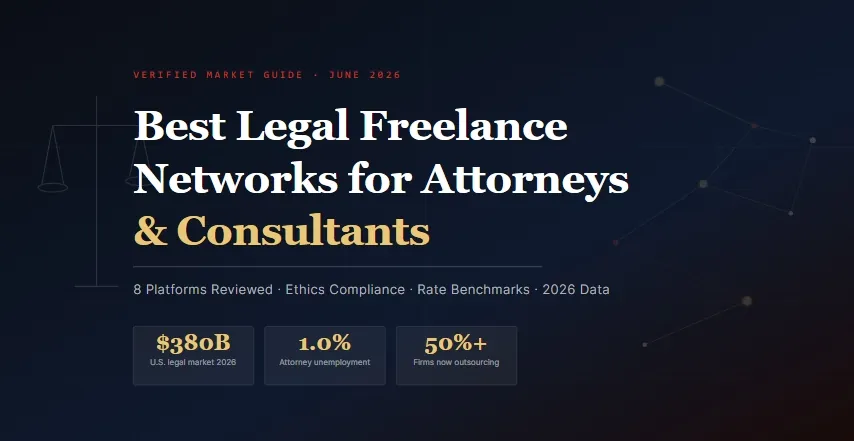


The U.S. attorney unemployment rate hit 1.0% in Q1 2026. Law school enrollment is down nearly 30% from its 2010 peak. Big Law is paying $200K+ to first-years. If you’re a small firm or solo practitioner trying to find qualified contract help — or an attorney building an independent practice — you are operating in a market that was not designed with you in mind. This guide is.
Here is the problem nobody in the “top 10 legal freelance sites” listicle industry bothers to state clearly: most legal freelance platforms were not built for attorneys doing serious legal work. Upwork and Fiverr are marketplaces for digital services that happen to tolerate legal profiles. The distinction matters because it determines ethics compliance, client confidentiality infrastructure, conflict-check mechanisms, and whether you’ll be competing against offshore paralegals on price.
This guide separates the platforms built specifically for the legal profession — where bar compliance, supervised delegation, and attorney-client privilege are structural features, not afterthoughts — from the generalist marketplaces where attorneys occasionally find work. Both categories have legitimate uses, but only if you know which one you’re actually on.
The Market Situation That Makes Freelance Legal Work Attractive Right Now
The talent shortage is real and measurable. According to Robert Half’s 2026 legal salary data, attorney unemployment sits at 1.0% — well below the national 4.3% rate — while the average starting salary for a 2-3 year associate has hit $123,500 nationally. For small and mid-size firms that cannot match Big Law’s $200,000+ packages, the math is simple: there is no surplus of unemployed attorneys waiting for calls, and the ones available are expensive.
On the other side of that equation: attorneys with 5-15 years of experience who have left traditional firm life — whether for family, geography, or autonomy — represent the majority of the freelance legal talent pool. These are not junior associates still learning the craft. Many hold Big Law alumni credentials and left by choice, not circumstance.
Figure 1 — Supply and demand forces driving the legal freelance market in 2026. Both sides are structural, not cyclical.
The legal freelance market also has a structural compliance requirement that most other freelance industries don’t: the attorney using the freelancer remains professionally and ethically responsible for the work product. This isn’t a formality. Under ABA Model Rules 5.1 and 5.3 — and their state equivalents — supervising attorneys must make reasonable efforts to ensure that subordinates comply with professional conduct rules. The platform you choose determines how easy or hard that compliance burden is.
When you delegate legal work through a freelance platform, you remain the responsible attorney of record. Platforms that are not designed around ABA compliance frameworks leave that burden entirely on you — including conflict checks, confidentiality protocols, and fee-sharing rules. This isn’t abstract risk. U.S. courts recorded 487 instances of AI errors or hallucinations in court documents in 2025 alone. Unsupervised freelance delegation without proper platform guardrails carries similar exposure.
The Platforms — Ranked by Fitness for Serious Legal Work
The eight platforms below are organized into three tiers based on how specifically they are built for attorney-grade legal work. Read all three — the right choice depends entirely on whether you are the person hiring or the person being hired, and what kind of work is involved.
LAWCLERK is the only legal freelance platform built explicitly to comply with bar ethics rules across all 50 states — a distinction that matters more than it sounds. The platform handles conflict checks, enforces confidentiality protocols, and its fee structure does not violate rules against improper fee-sharing between attorneys and non-lawyers, because LAWCLERK itself is owned by attorneys.
The mechanics: hiring attorneys post projects and set flat-fee prices. Freelance attorneys apply. The hiring attorney selects. Average of 12 attorneys apply per project posted, which gives you genuine optionality. The network currently lists 7,000+ vetted, U.S.-licensed freelance attorneys, and a Dedicated LAWCLERK Advisor comes standard with every account at no cost.
Their Virtual Associate Subscription Program is the most interesting product in this space — you essentially hire a fractional remote associate on a monthly basis, paying only for the hours you actually need in increments of ten, with no sign-up fees and no monthly platform fees. Rate guidance: expect to set flat fees equivalent to $75–$150/hr for standard work, more for rush or complex matters.
Works well when
- You need brief-drafting, research memos, or motion prep
- You want the hiring attorney to remain ethically clean
- You’re building a long-term “team” of trusted freelancers
- Flat-fee project work is your model
Friction points
- Rate-setting is your responsibility — no market benchmarks shown upfront
- Fewer corporate/Fortune 500 clients than Axiom or Priori
- Freelancers: you compete on application, not inbound leads
Axiom is not a freelance platform in the traditional sense. It is the largest alternative legal services provider globally, now generating approximately $1.5 billion in annual revenue and serving over 3,500 legal departments including 75% of the Fortune 100. The distinction matters: Axiom is a high-touch, managed deployment model, not a marketplace where individuals post and bid.
Only 3% of applicants are accepted. The average attorney in Axiom’s network has 18+ years of post-qualified experience. Many are Am Law 100 alumni. Rates come in at up to 50% below national law firm rates — but “below national law firm rates” still means significant hourly fees. This is not a platform for a solo practitioner looking to outsource a research memo for $400.
In 2024, Axiom launched Axiom Advice & Counsel, an Arizona-licensed law firm running on its network that can take on full engagements — M&A, regulatory compliance, data privacy, interim GC roles — at 25% below typical national law firm rates. Their Q1 2026 Net Promoter Score reached +73, which is genuinely rare in legal services. 93% of clients rate Axiom attorneys as equal to or better than top law firm attorneys.
Works well when
- You’re an in-house legal team needing scalable overflow coverage
- Complex multi-jurisdictional or M&A work is involved
- You need Am Law pedigree without Am Law billing rates
- You’re a senior attorney with Fortune 500 in-house experience seeking flexible engagements
Friction points
- Not accessible to solo practitioners or small firms as clients
- Attorneys must pass extremely selective vetting
- Not a self-serve platform — requires engagement with Axiom’s team
Hire an Esquire operates more like a sophisticated staffing firm than a marketplace. Its network includes 15,000+ attorneys and paraprofessionals. Unlike platforms where you bid for projects, here attorneys apply for posted positions similarly to a traditional job application — which filters out anyone who treats legal freelancing as a side-hustle afterthought.
Critically, Hire an Esquire supports three different engagement structures: 1099 contractor, W-2 employee, and permanent placement. The pricing reflects this: clients pay the contractor rate plus a 25% markup for 1099 arrangements, or the contractor rate plus a 55% markup for W-2 hires. If your firm has specific worker classification requirements or prefers the administrative simplicity of a W-2 arrangement, this is one of the very few legal-specific platforms that accommodates it. They also specifically support eDiscovery projects, which is a workflow most general freelance platforms handle poorly.
Works well when
- eDiscovery or document review projects at scale
- You need W-2 flexibility for worker classification reasons
- Predictive hiring analytics matter to your decision process
Friction points
- Less self-serve than LAWCLERK — more staffing-firm model
- The 55% W-2 markup can be significant on high-rate attorneys
Priori was built with Big Law and corporate in-house legal in mind, and it shows in every product decision. The core tool is an RFP infrastructure: in-house teams can craft structured requests for proposal, attorneys and boutique firms respond, and Priori facilitates the selection. This is genuinely different from what every other platform on this list does — it treats legal procurement the way procurement departments treat vendor selection.
For attorneys: Priori is less useful if you’re a solo practitioner looking for individual project work. It’s built for attorney-to-corporate-team relationships, not attorney-to-attorney outsourcing. If you run a boutique firm with demonstrable corporate experience and want a pipeline of in-house legal department clients, Priori’s positioning is worth the application process.
Works well when
- Corporate legal departments managing outside counsel panels
- Boutique firms seeking structured RFP-based client acquisition
- Diversity sourcing requirements apply in procurement
Friction points
- Not designed for individual project freelancing
- Solo practitioners will find limited fit
Montage requires all freelance attorneys to hold Ivy League degrees or Big Law experience — full stop. That entry requirement makes the talent pool smaller, but the quality floor is deliberately high. If your hiring firm’s internal standards or client expectations require top-pedigree work product, this is the platform where you don’t have to pre-screen credentials yourself.
For attorneys: you either meet the bar or you don’t. There is no grey area. If you do, the advantage is that clients who come to Montage are specifically seeking your caliber, which tends to mean better rates and better engagements than general-market platforms.
Works well when
- Client or matter sensitivity requires Ivy/Big Law provenance
- You want credential pre-screening done for you
Friction points
- Smaller network than LAWCLERK or Hire an Esquire
- Excludes capable attorneys who took non-traditional paths
UpCounsel is the most consumer-facing of the legal-specific platforms. The client profile is entrepreneurs, startups, and small businesses seeking contracts, entity formation, IP protection, and compliance work — not law firms outsourcing legal research. The platform uses AI and machine learning to match clients with appropriate attorneys, includes time-tracking, invoicing, and split billing tools.
For attorneys: UpCounsel positions itself as a marketing and practice-building tool, not just a job board. Attorneys create detailed profiles and the platform generates inbound client leads. If you have a business law focus and want to build a client pipeline rather than work sub-contracted to another attorney, UpCounsel’s model is designed for that.
Works well when
- Direct-to-client business legal work (contracts, entity, IP)
- You want to build your own client base, not sub-contract
- Billing and time-tracking tools matter to your workflow
Friction points
- Not designed for attorney-to-attorney delegation
- More competitive on price since clients are cost-sensitive
- Less infrastructure for complex, multi-matter work
EsquireX (formerly part of the Lawyer Exchange network) focuses specifically on matching attorneys to remote freelance legal work, with an emphasis on specializations — cybersecurity, healthcare compliance, international tax planning, environmental law, eDiscovery. The value proposition is specialization + flexibility rather than volume.
For attorneys looking to build a remote practice in a specific area of law rather than being a generalist contract worker, EsquireX’s framework of pre-vetted specialty matching is worth examining. Its network has grown substantially since rebranding, now serving firms of varying sizes seeking specialized expertise without long-term commitments.
Works well when
- You have a highly specialized practice area with national appeal
- You want remote work matched to your specific credentials
- Firms need specialty counsel for discrete matters
Friction points
- Smaller network than Axiom or LAWCLERK
- Less name recognition among hiring firms than legacy platforms
Side-by-Side: What Each Platform Actually Is
The most honest version of this comparison starts by acknowledging what most side-by-side tables omit: the type of relationship each platform is designed to facilitate, the ethics infrastructure built in, and who is actually paying fees to whom.
| Platform | Primary Relationship | Ethics Infra. | Vetting Level | Hiring Model | Best Fit Firm Size |
|---|---|---|---|---|---|
| LAWCLERK | Attorney → Attorney | ✓ All 50 states | Licensed, U.S.-barred | Project / Virtual Associate | Solo to mid-size |
| Axiom Law | Corporation → Attorney | ✓ Managed compliance | 3% accept rate; 18yr avg PQE | Secondment / Embedded | Fortune 500 / Enterprise |
| Hire an Esquire | Firm → Attorney/Para | ◑ Platform-facilitated | Vetted + predictive analytics | 1099 / W-2 / Permanent | Small to large firms |
| Priori Legal | Corp. Legal Dept → Firm/Attorney | ◑ RFP framework | Application + selection | RFP-based engagement | In-house legal depts. |
| Montage Legal | Attorney → Attorney | ✓ Ethics-focused | Ivy/Big Law required | Project | Mid to large firms |
| UpCounsel | Business Client → Attorney | ◑ Attorney responsibility | Vetted + AI matching | Project / Ongoing | SMB / Startup |
| EsquireX | Firm → Specialist Attorney | ◑ Attorney responsibility | Specialty-matched vetting | Project / Remote role | Small to mid firms |
What Attorneys Are Actually Charging — and What Firms Are Paying
Rate data in this space is notoriously inconsistent. Most platforms hide it deliberately to prevent race-to-the-bottom pricing dynamics. Here is what I’ve been able to piece together from public sources, platform documentation, and the Robert Half 2026 Salary Guide:
Ranges are estimates based on platform documentation and Robert Half 2026 data. Actual rates vary significantly by practice area, geography, experience, and matter complexity. Bars are normalized, not linear. The full salary range context for employed attorneys: 10-year experience attorneys earn $140K–$197K/yr (Robert Half 2026).
One thing that rarely gets stated directly: the platforms with the highest-quality vetting protect freelance attorney rates. When you compete on a general-purpose platform like Upwork, you are implicitly in a global talent pool where offshore legal professionals from lower-cost jurisdictions are active. On LAWCLERK, Montage, or Axiom, the field is U.S.-licensed attorneys only, which maintains a meaningful rate floor.
The Ethics Layer — What Most Platform Reviews Skip Entirely
Figure 2 — The three-layer ethics compliance framework that governs legal outsourcing. Most guides discuss Layer 1. Almost none discuss Layer 3.
The most underappreciated risk in legal freelancing is not malpractice — it’s unauthorized practice of law (UPL) and fee-splitting violations. When a hiring attorney uses a platform that isn’t built around ABA compliance, there is no structural mechanism preventing ethically problematic arrangements from forming. The supervising attorney’s license is the backstop, and it’s a fragile one if the platform doesn’t support proper conflict-checking or confidentiality workflows.
“The hiring attorney never stops being the attorney of record for the work product. A freelance platform that doesn’t build that responsibility into its architecture is offering you convenience at the cost of exposure.”
— LAWCLERK founding documentation, referenced in ABA ethics compliance review
Two specific issues arise frequently that platform reviews ignore:
Conflict checks at scale. If you regularly use freelance attorneys across multiple matters and clients, you need a platform that tracks which freelancer has worked on which client to prevent future conflicts. LAWCLERK has this built in. On a generalist platform, you’re doing this in a spreadsheet, hoping you remember to check.
AI-assisted work product and disclosure. ABA Formal Opinion 512 establishes that lawyers must “reasonably consult” with clients about the means used to accomplish their objectives — which now includes AI tools. Florida Opinion 24-1 goes further, requiring disclosure when AI affects billing. If your freelance attorney is using AI to draft the memo you’re billing for, you may have a disclosure obligation you didn’t know existed.
How to Actually Choose — A Decision Framework Without the Fluff
The right platform depends on two variables: whether you are hiring or seeking work, and the size and nature of the work involved. Here is the framework without padding:
If you’re a solo practitioner or 2–5 attorney firm
Start with LAWCLERK. The ethics compliance is built in, the talent pool is deep, the pricing model works at your scale, and the Virtual Associate subscription is the closest thing to a fractional associate that actually functions properly at small-firm economics. If you need Ivy/Big Law pedigree on a specific matter, check Montage as a secondary option.
If you’re an in-house legal department at a mid-to-large corporation
The choice is between Axiom (for embedded, long-term secondment work and complex matters) and Priori (for structured outside counsel sourcing via RFP). Hire an Esquire is useful if you need eDiscovery support or want W-2 classification for risk management purposes.
If you’re an attorney building a freelance practice (the supply side)
Your path depends on your pedigree and practice focus. Ivy/Big Law experience: apply to Axiom and Montage first. General practice with bar licensure: LAWCLERK for attorney-to-attorney work, UpCounsel if you want direct client relationships. Niche specialty: EsquireX and Hire an Esquire are worth testing simultaneously.
If you’re a consultant or non-attorney legal professional
The landscape is thinner. Hire an Esquire covers paralegals. For broader legal consulting — compliance work, legal ops, contract management — platforms like professional talent networks built for specialized roles often outperform the attorney-specific platforms, which are not designed for non-JD professionals even when their work is adjacent to legal.
Three Structural Shifts Happening Right Now
The legal freelance market is not static. Three dynamics are actively reshaping the landscape in 2026:
1. AI is creating a skills bifurcation, not a talent replacement
Industry data from 8am.law shows 69% of legal professionals are already using general-purpose AI, while firm-wide structured adoption sits at 34%. That 35-point gap means individual attorneys are getting measurably more productive (38% save 1-5 hours per week from AI tools) while institutions are still writing governance policies. Freelance attorneys who use AI effectively can deliver more work product per hour than an in-house associate — which makes them economically attractive even at premium hourly rates.
2. The four-day hybrid model is becoming the firm standard
The JD Journal’s 2025-2026 remote work report found that 68% of major law firms now enforce a four-day in-office mandate, with just 8% offering true work-from-anywhere policies. That in-office pressure on employees is driving experienced attorneys toward freelance models that don’t require them to be in any specific office. The supply of qualified freelance legal talent is being indirectly fueled by firm inflexibility.
3. Legal unemployment so low it’s redirecting market structure
At 1.0% attorney unemployment (BLS Q1 2026), law firms can no longer staff up the traditional way for overflow work. The result is a forced adoption of freelance platforms at firms that previously viewed outsourcing as ethically risky or logistically complex. LAWCLERK’s May 2026 piece on legal talent shortage dynamics documents this shift in direct terms.
Figure 3 — Individual attorney AI adoption vs. institutional AI governance. Data: Thomson Reuters 2025, 8am.law 2026 report. The gap creates uncontrolled risk exposure for firms.
The 35-point gap between individual attorney AI adoption (69%) and firm-level structured governance (34%) creates a real opportunity: freelance attorneys who have built documented, ethical AI workflows can market that as a differentiator. Clients increasingly want the productivity benefits of AI — they just don’t know how to manage it internally yet. Being the attorney who arrives with a governance framework, not just a tool, commands premium rates.
What This Guide Doesn’t Answer
Three questions that came up in research that I genuinely don’t have reliable data on:
International legal freelancing. Axiom operates in 6 regions across 4 continents, but the ethics compliance question gets considerably more complex outside the U.S. bar system. I haven’t found a platform that handles cross-jurisdictional attorney licensing with the same rigor LAWCLERK applies domestically.
Success rates for new freelance attorneys. Every platform claims a robust network and strong project volumes. None publishes data on how many attorneys in their network earn meaningful income in their first year. I’d treat any income claim in freelance legal marketing with significant skepticism until a platform publishes verified earnings data.
The impact of AI on document review pricing. eDiscovery and document review have historically been the highest-volume freelance legal work category. AI is disrupting the pricing floor for that work in ways that are not yet visible in public data. If document review is your core freelance income, that’s a category to monitor closely through 2026-2027.
If any of those questions matter to your decision, the CodeTalentHub resource library covers professional services talent trends with more depth than most legal-specific publications. For current attorney salary benchmarking, Robert Half’s 2026 Legal Salary Guide is the most reliable public reference I’ve found.
The Uncomfortable Part
The legal freelance market in 2026 is genuinely better than it was five years ago — for both sides. The platforms are more sophisticated. The ethics infrastructure is more robust on the purpose-built platforms. The talent pool has deepened as experienced attorneys have deliberately chosen independent practice.
But the word “freelance” still carries reputational baggage in some corners of the profession. I’ve had conversations with attorneys who avoid posting on LAWCLERK because they worry what their referral network will think. That concern is becoming as outdated as worrying about being seen on LinkedIn. Thomson Reuters’ 2025 ALSP report shows that over 50% of law firms and corporate legal departments now outsource legal work — the firms that haven’t adopted some form of flexible legal staffing are the ones behind the curve, not the ones that have.
If your firm’s hesitation is reputational: the firms using Axiom include 75% of the Fortune 100. The conversation has moved.
If your hesitation as an attorney is financial uncertainty: the combination of a 1.0% unemployment rate and platforms that provide regular project pipelines means the economics of legal freelancing have improved substantially. The uncertainty is real, but it’s manageable — especially if you treat freelance platforms as a portfolio rather than a single dependency.
The real risk isn’t choosing the wrong platform. It’s assuming the traditional model is the safe default when the traditional model is running out of supply.