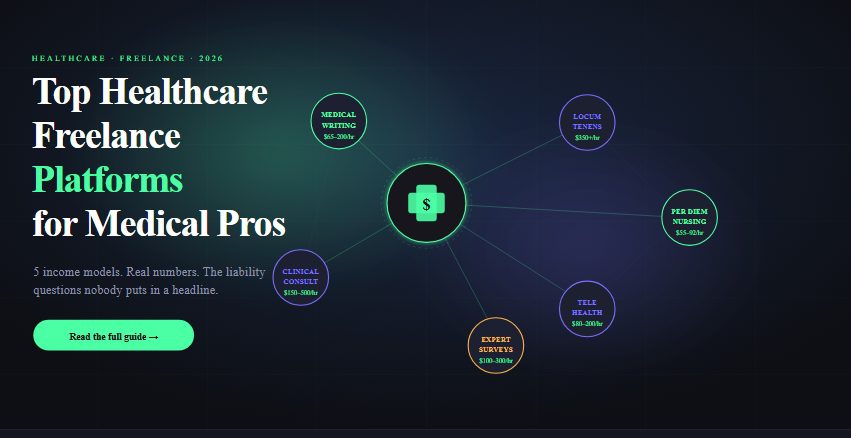

Healthcare · Freelance · Platforms · 2026
Most guides list job boards. This one maps the actual ecosystem — from locum tenens agencies and nurse shift apps to physician survey networks and medical writing platforms — with hard numbers, real trade-offs, and the liability questions nobody puts in a headline.
The brochure definition vs. how it actually works
Healthcare freelancing is routinely defined as “flexible work for medical professionals.” That’s the marketing definition. The operational definition is: a set of contractual arrangements where a clinician trades employment benefits, credentialing continuity, and legal protections for higher hourly rates and schedule autonomy — and personally absorbs the overhead that a hospital or practice would otherwise eat.
That second version is why the decision to go independent deserves more than a Google search for “best platforms.” It requires understanding that the phrase “freelance physician” covers at least five structurally different income models, each with its own platform ecosystem, tax exposure, and malpractice footprint.
The five models, plainly:
Fig 1. The five income models that constitute “healthcare freelancing” — structurally different, but often conflated in platform guides.
What follows covers each in concrete platform terms — who runs them, what the numbers actually look like, and where the hidden costs live.
Locum Tenens Agencies: The Highest-Ceiling, Highest-Complexity Model
The common advice is: “Sign with a big agency, take their first offer.” Every locum physician I’ve spoken to who did that wishes they hadn’t. The agencies that dominate this market — CompHealth, Weatherby Healthcare, AMN Healthcare, locumtenens.com (a CHG company), VISTA Staffing — are not interchangeable despite marketing language that suggests otherwise. They have different facility networks, different compensation transparency practices, and critically different malpractice coverage structures.
Agencies typically provide claims-made malpractice coverage during an assignment. The trap: claims-made policies cover only claims filed while the policy is active. If a patient files a claim six months after your assignment ends, you may have no coverage unless you purchased tail coverage — which can cost $15,000–$40,000 depending on specialty. Ask every agency, upfront, who pays tail. Many won’t volunteer this information.
Weatherby Healthcare
The most-cited independent practitioner feedback on Weatherby centers on recruiter continuity and specialty breadth. They’ve been placing locums for over 30 years and explicitly work with PAs and NPs alongside MDs — something that eliminates several competitors immediately if you’re an advanced practice provider. Their recruiter model is consultant-based rather than transactional, which either matters to you or it doesn’t. It matters most for physicians working infrequent locum blocks who need someone tracking credentialing deadlines across states.
CompHealth
CompHealth (CHG Healthcare) runs one of the largest facility networks in the locum market. Their published differentiator is comprehensive credentialing and licensing support — relevant because multi-state licensing for a specialty like emergency medicine or psychiatry can take 90–180 days and represents real income delay for new locums. CompHealth’s telehealth division also lets physicians shift between on-site and remote work without switching agencies, which is genuinely useful for building a mixed income strategy.
locumtenens.com
Also a CHG company, positioned more toward physicians and CRNAs than allied health. Their app handles hour logging, shift details, and credentialing documents in one place, which removes a real operational headache. For physicians doing 3–4 assignments per year across different facilities, administrative friction is a meaningful cost in time.
AMN Healthcare / VISTA Staffing
AMN’s scale is its main asset — they place across nursing, allied, and physician verticals, useful if you’re building a household where both partners are clinicians on different platforms. VISTA specifically has a strong VA and Indian Health Service pipeline, important for providers interested in federal facility placements or tribal health assignments.
Largest US locum network by facility count. Handles multi-state credentialing, travel, housing, and malpractice during assignments. Strong telehealth division allows remote+in-person hybrid strategy with one recruiter relationship.
30+ year operator with genuine advanced practice coverage (NPs, PAs alongside MDs). NALTO member. Recruiter-as-consultant model means one dedicated contact managing your scheduling, credentialing, and contract negotiation.
Founded 1990, Utah-based, strong in federal and government placements (VA, DoD, Indian Health Service). NALTO founding member. Over 60 specialties. Full credentialing, licensing, travel, and housing support. Clear cancellation terms in contracts.
As of early 2026, IRS and Department of Labor enforcement has specifically targeted healthcare independent contractor arrangements. If an agency controls your hours, requires specific attire, and provides all equipment — you may legally be an employee regardless of what your 1099 says. The consequences include unexpected tax bills and gaps in malpractice coverage. Review your contract terms against the IRS Economic Reality Test before signing.
Nurse Shift Apps: The Per Diem Model Has Finally Matured
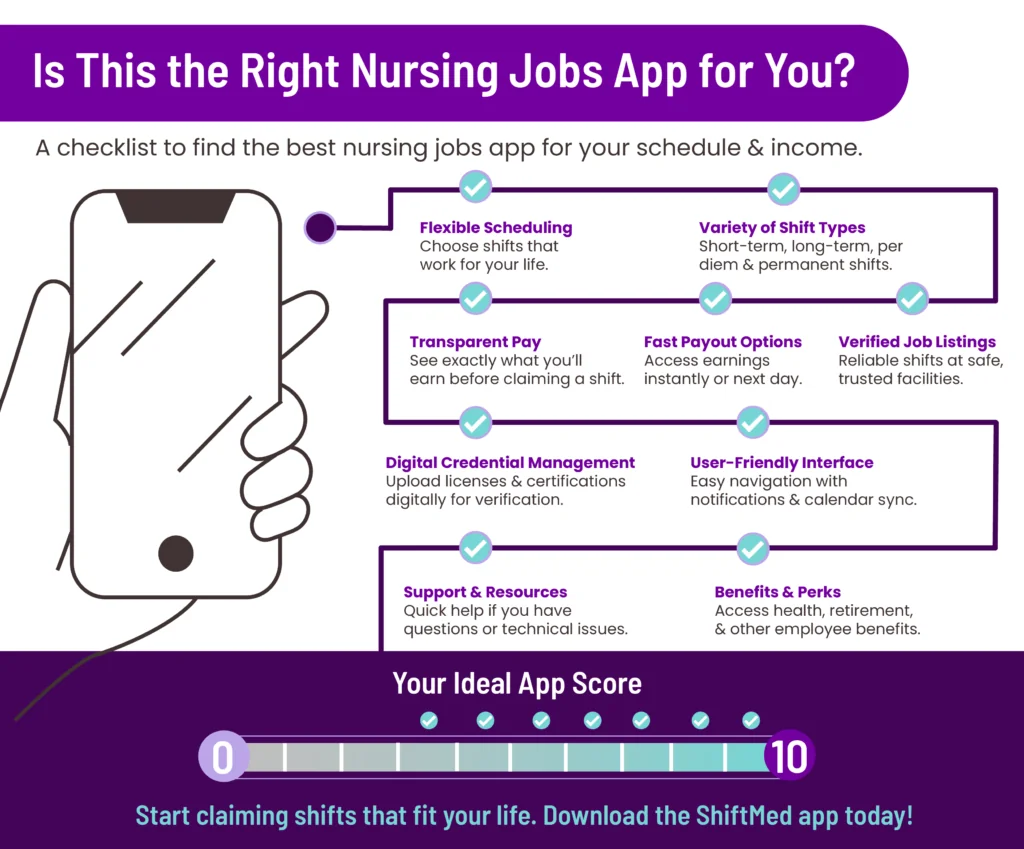
Five years ago, the advice was “per diem nursing is for new grads who can’t get staff jobs.” That advice is about a decade out of date. The per diem nurse shift market now has purpose-built platforms that rival agency work on pay rates while offering same-day payment, app-based scheduling, and in some cases — W2 employee protections rather than 1099 exposure.
The functional difference between platforms in this space breaks down cleanly along two axes: who carries the employer risk (facility, platform, or you) and whether rate negotiation is allowed.
Fig 2. Nurse shift platforms positioned by employer classification model vs. rate negotiation flexibility. Neither axis is strictly better — it depends on your financial and legal priorities.
IntelyCare
The structural decision IntelyCare made — treating nurses as W2 employees rather than 1099 gig workers — has real consequences. You get medical malpractice coverage included, access to benefits, and DailyPay (same-day wages after a shift). The rate ceiling is lower than platforms where you negotiate, but the legal and financial exposure is also lower. IntelyCare operates in 30+ states, and its app-based shift selection means you can pick morning shifts at one facility and evening shifts at another without a recruiter involved. For RNs and LPNs who are the primary earner in their household, the benefits access is worth the tradeoff in flexibility. Per diem rates run 25%+ higher than typical staff positions on average — their own data, and broadly consistent with what nurses report in forums.
Clipboard Health
The most distinctive feature of Clipboard Health is rate negotiation: clinicians can propose a new rate on a posted shift before accepting it. That’s unusual in this market. The platform also uses geo-tracking during shifts, which some nurses find intrusive and others find irrelevant. It’s a 1099 arrangement, which means self-employment tax exposure and no benefits. For experienced ICU nurses who want to extract maximum hourly rate and have their own malpractice coverage sorted, Clipboard is competitive. For someone who’s new to per diem work and hasn’t thought through the 15.3% self-employment tax hit, the higher gross rate can be illusory.
Vivian Health (formerly NurseFly)
Vivian is technically a marketplace rather than a staffing company — you don’t work “for” Vivian, you use it to connect with agencies and facilities. As of June 2026, Vivian lists over 190,000 active jobs including more than 100 specialties across nursing, therapy, and allied health. Vivian’s core differentiator is transparency: pay packages are shown upfront before you talk to a recruiter, which eliminates the information asymmetry that allows agencies to low-ball new locums and travel nurses. Per diem nursing pays average $55/hr on the platform (as of mid-June 2026), with travel nursing averaging $48.62/hr and some shifts listed above $90/hr. The VIP program offers bonuses for active use. The friction: you still end up working through an agency for actual contract terms, just with better information going in.
Physician Survey Platforms: The Most Accessible, Least Discussed Income Stream
Nobody talks about this in the same breath as locum tenens, but they should. Medical survey platforms are the only category where a clinician can generate $500–$3,000/month in supplemental income with zero credentialing delays, no scheduling commitments, no additional malpractice exposure, and shifts completed during a lunch break.
The catch: earnings are almost entirely driven by specialty and subspecialty. An oncologist specializing in rare tumor types will receive 2–5 invitations per week at $100–$300+ effective hourly rate. An internist in primary care will receive fewer, at lower rates. The platforms don’t tell you this until after you’ve completed your profile.
Sermo
Sermo is the largest physician-exclusive community globally — over 1 million verified physicians across 150+ countries. The surveys pay $25–$75 for 10–20 minutes (effective hourly: $75–$225), with longer studies reaching $100–$200+. Their quick-poll format pays $3–$5 for 30-second responses. The community features — anonymous clinical case discussion, drug ratings, peer polling — are the retention mechanism; the surveys are the income mechanism. Sermo reports paying members over $25M in a recent 12-month period. For physicians interested in shaping pharmaceutical market research and clinical guideline development, this is unusually direct access. Tax implication: all survey income issues 1099-NEC forms above $600/year. Set aside ~25–30% immediately.
M3 Global Research, InCrowd, GLG
M3 operates similarly to Sermo but with different specialty focus areas and often higher per-survey rates in life sciences verticals. InCrowd emphasizes speed — short surveys optimized for clinicians with 5–10 minute windows. GLG (Gerson Lehrman Group) is the premium tier: they run expert network consulting calls ($150–$500/hr effective) and are particularly used by pharmaceutical companies, investors, and management consultants who need real clinical insight. Getting into GLG requires a more formal application and availability for scheduled 30–60 minute calls, but the effective hourly rate for a specialist subspecialist can exceed anything in the survey category.
| Platform | Format | Typical Pay | Best Specialties | Time Commitment | Tax Form |
|---|---|---|---|---|---|
| Sermo | Surveys + community polls | $25–$200+/survey | All, highest for oncology/immunology | 5–30 min/session | 1099-NEC |
| M3 Global Research | Online surveys | $20–$150/survey | Oncology, neurology, rare disease | 10–25 min/session | 1099-NEC |
| InCrowd | Micro-surveys | $5–$75/survey | All licensed clinicians | 2–10 min/session | 1099-NEC |
| GLG (Gerson Lehrman) | Expert consulting calls | $150–$500/hr | Subspecialists, department chiefs | 30–60 min calls | 1099-NEC |
| Guidepoint | Expert consulting calls | $100–$400/hr | All specialists | 30–60 min calls | 1099-NEC |
Many hospital and health system employment agreements contain conflict-of-interest clauses that could prohibit paid consulting for pharmaceutical or device companies. Before joining any expert network or survey platform that compensates you for opinions on specific drugs or devices, have your employment contract reviewed. Violation can constitute breach of contract, and some CME-linked survey platforms have additional disclosure requirements under the Physician Payments Sunshine Act.
Medical Writing Platforms: The Highest Barrier, But Compounding Returns
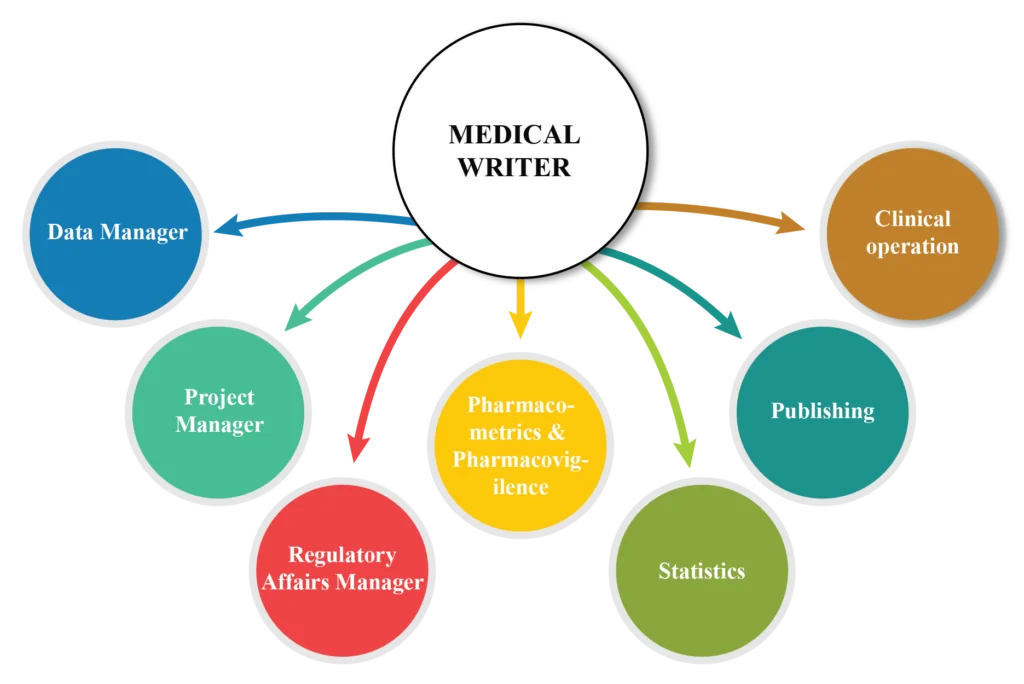
Medical writing is the most misunderstood category in healthcare freelancing because the income ceiling is genuinely high ($200/hr for experienced regulatory writers) but the ramp to get there is longer than most clinicians expect. A physician with strong academic writing credentials doesn’t automatically command $150/hr on day one — the market for regulatory writing (clinical study reports, INDs, NDAs) values document-specific experience that takes time to build.
The operational paths that actually work:
Kolabtree
Kolabtree is a vetted freelance science and medical talent marketplace that specifically positions against Upwork for medical/pharma/biotech work. Their vetting process is more selective than general platforms, which keeps rates higher. Medical writers on Kolabtree typically charge $65–$150/hr depending on therapeutic area and document complexity. For a physician or PhD with a specific subspecialty, Kolabtree provides access to biotech clients who need expert clinical commentary and won’t find it on Fiverr.
AMWA Freelance Directory
The American Medical Writers Association Freelance Directory is not a job board — it’s an active directory that pharma and med comms agencies search when sourcing writers. Being listed there requires AMWA membership, but the value is direct client inbound rather than competing on a platform. The AMWA Essential Skills Certificate also carries genuine market signal for regulatory writing clients evaluating candidates without clinical credentials.
Upwork (for medical writing specifically)
Upwork’s medical writing vertical has matured meaningfully. Rates for seasoned freelancers with verified publication or regulatory writing portfolios run $50–$150/hr. The platform’s escrow protection and client review system is useful for early-career medical writers building a portfolio. One practical note: the per-word rate structure that dominates content writing doesn’t translate to medical writing — clients who want $0.05/word for clinical content are not clients who understand what medical writing requires. Filter for hourly contracts or per-document fixed rates from pharma, biotech, or device companies specifically.
| Platform / Channel | Who Uses It | Realistic Starting Rate | Ceiling Rate | Time to First Contract | Best For |
|---|---|---|---|---|---|
| Kolabtree | Biotech / Pharma / Academic | $65/hr | $200+/hr | 2–4 weeks post-approval | Regulatory docs, manuscripts |
| AMWA Directory | Med comms agencies / Pharma | $80/hr | $250/hr | Varies (inbound only) | Experienced regulatory writers |
| Upwork | Broad pharma, device, health media | $50/hr | $150/hr | 1–3 weeks | Portfolio building, diverse clients |
| Freelancer.com | Mixed quality clients | $25/hr | $80/hr | Fast | Entry-level, general health content |
| LinkedIn Direct Outreach | Pharma med affairs, CME companies | $100/hr | $300+/hr | Months (relationship-based) | Senior clinician consultants |
The Math Nobody Runs Before Their First 1099
A physician sees a locum tenens contract offering $250/hr and compares it to their employed salary of $350,000/year ($168/hr at 40hrs/week). The locum rate looks better. It isn’t, automatically.
Fig 3. The comparison assumes standard US tax rates, mid-range insurance costs, and one tail policy purchase. An S-Corp structure and full deduction optimization can improve the 1099 position significantly — but requires a physician-specialist CPA, not a general tax software.
The math changes in your favor when you work enough hours (locum tenens physicians report earning more than employed peers once crossing approximately 1,600 billable hours/year), structure your business correctly (S-Corp election saves meaningful SE tax above ~$120,000 net income), and deduct systematically. The “One Big Beautiful Bill Act” signed in July 2025 altered some deduction structures; a CPA specializing in physician independent contractors is no longer optional overhead — it’s a cost-benefit positive at income over $200,000.
“The number of physicians I’ve seen take a locum assignment, earn $280/hr, pay $30,000 in avoidable self-employment tax, and then tell me the gig economy doesn’t work — it works. But only with the right structure.”
Platform Selection Matrix: Match to Your Actual Situation
The mistake most guides make is recommending a platform as if all clinicians have the same risk tolerance, tax situation, and schedule flexibility. They don’t. Here is the honest filter:
| Your Situation | Best Model | Best Platforms | Watch Out For |
|---|---|---|---|
| MD/DO wanting max hourly rate, flexible schedule | Locum Tenens | CompHealth, Weatherby, locumtenens.com | Tail coverage gap, multi-state credentialing delays |
| NP/PA wanting flexibility without leaving employment | Locum Tenens (part-time) | Weatherby, Barton Associates | Non-compete clauses in main job; check first |
| RN wanting per diem shifts with benefits | Per Diem / Shift Apps (W2) | IntelyCare | Lower rate ceiling vs. 1099 platforms |
| RN experienced ICU, wants max rate | Per Diem (negotiated) | Clipboard Health | 1099 exposure; self-employment tax, no benefits |
| Any clinician with rare subspecialty | Expert Consulting Surveys | Sermo, GLG, Guidepoint | Employer conflict-of-interest clauses |
| MD/PhD with academic writing experience | Medical Writing | Kolabtree, AMWA Directory, LinkedIn | Regulatory writing requires specific doc experience |
| Early career — building income + portfolio | Multi-platform | Vivian (discovery) + Sermo + Upwork | Spreading too thin before one stream is stable |
| Semi-retired physician, limited hours | Surveys + Telehealth | Sermo, M3 + local telehealth platforms | State license reactivation requirements |
The Checklist Before You Sign Anything
These are the questions that don’t appear in agency marketing materials but distinguish smooth freelance setups from expensive mistakes:
- Malpractice policy type: Claims-made or occurrence? If claims-made, who pays tail — and when does that obligation trigger?
- Independent contractor classification: Does the arrangement actually pass the IRS Economic Reality Test, or are you a de facto employee with 1099 exposure?
- Non-compete clause in current employment contract: Does it restrict locum or telehealth work? Geographic or specialty-specific?
- Multi-state licensing requirements: If working across states, which license is active and which needs activation? Does the agency handle this, or do you?
- Estimated quarterly tax payments: SE income requires quarterly estimates. Miss Q1 and you’ll owe interest starting April 15.
- Business entity structure: Sole proprietor (risky and tax-inefficient above $120k net), LLC (asset protection), or S-Corp (tax optimization above $200k)? This decision should precede signing your first contract.
- Conflict-of-interest review for survey/consulting work: Pharma-paid consulting can trigger Sunshine Act reporting; some employer agreements prohibit it entirely.
- Credentialing gap policy: What is the agency’s standard timeline from contract signing to first billable day? 60–90 days is common. Budget for zero income during this window.
The platform decision is just one layer. If you’re building a parallel independent income stream as a developer or AI consultant in healthcare, the structural questions — entity formation, contract law, income diversification — are covered in depth at CodeTalentHub.io, particularly in the guides on freelance contract structures and multi-income stack management for technical professionals.
One constraint this guide can’t solve for you
Everything above assumes you have an active, unrestricted license, no pending board actions, and a malpractice history that agencies can work with. For the majority of clinicians, that’s a non-issue. For the minority — board investigations, prior claims, license restrictions in specific states — the platform calculus changes entirely, and some categories close off.
That’s not a reason not to freelance. It’s a reason to know exactly what’s on your NPDB report before the agency does. Run your own NPDB query first. It costs $4.75 and takes ten minutes. The discovery process on the agency’s side, if something unexpected appears, will cost you weeks and potentially your first assignment.
The real ceiling on healthcare freelance income isn’t platform availability or market demand. Both are genuinely strong in 2026. The ceiling is administrative readiness — clean credentialing, correct entity structure, quarterly tax discipline, and a malpractice coverage strategy that doesn’t have gaps you discover after a patient files. That infrastructure, built correctly once, runs for a decade.
Platform data drawn from Vivian.com (active listings, June 17 2026), Doximity 2025 Physician Compensation Report (37,000+ survey respondents), Sermo compensation data and community reports, ZipRecruiter salary aggregates (May–June 2026), NEJM CareerCenter locum agency guides (April 2026), SalaryDr medical survey platform benchmarks (May 2026), and IRS/DOL enforcement reporting via Dental & Medical Counsel (January 2026). Tax figures are estimates for illustrative purposes only and do not constitute tax advice. All platform assessments are independent; no affiliate relationships exist with any platform named in this guide.