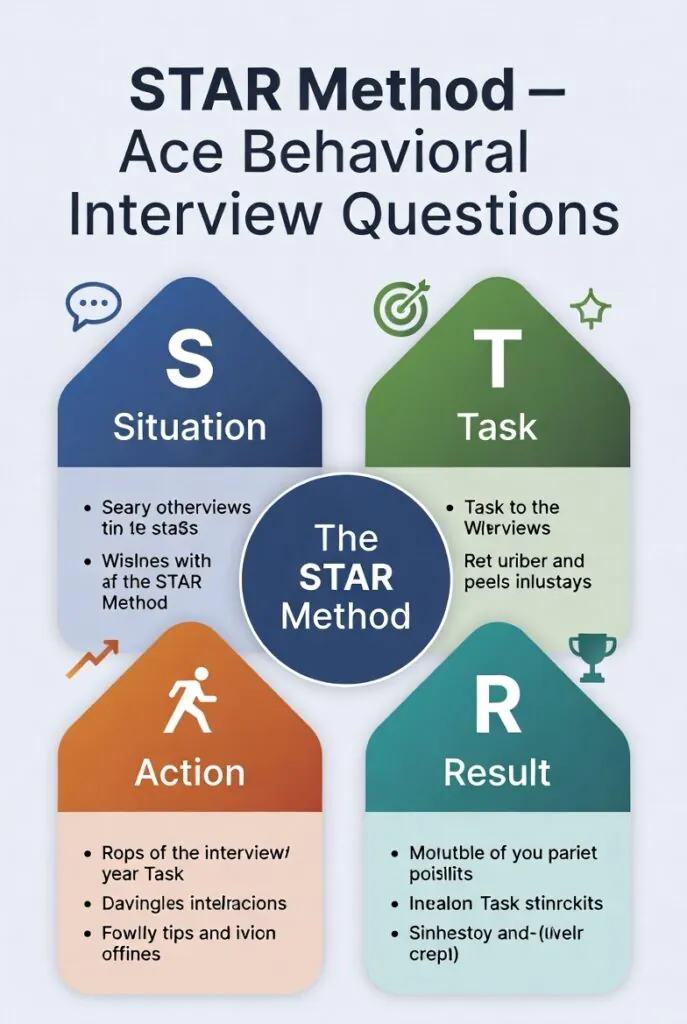
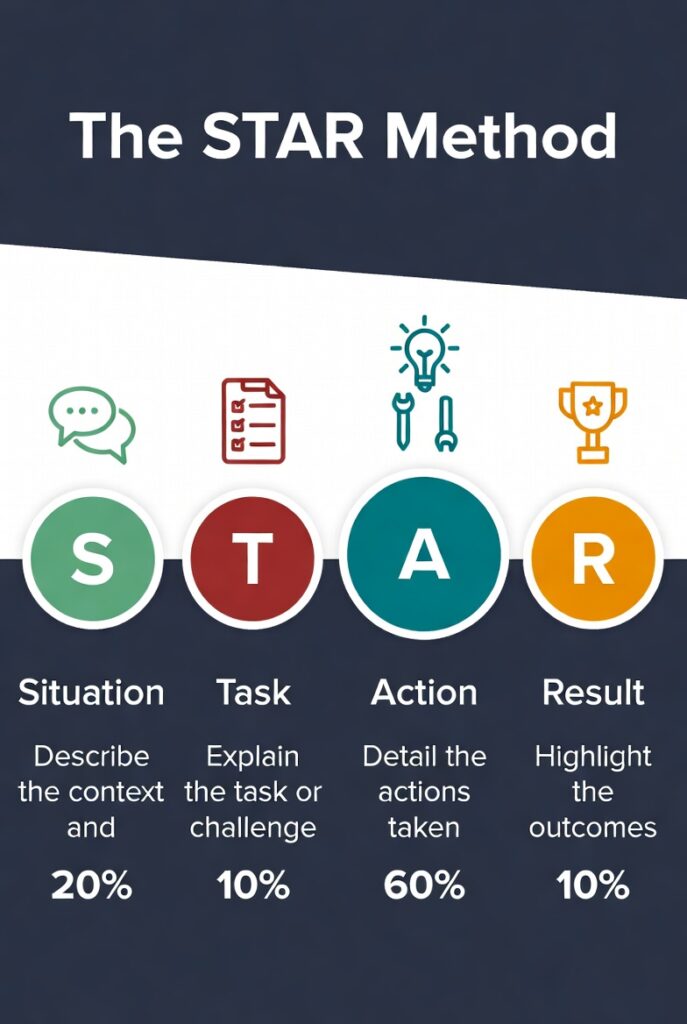
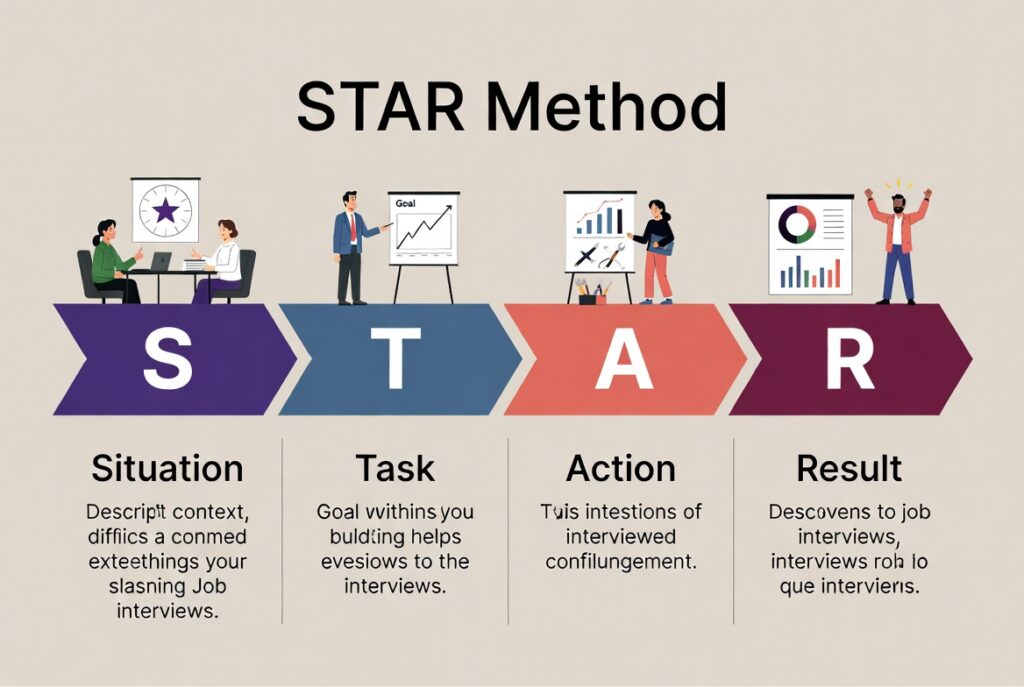
STAR isn’t dead. It’s been outpaced by a hiring landscape that values learning velocity over polished storytelling—and misused by candidates who treat a framework as a script. Here’s what peer-reviewed research, verified recruiter data, and real AI-screening science actually say.
- STAR (Situation-Task-Action-Result) remains the most widely taught behavioral interview framework—and its core logic is scientifically sound. DDI introduced it in 1974 and it’s been validated across 50 years of structured interviewing research.
- The problem isn’t the framework. It’s rigid over-rehearsal: candidates who treat STAR as a script sound identical to each other, miss the self-awareness signals modern interviewers probe for, and get flagged by AI pre-screening tools that analyze vocal authenticity.
- AI-assisted screening now touches over 60% of Fortune 100 hiring (HireVue, 2025). Among all organizations, 43% used AI for HR and recruiting in 2025—up from 26% in 2024, a 65% jump in one year.
- NACE’s Job Outlook 2025 survey found problem-solving, teamwork, and communication are the top three attributes employers seek—not a specific interview framework. Two-thirds of employers now use skills-based hiring practices.
- The right fix is adding one letter: CARL (Context-Action-Result-Learning) or STARR (STAR + Reflection) surfaces the learning component that makes candidates stand out without scrapping everything you already know.
What STAR Is—and Why It Was Built That Way
Development Dimensions International (DDI) introduced the STAR framework in 1974, and the premise has held up remarkably well across 50 years of selection science: past behavior is the strongest single predictor of future performance. When a candidate walks an interviewer through a real Situation, their specific Task, the Actions they took, and the measurable Result, they provide behavioral evidence that trained evaluators can score against competencies using Behaviorally Anchored Rating Scales (BARS).
The framework was never designed to be memorized. It was a guide for interviewers to structure probing and scoring, adopted by candidates as a way to organize their own answers. That inversion is where the problems start.
Understanding what STAR was built to do makes it easier to understand where it breaks down—and why the fix is more nuanced than simply switching to a different acronym.
The Real Problems With Rigid STAR in 2026
Problem 1: The Framework Stops at “Result”
STAR’s four components tell a complete story of what happened—but experienced interviewers in 2026 are after something different. NACE’s Job Outlook 2025 survey found that nearly 90% of employers seek problem-solving ability and more than 80% seek teamwork and communication skills in candidates. None of these top three attributes are reliably demonstrated by a story that ends at its result.
The follow-up question every experienced interviewer now asks—”What would you do differently?”—is specifically designed to probe for the component STAR leaves out: self-awareness and growth orientation. Candidates who’ve over-rehearsed a STAR response often stumble precisely here, because the framework gave them nowhere to go after the result.
“When everyone uses the same framework delivered as a script, the interview becomes an audition for memory recall—not a window into how someone actually thinks.”
Problem 2: Outcome Inflation Becomes the Rational Response
The pressure to end with an impressive “Result” creates a systematic incentive to exaggerate. Common inflation patterns: claiming credit for team achievements, presenting correlation as causation (“after I joined, revenue increased 40%”), selecting only projects with unambiguous positive outcomes, and omitting context that would complicate the narrative.
Experienced interviewers have developed a reliable counter: they ask for the messy details. “Walk me through specifically what you did in week two.” “How did your colleagues describe the situation at the time?” Candidates who’ve inflated a STAR story lose credibility at exactly the moment they need to build it.
Problem 3: The “Task” Framing Creates Passive Voice Problems
Human Capital Hub’s analysis of behavioral interviewing identifies a specific signal interviewers watch for: responses loaded with “we” and passive constructions. The STAR framework’s “Task” component (“I was tasked with improving…”) almost automatically triggers passive framing. The candidate describes a mandate received rather than initiative taken. For roles requiring ownership and leadership, this registers as a negative signal even when the underlying accomplishment is strong.
None of these problems are inherent to STAR itself. They are problems of rigid over-application. Big Interview’s Chief Coach, Pamela Skillings, is explicit: STAR should be a flexible organizing tool, not a memorized script. The failure mode isn’t the framework—it’s treating it as one.
AI Screening: What It Actually Does (and Doesn’t) Detect
This section requires more precision than most career articles provide, because AI hiring tools are frequently mischaracterized in both directions—either overhyped as all-seeing or dismissed as gimmicks.
What the Numbers Actually Show
HireVue’s 2025 Global Guide to AI in Hiring, based on surveys of more than 4,000 HR leaders worldwide, reported that AI adoption among HR professionals surged from 58% in 2024 to 72% in 2025. HireVue alone serves over 60% of the Fortune 100 and has hosted more than 70 million video interviews. According to HireTruffle’s 2026 AI recruitment statistics, nearly 20 million assessments and video interviews were completed in just the first quarter of 2024.
These are real numbers from verifiable sources—and they establish that AI pre-screening is no longer experimental. For enterprise and Fortune 100 candidates, the probability of AI touching your application before a human does is now high enough to warrant specific preparation.
What AI Screening Actually Analyzes
AI video interview tools like HireVue analyze speech patterns, vocabulary diversity, pause distribution, sentiment consistency, and content relevance. The systems are not reading minds. What they’re doing is pattern-matching against large datasets of responses that were subsequently rated by human evaluators.
The Real Risk: AI-Generated Applications, Not AI-Detected Delivery
HireVue’s 2025 report identified a more concrete and pressing concern: talent acquisition leaders are being “inundated with AI-generated applications” and are responding by embracing skills assessments specifically to verify what candidates claim. The TestGorilla State of Skills-Based Hiring 2025 report confirms this: their Big 5 personality test was completed over 127,000 times in Q1 2025—a 69% increase year-over-year—as employers shift toward validated assessments rather than relying solely on interview responses.
The AI-screening problem candidates most need to solve isn’t detecting rehearsed delivery. It’s demonstrating genuine skill when every application around theirs was assembled by a chatbot.
Five Modern Alternatives, Ranked by Use Case
The frameworks below aren’t competitors to STAR—they’re extensions. Each addresses a specific gap. Choose based on role type and interviewer style, not on a blanket belief that any one of them is universally superior.
| Framework | What It Adds Over STAR | Best For | Time | Shows Learning? |
|---|---|---|---|---|
| STAR (Traditional) | The baseline—no additions | Government, structured panels, entry-level | 2–3 min | No |
| CARL | Replaces Situation/Task with efficient Context; adds Learning | Tech, growth companies, behavioral roles | 2–3 min | Yes |
| STARR | Adds Reflection to the existing STAR structure | Senior/management, STAR-rubric orgs | 2.5–3.5 min | Yes |
| SOAR | Centers story on Obstacle rather than Task—creates narrative tension | Consulting, leadership, crisis management | 2–3 min | Partial |
| PAR | Strips setup—pure problem/action/impact efficiency | Technical roles, exec summaries, time-limited | 60–90 sec | No |
| Storytelling-First | Full narrative arc: Hook → Conflict → Resolution → Meaning | Creative, startups, culture-fit interviews | 2–4 min | Yes |
CARL earns the top spot for one reason: it is the most practical upgrade from STAR with the lowest relearning cost. The Context framing compresses what STAR splits across Situation and Task—you give the interviewer what they need to understand your story, nothing more. The Learning component, which STAR omits entirely, surfaces the self-awareness that modern interviewers explicitly probe for.
- CContext: One or two sentences. Role, company type, timeframe. Orient, don’t justify.
- AAction: Lead with “I” and active verbs. Specific decisions, tools, team sizes, numbers. This is the largest component.
- RResult: At least one quantified metric. If you cannot quantify, choose a different story.
- LLearning: The most-skipped and most-valuable component. Not “I learned teamwork is important”—something specific you changed in how you work afterward.
“The result was a 34% reduction in support tickets—but the more useful discovery was that I’d mapped the process without talking to frontline support staff first. I had assumed their workload. Now I run a stakeholder pre-map before any process redesign. Every single time.”
“The biggest lesson was that communication is really important in cross-functional projects.” — This is a category observation, not a personal insight. Any candidate could say it. It signals you haven’t actually reflected on the experience.
STARR is the right choice when you have strong reason to believe the interviewer is scoring against a STAR-based rubric—which remains common at large corporations, banks, and established consulting firms. You maintain the structure they expect while differentiating with the Reflection component. No adjustment to your existing stories required; just add 30-45 seconds at the end.
“If I ran this project today with what I know now, the one thing I’d do differently is…” / “What surprised me was that the friction wasn’t technical—it was…” / “This shaped how I now approach [specific situation] because…”
SOAR replaces the passive “Task” with “Obstacle”—an active framing that immediately positions you as a problem-solver rather than a task-recipient. The obstacle-centered structure creates narrative tension that holds attention, and it works particularly well when the most interesting part of your story is the diagnostic challenge, not the solution itself.
STAR (Task): “I was tasked with improving our onboarding timeline.”
SOAR (Obstacle): “The core problem wasn’t the process itself—it was that each team thought their handoff was fast. Nobody could see the full 21-day picture because there was no cross-functional visibility.”
PAR removes all setup and focuses on signal density: what broke, what you did, what changed. Technical interviewers evaluating problem-solving approach often prefer this efficiency. It also works well when an executive interviewer gives you 90 seconds rather than three minutes and you need to land your point cleanly.
The highest-variance framework on this list. When it works—for candidates with strong verbal storytelling skills in roles that value creative communication—it produces the most memorable interview responses. When it fails, it meanders and the “meaning” lands as forced.
This approach is not recommended for technical interviews, government roles, or highly structured panels. It requires practice to deliver without rambling. If your stories regularly exceed three minutes, stay with CARL or STARR until you’ve tightened the narrative significantly.
How to Use CARL: A Step-by-Step Breakdown
For most candidates upgrading from STAR, CARL is the highest-ROI investment. Here is how to implement it specifically.
- Set Context in 15-20 Seconds Maximum
Your role, the organization type, the timeframe. One or two sentences. The interviewer needs orientation, not biography. If you find yourself explaining how you joined the company, you’ve gone too far.
Good Context“As operations lead at a 200-person B2B SaaS company in early 2024, our customer onboarding was taking three weeks when competitors were averaging five days.”
Too Much Context“So I was actually at this company—it was my second role there after being promoted from associate—and we had this ongoing issue with onboarding that had been flagged for a while, and my manager had mentioned it a few quarters earlier…”
- Lead Your Action Section With What You Decided, Not What You Were Told
Use: “I identified,” “I proposed,” “I mapped,” “I built.” Avoid passive constructions or team-level “we” statements without specifying your specific role. Include concrete details: team sizes, tools, timelines, specific decisions and why you made them. This component should take 45-60 seconds.
- Quantify Your Result With at Least One Metric
If you genuinely cannot quantify the outcome, choose a different story. Vague results undermine the credibility of everything that came before them. “The team responded well” tells an interviewer nothing they can score.
Quantified“Onboarding dropped from 21 days to 6. We retained two enterprise clients—combined $400K ARR—who had been in cancellation conversations.”
- Deliver a Specific, Personal Learning—Not a Category Observation
This is where CARL candidates either differentiate themselves dramatically or collapse into the same generic territory as every STAR response. Your learning must describe a specific change in how you work now—something traceable to this experience.
Category Observation (Doesn’t Work)“I learned that stakeholder communication is really critical to project success.”
Personal Specific Learning (Works)“What I didn’t anticipate was that each team genuinely believed their handoff was fast. The delay wasn’t incompetence—it was invisible. I now run a cross-team process audit before recommending any workflow change. I bring the full timeline into the first meeting, not the third.”
- Optionally Connect to the Role in 10-15 Seconds
If the connection is natural, make it. “That’s directly relevant to what you described in the role brief about cross-functional coordination.” If it feels forced, skip it—a strong learning component already does the work.
- Prepare 7-10 Stories at Different Time Lengths
Practice each CARL story in 90 seconds, 2 minutes, and 3 minutes. You will not control interview pacing. When an interviewer is clearly moving quickly, compress to PAR efficiency. When they signal they want depth, expand the Action and Learning sections.
CARL Story Bank: Themes to Cover
| Theme | Common Question Triggers | What the Learning Should Demonstrate |
|---|---|---|
| Leadership | “Tell me about a time you led through a challenge.” | What you learned about motivation, delegation, or handling resistance—not generic “leadership principles” |
| Conflict Resolution | “Describe a disagreement and how you handled it.” | Specific change in how you approach disagreement now—not “I learned to listen more” |
| Failure / Recovery | “Tell me about a significant mistake.” | The prevention mechanism you built afterward. If you just say “I learned from it,” you’ve failed this one. |
| Innovation | “Describe a time you improved a process.” | What assumption you had to discard before the solution became visible |
| Collaboration | “Tell me about a successful team project.” | Your specific contribution to team functioning, not just to the output |
| Pressure / Deadlines | “Describe working under tight constraints.” | What you would de-prioritize differently—and why the trade-off is now clearer |
| Ethical Dilemma | “Tell me about a time you faced an ethical challenge.” | What the experience revealed about your actual values under pressure, not your stated values in calm reflection |
When STAR Still Wins
This is the section most “STAR is dead” articles skip, which is precisely why it’s important. Rigid application of a replacement framework is the same error as rigid application of the original one.
Government and public sector interviews frequently use standardized evaluation rubrics built around STAR. Interviewers score against a predetermined template. Deviating from the expected structure—even to add a more sophisticated reflection component—can reduce your score because evaluators are checking boxes, not assessing creativity.
Structured panel interviews with multiple independent evaluators reward STAR’s predictability. When five people are scoring responses separately, a clear four-part structure ensures all evaluators capture the same information in the same order. Conversational flexibility that works beautifully in a one-on-one creates inconsistent scoring in a panel.
Entry-level candidates with limited professional experience often need STAR’s Task framing to establish why they were involved in a situation at all. The additional context helps, not hurts. For early-career candidates, moving too quickly to Action can leave interviewers wondering about scope and credibility.
When the interviewer explicitly requests STAR: Use it. You can still incorporate reflection naturally into the Result section: “The result was X, and the unexpected lesson from that process was Y.” You’ve satisfied the rubric requirement and demonstrated depth simultaneously.
Six Myths About Interview Frameworks, Corrected
The STAR method is scientifically outdated and shouldn’t be used in 2026.
The underlying science is not outdated. Behavioral interviewing—asking candidates to describe past behavior as a predictor of future performance—remains among the most valid interview methods available. DDI introduced STAR in 1974 and it’s been validated across 50 years of selection research. The problem is rigid, scripted delivery—not the method’s foundational premise.
Longer, more detailed responses always outperform shorter ones.
Response length and response quality are not correlated—and may be inversely correlated. Answers that consistently exceed two to three minutes often signal poor prioritization and difficulty identifying what’s important. Aim for 90 seconds to two minutes for most behavioral questions. Expand to three minutes only when the interviewer signals they want more depth through follow-up questions.
You should only share success stories in interviews.
Failure stories with specific learning components consistently outperform pure success stories in evaluation ratings, according to Harvard Business Review research on authenticity and hiring perception. Candidates who discuss genuine setbacks are rated as more self-aware and more promotable—provided the story demonstrates specific growth, not just regret. The failure story is a feature, not a liability. The candidate who admits they misjudged stakeholder dynamics and rebuilt the process is more interesting than the one who won flawlessly every time.
AI interview tools will disqualify you for sounding rehearsed, so you should never prepare extensively.
This is a misread of how AI screening works. What AI tools detect is uniform, mechanical delivery—specific patterns that emerge from word-for-word memorization and robotic pacing. The solution isn’t less preparation; it’s different preparation. Know your key points deeply enough to deliver them in naturally varied language. Practice out loud until the content is internalized but the wording isn’t. “Structured spontaneity” requires more preparation than memorization, not less.
One framework is optimal for all behavioral questions and all interviewers.
Adaptability in applying frameworks is itself a competency signal. “Tell me about a failure” calls for CARL’s explicit Learning component. “Walk me through a complex project” may suit PAR’s efficiency with a technical interviewer. “How did you handle a crisis?” benefits from SOAR’s obstacle-centered tension. Reading which framework fits the question and the interviewer’s style—and deploying it fluidly—demonstrates more than any single framework can.
Interviewers primarily want to hear your most impressive achievements.
NACE’s Job Outlook 2025 survey found the top attributes employers seek are problem-solving ability, teamwork, and communication skills. None of these are best demonstrated by an unambiguously triumphant story. A modest achievement with specific, honest reflection on what you’d do differently often outperforms a polished win delivered without self-awareness. The question behind every behavioral question is: how does this person think about their own performance?
How Hiring Will Shift Through 2027-2028
This section requires a honest confidence calibration. Twelve-month trends in a rapidly changing labor market are reliable directional signals. Two-year projections carry meaningful uncertainty.
High-Confidence Trends (Verifiable Now)
Skills-based hiring is accelerating. NACE’s Job Outlook 2025 Spring Update found that almost two-thirds of employers now use skills-based hiring for entry-level candidates—up from the prior year—and more than two-thirds of those use it always or most of the time. NACE’s Job Outlook 2026 data shows 70% of employers report using skills-based hiring, up from 65% the previous year. The directional movement is consistent and the pace is accelerating.
AI-assisted hiring tools are becoming infrastructure, not innovation. According to HireTruffle’s comprehensive 2026 statistics, 43% of organizations used AI for HR tasks in 2025, up from 26% in 2024. Among Fortune 100 companies, over 60% now use AI-powered hiring tools. AI-generated resume flooding is pushing employers toward skills assessments, practical tasks, and validation-focused interviews rather than behavioral storytelling alone.
Medium-Confidence Projections
Behavioral interview questions will evolve rather than disappear. The shift toward skills-based hiring does not eliminate behavioral questions—it shifts what they’re designed to assess. Increasingly, the behavioral question “Tell me about a time you learned something difficult quickly” is more diagnostic than “Tell me about a major achievement.” The frameworks that add learning components (CARL, STARR) will be better adapted to this evolution than those that don’t.
AI interview preparation tools will become mainstream. Platforms like Yoodli, Big Interview, and Interviewing.io already provide real-time feedback on practice sessions. The infrastructure exists; adoption is the variable. By 2027-2028, these tools will likely be as standard as resume builders—which means the baseline for preparation quality will rise across the candidate pool. That makes genuine reflection and specific, personal stories more valuable, not less, because generic responses will be what everyone produces with an AI preparation tool.
| Trend | Current State (2026) | Projected Direction | Confidence |
|---|---|---|---|
| Skills-based hiring adoption | ~65-70% of employers (NACE 2025-2026) | Continued acceleration | 🟢 High |
| AI tools in enterprise hiring | 60%+ of Fortune 100 (HireVue) | Expanding to mid-market | 🟢 High |
| AI prep tool mainstream adoption | Early adopter / power user phase | Standard by 2027 | 🟡 Medium |
| Behavioral questions declining | Still dominant in most interviews | Supplemented by assessments | 🟡 Medium |
| Premium on authentic, specific stories | Growing (AI-generated apps flooding market) | High as AI prep normalizes | 🟡 Medium |
Your 10-Point Action Plan
The candidates who outperform in 2026’s interview landscape are not those who’ve memorized the best stories. They’re those who’ve reflected deeply enough on real experiences that they can discuss them with specific, honest detail—and adapt their delivery to the room they’re in. That combination—genuine reflection plus contextual adaptability—is what no AI preparation tool produces by default.
- Audit your existing STAR stories for a specific Learning component. If you don’t have one, choose different stories or do the reflection work before your next interview.
- Identify which framework fits each type of question: CARL for behavioral depth, STARR for rubric-scored panels, SOAR for problem-solving emphasis, PAR for technical efficiency, storytelling-first only if your delivery is genuinely fluid.
- Prepare a bank of 7-10 stories covering: leadership, conflict resolution, failure/recovery, innovation, collaboration, pressure/deadlines, and ethical dilemma.
- Practice each story at 90 seconds, 2 minutes, and 3 minutes so you can adapt to the interviewer’s pacing cues rather than delivering a fixed-length script.
- Record yourself. Watch specifically for passive constructions (“I was tasked with”), vague results (“it went well”), and generic learning statements (“communication is key”).
- Prepare at least two genuine failure stories with specific learning components. These will almost certainly be asked, and they’re where the most differentiation happens.
- Research whether your target company uses structured panels or rubric-based scoring. If yes, STARR is safer than CARL. If in doubt, ask the recruiter.
- Do not spend preparation time trying to “beat” AI screening with vocal technique. Spend it making your stories specific enough that they could only have happened to you.
- Anticipate the follow-up that always comes: “What would you do differently?” Have a specific, honest answer ready for every story in your bank.
- Keep answers under two minutes unless the interviewer signals they want more. Length signals prioritization ability—or its absence.
Frequently Asked Questions
The story that only you could tell—specific enough to be yours, honest enough to include what failed, grounded enough to show what changed afterward—outperforms any optimized framework delivery every time.
Sources & References
- DDI (Development Dimensions International). “STAR Method — Behavioral Interviewing.” ddi.com/solutions/behavioral-interviewing/star-method
- NACE (National Association of Colleges and Employers). “Job Outlook 2025.” Published November 2024. naceweb.org/research/reports/job-outlook/2025
- NACE. “The Attributes Employers Look for on New Grad Resumes.” December 2024. naceweb.org
- NACE. “Almost Two-thirds of Employers Use Skills-based Hiring.” May 2025. naceweb.org
- NACE. “Job Outlook 2026 Survey Results — Skills-Based Hiring.” 2025. naceweb.org/tag/surveys
- HireVue. “2025 Global Guide to AI in Hiring.” February 2025. hirevue.com
- HireTruffle. “100 AI Recruitment Statistics for 2026.” February 2026. hiretruffle.com
- HeroHunt.ai. “AI Adoption in Recruiting: 2025 Year in Review.” November 2025. herohunt.ai
- TestGorilla. “State of Skills-Based Hiring 2025.” June 2025. testgorilla.com
- LinkedIn. “Future of Recruiting 2025.” business.linkedin.com
- The Human Capital Hub. “Mastering the STAR Interview Method.” 2025. thehumancapitalhub.com
- Articsledge / HireTruffle. “AI Video Interview: Complete Guide 2026.” March 2026. articsledge.com
Data Disclaimer: Statistics reflect research conducted primarily in North American and Western European markets through early 2026. AI and hiring technology changes rapidly; verify current figures before citing. Projections beyond 12 months carry inherent uncertainty and are labeled accordingly.
10 Best Free Interview Practice Tools for 2026 Success
GitHub’s January 2026 Signal: AI Agent Tooling Explodes
[card url=”https://www.codetalenthub.io/ai-in-education-2025/”]
[card url=”https://www.codetalenthub.io/portfolio-presentation-framework/”]