
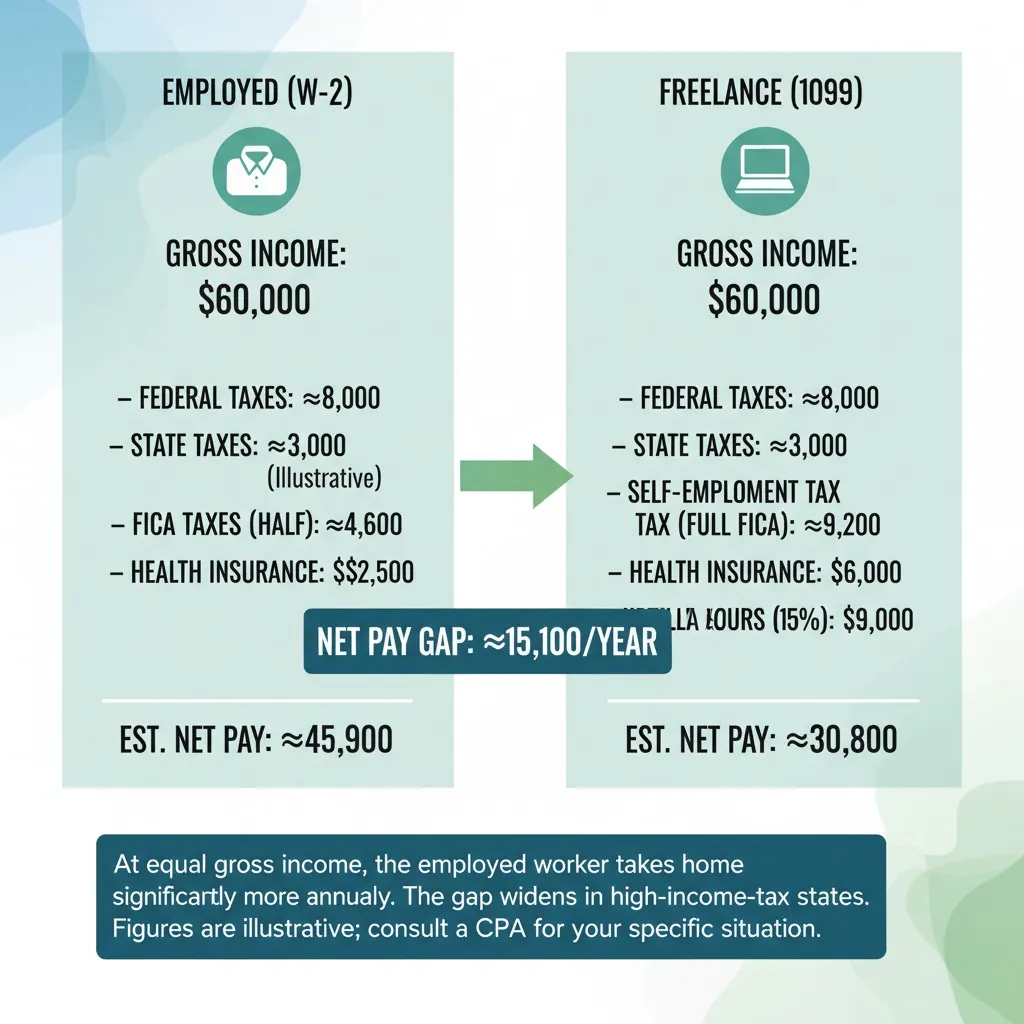


Most freelancing guides answer “can I do this?” The question that decides whether you last is different: can I get through month four? This guide is built around that question. It uses 2026 US tax rules, shows the arithmetic, and flags where the evidence is weak.
By Tom Morgan, founder of Code Talent Hub. Last updated October 21, 2026. US-focused on taxes; the AI and market sections apply more broadly. This is general information, not tax or legal advice.
How this was made. I use AI tools for research and first drafts, then check every figure against the sources listed at the bottom; the process is described on the methodology page. I started with $10–20 gigs, made plenty of mistakes and hit burnout along the way, which is why this guide spends more time on cash flow than on pitching. Spotted something wrong or out of date? Tell me and I’ll fix it.
Want your own numbers? Use the freelance take-home and runway calculator below the table, or the Freelance Rate Calculator to turn a net-income target into an hourly rate.
The short version
- Tax math is the biggest surprise. On $80,000 of invoices, a single US freelancer with direct clients keeps roughly $49,000–$53,000 after business costs, health insurance, and federal taxes, before state tax. With a 10% platform fee, it is closer to $44,000–$47,000.
- Fund a runway, not a hope. Six months of living costs if you have no anchor client; three to four if one client already covers about half your expenses. (This is editorial judgment, not a studied figure.)
- Niche is now a risk decision. Peer-reviewed research shows demand for automation-prone freelance work (writing, basic coding, image creation) fell after ChatGPT arrived.
- Health insurance got more expensive. The enhanced ACA subsidies expired at the end of 2025, which hit self-employed buyers directly.
Contents
- How big is freelancing, honestly?
- What $80,000 in invoices becomes
- Runway: how much to save before you quit
- Pick a niche AI is less likely to flatten
- The six-step launch sequence
- A lightweight operating system
- Four ways freelancing fails
- FAQ
- Sources and disclosures
How big is freelancing, honestly?
Counts of “freelancers” vary by who is counting and what they include, so treat every headline number as a range.
MBO Partners’ 2026 State of Independence report, based on an April 2026 survey of 4,557 US workers, estimates 74.9 million independent workers, up from about 72.9 million a year earlier. It says independents are 22% of the full-time US workforce and that 5.8 million earn $100,000 or more. Upwork’s research puts the median income of people who freelance full-time at $85,000 against $80,000 for full-time employees, but that figure is self-reported by a company that sells freelance services.
Two cautions. Both MBO and Upwork profit when freelancing looks attractive, and both use broad definitions (a weekend side gig counts). Medians also hide survivors: people who quit in month four are rarely in the next survey.
What $80,000 in invoices becomes
Here is the calculation most guides skip. It uses 2026 federal rules for a single filer with no other income, and it excludes state income tax, which ranges from zero to roughly 5% of income in most states.
Assumptions: $6,000 of business expenses (software, accounting, insurance, equipment); $6,000 a year for self-employed health insurance, deducted above the line; the 2026 standard deduction of $16,100; the 20% qualified business income (QBI) deduction; 2026 brackets (10% to $12,400, 12% to $50,400, 22% above that).
| Line | Direct clients | 10% platform fee |
|---|---|---|
| Gross invoiced | $80,000 | $80,000 |
| Platform fees | $0 | –$8,000 |
| Business expenses | –$6,000 | –$6,000 |
| Net profit (Schedule C) | $74,000 | $66,000 |
| Self-employment tax (15.3% × 92.35% of net) | –$10,456 | –$9,326 |
| Federal income tax (after standard, half-SE, health insurance, and QBI deductions) | –$4,233 | –$3,519 |
| Health insurance premiums | –$6,000 | –$6,000 |
| Cash left before state tax | ≈ $53,300 | ≈ $47,200 |
| As a share of gross | ≈ 67% | ≈ 59% |
Three things worth noticing:
- Self-employment tax is the big one. You pay both halves of Social Security and Medicare: 12.4% Social Security on net earnings up to the 2026 wage base of $184,500, plus 2.9% Medicare. The IRS lets you deduct half of it when computing income tax.
- Federal tax is lower than most people fear. The standard deduction, the half-SE deduction, the health insurance deduction, and QBI together shrink taxable income a lot. The combined federal burden here is about 19–20% of net profit.
- Health insurance is the swing factor. The table assumes $500 a month. If you buy on the ACA marketplace and your subsidy shrinks, that line can double. Enhanced premium tax credits expired at the start of 2026, and KFF estimated average net premium payments for subsidized enrollees would rise about 114%. Check current rules and your own quote at healthcare.gov before you resign.
What the table leaves out, and why it matters:
- State income tax. It ranges from none to several percent of income and is the biggest missing line for many readers.
- Spouse or other income. It changes your bracket, your QBI deduction, and any ACA subsidy.
- Retirement contributions. A SEP-IRA or solo 401(k) can cut taxable income, and you have no employer match to lean on.
- Higher earners. The QBI deduction has limits at higher incomes, and an S-corp election starts to be worth discussing with a CPA somewhere above the mid-five-figure range of net profit, depending on your state and situation.
Freelance take-home and runway calculator (US, 2026)
Single filer, 2026 federal rules. Estimates only, not tax advice.
Includes the half-of-SE-tax deduction, self-employed health insurance deduction, $16,100 standard deduction and the 20% QBI deduction. Not modeled: spouse or other income, retirement contributions, ACA subsidy changes, QBI limits for higher earners (roughly above $200,000 of net profit), and state-specific rules. Runway = living costs × months, funded separately from your tax set-aside.
Interactive calculator: change the inputs to see your own take-home, tax set-aside, and runway fund. It reproduces the table above with its default inputs.
Estimated tax payments
There is no withholding on freelance income, so you pay quarterly. The 2026 due dates were April 15, June 15, and September 15, with the last installment due January 15, 2027. To avoid an underpayment penalty, you generally need to pay the smaller of 90% of this year’s tax or 100% of last year’s (110% if last year’s AGI exceeded $150,000). Many people pick the prior-year method because it gives a fixed number on day one. Details are in IRS Form 1040-ES.
Runway: how much to save before you quit
Runway and taxes solve different problems, and mixing them overstates what you need.
- Runway fund = monthly living costs (including health insurance) × months you expect to earn too little to cover them. This is money for the gap between “quit” and “reliably paid.”
- Tax bucket = a percentage of each payment, moved to a separate account as money arrives. At the income level above, federal tax is about 20% of net profit; setting aside 25–30% leaves room for state tax and error. It is funded by income, not by your runway.
Worked example: living costs of $4,500 a month, including insurance.
| Situation | Months | Runway fund |
|---|---|---|
| No anchor client yet | 6 | $27,000 |
| Anchor client covering ~50% of costs | 3–4 | $13,500–$18,000 |
Why this much? Net-30 payment terms are common and clients often pay later than the terms say, so plan for 30–45 days between finishing work and having cash. Add a first month that is rarely fully booked and a network of warm leads that is finite, and a gap around month three or four is a reasonable scenario to plan for. These are planning assumptions, not measured statistics.
Outside the US, the logic carries over but the percentages do not. UK freelancers deal with Class 2 and Class 4 National Insurance; EU rules differ by country.
Pick a niche AI is less likely to flatten
“Choose what you enjoy” is still true, and no longer enough. Three studies show how unevenly generative AI has landed.
Freelance platform research (peer-reviewed).
- Hui, Reshef, and Zhou, published in Organization Science in 2024, studied Upwork after ChatGPT’s launch. Writing-related freelancers saw monthly jobs fall about 2% and monthly earnings about 5.2%. The authors found no evidence that a strong track record protected freelancers, and suggestive evidence that top performers were hit harder.
- Demirci, Hannane, and Zhu, in Management Science in 2025, found about a 21% drop in job posts for automation-prone work (writing and coding) relative to manual-intensive work within eight months of ChatGPT. Image-creation postings fell about 17% after image generators arrived. The remaining automation-prone jobs were more complex and paid more, and competition for them rose.
Payroll research (employed workers, not freelancers). Stanford’s Brynjolfsson, Chandar, and Chen analyzed ADP payroll data and found a 13% relative employment decline for workers aged 22–25 in the most AI-exposed occupations, while older workers in the same fields held steady. An August 2026 update extends the data through June 2026 and describes its results as early descriptive indicators, not causal estimates. Applying this to freelancers is an inference: it rests on the idea that the same tasks face the same pressure whether the buyer hires an employee or a contractor.
What this suggests, in plain terms: commodity output is under price pressure, and judgment, accountability, and domain knowledge are holding up better. Your evidence is thinner than the headlines imply, so treat the table below as a starting hypothesis, not a forecast.
| Niche | AI pressure (my assessment) | What to do |
|---|---|---|
| Entry-level writing, translation | High | Don’t make it your sole income. Add strategy, editing, or subject expertise |
| Junior coding and routine web builds | High | Move toward architecture, review, integrations, and AI-tool implementation |
| Strategic UX, product, and research consulting | Lower | Clients want a person accountable for decisions |
| AI implementation and automation for businesses | Complementary | Demand is real; proof of results matters more than credentials |
| Video and narrative editing | Moderate | Assembly is automating; story and tone judgment is not |
| Fractional leadership (finance, marketing, technical) | Lower | Needs a verifiable track record, and pays the most |
The pressure column is my judgment from the studies above plus market observation, not a measured score. Revisit it every six months.
The six-step launch sequence
1. Pick one deliverable for one client type. “Email onboarding sequences for B2B SaaS” beats “marketing.” Specific offers are easier to evaluate, and they let you charge for the outcome instead of competing on price.
2. Build three portfolio pieces before you have clients. Do one spec project and label it as spec. Rework something visibly weak and document your reasoning. Write a case study that shows how you think. Three solid pieces beat ten thin ones.
3. Set a rate floor and hold it. Divide your target net income plus tax, insurance, and expenses by realistic billable hours. Sales, admin, and bookkeeping eat a large share of a freelancer’s week, so don’t divide by 40. As a planning assumption (not a measured figure), budget for roughly half to two-thirds of your working hours being billable. If your floor is $45 an hour, a $20 job costs you money.
4. Land an anchor client before you leave. An anchor is one client that covers roughly a third to a half of your monthly target on a retainer or repeat basis. Look first to former employers, vendors, and colleagues. Cold platform bidding rarely converts to retainers.
5. Use marketplaces for overflow and early reviews, not as your foundation. Fees and ranking rules change without notice, and an account in good standing can still lose visibility. Check current fee schedules before you sign up.
6. Track cash weekly. Keep three columns: invoiced, received, and expected over the next 90 days. If the 90-day figure covers less than two months of costs, start outreach immediately. Put payment terms, late fees, and a deposit in every contract.
If you freelance in California or New York, look up the freelancer protection laws in your state; both require written contracts and set rules for payment timing. New York’s Freelance Isn’t Free Act is a good starting point. Rules vary by state, so confirm yours.
A lightweight operating system
You can run a one-person practice on a few tools, usually for under $50 a month at the start. Prices and features change, so verify before buying. None of these links are affiliate links.
- Cash tracker: a spreadsheet or Notion database with the three columns above.
- Proposals, contracts, invoices: one all-in-one client tool (Bonsai, HoneyBook, and Dubsado are common choices) or a template folder plus a separate invoicing app.
- Money separation: a business checking account, plus a separate savings account where your tax bucket goes the day each payment lands.
- Time and scope: a simple time tracker. Never start work without a signed agreement and a deposit.
- Portfolio page: a single page with three case studies, your offer, and a booking link. Don’t build a full site until you have an anchor client.
Set aside one 15-minute weekly review: cash position, pipeline, and whether any client is below your rate floor.
Four ways freelancing fails
The month-three cliff. Warm leads run out before cold outreach produces a pipeline. An anchor client and six months of runway turn this from a crisis into a bad quarter.
The underpricing spiral. Starting cheap to collect reviews anchors clients to a low rate, and raising it later usually means replacing those clients. Setting the right rate on day one is cheaper than correcting it. This is a pattern practitioners report widely, not a studied statistic.
Platform dependence. If most of your income comes from one marketplace, its algorithm effectively sets your salary. Build direct relationships early.
Survivorship bias in the advice itself. Freelancing success stories come disproportionately from people who made it, and the biggest datasets come from companies that sell to freelancers. Even the large surveys disagree with each other by several million people. Read income claims as ranges and test them against your own market before you quit a job.
Keep going on Code Talent Hub
- Freelance Rate Calculator: turn a net-income target into an hourly rate.
- Developer Rate Data: see what rates look like before you set your floor.
- Tips for first clients and the Freelancing category: outreach and early-client guides.
- Tools I Use: the tools behind my own workflow.
FAQ
How long until I earn a full-time income? There is no good longitudinal study. Practitioners commonly report a first paid project within weeks and stable income within roughly 6 to 18 months, depending on niche, network, and whether an anchor client exists. Plan the first six months as a funded experiment.
Do I need an LLC? No. You are a sole proprietor by default once you earn money for services. An LLC can add liability protection and, in some states, costs; whether it helps taxes depends on your situation. Ask a CPA or attorney before forming one.
Should I use Upwork or find clients directly? Use both for different jobs: platforms for early reviews and filling gaps, direct outreach for anchor clients and retainers.
Will AI replace my freelance income? It depends on what you sell. The studies above show pressure on commodity writing, basic coding, and image work, and no comparable evidence yet of the same pressure on strategic, accountable work. The trend can change quickly, so reassess your niche every six months.
How should I handle taxes in year one? Open a separate account, move 25–30% of each payment into it, pay quarterly estimates using a safe-harbor method, and keep clean records of business expenses. Hire a CPA or enrolled agent for your first year.
What is the most common first-year mistake? Quitting before building the pipeline: no anchor client, too little runway, and prices set to win the first project instead of sustain the business.
Sources and disclosures
Market size and income
- MBO Partners, State of Independence 2026 (April 2026 survey; 74.9M independents, 5.8M earning $100K+), as reported by Staffing Industry Analysts; prior-year figures from MBO’s 2025 release. Commercial interest: MBO sells services to independent professionals and is owned by Beeline.
- Upwork Research Institute, Future Workforce Index 2025 (median full-time freelancer income of $85,000), as reported by Small Business Trends. Commercial interest: Upwork operates a freelance marketplace.
AI and the labor market
- Hui, Reshef, and Zhou (2024), “The Short-Term Effects of Generative Artificial Intelligence on Employment: Evidence from an Online Labor Market,” Organization Science. doi.org/10.1287/orsc.2023.18441
- Demirci, Hannane, and Zhu (2025), “Who Is AI Replacing? The Impact of Generative AI on Online Freelancing Platforms,” Management Science 71(10). doi.org/10.1287/mnsc.2024.05420
- Brynjolfsson, Chandar, and Chen, “Canaries in the Coal Mine? Six Facts about the Recent Employment Effects of Artificial Intelligence” (August 2025; updated August 2026). Stanford Digital Economy Lab
Tax and health insurance
- IRS, Self-Employment Tax and Form 1040-ES.
- Social Security Administration 2026 wage base of $184,500, as reported by Journal of Accountancy.
- IRS Rev. Proc. 2025-32 (2026 standard deduction of $16,100 for single filers and 2026 brackets), as summarized by Journal of Accountancy.
- KFF analysis of 2026 ACA marketplace premiums after the expiration of enhanced subsidies, as reported by Spectrum News.
What is original here. The take-home table is my own calculation from the rules above, with the stated assumptions. The runway recommendations, the niche “AI pressure” column, and the sequencing advice are editorial judgments. They are labeled as such where they appear.
Disclosure. This article contains no affiliate links and no sponsored mentions. Code Talent Hub does show a referral banner elsewhere on the site. Tool names here are examples, not endorsements. The tax figures are my own calculations from the cited rules and have not been reviewed by a CPA. This is general information, not tax, legal, or financial advice; consult a qualified professional about your situation.