

Data-backed, recruiter-verified strategies to beat ATS, showcase your skills, and multiply your interview callbacks — in a market that screens 70% of résumés before a human ever reads them.
- 97% of Fortune 500 companies use ATS — your résumé must be optimized, or it won’t reach human eyes.
- Skills-based hiring pays off: Companies with the most skills-based searches are 12% more likely to make quality hires (LinkedIn, 2025).
- Quantified achievements increase your interview chances by up to 40% — numbers are no longer optional.
- 50% of LinkedIn hires rely on skills data — your profile is a critical résumé extension.
- Tailoring your résumé to each job description can increase interview callbacks by 3.5× (TalentWorks, 1M+ applications).
The tech job market in 2026 is simultaneously more competitive and more opportunity-rich than ever. According to CompTIA’s State of the Tech Workforce, the U.S. tech occupation workforce is projected to grow from 6.09 million in 2025 to 7.03 million by 2035 — 2.6× faster than the overall workforce. Yet the uncomfortable reality is that the initial screening stage rejects 70% of résumés, often before a human ever sees them.
The candidates who succeed aren’t necessarily more qualified — they understand how modern hiring actually works. These seven strategies come from analyzing thousands of successful tech résumés and interviewing recruiters at companies ranging from startups to FAANG.
ContextThe 2026 Tech Hiring Landscape
Before diving into tactics, you need to understand the landscape. The tech sector added 900,000+ jobs in 2025 with 7.4% overall growth, led by software development (10.4%) and cloud computing (17.9%). Yet hiring has become more selective — teams open roles with clearer scopes and stronger alignment to immediate needs.
| Metric | 2024 | 2025–2026 | Source |
|---|---|---|---|
| Companies using ATS | 75% | 97% (Fortune 500) | High5Test |
| AI résumé screening adoption | 48% | 83% | Resume Builder (n=948) |
| Skills-based hiring quality lift | – | +12% quality hires | LinkedIn Future of Recruiting |
| Job posts not requiring a degree | 22% (2020) | 26% (2024) | LinkedIn Economic Graph |
| Weekly LinkedIn job seekers | – | 61 million | DemandSage / LinkedIn Official |
| Hires relying on skills data | – | 50% | LinkedIn Official 2025 |
Lead with Skills-First Formatting
The generalist résumé is dead. LinkedIn’s Future of Recruiting 2025 found that companies using skills-based searches are 12% more likely to make quality hires. This shift rewards candidates who lead with skills rather than job history — and it matches exactly how modern ATS systems parse your document.
“The market is experiencing a significant divide. While there is a surplus of applicants for generalist tech roles, there is a shortage in the deeply specialized AI space.” — Jessica Hardeman, Global Head of Attraction & Engagement, Indeed (Dec 2025)
What Does “Skills-First” Look Like in Practice?
Place a dedicated Core Skills or Technical Proficiencies section within the top third of your résumé. For tech professionals, this typically includes:
- ›Programming Languages: List by proficiency level — e.g., “Python (Advanced), Go (Intermediate), Rust (Learning)”
- ›Frameworks & Tools: React, Django, Kubernetes, Terraform, etc.
- ›Cloud Platforms: AWS, GCP, Azure — specify the services you’ve used (EC2, Lambda, S3)
- ›AI/ML Tools: GitHub Copilot, Claude API, LangChain — show how you applied them
- ›Certifications: AWS Solutions Architect, CKA, PMP
Quantify Every Achievement
This isn’t new advice, but in 2026 quantified achievements are expected on nearly every bullet point. Numbers transform vague claims into credible, verifiable evidence of impact — and they’re what ATS systems and human reviewers actually scan for first.
Metrics by Tech Role
| Role | High-Impact Metrics | Example Bullet |
|---|---|---|
| Software Engineer | Performance, latency, deployment time | “Optimized Redis caching to reduce API latency by 71%, serving 10k+ daily requests.” |
| DevOps Engineer | Uptime, MTTR, deployment frequency | “Implemented CI/CD pipelines, cutting deployment cycles by 60% with 99.99% uptime.” |
| Data Scientist | Prediction accuracy, cost savings, speed | “Improved ML accuracy by 15%, saving $2.5M annually in processing costs.” |
| QA Engineer | Automation coverage, defect rate, regression time | “Raised automation coverage from 28% to 78%, cutting regression time from 6 hrs to 90 min.” |
| Engineering Manager | Team velocity, revenue impact, retention | “Led 8-person team delivering features that drove a 25% increase in user engagement.” |
The PAR Formula
Structure every bullet using Problem → Action → Result:
Example: “Refactored legacy monolith using microservices architecture, resulting in a 50% reduction in server load and a 25% improvement in page load times.”
Case StudyWhat a Winning 2026 Tech Résumé Looks Like
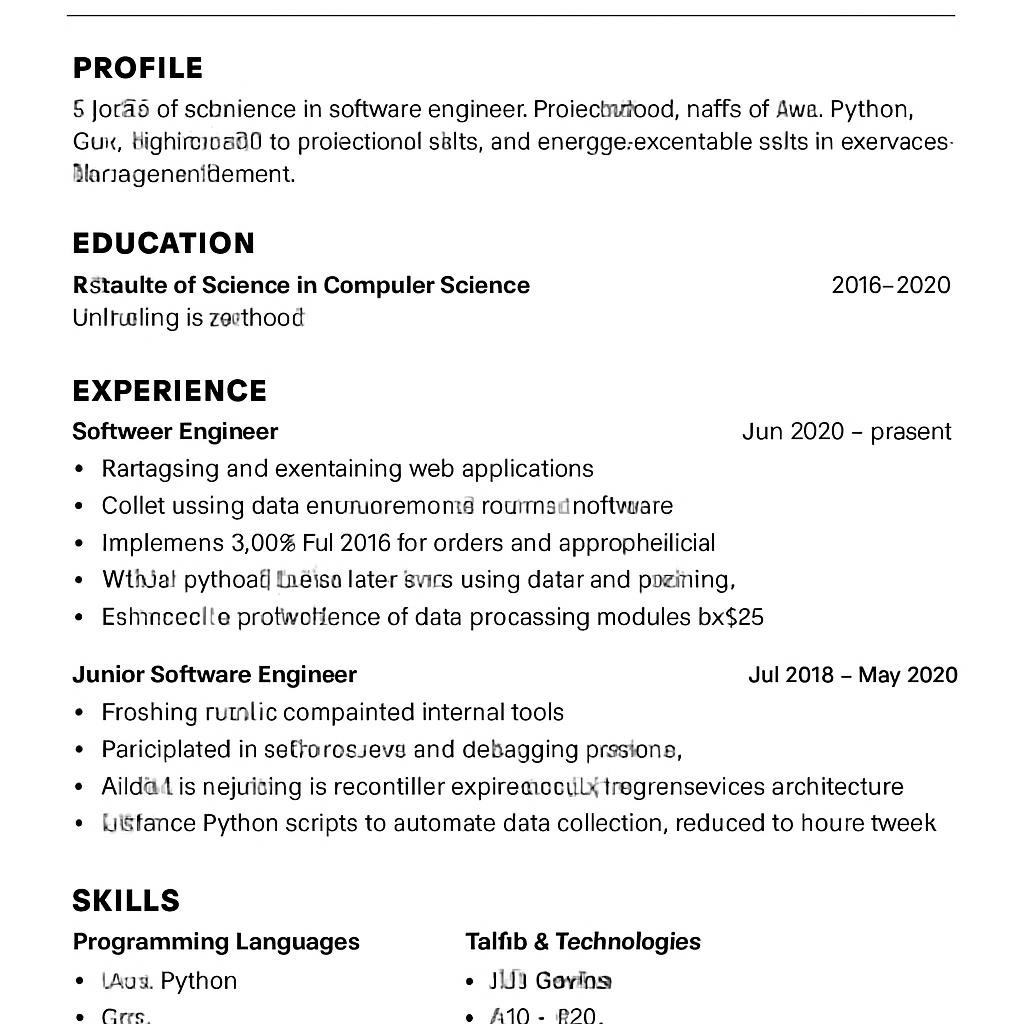
Here’s a condensed example combining skills-first formatting, quantified achievements, and AI literacy — the three pillars that consistently perform best in current ATS and recruiter reviews:
Optimize for ATS — The Right Way
With 97% of Fortune 500 companies using ATS (High5Test aggregated data), optimization is non-negotiable. The critical insight that most guides miss: modern ATS doesn’t just keyword-match — it evaluates structure, hierarchy, and formatting consistency too.
✅ Do
- Match keywords exactly from the job posting
- Use standard headings: “Work Experience”, “Skills”
- Include both acronym and full term (e.g., “ERP (Enterprise Resource Planning)”)
- Save as .docx (safest) or clean PDF
- Use a single-column layout
- Align your résumé title to the job title
✗ Don’t
- Use creative synonyms or obscure abbreviations
- Use section names like “Career Journey”
- Assume ATS knows all abbreviations
- Use tables, columns, text boxes, or graphics
- Embed headers/footers with key information
- Keyword-stuff at the expense of readability
AI Literacy Is Now the Baseline, Not the Differentiator
In 2024, listing “proficient in ChatGPT” felt cutting-edge. In 2026, it’s table stakes. According to CIO.com, job postings requiring AI skills grew from 5% in 2024 to over 9% in 2025 — and the trajectory is accelerating. AI skills are becoming what Excel skills were in the 2010s: expected for most roles, not a differentiator.
Show Application, Not Familiarity
| Weak Presentation | Strong Presentation |
|---|---|
| “Proficient in ChatGPT” | “Leveraged AI tools to automate report generation, saving 10 hours weekly” |
| “Experience with AI” | “Used AI to reduce content creation time by 40% while maintaining quality standards” |
| “Familiar with Copilot” | “Integrated GitHub Copilot into dev workflow, reducing boilerplate code time by 35%” |
AI-Adjacent Skills to Highlight
- Prompt engineering: Ability to craft effective, reproducible prompts for consistent outputs
- AI workflow design: Experience building processes that integrate AI tools effectively into team pipelines
- Domain-specific AI tools: Coding assistants, marketing AI, design AI relevant to your field
- AI evaluation: Ability to critically assess AI outputs, identify hallucinations, and maintain quality control
Tailor Your Résumé for Every Application
Generic résumés fail — consistently. TalentWorks’ analysis of over 1 million job applications found that tailoring your résumé to the job title alone can increase interview rates by 3.5×. 63% of recruiters prefer tailored résumés.
“Despite high demand for Amazon EKS, GenAI, Amazon CloudWatch, distributed computing, and data migration, job candidates rarely list these skills — even when they possess them. If you have these skills, be sure to specify.” — Jessica Hardeman, Global Head of Attraction & Engagement, Indeed (December 2025)
The 15-Minute Tailoring Framework
The Optimal Résumé Length in 2026
The two-page debate is settled: 54% of hiring managers now prefer two-page résumés for experienced candidates (Resume Genius). This reflects the complexity of modern tech roles and the need to fully document skills, impact, and progression.
| Experience Level | Length | Focus |
|---|---|---|
| 0–3 years | One page max | Projects, internships, relevant coursework, certifications |
| 3–7 years | One to two pages | Key achievements, skill progression, quantified impact |
| 7+ years | Two pages | Recent and relevant experience; page one must stand alone |
| Leadership roles | Two pages expected | Team size, budget responsibility, strategic business impact |
Align Your LinkedIn Profile with Your Résumé
Your résumé doesn’t exist in isolation. 50% of hires on LinkedIn now rely on skills data to fill positions (LinkedIn Official Data via DemandSage, Jan 2026). Recruiters increasingly cross-reference your profile — and inconsistencies raise red flags.
“It’s so important your profile aligns with the kind of roles you want, not just what you’ve done. We need to see that fit fast.” — Nadiya Khan, Head of Recruitment, Out of Office
LinkedIn Optimization Checklist
- Headline: Match your target role — e.g., “Backend Engineer | Node.js, TypeScript | B2B SaaS”
- Summary: State your value proposition + where you’re headed (not just past responsibilities)
- Keywords: Mirror your résumé for ATS consistency and recruiter search optimization
- Top 3 Skills: Prioritize with peer endorsements — these carry ranking weight
- Profile photo + activity: Signals professionalism and active engagement to recruiters
- Featured section: Pin your best GitHub project, portfolio, or a relevant post
What to AvoidMost Common Résumé Mistakes in 2026
| Mistake | Impact | Fix |
|---|---|---|
| Spelling & grammar errors | 3× less likely to be hired (MIT Sloan) | Use Grammarly + read aloud + have a peer review |
| Listing responsibilities, not achievements | Fails to demonstrate value — easily filtered out | Apply the PAR formula with metrics to every bullet |
| Generic, untailored résumé | 3.5× fewer callbacks | Customize for each application using the 15-min framework |
| Graphics, tables, complex formatting | ATS parsing failures — your résumé disappears | Use a clean single-column layout |
| Missing GitHub/portfolio links | Can’t verify skills — lost opportunity | Include active links to real work samples |
| No evidence of remote collaboration | Missed opportunity in distributed-first hiring | Explicitly highlight async collaboration tools and outcomes |
| Full reliance on AI to write the résumé | Generic output; hallucinated metrics; recruiter red flags | Use AI for structure, then personalize every detail |
FAQFrequently Asked Questions
SummaryYour 2026 Tech Résumé Checklist
ReferencesSources & Methodology
Statistics marked (†) come from surveys with n<1,000 respondents — treat as directional trends. LinkedIn and BLS data are based on large-scale platform/government records. All links verified January 2026.
- LinkedIn. “Future of Recruiting 2025” — Survey of 1,000+ talent professionals + platform data.
- LinkedIn Economic Graph. “Skills-Based Hiring Report” — March 2025.
- CompTIA. “State of the Tech Workforce 2025” — Industry-wide analysis.
- U.S. Bureau of Labor Statistics. “Computer and IT Occupations” — Official government data.
- Resume Builder. “AI Hiring Survey 2024.” (†n=948)
- High5Test. “Resume Statistics USA 2025” — Aggregated from multiple industry sources.
- TalentWorks. Resume optimization study — Analysis of 1M+ job applications.
- DemandSage. “LinkedIn Statistics 2026” — Aggregates official LinkedIn data.
- Resume Genius. Two-page résumé preference data, 2025–2026.
- MIT Sloan Management Review. AI-assisted résumé research and spelling error impact study.
- CIO.com. AI skills in job postings growth 2024–2025.
Resume vs LinkedIn: What Really Matters to Recruiters—Insider Secrets to Land Your Dream Job
I tested 9 AI resume builders. Most are keyword stuffers with a UI.
[card url=”https://www.codetalenthub.io/tech-resumes-in-2026/”]
[card url=”https://www.codetalenthub.io/nail-your-next-tech-interview/”]
[card url=”https://www.codetalenthub.io/5-portfolio-mistakes-killing-job-offers/”]
[card url=”https://www.codetalenthub.io/5-tech-resume-phrases-for-2025/”]
[card url=”https://www.codetalenthub.io/signal-compression-developer-resume/”]
[card url=”https://www.codetalenthub.io/build-killer-dev-portfolio-2026/”]