

Why Your Developer Portfolio Isn’t Getting Interviews in 2026
Five fixes, ranked by how much they actually cost you, with the numbers traced to their sources.
By CodeTalentHub Editorial · Updated September 30, 2026 · 11 min read
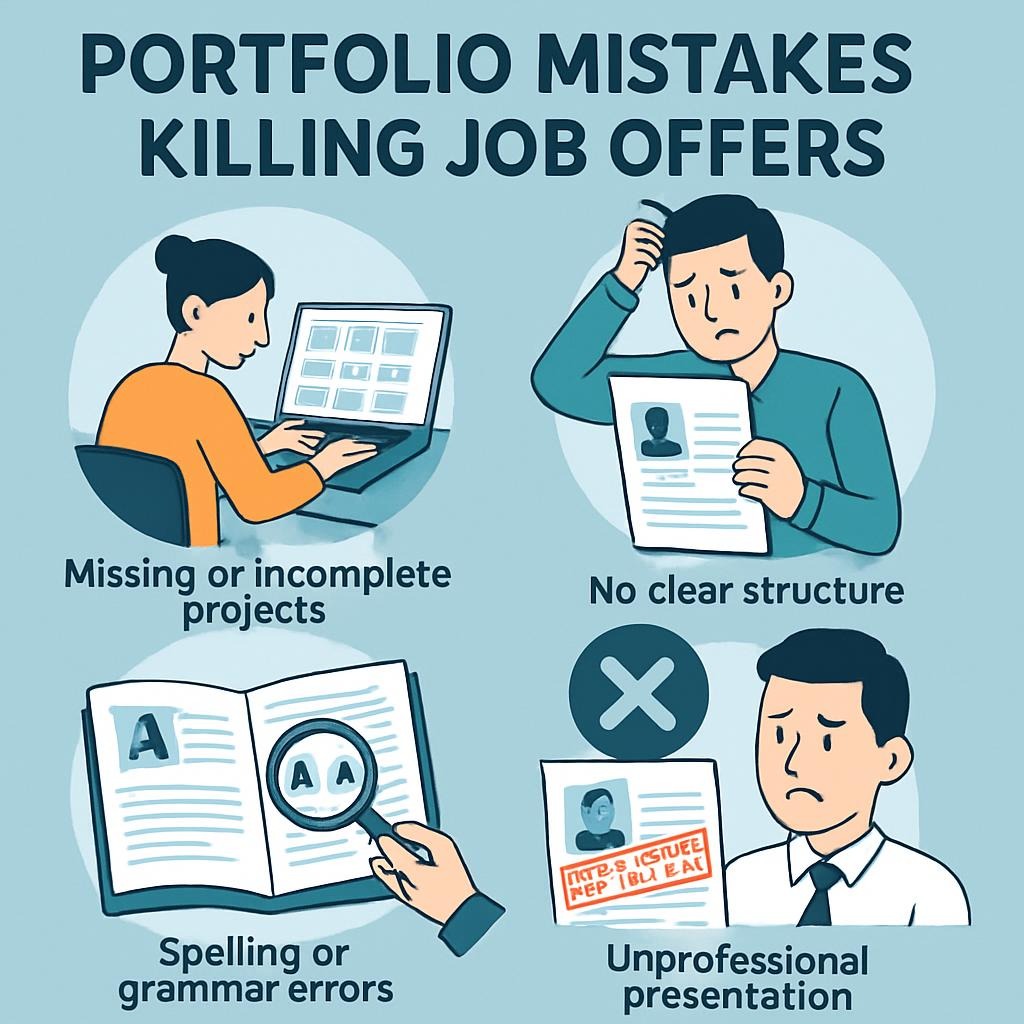
The short answer The junior market is not dead, but it is lopsided. Developer job postings are recovering from a deep trough, and most of the recovery is in senior roles. A junior portfolio therefore has one job: to substitute for the years of experience you don’t have. It does that with evidence that is expensive to fake: a measured result, a documented failure, a real user, a reviewed pull request. The five mistakes below are all failures of that one test. I’ve ranked them by damage, not by how often they’re discussed.
The market in numbers (and how much to trust each one)
I traced every statistic in the earlier version of this article back to its original publisher. Several didn’t survive. What follows is what did, graded by the strength of the evidence.
| Claim | Figure | Source | Evidence strength |
|---|---|---|---|
| US software development postings vs. pre-pandemic | 27.5% below the Feb 2020 baseline (June 2026) | Indeed Hiring Lab, July 2026 | Strong. Primary, transparent index, seasonally adjusted |
| Who the 2025–26 rebound is for | 71% of the increase in postings (May 2025 to May 2026) came from senior roles; 37% mentioned AI in the title | Indeed Hiring Lab, as reported by CIO | Strong (primary data, secondary report) |
| Experience requirements creeping up | Postings wanting 5+ years: 37% → 42%. Postings wanting 2–4 years: 46% → 40% (mid-2022 to mid-2025) | Indeed, as reported by LeadDev | Strong |
| Employment of young developers | Software developers aged 22–25: down nearly 20% from the late-2022 peak (through July 2025) | Stanford Digital Economy Lab, “Canaries in the Coal Mine?”, ADP payroll data | Strong for direction. Causation is contested (see below) |
| Entry-level hiring at the 15 largest tech firms | Down 25%, 2023 to 2024 | SignalFire State of Talent 2025, via secondary coverage | Moderate. I couldn’t read the original report |
| “Junior postings down 67%” | 67% | Single aggregator, methodology not published | Weak. Not used as fact here |
A few honest notes on this table.
The Stanford number moves depending on the version you read. The August 2025 working paper reported a 13% relative employment decline for 22–25-year-olds in the most AI-exposed occupations. Later coverage of the November 2025 revision cites 16%. The “nearly 20%” figure is a different measure: the raw decline for young software developers specifically. They are not interchangeable, and plenty of articles mix them up.
Indeed’s “27.5% below” covers all software development postings, not just junior ones. Nobody I found publishes a clean, audited entry-level-only series. Any article that hands you a precise junior-posting collapse percentage is using a proprietary or unexplained source. The earlier version of this article did exactly that, with an unsourced “35–40%.” It’s gone.
The non-obvious part: code got cheap, so proof got expensive
Most commentary stops at “AI is hurting junior hiring.” The Stanford team’s own follow-up note found that interest rates don’t explain the disproportionate fall in entry-level hiring in AI-exposed jobs. That supports AI exposure as a real factor. It does not isolate it. What would settle it is firm-level hiring data by seniority, matched to the date each firm adopted AI coding tools. That dataset doesn’t exist publicly yet, so treat the causal story as probable, not proven.
What the evidence does support is a distinction I rarely see made: the market hasn’t lost its appetite for engineers. It has lost its ability to cheaply tell which juniors can do the work.
A polished to-do app, a clean README, a fluent cover letter: a model can produce any of them in minutes. So hiring managers discount all of them. What they can’t discount is evidence that is costly to manufacture:
- a number you measured before and after a change
- a failed approach you documented honestly
- a person who used the thing and said so
- a pull request a stranger reviewed and merged
That’s the frame for everything below. A portfolio item is worth what it would cost someone to fake.
The five mistakes, ranked by damage
My ranking is analysis, not measurement. No study has tested which portfolio flaws cost the most interviews. I ordered them by two questions: does it undermine trust (fatal) or merely impression (recoverable), and how quickly can a reviewer detect it?
1. Descriptions with no result in them
“Built a React dashboard.” “Implemented authentication.” These tell a reviewer what you typed, not what happened.
The fix is one measured number per project, in the first line of the README. Not invented. Measured.
Illustrative format. The numbers are placeholders, not real results.
❌ “Implemented caching to improve performance.” ✅ “Added Redis caching to the product-search endpoint. p95 latency 1,840 ms → 310 ms under a 50-concurrent-user k6 load test. Method and raw output in
/benchmarks.”
The second version is checkable, which is the whole point. Anyone can run your benchmark folder.
No users? You can still measure. Response time, bundle size, test runtime, build time, memory use, Lighthouse score, query count. All of these are available on a side project with zero traffic. Free tools: k6, hyperfine, Lighthouse CI.
The trap: a number you can’t defend in an interview is worse than no number. Expect the follow-up: what was the baseline, how many runs, on what hardware? If you can’t answer, cut the claim.
2. Claims your repositories can’t back
“Python expert” on the resume and no Python on your profile. “5+ years React” next to a portfolio with no hooks (React 16.8 shipped them in February 2019). Reviewers cross-check because they’ve been burned, and a mismatch reads as dishonesty, not modesty.
I couldn’t find a controlled study measuring how often this gets candidates rejected, so I won’t put a percentage on it. The mechanism is simple enough: it’s a two-minute check, and it breaks trust.
The rule that bites: every skill on your resume must have evidence within two clicks. If it doesn’t, either delete it from the skills list or add a “Currently learning” line pointing to the repo where you’re actually doing it.
| Instead of | Write |
|---|---|
| “Python expert” | “Python: intermediate. One deployed API (link), 40+ tests” |
| “React / Next.js / React Native” | “Proficient: React hooks, context. Comfortable: Next.js routing. Beginner: React Native” |
| “Full-stack” | The specific layers you built, and the one you’d hand to someone else |
3. Tutorial projects
The to-do app, the weather fetcher, the Udemy e-commerce clone. The problem isn’t the tech. It’s that the project answers “can you follow instructions?” and leaves “can you choose a problem and make trade-offs?” blank.
I’m not going to claim recruiters hate these. I found no data on it. The defensible claim is narrower: they carry zero differentiating information, because thousands of identical repos exist, so they can’t help you and may slightly hurt.
Four questions before a project earns a spot:
- Would a stranger recognise this from a course? If yes, cut it or extend it in a direction the course never went.
- Did someone other than me use it?
- Is there a number?
- Is there a section on what I tried that didn’t work?
That last one is the cheapest high-signal move available. A “What didn’t work” section shows iteration, costs you one evening, and is hard to fake convincingly because specifics give fabrication away.
markdown
## Problem(Who had it, how you know. One paragraph.)## Result(One measured number, first.)## Approaches tried1. Approach A: what happened, why it failed2. Approach B: what happened, what limit it hit3. Final approach: why it won, what it still gets wrong## Stack and decisions(Only the decisions that cost you something.)## Limitations(What this doesn't do. Reviewers trust the people who say it.)4. GitHub used as storage, not as evidence
Fifteen half-finished repos, empty READMEs, and commit messages like “fix” and “update” give a reviewer nothing to learn from. I found no published study on how often hiring engineers open a candidate’s GitHub, so I’m not going to say “recruiters always check.” I’d plan on the assumption that a technical reviewer might, and ask whether your profile survives two minutes of scrutiny.
What to do, in order:
- Pin two or three repositories. Archive the rest. Keep one clearly labelled “learning” repo so it doesn’t look like concealment.
- Make your best pinned repo’s README lead with the result.
- Write commit messages that state the reason:
- ❌
update code - ✅
Replace per-row queries with a batched lookup; search page 2.3s → 0.4s
- ❌
- Make one open-source contribution. Documentation counts, and a merged PR in a project you actually use is a reviewed artifact a stranger signed off on, the hardest thing on this list to fake.
Don’t pad the contribution graph with empty commits, and don’t rewrite old commit messages after the fact. Both are easy to spot.
5. Mobile neglect (real problem, wrong statistic)
The earlier version of this article said “60%+ of recruiters view portfolios on mobile.” That is wrong, and I’ll explain why, because the error is instructive.
I checked Statcounter directly. Worldwide, mobile’s share of web traffic was 52.2% in June 2026 and 53.4% in July, with desktop close behind (Statcounter Global Stats). That’s a measure of all web traffic. It says nothing about what device a hiring manager uses when they open your link, and I found no published data on that.
So the honest case for mobile is narrower, and I think still convincing: portfolio links are shared by message and email, and a meaningful number of them get opened on a phone. A broken layout is a cheap, fast competence check, and you fail it in seconds.
| Test | Pass standard | Source |
|---|---|---|
| No horizontal scroll at 360 px wide | Zero | Your own test |
| Tap targets | 24×24 CSS px minimum (WCAG 2.2 AA, SC 2.5.8). Aim for 44×44 (the AAA level, and Apple’s guideline). Material Design suggests 48 | W3C via Smashing Magazine |
| Load on a throttled connection | Content visible in under 3 s | Google’s 2016 study found 53% of mobile visits abandoned past 3 s (Google DoubleClick) |
| Real device | Open it on an actual phone, one thumb | Yours |
Two corrections to the old version. The “44×44 is the WCAG standard” line was wrong: it’s the AAA level, while the AA requirement is 24×24. And the 3-second figure is from a 2016 Google study of 10,000+ mobile domains, so treat it as a pattern, not a current measurement.
Why it’s ranked fifth: it’s the quickest to fix and the least likely to be the thing that loses you an interview on its own. Do it last, but do it.
The 6-hour rebuild
You don’t need a new portfolio. You need fewer, better things. In this order:
| Hour | Action | Done when |
|---|---|---|
| 1 | Pick your two strongest projects. Archive or unlist the rest | Two projects remain visible |
| 2–3 | For each, measure one real before/after number | The number and its method are in the README |
| 4 | Write the “Approaches tried” and “Limitations” sections | Both contain real specifics |
| 5 | Audit your resume against your repos. Remove every unsupported claim | Every skill has evidence within two clicks |
| 6 | Mobile pass on a real phone, then one open-source issue picked | No horizontal scroll; issue bookmarked |
If you’re short on time, do hours 2–3 and 5. Those address the two trust failures. Everything else is polish.
One thing I’d tell a bootcamp graduate specifically: the tutorial-clone assumption is the hurdle you start behind. A single merged PR in someone else’s real codebase contradicts it more directly than another personal project can.
Where this analysis is weak
- Nothing here is experimentally tested. I didn’t run a hiring experiment, and none is cited. The portfolio advice is analysis built on the labour-market data and on how the evidence problem works. The ranking of the five mistakes is my judgment.
- Recruiter screening-time figures are thin. The widely quoted 6–8 seconds comes from Ladders’ 2018 eye-tracking study, which found 7.4 seconds for the initial screen of a resume, not a portfolio. It measures triage, not how long someone reads a résumé they like. The earlier “under 30 seconds for portfolios” figure had no source and is removed.
- Causation is open. AI exposure looks like a real driver of the young-developer decline, but the data to prove it doesn’t yet exist.
- Regional variation is invisible here. Most figures are US data.
FAQ
How many projects should a junior developer portfolio have? Two or three. I found no study setting an optimum, but fewer, better-evidenced projects give a reviewer less to doubt. Each project should have a measured result and a documented failure.
Do recruiters look at GitHub? There’s no reliable published rate. Technical reviewers plausibly do, and non-technical screeners less often. Build it to survive two minutes of scrutiny and you’re covered either way.
Is the junior developer market really that bad in 2026? It’s weak at the bottom and improving at the top. US software postings are still 27.5% below the pre-pandemic baseline, and most of the recent growth is senior and AI-related. Employment among 22–25-year-old developers fell nearly 20% from its late-2022 peak.
How do I get metrics if nobody uses my project? Measure performance: latency, bundle size, build time, query count, test runtime, Lighthouse score. Record the baseline first, change one thing, measure again, and publish the method.
Are templates acceptable for a portfolio site? For back-end and data roles, yes. Put your effort into project depth. For front-end roles, a custom build is itself evidence of the skill you’re claiming.
Should I include team projects? Yes, and state exactly what you built. “Built the auth service and database schema for a team of four” is checkable through commits and PRs; “worked on the project” isn’t.
Sources
- Indeed Hiring Lab: software development postings rebound from a low starting point (July 2026)
- Indeed Hiring Lab: US labor market snapshot, June 2026
- CIO.com: IT hiring sees a boost as software development jobs slowly bounce back
- LeadDev: What happens when learn to code fails a generation
- Brynjolfsson, Chandar, Chen, Stanford Digital Economy Lab: Canaries, interest rates, and timing (Feb 2026), follow-up to the “Canaries in the Coal Mine?” working paper
- Statcounter Global Stats: mobile vs desktop worldwide
- Google / DoubleClick: The Need for Mobile Speed (2016)
- Smashing Magazine: Minimum WCAG-conformant interactive element size
- HR Dive: Ladders 2018 eye-tracking study
Editorial policy: figures are attributed to the publisher that produced them. Where I could only read secondary coverage of a primary source, the table says so. Claims I couldn’t source were removed, not softened. Corrections: [email protected].
→ Get a free portfolio review from the CodeTalentHub team