
Creative Freelancing · Platform Guide · Updated August 2026
15 Creative Freelance Platforms in 2026, Ranked by What They Actually Cost You
The full fee math, client-quality trade-offs, and AI-saturation reality for designers, writers, illustrators, and artists — plus an interactive matrix, a downloadable comparison PDF, and a calculator for what a multi-platform stack actually nets you.
If you need one recommendation right now: designers and illustrators get the best fee-to-client-quality ratio from Contra (0% commission) paired with Dribbble or Behance for portfolio discovery; writers still do best on Upwork, where the B2B content budget actually lives; and senior creatives in any discipline should apply to Toptal, Braintrust, or Working Not Working now, even before they qualify, because the queue and vetting process take months.
- Lowest freelancer-side fees: Toptal, Braintrust, Working Not Working, Behance, ArtStation job board — all 0% direct to the freelancer (the cost is shifted to the client instead).
- Highest freelancer-side fees: Fiverr (20% flat, no volume discount) and the first tier of PeoplePerHour (20% on a new client relationship).
- Best for writers specifically: Upwork, by a wide margin — most of this list treats writing as an afterthought.
- Best for entertainment-industry artists: ArtStation, non-negotiable if you work in games, film, or animation.
“Gig platform” is usually defined as a marketplace where freelancers find clients. That’s the brochure definition. The operational definition is: a software company that charges you somewhere between 0% and 20% of every dollar you earn — or charges your client instead — in exchange for access you could theoretically build yourself, but probably won’t, because organic client acquisition takes years and most people don’t start early enough.
That distinction matters more in 2026 than it ever has, for one specific reason: AI-generated creative work is flooding the bottom of every major platform. Clients who once paid $200 for a logo are getting three AI-generated options for $15 and asking a human designer to “just refine” one. The platforms haven’t solved this. Several have quietly pivoted to surfacing AI-assisted freelancers higher in search results, because those freelancers deliver faster and generate more completed orders — which improves platform metrics regardless of what it does to median human earnings.
I pulled fee data directly from each platform’s own pricing pages and terms of service, then cross-checked it against 2026 fee-tracking coverage and freelancer community reports, because platform pricing pages and the guides that describe them frequently disagree — Upwork’s May 2025 shift from a tiered commission to a variable per-contract fee is a good example; plenty of 2026 content still describes the old system as current. Where a platform doesn’t publish a number (Toptal’s client markup, for instance), I’ve said so rather than guessing.
If you’re a designer, writer, illustrator, or photographer building a freelance income in this environment, the platform question isn’t “which one has the most clients.” It’s “which one doesn’t punish me for being good at what I do — and what does it actually cost me to find out.”
The “Passive Income From Gigs” Myth — And What’s Replaced It
The idea that creative freelancers can post work on a platform and passively receive client inquiries was never quite true, but it felt true during 2019–2022, when demand outpaced supply on platforms like Upwork and Fiverr. That equilibrium broke down. Upwork’s own figures put its freelancer base above 18 million. Fiverr’s gig model, which it pioneered, now hosts categories so saturated that logo design and basic copywriting have commoditized to the point where a new account can expect close to zero organic discovery for three to six months.
What’s passive now is the race to the bottom. What’s active is the escape from it.
“I paid Upwork over $8,400 in fees the previous year. Moving my top five clients off the platform was the best financial decision of my freelance career.”
— Independent designer, via SmartRemoteGigs community review, 2026The correction to the myth isn’t “gig platforms are bad.” It’s narrower: gig platforms are a client-acquisition channel with a recurring cost attached, and that cost compounds. A designer doing $80,000 a year on Upwork at an effective 10% rate is paying roughly $8,000 annually for client access — before Connects, contract-initiation friction, and withdrawal fees. That’s a marketing budget most small agencies would consider aggressive.
What changed about Upwork’s fee, specifically
Since May 1, 2025, Upwork no longer uses the tiered structure that many still-circulating guides describe (20% on the first $500 with a client, 10% up to $10,000, 5% above). It now charges a variable freelancer service fee between 0% and 15%, set per contract at the time you submit a proposal, based on factors Upwork doesn’t fully publish. Most freelancers report an effective rate close to 10% across a typical mix of contracts. I’m flagging this specifically because I checked five separate 2026 sources while researching this piece and found three still quoting the old tiered numbers as current — worth remembering any time you’re reading fee comparisons, including this one, months after publication.
The Full 15-Platform Fee Comparison
This is the complete table — every platform covered in this guide, with its actual fee mechanism, not just a headline percentage.
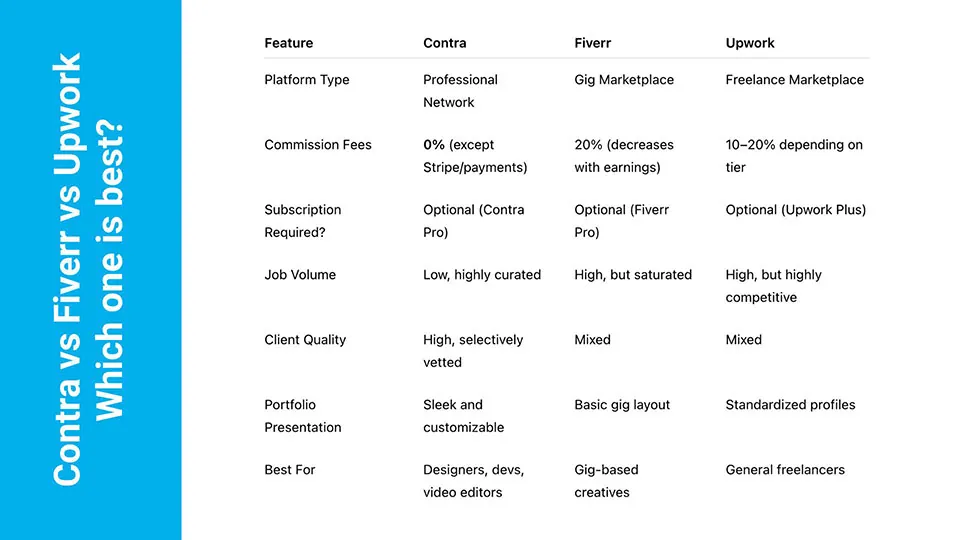
| Platform | Freelancer fee | Who pays | Discipline fit |
|---|---|---|---|
| Fiverr | 20% flat | Freelancer | Designers, writers |
| Upwork | Variable 0–15% (~10% typical) | Freelancer | Broad; strong for writers |
| Contra | 0% + Stripe ~2.9%+$0.30 | Freelancer (processing only) | Visual design, illustration |
| 99designs | 5–15% tiered (1-to-1); client +5% | Both | Brand & logo design |
| ArtStation | 0% job board / 30% Marketplace | Freelancer (Marketplace only) | Concept art, 3D, VFX, games |
| Working Not Working | 0% | Client (access fee) | Senior creatives, all disciplines |
| Freelancer.com | 10% or $5, greater of | Freelancer | Entry-level design, writing |
| Toptal | 0% (client markup ~20–50%) | Client | Senior devs, UX, finance |
| Braintrust | 0% (client pays 15% flat) | Client | Senior tech & design |
| Dribbble | 3.5% free / 0% with Pro ($4–99/mo) | Freelancer | UI/UX, illustration, branding |
| Behance (Adobe) | 0%, free portfolio + job board | N/A | All visual disciplines |
| PeoplePerHour | 20% → 7.5% → 3.5% by client spend | Freelancer | UK design & writing |
| Malt | 7.5–20% tiered by billings | Freelancer | EU freelancers (France, Germany) |
| Guru | 5–9% by membership tier | Freelancer | High-volume generalists |
| Contena | Subscription, no per-project cut | Freelancer (subscription) | Freelance & content writers |
The math below uses a $1,000 project because it’s clean, not because it’s representative. The real damage is visible at scale. A mid-career designer billing $80K a year on Fiverr permanently hands over $16,000 a year to Fiverr’s shareholders. That number doesn’t shrink at a higher earning tier, because Fiverr has no higher earning tier. The 20% is flat, from the first dollar to the millionth.
Fig. 1 — Annual fee burden for a freelancer earning $60,000/year, by platform. The “$0” platforms aren’t free — the cost just moves to whoever’s paying the invoice.
The Nine Platforms Worth a Full Profile
These are the platforms where the fee structure, client base, or discipline fit is complicated enough to need more than a table row. I’m going through each with one question in mind: what does this actually cost someone who is already good at their craft?
Fiverr works well for creative work that fits cleanly into a deliverable box: logo, banner, resume rewrite, voiceover, short-form copy. The productized model — you set a package, clients buy it — removes negotiation friction. That’s a real advantage when starting out or when scope is predictable.
The 20% doesn’t feel painful at $150 gigs. It becomes structural at $3,000 brand identity projects, where you’re handing Fiverr $600 for nothing beyond using their checkout page. Many senior designers use Fiverr only for intake — meet the client on-platform, then migrate off for subsequent work.
- Fast client discovery for new accounts
- Productized, defined-scope services
- Fiverr Pro (vetted) commands higher rates
- Flat 20% with zero loyalty discount
- AI-generated work flooding creative categories
- Price-war dynamics in oversaturated niches
Upwork is where the serious budget lives. Enterprise clients, funded startups, and agencies all use it as a staffing layer. Competition is brutal at entry level, but experienced freelancers with strong portfolios and a track record of Upwork earnings tend to get matched with better clients than they’d find cold-prospecting alone.
The catch with the 2025 fee change: you don’t know your exact rate until it’s shown at proposal or offer stage, which makes it harder to price work in advance. Connects (proposal credits) cost roughly $0.15 each and are non-refundable if you don’t win the job, which is a real, if small, cost of doing business.
- Long-term retainer work and repeat clients
- Enterprise and agency budgets
- Copywriters and UX writers at mid-senior level
- Connects credit system, non-refundable per lost bid
- 18M+ competitor pool — discovery is hard
- Fee not knowable until proposal stage
Toptal’s pitch — “you keep 100% of your rate” — is true as far as it goes, and it’s the reason serious professionals take the screening seriously. But it’s not the whole picture: Toptal marks up what the client pays, and that markup isn’t published. “No commission for freelancers” means the fee moved to the client’s invoice, not that it disappeared.
Screening accepts roughly 3% of applicants and takes two to five weeks — live expert interviews, technical assessments, project simulations. It covers developers, designers (UX/UI, product), and finance specialists; there’s no meaningful writing or illustration track. Client rates run $60–$200+/hour, which filters for well-funded companies by design.
- Senior UX/product designers, 5+ years’ experience
- Access to Fortune 500 and funded-startup budgets
- You set and keep your full quoted rate
- ~3% acceptance rate; 2–5 week screening
- No writing, illustration, or entertainment-art tracks
- Client markup isn’t disclosed — it shapes which clients can afford you
Braintrust is a token-governed network connecting senior tech and design freelancers with enterprise brands — its client list includes Nike, Nestlé, Porsche, and Goldman Sachs. Talent keep 100% of their invoiced rate; the platform’s revenue comes entirely from the client-side 15% fee, which is transparent and doesn’t fluctuate per contract the way Upwork’s does.
The honest trade-off: unlike Toptal, Braintrust doesn’t do heavy independent vetting — the community model means you’re doing more of your own client screening. The blockchain-governance layer (BTRST tokens) is largely irrelevant to day-to-day freelance use unless you want to participate in platform governance.
- Senior developers and product/UI designers
- Freelancers who want transparent, fixed client-side fees
- Enterprise clients with real budgets
- Lighter vetting than Toptal — do your own client diligence
- Design track skews product/UI, not illustration or branding
- Smaller network (~600K members) than Upwork’s scale
Contra’s zero-commission model isn’t marketing fiction — it’s real, with the caveat that Stripe’s processing fee still applies. On a $1,000 project, you keep about $971. On Upwork’s ~10%, you keep $900. That $70 difference compounds fast at scale.
The honest limitation, from people who’ve used it for months: Contra’s job board skews heavily toward design and development. Writers report thin relevant listings after months of active searching. The platform is still worth using as a portfolio host and payment tool — clean UI, built-in proposals and contracts — but as a client-discovery engine, it underdelivers outside visual and product disciplines. Contra Pro ($29/month) adds visibility and an AI proposal assistant, but isn’t worth paying before the free tier has generated any inbound.
- Designers migrating existing clients off other platforms
- Visual portfolios (illustrators, photographers, UI/UX)
- Freelancers who already have clients but need invoicing
- Thin job board for writers and non-visual creatives
- Smaller client pool than Upwork or Fiverr
- Approval process reportedly opaque for some applicants
99designs runs two models simultaneously, and the distinction matters. The contest model is speculative work — you submit a design, and get paid only if the client picks you. Contests can attract 60–200 submissions for a $400 prize, which is genuinely difficult for anyone who values their time.
The 1-to-1 model is different: you quote directly, and your platform commission is tiered by your designer level (roughly 5–15%), with the client paying an additional service fee on top. It requires being discoverable in 99designs’ search — a strong portfolio and reviews — so the contest model often functions as the entry point even for designers who ultimately want 1-to-1 work.
- Logo, brand identity, packaging designers
- Contest-tolerant creatives building reviews fast
- Designers wanting a defined 1-to-1 fee structure
- Contest spec work: high effort, uncertain return
- Blind contests non-refundable once final round begins
- Better for isolated projects than ongoing relationships
Dribbble is portfolio-first: clients find you based on the quality of your “shots” (design uploads), not keyword bidding or proposal writing. That model rewards strong, consistent visual work and attracts design-conscious clients. It’s one of the largest designer communities on the internet, with a job board built in.
Pro Lite ($4/mo) or Standard ($8/mo) pay off once you’re actively landing work through the platform; Pro Plus ($99/mo) is the agency tier with team profiles. The most common criticism, echoed across design-community reviews, is that “shots” show polished concepts without real project constraints — pair a Dribbble profile with Behance or a personal site for fuller case-study evidence.
- UI/UX designers, illustrators, brand designers
- Portfolio-based discovery, no bidding required
- Pro subscription drops fees to zero
- No bidding means visibility is everything
- Shots alone can look like concepts without real constraints
- Free-tier client fee (5%) plus payment processing adds up
ArtStation occupies a specific, non-interchangeable niche: concept art, character design, 3D modeling, VFX, and game illustration for entertainment-industry pipelines. If that’s your discipline, there’s no better portfolio host on the internet — AAA studios, film VFX houses, and animation studios actively recruit from it.
The ArtStation Marketplace (brushes, textures, tutorials, 3D assets) takes 30%, which is steep. The job board is where the real value sits for working artists: free to browse and apply, with client quality at the top end significantly higher than general-purpose platforms. With AR/VR design becoming a standard enterprise requirement in 2026, ArtStation’s talent pool has become relevant beyond gaming into corporate spatial design.
- Concept artists, 3D modelers, VFX artists
- Anyone seeking studio work in games, film, animation
- Selling tutorials or digital assets passively
- 30% marketplace fee on digital asset sales
- Irrelevant for writers or non-visual creatives
- Intense competition at senior creative levels
Working Not Working is invite-only, which immediately disqualifies it for anyone who needs clients this week. But it answers a specific question: “Where do Nike, Google, Apple, and Spotify find contract creative directors, senior copywriters, and art directors on short notice?” This is that place.
Coverage spans designers, copywriters, illustrators, and animators — genuinely broad creative disciplines. Getting in requires either a referral from a current member or applying and waiting, sometimes several months. It’s not a platform for building a career; it’s a platform for someone whose career is built and wants inbound from clients who can actually afford them.
- Senior creative professionals (5+ years)
- Designers and copywriters targeting agency/brand work
- Those with a client base wanting zero fees
- Invite-only — no immediate self-onboarding
- Geographic concentration (US/UK heavy)
- Not a replacement for junior-to-mid acquisition channels
Six More Worth Knowing — Specialist and Niche Platforms
These don’t need a full profile, but each solves a specific problem the nine above don’t.
Competitive bidding marketplace — you submit proposals, compete on price. The $5 minimum hits small projects hardest (a $20 project effectively costs 25% in fees). Best for entry-level designers and writers comfortable with bidding wars.
UK-centric marketplace with a tiered fee that improves as billings with one client grow: 20% on the first £250, 7.5% up to £5,000, then 3.5% above. Strong for UK-based designers and writers; a steep entry cost before it gets cheaper.
The dominant freelance marketplace in France and Germany, with direct client relationships and a workstream model. Fees run 7.5–20% depending on total billings with a given client. Limited relevance outside continental Europe.
The lowest fee among traditional bid-based marketplaces, scaling from 5% to 9% depending on membership plan. Smaller, less brand-recognized client pool than Upwork or Fiverr, but a real option for high-volume generalist freelancers.
Adobe’s free portfolio and job-board platform for visual creatives — over 50 million members. No built-in payments, escrow, or dispute resolution, so it functions as a discovery and credibility layer rather than a transaction platform.
A curated job board specifically for freelance and content writers, priced as a subscription rather than a per-project commission. You pay for access before you’ve landed a client — worth it only if you’ll actually work the leads.
Interactive Tool: Platform × Specialization Matrix
Filter the full 15-platform list by your discipline to see, at a glance, which platforms are actually built for the kind of work you do — not just which ones are popular.
| Platform | Designers | Writers | Illustrators/Artists | Photographers | UX/Product |
|---|---|---|---|---|---|
| Fiverr | Strong | Strong | OK | Niche | Weak |
| Upwork | Strong | Strong | OK | OK | Strong |
| Contra | Strong | Thin | Strong | OK | Strong |
| 99designs | Primary | N/A | Illustrators | N/A | OK |
| ArtStation | Specific only | N/A | Primary | N/A | N/A |
| Working Not Working | Strong | Strong | Strong | OK | Strong |
| Freelancer.com | OK | OK | OK | OK | OK |
| Toptal | N/A | N/A | N/A | N/A | Primary |
| Braintrust | Product UI | N/A | N/A | N/A | Primary |
| Dribbble | Strong | N/A | Strong | N/A | Strong |
| Behance | Strong | N/A | Strong | Strong | OK |
| PeoplePerHour | Strong (UK) | OK (UK) | OK | OK | OK |
| Malt | Strong (EU) | OK (EU) | OK | OK | OK |
| Guru | OK | OK | OK | OK | OK |
| Contena | N/A | Primary | N/A | N/A | N/A |
AI-Resistant Niches — What Won’t Be Replaced in 2026
Every platform-strategy conversation in 2026 eventually runs into the same wall: AI tools have compressed the bottom tier of nearly every creative category, and no amount of platform optimization fixes that. The more useful question is which parts of creative work are structurally resistant to that compression — not because AI can’t produce something that looks similar, but because the value being paid for isn’t the output alone.
The practical implication isn’t “avoid AI-adjacent categories entirely” — it’s to price and position your work around the parts of it that are structurally resistant to compression: your access, your accountability, your live judgment, your taste. Platforms like Working Not Working, Toptal, and Braintrust already select for exactly these attributes, which is part of why their client budgets have held up better than the commodity tiers of Fiverr and Freelancer.com.
Fig. 2 — Platform strategy isn’t static. Where you start is not where you should still be in three years.
The Part That Invalidates Simple “Best Platform” Lists
Here’s the nuance every comparison article on this topic either buries or skips: the best platform for you is the one where the ratio of your effort to client quality is highest. That ratio isn’t the same as “low fees,” and it isn’t the same as “large client pool.” Those are inputs. The output — client quality you can actually access — is determined by your discipline, your career stage, and your portfolio’s current depth.
A working illustrator with a strong ArtStation portfolio and six years of entertainment credits gets zero useful results from Fiverr, where their work gets algorithmically deprioritized because they have no reviews yet. The same illustrator on ArtStation is a known quantity in a system designed to surface known quantities.
A mid-career copywriter considering Contra will find a platform that’s beautiful to use, charges nothing, and shows three relevant job listings a month. They’ll find Upwork noisy, expensive, and full of $12/hour writing requests — but also the only place where B2B tech companies post $8,000 white-paper projects. Those projects exist. Accessing them requires knowing which search parameters to use and accepting that ~10% is the cost of admission.
In mid-2026, AI-generated content is flooding the bottom tier of every major creative platform. Logo design, stock illustration, short-form copywriting, and basic social visuals have all seen median gig prices drop as AI-assisted freelancers undercut human-only pricing. This isn’t abstract — it’s happening in the exact categories where new creative freelancers typically start. The mitigation isn’t competing on price. It’s specializing earlier and at a higher tier than feels comfortable. See the AI-Resistant Niches section above for where that tier tends to sit.
The Multi-Platform Stack Most People Actually Run
Almost no working creative freelancer uses a single platform exclusively. A realistic 2026 stack for a mid-career designer: an active Upwork profile with three to five long-term clients never moved off-platform, a Contra profile with a clean portfolio and one or two direct clients who pay through it because it’s easier than invoicing, a Dribbble Pro presence for portfolio-driven inbound, a 99designs 1-to-1 profile generating occasional brand-identity leads, and an application in progress at Toptal or Braintrust for the enterprise tier.
Writers tend to stack differently: Upwork for the B2B content and thought-leadership budget (real and significant if you know where to look), Contena for curated leads, LinkedIn for direct prospecting, and — for senior writers — Working Not Working or direct agency relationships with ongoing editorial needs. Platforms like Textbroker and iWriter, common recommendations five years ago, have largely been abandoned by anyone charging professional rates; AI has compressed those categories past the point of viability for skilled humans.
Interactive Tool: Multi-Platform ROI Calculator
Enter your target annual freelance revenue and how you’d split it across up to three platforms plus direct clients. The calculator applies each platform’s representative effective fee rate and shows what you’d actually keep, compared with running everything through a single platform.
What the Platform Fee Math Doesn’t Capture
The fee comparisons above make the zero-commission platforms look like obvious winners on pure math. But fee percentage isn’t the whole calculation. Three things the math misses:
Client quality variance. Upwork’s client pool includes a meaningful segment of high-budget, well-scoped projects that don’t appear elsewhere. A ~10% commission on a $15,000 brand strategy project is $1,500. Finding that client through direct outreach instead costs hours of prospecting time at whatever your effective hourly rate is. For many freelancers, paying that commission is still the better trade than the time cost of replacing it.
Payment protection and dispute handling. Platform fees fund escrow, payment protection, and dispute-resolution infrastructure. Contra’s zero-commission model routes payments directly through Stripe — if a client disappears mid-project, your recourse is Stripe’s dispute process, not a platform with a financial interest in maintaining its marketplace reputation. This matters less for small projects and a great deal for projects over $5,000.
Discovery isn’t free. Working Not Working’s zero-fee model is real, but getting into it costs reputation-building time. ArtStation’s zero-fee job board is real, but building the portfolio that generates inbound there costs years. Contra’s zero-commission payments are real, but generating inbound through its job board has proven disappointing for non-visual disciplines. The fee you pay on Fiverr or Upwork is partly buying discovery you haven’t yet built organically.
The honest framework: use higher-fee platforms while your organic reputation is insufficient to replace them, and systematically move clients off-platform as your reputation grows. At a certain point — different for every freelancer, but roughly $80,000–$100,000 in annual billings — the math on platform fees versus the time cost of direct client acquisition tips toward going direct.
That point isn’t week one. And it’s not where most platform comparison articles leave you.
One More Thing Before You Optimize Your Stack
Every platform in this piece is optimized around a client-freelancer transaction. What makes long-term creative careers sustainable isn’t transaction optimization — it’s reputation accumulation that makes clients seek you out rather than the reverse.
CodeTalentHub’s talent placement work operates on exactly this principle: the most valuable creative professionals aren’t the ones on the most platforms, they’re the ones whose work is known well enough to generate referral demand. Platform strategy is a means to that end, not the end itself. The creatives insulated from platform-fee changes, algorithm shifts, and AI commoditization in 2026 are the ones with reputations that exist independent of any marketplace.
That’s a longer play. But it’s the only one without a commission attached.
This Works. Except When It Doesn’t.
Everything above holds for creative freelancers in English-language markets — primarily US/UK/Canada/Australia, with Malt covering France and Germany — working with clients who have professional design and content budgets. That’s a large but specific population.
If you’re a creative in a developing market where platform fees represent a different proportion of local income math, working in a language where platform client pools are thin, or in a discipline — ceramics, textile design, fine art, live mural work — that doesn’t translate to digital deliverables at all, most of this piece doesn’t apply to you. Platforms like Etsy and Society6 occupy a completely separate model (digital/physical goods, not service delivery) that deserves its own treatment.
And if you’re a writer hoping one of the newer platforms in this list is secretly great for writers: Upwork is still the honest answer, with Contena as a curated supplement. The rest have writing tacked on as an afterthought, or don’t have it at all. I haven’t found reliable data on which platform will close that gap first. My observation, reviewing Contra’s own job-board activity, is that it’s aware of the problem and expanding categories — but awareness and shipping are different things, and it’s August 2026.
Fee figures throughout this piece come from each platform’s own pricing pages and terms of service, checked directly rather than taken from secondary summaries, because — as the Upwork example above shows — a meaningful share of 2026 coverage still describes fee structures that changed over a year ago. Where a platform doesn’t publish a number, like Toptal’s client-side markup, I’ve said so rather than estimating a false precision. The one limitation worth naming honestly: platform fee schedules change without much notice, and a few of the tiered figures here (PeoplePerHour, Malt, 99designs) are blended estimates rather than a single published rate, since the real number depends on how your billings are distributed across clients.