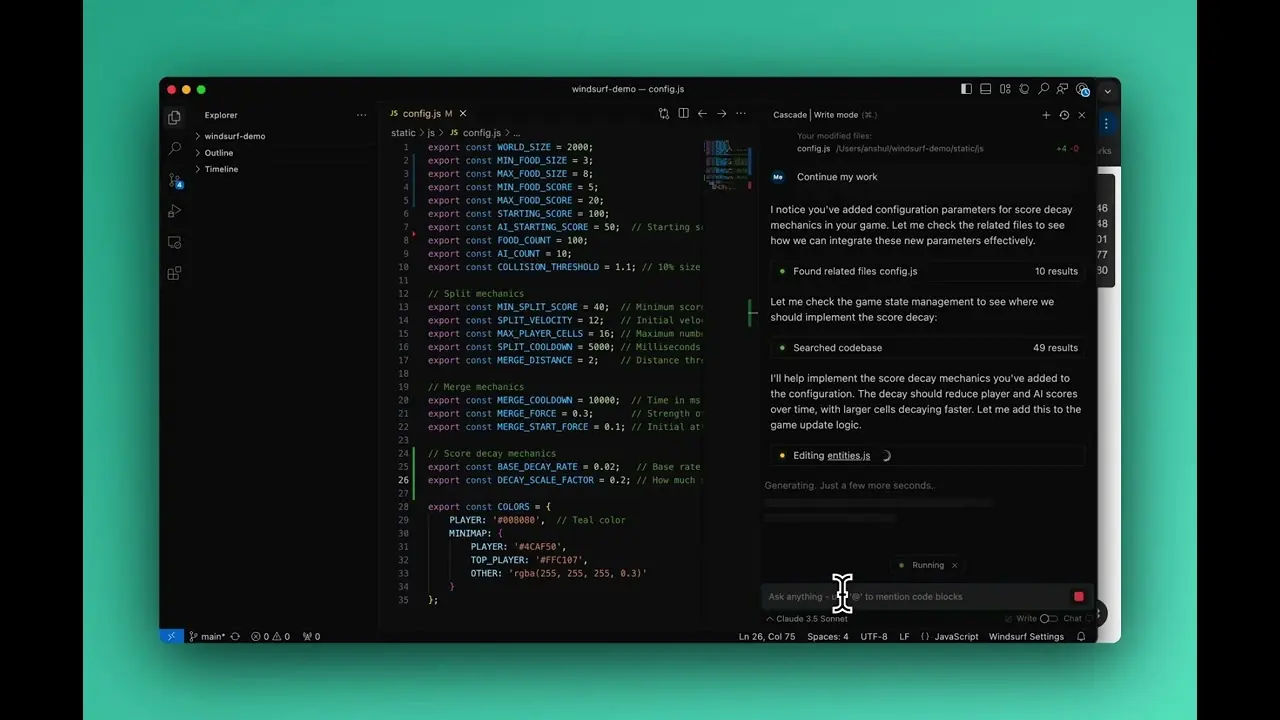

Cursor vs. GitHub Copilot vs. Windsurf
This comparison isn’t really “three editors” anymore. It’s a Microsoft-governed extension, a Cognition product wearing the Devin brand, and — as of two weeks ago — a SpaceX subsidiary. Here’s what actually changed, what it costs, and what I’d put in front of a new hire tomorrow.
An earlier version of this piece dated the Codeium→Windsurf company rename to November 2024 and didn’t mention that SpaceX had acquired Cursor. Both are fixed below: November 2024 was when Codeium launched the Windsurf Editor as a product — the company itself didn’t rename to Windsurf until April 2025. And the SpaceX deal, which closed while I was writing the first draft, changes the framing of this whole article. Leaving this note up rather than quietly editing it out.
If you last looked at this category a year ago: the “cheap standalone editor” you remember has changed hands twice and changed its name twice. And the editor you probably think of as the scrappy independent one is now owned by the same company that just had the biggest IPO in history. Most comparison posts you’ll find today were written before one or both of these landed. I’ll flag it every time it matters below.
- Cursor is no longer an independent company. SpaceX bought parent company Anysphere for $60B in an all-stock deal (announced June 16, closed mid-August 2026); Cursor now runs under a new “SpaceXAI” division with access to SpaceX/xAI’s Colossus compute. Pricing is unchanged for now, but the ownership question belongs in your risk calculus.
- GitHub Copilot ($10–$100/mo, $19–$39/seat) wins on distribution and on “my company already approved it,” not on raw editing power.
- Windsurf no longer exists as a brand either. It’s now Devin Desktop, owned by Cognition, priced identically to Cursor Pro at $20/mo — the price advantage that used to be its whole pitch is gone.
- All three route requests to overlapping frontier models under the hood. The product and now the parent company, not the model, is what you’re actually betting on.
The pricing, as of this week Established
Every one of these tools has changed its billing model at least once in 2026, so treat any price you see on a screenshot older than a couple of months as suspect. Here’s what’s on the vendors’ own pricing pages right now.
| Plan tier | Cursor | GitHub Copilot | Devin Desktop (ex‑Windsurf) |
|---|---|---|---|
| Free | Hobby — limited completions | Free — 2,000 completions/mo | Free — unlimited Tab, light agent quota |
| Entry paid | Pro — $20/mo | Pro — $10/mo | Pro — $20/mo |
| Power user | Pro+ — $60/mo | Pro+ — $39/mo | Max — $200/mo |
| Top individual | Ultra — $200/mo | Max — $100/mo, verified directly on GitHub’s own pricing page | — |
| Team seat | Teams — $40/user | Business — $19/seat | Teams — $80 base + $40/seat |
| Org | Enterprise — custom | Enterprise — $39/seat | Enterprise — custom |
Sourced from vendor pricing pages and cross-checked against multiple independent trackers, verified June–July 2026.[1–5] All three now bill premium usage on a credits/token basis rather than flat request counts — Copilot switched on June 1, 2026; Cursor moved to credits in mid-2025; Devin Desktop dropped its old credit system for daily/weekly quotas in March 2026.
Notice what happened to Windsurf’s pricing specifically: its Pro plan was $15/month for most of its life — the reason half the internet still calls it “the cheap one.” Cognition raised it to $20 on March 19, 2026, matching Cursor exactly, months before the rename even shipped. If a comparison chart you’re reading still lists Windsurf at $15, it’s stale.
What actually happened to Windsurf Established
This part is genuinely one of the stranger stories in software M&A this year, and I don’t think most engineering teams clocked it. In May 2025, OpenAI agreed to buy Windsurf for a reported $3 billion. The deal collapsed over Windsurf’s refusal to expose its IP to Microsoft under OpenAI’s existing partnership terms. Within 72 hours, Google stepped in and paid $2.4 billion to license Windsurf’s technology and hire away CEO Varun Mohan, co-founder Douglas Chen, and roughly 40 senior R&D staff — a non-exclusive licensing deal structured specifically to sidestep the antitrust review a full acquisition would trigger. Three days later, Cognition (maker of the Devin coding agent) bought what remained: the product, brand, trademark, IP, and the ~210 employees Google didn’t take, for a reported sum around $250 million.[6–8]
Cognition ran it as a standalone “Windsurf” brand for eleven months, then folded it into its own product line as Devin Desktop on June 2, 2026. Same editor, same VS Code fork, same settings — Cascade, the original in-editor agent, was retired on July 1, 2026, replaced by “Devin Local.” If you’re evaluating this tool today, you’re evaluating a Cognition product with Codeium’s original engineering underneath it, not an independent company anymore. One note on the deal price: Cognition never disclosed a figure, and TechCrunch’s own reporting lists it as undisclosed — the “~$250 million” you’ll see cited around the web, including earlier in this piece, is VentureBeat’s estimate, not a confirmed number.[14]
The bigger story: Cursor is now a SpaceX company Established
This is the part that should have led this article from the start. On June 16, 2026 — four days after SpaceX’s own record-setting IPO (the largest in stock market history, $75B raised on June 12, 2026) — SpaceX exercised an option, originally signed April 2026, to acquire Anysphere, Cursor’s parent company, for $60 billion in an all-stock deal. Per SpaceX’s own SEC filings, the deal was structured through merger subsidiary “X67 Inc.” and closed on August 14, 2026 — not “mid-August,” the exact date, straight from the filing itself.[15,20,21] Anysphere shareholders converted into roughly 391 million shares of SpaceX Class A stock. Cursor now operates as a wholly owned subsidiary under a newly created “SpaceXAI” division.[16–18]
Context that matters: SpaceX completed its own all-stock merger with Elon Musk’s xAI in February 2026 — a deal that valued the combined entity at $1.25 trillion before the IPO — so this folds Cursor into the same corporate family as Grok and the Colossus supercompute cluster. Reporting from CNBC and the Motley Fool frames the deal as SpaceX buying its way into enterprise AI software revenue — Anysphere reportedly runs near $4 billion in annualized revenue, roughly $2.6 billion of it from enterprise customers — rather than a product decision about the editor itself.[19,22]
Confirmed, as of a post-close check three days after the deal: Cursor’s data processing agreement and subprocessor list — last retrieved mid-August 2026 — still list SpaceXAI as one inference provider alongside, not in place of, OpenAI, Anthropic, and Google Gemini; nothing in the DPA’s change-of-control language has shifted yet, though the DPA does carry a 30-business-day notice window for future changes.[23] Cursor also shipped a new feature (Origin, code hosting) three days after close — evidence of continued independent product velocity, at least so far.
Still genuinely open: whether that subprocessor mix changes once integration deepens, and whether xAI model access gets prioritized in the router over time. I’m not asserting an answer to either — I’m telling you what’s confirmed today so you can re-check it yourself before you standardize on this tool long-term.
Where each one actually wins Probable
I’m hedging the badge here on purpose — this section leans on independent reviewer testing and hands-on comparisons rather than vendor claims, and reviewers disagree at the margins even when they agree on the shape of it.
| Where it shows up | Cursor | Copilot | Devin Desktop |
|---|---|---|---|
| Multi-file agentic edits | Strongest — parallel subagents, cloud sandboxes[9] | More conservative, tied to Agent Mode/Workspace[9] | Competitive; Cascade/Devin Local parallelizes some steps[10] |
| Single-line completion | Matches Copilot in most languages[10] | Slight edge from GitHub’s training corpus[10] | Occasionally stylistically off in less common languages[10] |
| Where it’s distributed | Standalone editor only | Extension — works in VS Code, JetBrains, Visual Studio, Neovim[2] | Standalone editor + JetBrains/Vim/Neovim/Xcode plugin[11] |
| Enterprise fit | Growing SSO/SCIM support | Deepest — GitHub Enterprise, IP indemnity, PR/issue integration built in[2] | SSO gated to Enterprise-only, custom pricing[12] |
The performance-table claims above — Cursor’s editing “strongest,” Copilot’s “slight edge” on single-line completion — trace to independent reviewer testing (buildmvpfast.com, PE Collective), not vendor benchmarks or a benchmark I ran myself. Those sites also optimize for AI-search visibility, same as most of this category, so treat the table as directionally useful, not lab-verified. I also found an otherwise-solid pricing source with an oddly specific “case study” — a suspiciously round ROI number, no named source — while researching this piece and left it out entirely rather than launder it into this article. Read the specific-sounding stats in any AI-coding-tool comparison, including this one, with real skepticism, and check the vendor’s own docs before you buy on the strength of a single blog’s numbers.
The unpopular take
Model access is no longer a differentiator, and most comparison content still treats it like one. Cursor, Copilot, and Devin Desktop all route to overlapping sets of frontier models (Claude, GPT, Gemini, plus each vendor’s own in-house model for speed-optimized completions). The actual decision in 2026 is an org-chart decision, not a tooling decision: do you want a standalone editor your team adopts on its own (Cursor, Devin Desktop) or an extension your existing GitHub governance already covers (Copilot)? I used to tell teams “just pick whichever model is smartest this month” — that was wrong even a year ago, and it’s more wrong now that the model layer has converged.
When not to use any of these
If your team is on a mixed IDE fleet with strict data-residency requirements, Copilot’s tighter GitHub-ecosystem coupling and Enterprise IP indemnity will save you more procurement headache than either standalone editor, even if Cursor edits faster. If you’re a solo developer on a tight budget, don’t assume Devin Desktop is still the cheap option — check current pricing before you commit, because the $15 figure floating around the internet is nine months stale. And if your org’s procurement policy has a clause about vendor independence or avoiding concentration risk with the frontier-lab ecosystem, run Cursor’s new ownership past whoever owns that policy before you standardize on it — that’s a conversation, not a blocker, but it’s a conversation.
FAQ
Is Windsurf still a thing I can install?
No — as of June 2, 2026, it’s called Devin Desktop, owned by Cognition. windsurf.com now redirects to devin.ai. Existing installs, plans, and settings carried over automatically.[13]
Do Cursor, Copilot, and Devin Desktop use different AI models?
Mostly no. All three give you access to overlapping frontier models (Claude, GPT, Gemini families) plus a fast in-house model for low-latency completions. The differentiation is in the editor, agent orchestration, and integrations — not the underlying model.
Which one is cheapest for a solo developer?
GitHub Copilot Pro at $10/month is the cheapest paid entry point of the three. Cursor and Devin Desktop both start their paid tiers at $20/month.
Can I run Copilot and Cursor at the same time?
Technically yes — Cursor allows Copilot as an extension — but two AI completion systems firing on the same keystroke tend to conflict. Pick one for completions; use the other for chat/agent tasks if you want both.
Is GitHub Copilot better for large enterprises?
It has the deepest enterprise integration story because it lives inside the GitHub workflow your org likely already governs — audit logs, IP indemnity, and PR/issue automation are more mature there than in either standalone editor.
What’s “Devin Cloud” and is it the same as Devin Desktop?
No. Devin Desktop is the local IDE (what Windsurf used to be). Devin Cloud is Cognition’s separate autonomous agent that runs tasks asynchronously in the cloud; Cloud access now ships bundled starting on Devin Desktop’s $20 Pro tier.[11]
Did Windsurf’s original team go anywhere?
Yes — CEO Varun Mohan, co-founder Douglas Chen, and roughly 40 senior R&D staff moved to Google as part of the $2.4B licensing-and-hiring deal in July 2025. The product and remaining team went to Cognition separately.
Wait, is Cursor still an independent company?
No. SpaceX acquired parent company Anysphere for $60 billion in an all-stock deal that closed August 14, 2026, per SpaceX’s own SEC filing. Cursor now operates as a subsidiary under SpaceX’s “SpaceXAI” division, alongside Grok and xAI.
Did Cursor’s pricing or model access change after the SpaceX deal?
Pricing hasn’t changed as of this writing. On model routing: a post-close check of Cursor’s own subprocessor list still shows SpaceXAI listed alongside — not replacing — OpenAI, Anthropic, and Google Gemini. Whether that shifts as integration continues is genuinely unresolved; re-check before you standardize on this tool long-term.
Related on Code Talent Hub:
Cursor vs GitHub Copilot vs Claude Which AI Tool Fixes Bugs Fastest? 8 AI Coding Tools, One Messy Codebase AI Coding Showdown Our Methodology
- Cursor pricing — nocode.mba, Cursor Pricing 2026
- GitHub Copilot pricing — nocode.mba, GitHub Copilot Pricing 2026; techjacksolutions.com
- Devin Desktop / Windsurf pricing — devtoolsreview.com; emergent.sh
- Cursor credit-based billing detail — flexprice.io
- Copilot AI Credits transition (June 1, 2026) — automationatlas.io
- OpenAI’s collapsed $3B bid / Google licensing deal — The Batch, DeepLearning.AI
- Cognition acquisition of Windsurf, July 14 2025 — CNBC; PYMNTS
- Deal structure / headcount detail — Inc.
- Cursor vs Copilot agentic feature comparison — buildmvpfast.com
- 30-day hands-on testing comparison — PE Collective
- Devin Desktop rebrand detail, Devin Cloud bundling — AIToolTier; The AI Agent Index
- Enterprise SSO gating — emergent.sh
- Rebrand date and redirect confirmation — tech-insider.org
- Codeium→Windsurf company rename, April 2025 (vs. Nov 2024 product launch) — Devin/Cognition blog; AI Wiki
- Cognition-Windsurf deal price reported as undisclosed — TechCrunch; $250M estimate — VentureBeat
- SpaceX acquires Anysphere/Cursor for $60B, deal terms — CNBC; Yahoo Finance
- Primary source — SEC Form 8-K, merger agreement (filed June 16, 2026): sec.gov/Archives/edgar/data/1181412
- Primary source — SEC Form 8-K, deal closing (filed August 14, 2026): sec.gov/Archives/edgar/data/1181412
- SpaceX IPO, largest in history ($75B, June 12, 2026) — NPR; CNN
- SpaceX–xAI merger, February 2026, $1.25T combined valuation — Tech Times, citing Reuters/Bloomberg/CNBC
- Post-close subprocessor/DPA check, Cursor’s Origin launch — digitalapplied.com
- SpaceX/xAI strategic context and Anysphere revenue figures — The Motley Fool
- GitHub Copilot Max tier, $100/mo — verified directly on github.com/features/copilot/plans
All pricing and deal-status claims verified against primary sources on August 28, 2026. This is a fast-moving market — re-check vendor pricing pages and the SEC filings linked above before making a purchasing decision.
Windsurf isn’t the budget option anymore, and Cursor isn’t the independent one. Buy the editor — but know whose balance sheet it sits on.