
Every platform claims to connect experts with premium clients. Fewer than four actually do it in a way that’s worth your time. Here’s the unfiltered breakdown — including the fee structures platforms bury in fine print.
“Expert freelancer platform” is often defined as any marketplace with a vetting step. That’s the marketing definition. The operational definition is a platform where the client’s budget, seriousness, and contract size justify the cost of getting accepted.
Those two definitions exclude each other more often than people realize. A platform can vet talent rigorously and still fill your pipeline with clients who fight over $500 fixed-price projects. This guide is about the second definition — not who vets hardest, but who vets for the right clients.
I’ve organized this by a framework that most comparison posts don’t use: misconception first, then the correction, then the nuance that makes the correction incomplete too. Because if you walk away from this thinking there’s a single right answer, you’ve missed the point.
The Misconception: Vetting Stringency = Premium Clients
Ask most senior freelancers which platform to join for premium work and they’ll say Toptal immediately, as if vetting percentage equals client budget. It doesn’t. Vetting filters supply. It says nothing about demand.
The platforms that vett hardest aren’t necessarily the ones Fortune 500 procurement teams use. They’re often the ones that marketers at those companies use for project-based work. There’s a difference. A Fortune 500 CMO project routed through a marketing coordinator’s Upwork account is still an Upwork project — and the budget often reflects that routing, not the company’s actual size.
The misconception also runs in the opposite direction for clients: that premium platforms guarantee premium talent. Niche platforms do consistently outperform general marketplaces on rate ceilings — but acceptance into Toptal’s network doesn’t mean a given freelancer is the right fit for your specific project. It means they passed a screening process designed for generalized technical competence. That’s not the same thing.
The Correction: Separate the Stack by Use Case, Not Prestige
There are actually three distinct client types hiding inside the phrase “premium client.” They need different platforms. Conflating them wastes everyone’s time.
Funded startups and scale-ups — $1M–$50M ARR, moving fast, often paying $80–$180/hr for senior implementation work. They want vetted talent, quick matching, and minimal process overhead. They don’t want a strategy deck. They want someone shipping code next Tuesday.
Enterprise innovation teams — large companies running discrete projects with defined scope and $50K–$500K+ budgets. They want accountability structures, usually a statement of work, and ideally someone who can interface with legal and procurement without melting down. They are Toptal’s actual sweet spot.
C-suite and board-adjacent advisory — strategic consulting engagements where the deliverable is insight, not implementation. Former McKinsey associates, ex-CxOs, domain-specific strategists. The rates can hit $400/hr and the engagement often lasts two weeks, not six months. This is Catalant’s territory, not Toptal’s — and the two get confused constantly.
Elite-Tier Platforms: Where the Money Actually Is
Toptal
Top 3% vetting · Enterprise implementation · Individual contributors
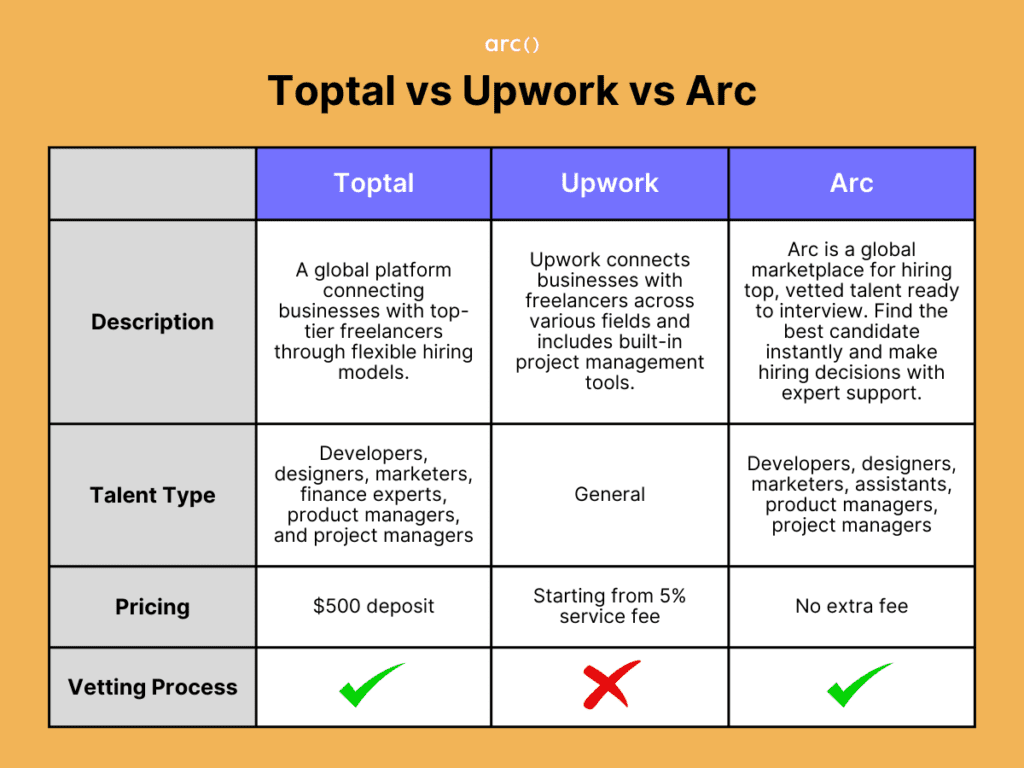
Toptal’s acceptance rate sits below 3% after a multi-stage process: English assessment, technical interview, live coding or design challenge, and a paid test project. The entire funnel typically takes 4–8 weeks. If you’re in, you’re matched with enterprise clients and startups whose minimum project sizes are structured to prevent low-budget noise.
The fee model is counterintuitive: freelancers pay zero direct commission. Toptal applies a hidden margin between what the client pays and what lands in your account. Market estimates put that margin at 30–50% — which means if you’re billing $120/hr, the client may be paying $175–$200/hr. Most freelancers don’t know this number. It doesn’t change what you earn, but it affects how you price retainers when clients try to take engagements off-platform.
- Senior dev, designer, or finance expert with strong track record
- Comfortable with white-glove matching (you don’t browse jobs)
- Want Fortune 500 clients without BD effort
- Under 5 years experience in your primary domain
- You need work within 2 weeks — matching takes time
- You want price transparency with clients
Catalant
Management consulting marketplace · Former MBB network · C-suite advisory
Catalant isn’t a freelance platform in the traditional sense. It’s a consulting marketplace — the distinction matters enormously in how engagements are structured, priced, and delivered. The talent network includes former McKinsey, Bain, and BCG consultants, senior executives, and technical domain specialists. Projects skew toward high-value, short-duration strategic work: market entry analysis, AI architecture decisions, build-vs-buy evaluations, competitive intelligence.
Rates typically run $150–$400/hr with some engagements hitting $500/hr for specialized strategy work. The client base is enterprise-first — companies with actual procurement processes and multi-month approval cycles. This cuts both ways: the projects are lucrative, but the sales cycle is long. Expect weeks between initial contact and a signed statement of work.
- Ex-management consultant or senior executive
- Your deliverable is insight, not implementation
- Comfortable operating without a platform-mediated job board
- You need consistent monthly volume
- Your background is primarily technical execution
- You’re not comfortable with enterprise procurement friction
Premium-Tier Platforms: High Rates, Lower Barrier
Gun.io
Top 10% vetting · US-focused · Senior dev sweet spot
Gun.io operates as a boutique developer marketplace — every engineer is individually reviewed, not auto-approved. The acceptance threshold sits around the top 10% of applicants, which is less exclusive than Toptal but still a meaningful signal. Rates run $80–$150/hr for senior US-based developers. The platform skews toward longer-term engagements and takes no direct commission from freelancers, generating revenue through a client-side markup instead.
One honest limitation: Gun.io’s client base is primarily US startups and growth-stage companies, not Fortune 500 enterprise. The upside is faster matching and less procurement friction. If your goal is $100–$140/hr contracts with a funded Series B company, this is a more realistic path in 2026 than Toptal, where the matching queue can take weeks.
Braintrust
Decentralized model · Peer reputation · 0% freelancer fee
Braintrust is structurally different from every other platform here. It operates on a decentralized model where the network itself is owned by participants — freelancers earn BTRST tokens for contributing to the network, and clients are charged a markup rather than freelancers paying a percentage. The practical result: $0 commission from your rate.
Rates reported by Braintrust developers cluster between $80–$200/hr for senior technical roles. The vetting model relies more on peer reputation and portfolio review than a centralized screening panel, which some freelancers prefer. The risk: quality consistency is harder to guarantee without centralized vetting. The clients are often tech-forward companies and mid-sized enterprises — not the same Fortune 500 procurement pipeline as Toptal, but solid for the rate range.
Contra
Commission-free · Fast-growing · Portfolio-first profiles
Contra has carved out a distinct position in 2026: zero platform fees for freelancers, portfolio-first discovery (clients browse your work before any proposal), and a community-driven quality layer. Optional payment processing incurs fees only if you use their payment rails — otherwise, you bill independently and the platform is free.
The client caliber here is mid-market and growth-stage rather than enterprise. Expect $50–$150/hr engagements depending on discipline — design, development, writing, marketing. Contra works best as a mid-career move: once you have portfolio strength and don’t need platform-mediated trust-building, the fee savings compound quickly. For developers building consistent side income, the zero-fee model alone makes it worth maintaining a profile here.
The Established Platforms: What They’re Actually Good For in 2026
Upwork and Fiverr Pro don’t belong in a “premium clients” article if we’re being strict about the definition. But they belong in this one for a reason: they’re where premium clients who don’t know better still post. And that’s an opportunity most specialists ignore.
Upwork
Largest client pool · 841K active clients · Specialist extraction play
Upwork’s 97% payment success rate and 841,000 active clients make it the largest liquidity pool in freelancing. The problem isn’t the platform — it’s how most people use it. Generalists lose. Specialists with a 90%+ Job Success Score and niche positioning (not “full-stack developer” but “Django API specialist for healthcare data pipelines”) can command $80–$150/hr in 2026 because 68% of Upwork clients prefer demonstrated niche expertise over broader availability.
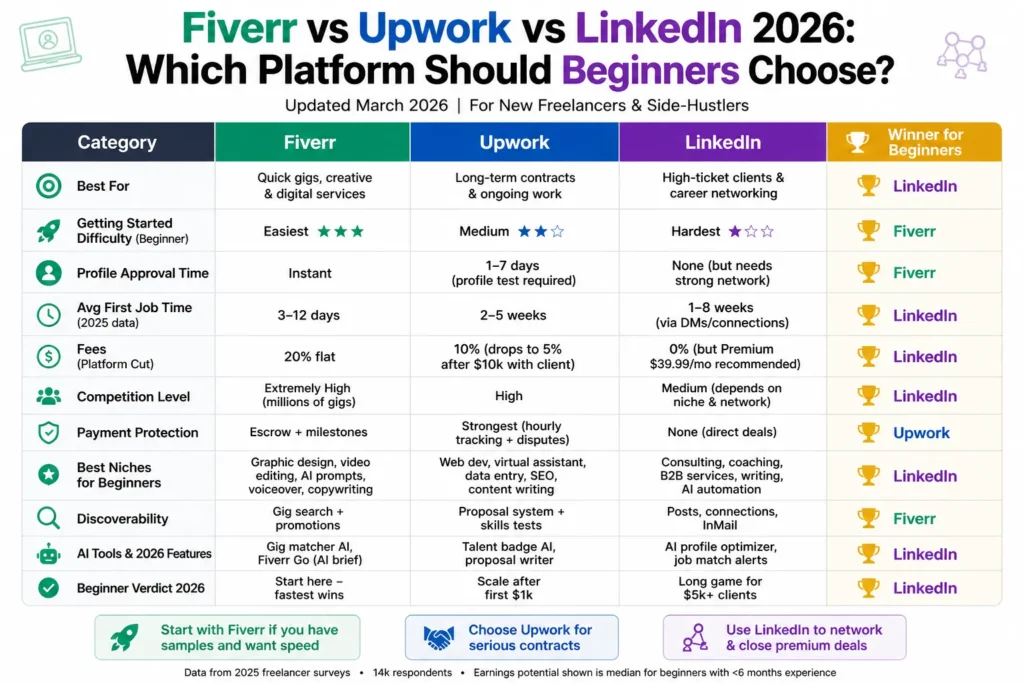
The platform’s 10% flat fee since 2023 (down from the old tiered 20%–5% structure) actually improved math for high earners. A senior developer earning $120/hr walks away with $108/hr — not spectacular, but competitive when the volume of inbound requests from a mature profile eliminates the cost of outbound BD entirely.
Fiverr Pro
Hand-vetted specialists · Package-based pricing · Brand client access
Fiverr Pro is a different product from the Fiverr gig economy beneath it. Pro sellers are application-reviewed by the Fiverr team, and the client segment using Pro is disproportionately brand marketing teams and agencies rather than bootstrapped founders. Rates for Pro top earners hit $50–$200/hr depending on discipline — creative disciplines often command the ceiling while development work sits lower than on developer-first platforms.
Fiverr’s 20% platform fee is the worst take rate in this comparison. At $150/hr, that’s $30 in fees per hour — the equivalent of one full working day per week, handed to the platform. For high-volume, package-based services where you’re not billing by the hour, the math can still work. For hourly senior consulting, it doesn’t.
The Nuance: The Platform Is Not the Strategy
Here’s the part that breaks the correction I just made.
The freelancers earning $200–$400K annually from “platforms” are almost never dependent on the platform’s matching algorithm. They got accepted, built two or three client relationships, and converted those clients to direct retainers. The platform was an acquisition channel, not an ongoing marketplace.
This is well-documented but rarely stated plainly: the goal of joining a premium platform is to leave it — not leave it by breaking terms of service, but to graduate from needing the platform as an intermediary. The platforms that facilitate this transition best are the ones worth your time during the hard 6–18 months of getting established.
That means the matching quality at your chosen platform matters more than the vetting rigor. A Toptal client who gets excellent results from you and later leaves Toptal to hire you directly is worth more over a career than five sequential Toptal matches who never convert. Think about which platform’s clients are the type who want a direct relationship — versus the type who specifically chose a curated marketplace to avoid managing vendor relationships.
Full Comparison: 2026 Platform Data at a Glance
| Platform | Acceptance | Typical Rate | Freelancer Fee | Client Type | Best For |
|---|---|---|---|---|---|
| Toptal | <3% | $100–$250/hr | 0%* | Fortune 500, Enterprise | Senior dev, design, finance, PM |
| Catalant | Application-based | $150–$400/hr | ~20–30%* | Enterprise (C-suite) | Ex-consultants, strategists |
| Gun.io | Top 10% | $80–$150/hr | 0% | Funded startups, Scale-ups | US-based senior developers |
| Braintrust | Peer-vetted | $80–$200/hr | 0% | Tech companies, Mid-market | Developers wanting no fees |
| Contra | Portfolio review | $50–$150/hr | 0% base | Startups, Growth-stage | Mid-career specialists |
| Upwork | Open (minimal) | $15–$200/hr | 10% | Startups to Enterprise | Niche-positioned, high JSS |
| Fiverr Pro | Application-based | $50–$200/hr | 20% | Brands, Agencies | Package-based creative services |
* Toptal and Catalant charge freelancers 0% directly but apply undisclosed margins to client-side rates. Estimated net effect shown in earlier section. Fee data sourced from platform documentation and independent market research, May–June 2026.
Which Platform, Given Where You Actually Are
The Constraint Nobody Mentions
Everything I’ve outlined works — except for roughly 35–40% of experienced freelancers who fall into a specific trap: they’re good enough to get accepted at Toptal, and not quite the profile Catalant wants, and they’ve maxed out Upwork’s ceiling for their niche.
That’s the real conversation that platform comparison articles avoid. There’s a large group of senior-to-excellent freelancers who don’t fit neatly into any premium platform’s designed profile. They’re too advanced for the volume tier, too specialized for Catalant, and not the right geography or discipline for Gun.io’s sweet spot. For them, the platforms listed here are stepping stones to direct client relationships, not the destination.
The honest path for that group: use any premium platform to land two enterprise engagements, document those outcomes rigorously, and build a direct outreach practice from the case studies. The platform’s value is the initial trust signal, not the ongoing infrastructure.
What percentage of freelancers in this article’s target audience fall into that gap? I don’t have reliable data on this — and anyone claiming they do is extrapolating from sample sizes that don’t justify the confidence.
The Short Version — If You Need a Decision Today
Senior developer or designer: apply to Toptal if you can stomach an 8-week process. Apply to Gun.io simultaneously — the screening is shorter and the client quality for funded startups is comparable.
Strategic consultant or executive: Catalant is the only purpose-built option. Everything else will misclassify your profile and undervalue your time.
Mid-career specialist building toward premium: Contra or Braintrust now. Zero fees, real clients, portfolio-building. Apply to Toptal in 12–18 months when your case studies are stronger.
On any platform: niche positioning matters more than acceptance tier. The freelancer who claims “senior React developer” earns 60–80% of the hourly rate of the freelancer who claims “React performance specialist for fintech checkout flows.” Same skills. Completely different market position.
Questions That Came Up in Research
Does Toptal’s hidden margin change what I earn?
Not directly — you negotiate your rate with Toptal and that’s what you receive. The margin affects you indirectly: if a client is paying $180/hr and you’re billing at $120/hr, the spread creates friction when clients try to take the relationship off-platform (they see the cost savings differently than you do). Know this dynamic before it becomes an awkward conversation.
Can I be on multiple premium platforms simultaneously?
Generally yes, unless you’re under an exclusivity clause (rare but exists in some Toptal contracts). Running Upwork alongside a curated network is standard practice. Running Toptal and Gun.io simultaneously is common for senior developers. Catalant tends to be self-selecting — if you’re the right profile, it becomes your primary channel quickly.
What about A.Team and Lemon.io?
Both are worth awareness. A.Team focuses on product teams rather than individual contributors — if you want to work as part of a dedicated fractional team rather than solo, it’s an interesting model. Lemon.io markets itself as a Toptal alternative for startups with less enterprise overhead. Rates reported at $80–$200/hr. Neither has the client documentation volume to appear with confidence in this analysis.
Is LinkedIn’s Service Marketplace actually usable in 2026?
The client quality and project values are real — $5K–$25K average reported by some practitioners. The infrastructure around it remains underdeveloped compared to dedicated platforms: dispute resolution, milestone tracking, and payment protection are all less mature. Use LinkedIn to generate leads. Close and manage the engagement elsewhere.
Fee and rate data sourced from platform-published documentation, Jobbers.io market analysis (May 2026), Fastlancer platform comparison (June 2026), SFAI Labs developer hiring guide (February 2026), and ExpertStackHub editorial (June 2026). Platform margins and acceptance rates are estimates where official figures are not published. Always verify directly with each platform before making a financial or professional decision — these figures change without notice.