

Analysis · Job Search · Portfolio Strategy
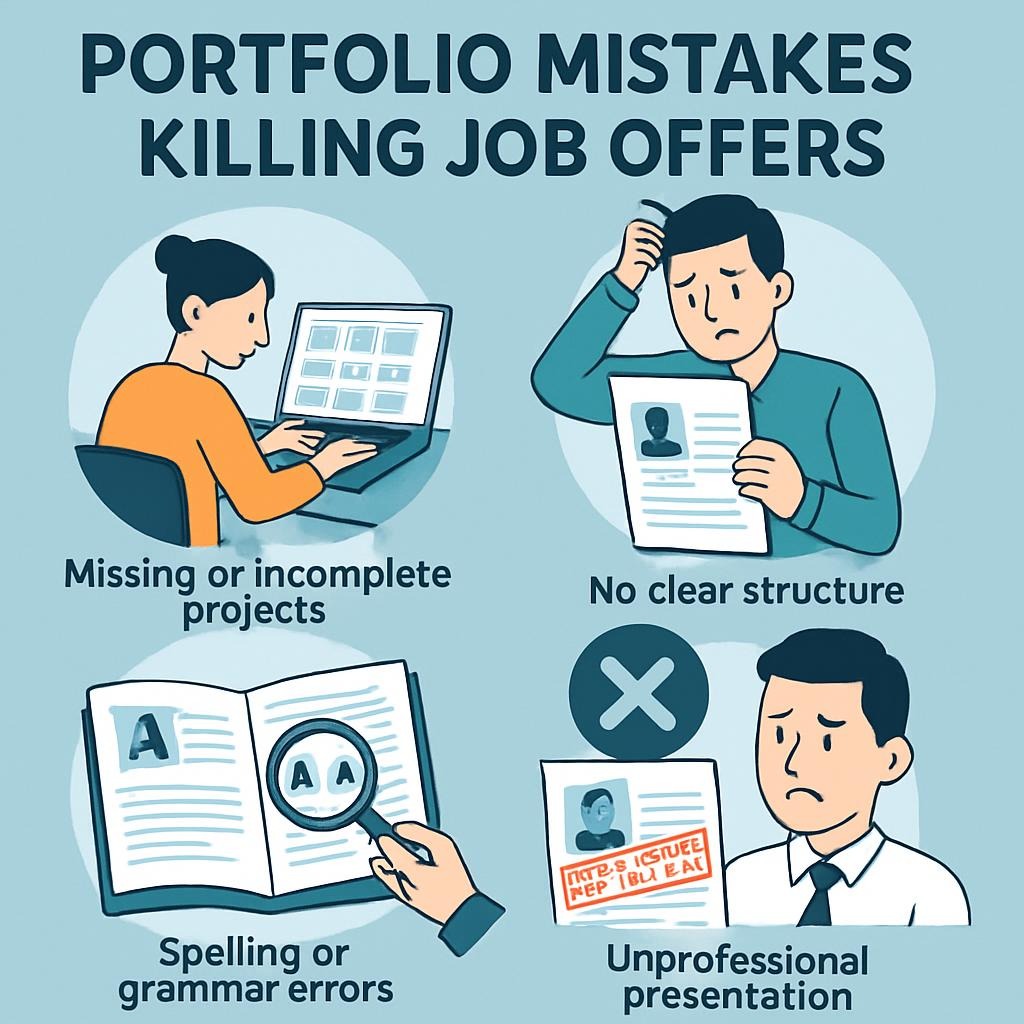
Entry-level roles dropped roughly 35–40% from pre-2022 peaks while bootcamp and CS graduate output held steady. Recruiters scan your portfolio in under 30 seconds. These are the five things that end your application before it starts — and what you can actually do about it.
⚡ Fix These Now
- Kill tutorial projects. Replace with one original solution that names a real problem and a measurable result.
- GitHub isn’t storage. It’s your work history. 2–4 pinned repos, clear READMEs, commit messages that explain decisions.
- 60%+ of recruiters view portfolios on mobile. If yours breaks on an iPhone SE, you’re losing more than half your audience before they see your work.
- Every project needs one number. “Reduced API response from 2.1s to 0.3s” beats “improved performance” in every ATS, every recruiter, every time.
- If your resume says “Python expert” and your GitHub has zero Python, you’re done. The mismatch registers in seconds.
Here’s the actual situation. Tech job postings for junior and entry-level developers dropped an estimated 35–40% from pre-2022 peaks — this tracks across LinkedIn’s own Jobs on the Rise data and reporting from Layoffs.fyi, though the precise figure varies by role and geography. Directional — no single authoritative survey has produced a perfectly clean unified number for this contraction.
Meanwhile, CS bachelor’s degree completions hit record highs in 2023 and 2024, per NSF Science and Engineering Indicators 2025, and bootcamp graduate output didn’t slow down. Supply went up. Demand at the entry level went down. And AI-assisted coding tools let companies extract more productivity from the senior engineers they already have — meaning the economic case for handholding juniors got worse, not better.
That’s the market. Your portfolio isn’t competing against other developers anymore in some abstract sense. It’s competing against AI coding tools, an oversupplied candidate pool, and hiring managers who have seen 400 near-identical portfolios this week alone.
These five mistakes are how they sort you out in under a minute.
Tutorial Hell: Your Projects Scream “I Follow Instructions”
Your to-do app with React. Your weather API fetcher. Your e-commerce clone from that Udemy course everyone took in 2021. Recruiters have seen each of these hundreds of times this week. And the problem isn’t the technology — it’s what the project reveals about how you think.
Tutorial projects answer one question: can you follow instructions? They do not answer: can you identify a problem, scope a solution, make tradeoffs under uncertainty, and ship something that works for real people? That second set of questions is what a job actually requires.
“The market no longer tolerates hand-holding. Companies want developers who diagnose problems, not implement solutions they’ve been handed step by step.”
Heather Doshay, Partner, SignalFire — SignalFire BlogThe threshold has moved. A few years ago, a clean to-do app with well-organized components could get you a phone screen. Now, the same portfolio signals “bootcamp-complete, never shipped anything real.” It’s not a neutral signal. It’s an active negative one.
The Tutorial Project Audit
Run every project through these four questions before it touches your portfolio:
| Audit Question | What It Reveals | The Fix | ⚠ Limitation |
|---|---|---|---|
| Does this exist in a Udemy course? | You follow instructions, not problems | Build without a tutorial — find a friction point in your own life | Some original projects still look tutorial-ish if underdocumented |
| Could I find 50 identical GitHub repos? | Zero differentiation in a crowded pool | Add a unique feature, or solve a domain-specific variant | Uniqueness alone doesn’t matter — it needs to be clearly explained |
| Does it solve a real person’s real problem? | Business thinking vs. tech demonstration | Interview 3 people with the problem before you write a line | “Real users” who are friends or family often give false validation |
| Can I quantify its impact? | Results-orientation vs. feature-orientation | Add one metric: time saved, error rate reduced, cost cut | Fabricated metrics are worse than no metrics — recruiters ask about them |
| Did I document what failed? | Iteration depth vs. first-draft shipping | Write an “Approaches Tried” section showing what didn’t work | Failure documentation only impresses if the failure was real, not manufactured for optics |
What a Transformed Project Actually Looks Like
❌ Tutorial Clone
“To-Do App with React and local storage. Add, edit, delete tasks. Built following a YouTube tutorial.”
✅ Original Solution
“Sprint Categorizer: ML classifier (fine-tuned BERT) that auto-tags 100+ Jira tickets by priority and sprint readiness. Reduced planning time from 4 hours to 45 minutes for our team of 6. Accuracy: 34% (keyword matching) → 87% (BERT). Case study →“
Notice what the transformed version includes: a specific problem (not “I wanted to learn ML”), a measurable result, a before/after on the approach (the 34% → 87% journey shows iteration), and actual usage by real people.
Second-Order Mechanism
Tutorial projects don’t just fail to impress — they actively signal the opposite of what you want. A recruiter seeing your third weather dashboard this hour doesn’t think “this candidate is thorough.” They think “this candidate has never had an idea.” The project communicates something about you that no cover letter can walk back.
And here’s the part most candidates don’t see: once a recruiter forms this impression in the first 8 seconds, confirmation bias does the rest. Every other decision in your portfolio gets filtered through “tutorial follower, not independent thinker.”
The Perfect README Template
README Structure — What Actually Gets Read
## ProblemThe team spent 4 hours planning each sprint, manuallycategorizing 100+ Jira tickets by hand.## SolutionML classifier using fine-tuned BERT to auto-categorizeby priority, complexity, and sprint readiness.## ResultsPlanning time: 4h → 45 min (81% reduction)Classifier accuracy: 34% → 87%Active usage: 6 teams, daily## Tech StackPython · Transformers · FastAPI · React · PostgreSQL## Failed Approaches (important — don't skip this)① Keyword matching: 34% accuracy. Fast, but brittle.② TF-IDF: 56%. Better, hit a ceiling on domain vocab.③ BERT fine-tune: 87%. Winner on accuracy/latency tradeoff.
The “Failed Approaches” section is what separates a case study from a demo. It shows you iterate. It shows you understand tradeoffs. And it shows intellectual honesty — which, in an era of AI-assisted coding, is increasingly the thing companies are actually trying to hire for. More on writing portfolio case studies →
The GitHub Graveyard: Your Commit History Tells the Truth
Recruiters and hiring engineers look at your GitHub before your resume. Not always — but often enough that a graveyard of abandoned repos, empty READMEs, and three-month commit gaps is a real disqualifier. Your contribution graph is a proxy for work habits, and people know how to read proxies.
The shift to skills-based hiring makes this worse, not better. When 45% of tech employers dropped degree requirements by 2025 (TestGorilla State of Skills-Based Hiring 2025 — self-reported; directional), the question “how do we evaluate candidates without a degree as a filter?” has a practical answer: GitHub, portfolio, technical interview. You just moved GitHub up the evaluation stack.
Cross-Source Synthesis
Here’s the non-obvious finding: Skills-based hiring didn’t just remove degree requirements — it made GitHub the de-facto credential. When you take away one filtering mechanism, hiring managers reach for another. The result is that GitHub carries more evaluative weight now than at any point in the last decade. Candidates treating it as storage (not signal) are making an increasingly costly mistake.
Sources: TestGorilla Skills-Based Hiring Report 2025 (directional); LinkedIn Economic Graph Jobs on the Rise 2025; SHRM skills-based hiring guidance 2024.
The 5 GitHub Red Flags — and What They Signal
| Red Flag | Recruiter Interpretation | 30-Min Fix | ⚠ Limit |
|---|---|---|---|
| Empty or generic README | “Can’t communicate technical thinking” | Add: problem, stack, results, demo link | A great README on a bad project doesn’t save you |
| 3-month commit gap right before job search | “Cramming. Not a consistent builder.” | Commit something small 3–4x per week — even docs | Fake commit padding (empty files, cosmetic changes) is worse — engineers spot it immediately |
| Zero forks, zero PRs, zero collaboration | “Has never worked with another human on code” | Make 1 open-source PR this month (start with “good first issue”) | One merged PR in a doc repo doesn’t prove team skills — but it’s better than zero |
| 15 abandoned repos | “Starts things, doesn’t finish them” | Archive 12. Polish 3. Unarchive only if they’re production-quality. | Archiving everything looks like hiding — keep at least one “learning” repo clearly labeled as such |
| “Update,” “fix,” “changes” commit messages | “Careless. Doesn’t document decisions.” | Rewrite last 10 commits to explain the why, not the what | Retroactively rewriting commit messages is easy to do and easy to spot if the timestamps don’t match |
Commit Messages That Show Technical Thinking
Before / After — Commit Message Quality
❌ "Update code."✅ "Refactor N+1 query using eager loading — page load 2.3s → 0.4s"❌ "Fix bug."✅ "Fix race condition in payment processor causing duplicate charges (affects ~0.3% of txns)"❌ "Add feature."✅ "Implement Redis caching for top-100 products — API response time -65%, DB queries -80%"❌ "Changes."✅ "Switch auth from JWT localStorage → HttpOnly cookie (XSS mitigation, OWASP A07)"
The good commit messages do something specific: they make the reviewer feel like they understand the codebase without opening a single file. That’s the point. A hiring engineer reviewing 40 GitHub profiles in an afternoon will spend more time on the one where the commit history reads like a technical diary and less on the one that reads like a draft folder. Full GitHub profile optimization guide →
⏱ 30-Minute GitHub Action Plan
- Pin your 3 best repos — complex problem, clear impact, actively maintained
- Add Problem / Solution / Results structure to each pinned README
- Add a working live demo link (test it right now — broken demos are worse than no demo)
- Rewrite the last 10 commit messages to explain decisions, not just actions
- Archive anything half-finished or tutorial-based
- Make 1 open-source contribution this week — documentation counts
Mobile-First Neglect: Losing 60% of Recruiters Before They See Your Work
Recruiters check portfolios during commutes. Between interviews. On their phone at 7 a.m. before they open their laptop. According to Statcounter’s 2025 global platform data, mobile devices account for over 60% of web traffic globally — and portfolio sites are not exempt from this.
If your portfolio has horizontal scroll on an iPhone SE, or your hero text is 10px on a Galaxy S21, or your project thumbnails stack into a broken grid on a 375px viewport — you’ve failed the interview before it started. And here’s what makes this worse: broken mobile UX doesn’t just lose you the recruiter. It actively signals something damaging. You’re a developer who didn’t test their own work on the most common screen size in the world.
“Broken mobile experience doesn’t just inconvenience the reviewer. It tells them something specific about your attention to detail and your deployment habits.”
Editorial synthesis — sources: Google PageSpeed Insights UX guidance (2024); WCAG 2.2 touch target requirements; Statcounter mobile share data 2025Mobile Portfolio Failure Points — Prioritized
Mobile Bounce Rate by Load Time
Source: Google/SOASTA Research 2017 (mobile page speed study) — vintage data, mechanically stable. Load time / bounce relationship is consistent across subsequent studies. Treat specific percentages as directional.
| Failure Type | Recruiter Signal | Priority | Fix | ⚠ Limit |
|---|---|---|---|---|
| Load time > 3 seconds on 3G | 53% abandon rate before content appears | 🔴 Critical | Lighthouse audit, WebP images, lazy loading | Lighthouse score doesn’t perfectly predict real-world performance on older devices |
| Horizontal scroll on 375px | “Didn’t test their own work” | 🔴 Critical | CSS Grid/Flexbox, remove fixed pixel widths | CSS fixes can break on specific device/browser combos — test on actual hardware, not just DevTools |
| Base font under 16px | Forces pinch-zoom, portfolio abandoned | 🟠 High | Minimum 16px base, 1.5 line-height | Larger font on a poorly typeset layout still reads badly — font size is one variable |
| Tap targets under 44×44px | “Has never used mobile UI guidelines” | 🟠 High | WCAG 2.2 minimum touch target standard | 44px is the standard; some designers argue 48px given thumb size variance across users |
| Unoptimized PNG/JPG images | Slow cellular load, data cost to the viewer | 🟡 Medium | Convert to WebP, use srcset for responsive images | WebP support is near-universal but still fails on very old Android browsers — check your target audience |
✅ Mobile Test Protocol — Do This Today
- Run Google PageSpeed Insights on your portfolio URL — target 90+ mobile score
- Open Chrome DevTools → Toggle device toolbar → Test at 375px (iPhone SE), 390px (iPhone 14), 768px (tablet)
- Test on a real phone, not just DevTools — rendering differs more than you think
- Verify all buttons/links have 44×44px minimum tap targets (WCAG 2.2 standard)
- Check load time on a throttled 3G connection (DevTools → Network → Slow 3G)
- Verify zero horizontal scroll at any viewport width from 320px upward
The Impact-Free Zone: “Built a Feature” Is Not a Sentence
“Built React dashboard.” Okay. And? “Implemented authentication.” So? “Created recommendation algorithm.” What happened when you did?
Every line of code costs a company money. Salary, compute, maintenance, opportunity cost of not building something else. Every feature either makes money, saves money, or meaningfully improves user experience. If you can’t state which — or how much — you’re communicating that you don’t understand software’s actual purpose.
This isn’t about padding. Fake metrics are worse than no metrics — hiring engineers ask about them in technical screens, and getting caught confabulating numbers is a fast path to rejection. But if you built something and measured it, even casually, that number belongs in your portfolio description.
Second-Order Mechanism
Here’s what candidates miss: quantified impact doesn’t just impress. It demonstrates that you think about software as a system with inputs and outputs, not as a set of features to implement. “Reduced API response time from 2.1s to 0.3s” tells a reviewer you benchmarked before and after. “Fixed slow API” tells them you felt the problem and patched it.
Senior engineers reading portfolios aren’t just evaluating what you built. They’re evaluating how you think about what you built. The number is evidence of the thinking.
The Before/After Transformation Framework
❌ Career-Killing
“Built real-time chat app with React and Node.js.”
✅ Interview-Getting
“WebSocket-based internal messaging reduced customer support response time by 60%. Initial polling: 2.3s latency. WebSocket: <200ms. Support team handles 40% more tickets/hour. 200+ daily active users across 6 teams.”
❌ Meaningless
“Implemented caching system for better performance.”
✅ Concrete
“Redis caching reduced database queries by 85% and cut monthly server costs from $1,200 to $450. API response: 1.8s → 0.3s. Zero cache invalidation bugs in 6 months of production use.”
❌ Vague
“Created mobile-responsive design.”
✅ Specific
“Responsive redesign: mobile conversion rate 2.1% → 4.7%. Lighthouse mobile score 34 → 96. Bounce rate on mobile 68% → 41%. Measured over 60-day post-launch window.”
Impact Metrics That Actually Matter
| Vanity Metric | Impact Metric | How to Measure It | ⚠ Credibility Risk |
|---|---|---|---|
| “1,000+ lines of code” | “Reduced codebase by 30% while adding 5 features” | Git diff stats before/after refactor | LOC reduction can mean you deleted necessary complexity — be ready to explain what you removed |
| “10 API endpoints” | “API response: 1.2s → 0.3s on p95” | k6, Apache Bench, or Datadog traces | p95 without a traffic volume number is incomplete — how many requests/second at this latency? |
| “Implemented caching” | “85% fewer DB queries, $400/month cost savings” | Database monitoring + cloud billing | Cost numbers from personal projects (tiny traffic) don’t extrapolate — avoid implying production scale you don’t have |
| “100% test coverage” | “Caught 23 regressions before prod in 6 months” | Issue tracker + deployment logs | 100% line coverage with no branch coverage is a false metric — know the difference before you’re asked |
| “Used React hooks” | “Component reuse 3×, dev time -40% across 4 sprints” | Time tracking in tickets + component import count | “Dev time -40%” on solo projects is notoriously hard to measure without a baseline comparison |
One more thing. If you built a project without real users and can’t produce business metrics — performance metrics are always available. Response time, memory usage, test coverage regression count, build time — any of these are measurable without deploying to production. “I have no metrics” is almost never true. How to find metrics on any project →
The Skills Lie: When Portfolio Contradicts Resume
This one moves fast. “Python expert” on the resume, zero Python projects on GitHub: rejected. “5+ years React” on the resume, all class components in the portfolio (Hooks released 2019): trust destroyed. “ML Engineer” in the headline, one linear regression tutorial in the repos: skipped.
Recruiters use simple cross-checks. They’ve been burned by inflated claims before. And in 2026, with AI-assisted application tools making it trivially easy to tailor a resume to any job description, the mismatch between resume claims and portfolio evidence has become one of the most common disqualifiers they encounter. No controlled study number available — this is qualitative consensus from recruiter accounts and hiring manager commentary across LinkedIn and industry surveys.
One 2023 ResumeBuilder survey found that a majority of respondents admitted to resume inaccuracies, with skills/abilities ranking among the most frequently inflated areas. Self-reported survey data from ResumeBuilder — conflict of interest disclosure: ResumeBuilder benefits commercially from resume-related anxiety. Treat the directional finding (skills inflation is common) as plausible; do not cite the specific percentage as an authoritative figure. The point isn’t the exact number. The point is that recruiters assume some level of inflation and cross-reference accordingly.
“The mismatch between what the resume claims and what the portfolio demonstrates is one of the most reliable rejection signals. It’s not just dishonesty. It’s also evidence that the candidate doesn’t actually do the work they claim to do.”
Editorial synthesis — sources: Recruiter qualitative accounts, LinkedIn Talent Blog 2024; TestGorilla Skills-Based Hiring Report 2025The Skill Verification Hierarchy
| Verification Step | What Recruiters Check | Fail = Rejection | ⚠ Limit |
|---|---|---|---|
| 1. GitHub Activity | Recent commits in claimed languages; real projects not forks | Zero activity in claimed tech stack | GitHub activity is gameable — empty commits, imported repos. Experienced engineers spot fake activity quickly. |
| 2. Portfolio Depth | Do projects match claimed expertise level? | “Expert” claim with beginner-level projects | “Depth” is subjective — what reads as advanced to one reviewer reads as intermediate to another at a more senior company |
| 3. Technical Interview | Can you explain architectural decisions in your own projects? | Can’t defend decisions in code you wrote | Technical interviews have their own reliability problems — this step is necessary but not sufficient |
| 4. Reference Checks | Do prior employers confirm skill claims? | References contradict resume | Reference checks are increasingly rare for junior roles — but they surface at senior levels and in regulated industries |
The Honest Strategy That Actually Works
✅ Honest Skill Representation
List only what you can demonstrate with existing projects. If you used Python in one serious project, “Python — intermediate, 1 production project” is more credible than “Python expert” with nothing to show for it.
Add a “Currently Learning” section. “Exploring Next.js through an active migration project (see repo X)” signals growth without claiming proficiency you don’t have.
Be specific about depth. “Proficient in React (hooks, context, performance optimization); comfortable with Next.js routing and SSR; beginner with React Native” is more trustworthy than “React/Next.js/React Native.”
Show progression. “Started with Express, now using NestJS for better architecture” tells a hiring manager more about how you think than any skills list can.
Recruiters don’t expect you to know everything. They do expect you not to lie. And a “Currently Learning” section with an active GitHub repo attached is a stronger signal than a hollow expertise claim. Resume-portfolio alignment guide →
What Actually Breaks Through in 2026: The Contrarian Playbook
Cross-Source Synthesis — not visible in any single source
The hidden logic behind all five mistakes: The entry-level market contracted not because companies stopped needing developers, but because AI tools raised the productivity floor for existing engineers — and simultaneously raised the evidence bar for new hires. Tutorial projects, empty GitHub profiles, and vague impact claims all fail the same underlying test: they provide no evidence that you can contribute independently from day one, without hand-holding.
Combine the skills-based hiring shift (degrees out, portfolio in), the AI productivity gain (less tolerance for ramp-up time), and the supply overhang (more graduates than junior roles) — and the portfolio becomes not just a marketing document but an employment test. It has to demonstrate independent problem-solving, technical depth, and results-orientation simultaneously, before a 30-second scan is over.
None of the three source trends (skills-based hiring data, AI productivity research, graduate oversupply data) individually explains the urgency. Together they do.
Sources: TestGorilla Skills-Based Hiring 2025; Stanford HAI AI Index 2024; NSF Science & Engineering Indicators 2025.
Four Strategies That Actually Break Through
Document your failures. The portfolios that get callbacks include a “What Went Wrong” section. Not to confess, but to demonstrate exactly the thinking pattern senior engineers want to hire: you identified a problem, tried a wrong approach, understood why it failed, and corrected. That’s the entire job description for most software engineering roles.
Build for real users. Find a local business, nonprofit, or friend’s startup. Build something they’ll actually use. Document the full loop: requirements gathering → user testing → iteration → deployment. One project with three real users and documented feedback beats ten tutorial clones in every hiring conversation. How to find real projects as a junior developer →
Contribute to what you use. Open-source contributions prove you can navigate unfamiliar codebases, follow standards you didn’t write, respond to code review from people who don’t know you, and collaborate asynchronously. Start with documentation or bug fixes — a merged PR in a real project you actually use is more credible than a side project nobody has seen.
Write a case study, not a readme. Transform your best project into a 1,000-word technical case study: business context, architectural decisions, challenges encountered, performance metrics, lessons. This single document demonstrates communication, technical depth, and business thinking simultaneously. It’s what separates the “junior” folder from the callback folder. Portfolio case study template →
For: Junior Developers (0–2 years experience)
Your Portfolio Is a Test You Don’t Know You’re Taking
The reframe: your portfolio isn’t about showcasing what you know. It’s about demonstrating that you think like someone who adds value without requiring supervision. Every item on it is evidence for or against that claim.
What you do: Pick one project from your current portfolio — the one you’re most proud of. Rewrite the description using the Problem / Solution / Results / Failed Approaches structure above. Add one number you can actually defend. Then test the page on your phone. Fix what’s broken. That’s your first 90 minutes.
What’s going to stop you: You don’t have a “real” project with real users. Most juniors don’t. The workaround: performance metrics and architecture decisions are always measurable, even on side projects. “API response time before and after” doesn’t require production users.
For: Bootcamp Graduates Entering the Market
The Bootcamp Stamp Is a Hurdle — Here’s How to Clear It
The reframe: bootcamp graduates face one specific credibility gap that CS grads don’t — the assumption that every project is a tutorial clone. The fix isn’t more projects. It’s more visible evidence of independent problem-solving.
What you do: Find one “good first issue” on a GitHub project you actually use — not a tutorial repo — and make a contribution this week. A merged PR in someone else’s real codebase is harder to dismiss as tutorial work, because it demonstrably isn’t. Document the process in a short case study.
The annual planning gap others don’t mention: Bootcamp job searches are typically compressed — 3–6 months post-graduation, which means you’re competing with every other cohort graduate hitting the market simultaneously. Time-boxing your fix to the highest-ROI items (README rewrites + one real contribution + mobile fix) is more effective than trying to rebuild your entire portfolio from scratch in this window.
Frequently Asked Questions
How many projects should a developer portfolio have in 2026?
Two to four polished projects with clear impact statements, working demos, and thorough documentation. Recruiters scan under 30 seconds — fifteen half-finished projects create a worse impression than three exceptional ones. Quality over quantity is not a cliché here; it’s the filtering heuristic recruiters actually use. Portfolio size guide →
Do recruiters actually look at GitHub?
Yes — with the caveat that not all recruiters and not all companies weigh it equally. Technical hiring managers almost always check it. Non-technical HR screeners less often. The safest assumption: treat your GitHub as if a senior engineer will look at it before your phone screen, because often one will. GitHub for job search →
What’s the biggest portfolio mistake junior developers make in 2026?
Showcasing tutorial projects without any evidence of independent problem-solving or measurable impact. With entry-level roles down roughly 35–40% from pre-2022 peaks while graduate output held steady, the filter is brutal. Tutorial clones don’t clear it. The fix is one original project with a real problem statement and one defensible metric — that alone moves you ahead of the majority of applicants.
How important is mobile responsiveness for developer portfolios?
Critical. Over 60% of web traffic globally is mobile (Statcounter, 2025). Broken mobile portfolios don’t just cost you reviewers — they actively signal a lack of attention to detail and production-readiness. Test on actual devices, not just browser DevTools.
What percentage of resumes are rejected by ATS systems?
The “75% ATS rejection” figure circulated widely is not well-sourced and doesn’t hold up against recruiter accounts. Enhancv’s 25-recruiter qualitative study found most rejections are human-driven or result from knockout questions, not automated parsing. That said, keyword mismatches and formatting failures do cause issues — the point is to not over-optimize for ATS at the expense of human readability. ATS myths debunked →
Can I use portfolio templates, or do I need to build from scratch?
Templates are acceptable for non-design roles if meaningfully customized. For frontend positions, a custom portfolio demonstrates the very skills you’re claiming. For backend, data, and systems roles, a polished template lets you focus effort on project depth instead of design. The rule: don’t let the portfolio design undersell the portfolio content.
Should I include group projects in my portfolio?
Yes — with clear documentation of your specific contribution. “Built the authentication system and database schema for a team of four” is credible and demonstrates real collaboration. “Worked on the project” is not. Include commit history evidence and PRs where possible. How to document team projects →
The Uncomfortable Reality
The developer market restructured, and the portfolio rules changed with it. What worked in 2019 or 2021 actively hurts you now. Tutorial projects, weak GitHub profiles, desktop-only design, vague feature lists, inflated skills — each of these is a fast filter. Recruiters have too many candidates and too little time to give you the benefit of the doubt.
NSF projections put computer and IT employment growing from roughly 6.1 million in 2025 to 7 million by 2035 (NSF Science and Engineering Indicators 2025). The long-term demand is real. But the current entry-level bottleneck is also real — companies cut generalists and hold out for specialists who can contribute immediately. Your portfolio’s job is to make the case that you’re the second kind of hire.
Five mistakes. Each fixable in under a week. The ones who fix them move through the filter. The ones who don’t keep wondering why the applications aren’t converting.
All statistics include source attributions and publication dates. Vendor-reported figures are disclosed as such with conflict-of-interest notes. Figures not independently audited are labeled “directional.” This article was updated April 2026. Source corrections and updates: [email protected]

Build These 15 Web Apps to Boost Dev Portfolio (2026)
Resume vs LinkedIn: What Really Matters to Recruiters—Insider Secrets to Land Your Dream Job
The Advice That Got Developers Hired in 2022 Is Getting Them Rejected in 2026
[card url=”https://www.codetalenthub.io/portfolio-layout-formula/”]
[card url=”https://www.codetalenthub.io/remote-coding-interview-with-ai-support/”]
[card url=”https://www.codetalenthub.io/2025-tech-portfolio-mastery-guide/”]
[card url=”https://www.codetalenthub.io/top-7-tech-resume-tips/”]
[card url=”https://www.codetalenthub.io/5-tech-resume-phrases-for-2025/”]
[card url=”https://www.codetalenthub.io/best-ai-resume-builders/”]