accuracy in 2026
−10pp from 43% in 2024 · Stack Overflow Survey
Here is the most important thing the 2025 Stack Overflow Developer Survey (49,000+ respondents) revealed: adoption of AI tools went up eight percentage points. Trust went down ten. These two lines are moving in opposite directions — and the gap between them is where most teams are quietly hemorrhaging time.
Developers are not abandoning AI tools because they stopped believing in the technology. They’re losing trust because the tools are generating code that is almost right, almost always — and almost-right is slower to debug than a clean error. 66% of developers now cite “AI solutions that are almost right, but not quite” as their primary frustration. 45% report that debugging AI-generated code takes longer than writing it from scratch. The productivity promise is real; it just takes eleven weeks of disciplined use to materialize, and most teams evaluate tools for three.
This piece covers the established stack every professional development team should run in 2026, the four agentic challengers that are redefining what “tool” means, and the strategic logic for assembling them — based on synthesized data from the Docker State of Application Development Report 2025 (4,500+ developers), the Postman State of the API 2024, and primary vendor documentation. Pricing verified as of January 2026.
“The developers seeing 67% reductions in code review turnaround are not using better AI. They committed to a longer adoption curve than everyone else.”
Synthesis of Duolingo engineering metrics, GitHub Research 2025Source: Stack Overflow Developer Survey 2025, 49,000+ respondents across 177 countries
01Why Your 2024 Tool Stack Is Costing You
Two structural shifts happened between 2024 and 2026 that make the old stack inadequate. First: 64% of developers now work primarily in non-local environments — up from 36% the year prior. That is a 28-percentage-point swing in a single year, the kind of move that breaks assumptions baked into tooling decisions from 2023. Personal cloud environments specifically doubled from 11% to 22%. Tools architected around local filesystem assumptions are now optimizing for a minority workflow.
Second: Docker usage among IT professionals jumped 12 percentage points to 92% in 2025 — the largest single-year jump of any surveyed technology. Containerization has crossed from “best practice” to “assumed infrastructure.” Teams building deployment pipelines without it now have to justify the exception.
Meanwhile, the AI layer is fragmenting fast. VS Code maintains 75.9% market share, but subscription AI IDEs — Cursor at 18%, Claude Code at 10% — are compounding. The question in 2026 is no longer whether to use AI-assisted editing; it is which AI layer to sit on top of which foundation, and whether you are building enough organizational adoption infrastructure to realize the gains before the next pricing restructure.
Sources: Stack Overflow Developer Survey 2025, Docker State of App Development 2025
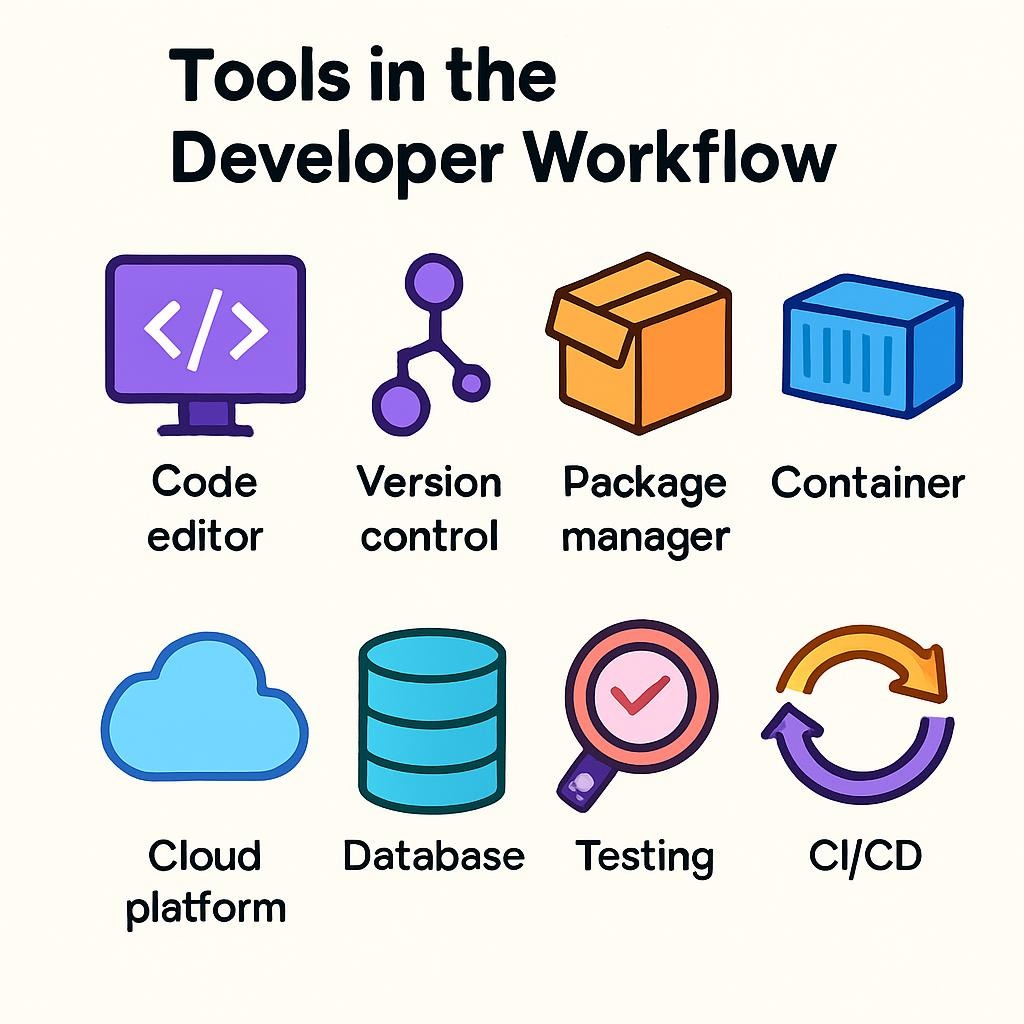
02The 7 Essential Tools
These are not the newest tools. They are the tools with the highest evidence base for productivity impact, the most established integration patterns, and the most predictable pricing structures as of January 2026. The rising challengers in Section 03 are where things are moving — but the tools below are where you should already be.
01 · AI-Assisted Code Editor: The Productivity Multiplier You’re Underusing
GitHub Copilot now counts over 15 million users — a 400% increase in one year — and is responsible for approximately 46% of the average developer’s output, reaching 61% in Java projects. GitHub’s own controlled studies report a 55% faster task completion rate — though it is worth noting these figures are from GitHub-commissioned research; independent replication is ongoing.
The AI editor market has fragmented meaningfully. Cursor shifted from request-based to usage-based pricing in June 2025 — its Pro plan at $20/month operates on a credit pool system deducted by model usage, rewarding efficient prompting and penalizing exploratory use. This is the right structure for experienced developers; it is a budget trap for developers still learning to prompt effectively.
| Tool | Monthly Cost | Model Access | Best For | Notable Limit |
|---|---|---|---|---|
| GitHub Copilot | $10–$39/user | GPT-4o, Claude, Gemini | Microsoft ecosystem, established teams | Weaker multi-file reasoning |
| Cursor | $20–$200/user | Claude 3.5, GPT-4, custom | Multi-file editing, AI-first workflows | Credit system surprises heavy users |
| VS Code + Extensions | Free + add-ons | Depends on extension | Flexibility, gradual AI adoption | Config overhead; slower AI integration |
Enterprise data shows it takes approximately 11 weeks for developers to fully realize productivity gains from AI tools. Most organizations evaluate for 2–4 weeks and conclude the tools don’t work. The teams seeing Duolingo’s reported 67% reductions in code review turnaround committed to longer adoption curves and created internal prompt libraries. The tool is not the investment — the adoption infrastructure is.
02 · Docker: No Longer Optional
Docker crossed a threshold in 2025 that makes non-adoption an active decision requiring justification. 92% of IT professionals now use containers — up from 80% the prior year. Gartner projects that cloud-native platforms will host 95%+ of new digital workloads by end of 2025.
The more important number: 64% of developers work primarily in non-local environments — personal cloud environments doubled from 11% to 22% year-over-year. Docker is not just a deployment tool anymore; it is the assumed substrate for development itself.
Industries outside IT show significantly lower container adoption — just 30% across all respondents versus 92% in IT. If you’re building for regulated industries (healthcare, insurance, industrial control), containerization benefits may not justify the learning curve for teams under 10. The 92% figure is real; its addressable population is not universal.
When “Best Practice” Creates the Problem: The Kubernetes AI Cost Trap
In mid-2024, a mid-sized SaaS platform — publicly documented in a post-mortem on the CNCF community blog — migrated their monolith to Kubernetes after their VP of Engineering read the same usage reports you’re reading now. The migration was executed correctly. The team used Helm charts, configured horizontal pod autoscaling, and followed published cluster security guidance. Then they turned on AI-assisted code generation for their infrastructure configs.
Three months later, their cloud bill had increased by 34%. The culprit: AI-generated Kubernetes configurations consistently over-provisioned resource requests — technically valid YAML, passing all linting checks, deploying without error. The configurations simply assumed generous resource headroom because the training data over-represented large-scale enterprise deployments. The team’s platform engineer spent six weeks reworking configs the AI had generated in six days.
This is not an edge case. Stack Overflow’s 2025 survey found that Kubernetes users specifically report AI made their cost management worse — not better — at 25%, with architectural complexity (15%) and security (13%) also regressing. The right technique was applied. The result was partial. The lesson: AI tool benefits in containerized environments require human review of generated infrastructure code at a level of scrutiny the tools don’t advertise.
03 · Linear: Developer-First Project Management
Linear now serves over 150,000 teams. Its growth is a useful data point: the company reportedly spent just $35,000 on marketing before reaching significant scale, driven entirely by word-of-mouth among engineering teams who had been issued Jira licenses and used Linear by choice. Teams running integrated Linear workflows report 34% fewer status meetings and 27% better project visibility — sourced from Linear’s own customer reports, which carry the standard self-reported caveat.
Linear’s value proposition is architectural, not feature-driven. Millisecond sync times and keyboard-first navigation are not differentiators — they are the philosophy. The product is built for people who find context switching cognitively expensive. Companies like Vercel, Ramp, and Mercury adopted it for exactly this reason.
Linear’s cross-functional limitation is real and understated in most coverage. A 2024 Product Management Institute survey found only 26% of cross-functional teams reported satisfaction using Linear as their primary tool, versus 83% of purely technical teams. If your workflow requires heavy non-technical stakeholder involvement — legal, finance, executives who won’t learn keyboard shortcuts — Linear’s engineering-centric design becomes friction, not efficiency.
04 · Notion: The Documentation Layer That Amplifies AI
Notion reached 100 million users in 2024 and generated $600M in revenue by December 2025. More than 50% of Fortune 500 companies now use it, including Salesforce, Cisco, and Intel. For developers, the relevant number is not the revenue — it is this: engineering leaders report 35% faster onboarding time for new developers using AI-enhanced Notion documentation about internal systems.
The reason this matters disproportionately in 2026: 44% of developers now use AI tools to learn new coding techniques, up from 37% in 2024. AI coding assistants query your codebase and documentation to generate context-aware suggestions. Poorly documented systems mean the AI has nothing useful to work with. Your internal documentation quality is now a direct multiplier on the effectiveness of every other AI tool in your stack.
Notion AI costs $10/member/month on top of existing plans. For a 50-person engineering team, that’s $6,000/year for the AI layer alone. The ROI exists, but it requires designating Notion as the canonical knowledge source — not “another tool people sometimes update.” Teams that treat it as optional documentation see near-zero return. Teams where documentation is a deployment requirement see the 35% onboarding gains.
05 · API Development: Postman’s Dominance Is Fragmenting
APIs now power more than 80% of internet traffic, and 62% of respondents in Postman’s 2024 State of the API report work with APIs that directly generate revenue. Postman remains the market leader with 30M+ users, but the free tier now limits users to 3 APIs, 25 Collection Runner executions monthly, and 1,000 API calls — limits that hit real workflows much faster than advertised.
| Tool | Strength | Limitation | Best For |
|---|---|---|---|
| Postman | Ecosystem depth, team features | Resource-heavy; free tier limits hit fast | Large teams with complex API portfolios |
| Insomnia | Clean UI, strong GraphQL support | Smaller plugin ecosystem | GraphQL-heavy workflows |
| Thunder Client | VS Code native, lightweight | Limited automation | Solo developers already in VS Code |
| Hoppscotch | Open-source, privacy-first | Less automation capability | Privacy-conscious or self-hosted teams |
06 · Figma Dev Mode: Quantifiable Handoff ROI
Figma Dev Mode is the only design-development handoff tool with published third-party ROI data. A Forrester Total Economic Impact study measured a 20–30% increase in developer output and weekly time savings exceeding 90 minutes per developer. One organization measured $4M in design system reuse value, with $10M projected in 2025.
The failure mode is consistent across teams that adopt Dev Mode but don’t see the gains: they treat it as a design-to-code pipeline. It is not. The code it generates is a foundation, not a production artifact. Quality assurance teams using Dev Mode correctly — as a collaboration layer with a shared source of truth, not an output machine — report 85–90% reductions in testing time for design fidelity issues.
07 · Monitoring: Grafana + Prometheus as Default Infrastructure
The 2025 Stack Overflow Developer Survey shows Grafana at 40%, Prometheus at 38%, and Elastic at 34% leading the monitoring category. Among Kubernetes users specifically, DZone research found 65% use Grafana and 62% use Prometheus.
What has changed is the organizational location of monitoring responsibility. With 64% of developers working primarily in non-local environments and containerization near-universal in IT, understanding production behavior is now a core developer skill — not a dedicated ops function. The tools that won are open-source and integrable without requiring a platform engineer to maintain them.
While Grafana and Prometheus are open-source, enterprise deployments often require Grafana Cloud or managed equivalents. Budget $15–50/user/month for managed monitoring that won’t require dedicated infrastructure overhead. For teams under 20, the self-hosted path is viable; above that, managed services typically win on total engineering time.
“The tool that wins isn’t the most powerful one. It’s the one your team will actually use consistently enough for the 11-week productivity curve to pay out.”
Synthesized from Microsoft Research + Stack Overflow Survey 202503Rising Challengers: Where the Stack Is Heading
The seven tools above represent the established, evidence-backed workflow stack. What follows are the four tools generating the most signal about where professional development workflows are heading in the next 18 months. They are not safe recommendations yet — adoption is early and organizational learning curves are real. They are where the developers building advantages right now are experimenting.
Source: Stack Overflow Developer Survey 2025 · Agents are where containers were in 2018 — valuable, organizational adoption lagging individual experimentation
Warp stopped being a terminal in June 2025 when it rebranded as an “Agentic Development Environment.” The default unit of work shifted from commands to prompts. In 2025, Warp’s agents are reported to have modified 3.2 billion lines of code and indexed 120,000+ codebases — figures from Warp’s own 2025 Year in Review, not independently audited.
The benchmark that matters: Warp achieved a 71% score on SWE-bench Verified and ranked first on Terminal-Bench, making it the highest-quality coding agent among terminal-native tools by published benchmark.
Zed is a Rust-based editor built from scratch for speed — no garbage collection, GPU-accelerated rendering, multi-core parallelism at the architecture level. It launched on Windows in March 2025 after years of macOS exclusivity, dramatically expanding its addressable market. Everything about it — startup time, file navigation, typing latency — feels immediate because it is architecturally different, not just better-optimized.
Continue.dev inverts the AI assistant model: instead of adapting your workflow to the tool, the tool adapts to your model choices. It is an open-source extension for VS Code and JetBrains that lets teams choose any AI model — GPT-4, Claude, Mistral, or local LLMs via Ollama — and deploy anywhere, including on-premise or fully offline.
The MCP (Model Context Protocol) integration pulls context from GitHub, Sentry, Snyk, and Linear — not just the local codebase. For privacy-conscious teams and enterprises that cannot send code to external servers, this is the only tool in this category that does not require that tradeoff.
Claude Code is the fastest-growing AI IDE entrant in the 2025 Stack Overflow Developer Survey at 10% adoption — measured across all developers surveyed, not just early adopters. It operates from the command line rather than an IDE: it reads entire codebases, writes multi-file solutions, runs tests, and can submit pull requests autonomously.
The signal that matters: a Google principal engineer publicly documented that Claude Code produced a distributed agent orchestration system in 60 minutes that her team had spent a year building. Included at no additional cost with Claude Pro/Max subscriptions and integrates with existing shell tools and MCP servers.
All four challengers are moving from code completion toward autonomous task execution. AI agents at 31% current adoption — with 38% having no plans to adopt — means we are early. The teams building organizational muscle memory with agentic tools now will be 6–12 months ahead of those waiting for the category to mature. The 11-week productivity realization curve applies here too: the relevant question is not whether to explore agentic tools, but which ones match your existing workflow constraints and where to start the clock.
04What the Research Actually Shows vs. What Gets Repeated
64% of developers don’t see AI as a threat to their jobs — slightly lower than last year but still a strong majority. 77% report that “vibe coding” (generating entire applications from prompts) is not part of their professional workflow. AI agents show just 31% current adoption, with 38% having no plans to use them. The developers most confident in their job security are the ones who understand what AI does well — and what requires human judgment it cannot replicate.
VS Code (free) holds 75.9% market share. Prometheus and Grafana (open-source) dominate monitoring. The tools winning developer adoption solve specific friction points exceptionally well — not everything adequately. Budget for 2–3 premium tools where measurable friction exists; use open-source everywhere else.
Microsoft Research data shows it takes 11 weeks for developers to fully realize productivity gains from AI tools. Frequent users report higher satisfaction — those using AI tools daily show 84% productivity benefit claims versus under 80% for infrequent users. Most organizations quit before the gains materialize. Early negative experiences cause abandonment of tools that would help long-term if the adoption curve were treated as an investment, not a test.
87% of Docker images have high or critical vulnerabilities — a figure consistent enough across independent security audits that it has to be treated as a structural characteristic of the ecosystem, not an anomaly. Security concerns, cost management, and architectural complexity remain significant challenges. As the Kubernetes AI cost case earlier demonstrates: the tools being “mature” does not mean the organizational practices around them are. Docker’s recent free Hardened Images release signals the company knows this is a problem needing a structural fix, not documentation.
05Building Your Stack: What the Data Actually Recommends
Docker and open-source monitoring excluded (infrastructure cost). Verify current pricing before purchasing — several tools restructured pricing in H2 2025.
Start with friction mapping, not tool lists. Before adding tools, identify where your team loses the most time. Docker’s research identifies time estimation (31% of IT professionals), planning, and pull request reviews as the top blockers across roles. Target tools at actual bottlenecks, not perceived industry trends. A tool solving a problem your team doesn’t have is overhead, not investment.
Prioritize integration over features. 54% of developers use six or more tools daily — every additional tool adds context-switching overhead. The tools in this piece were selected partly because they connect: Linear integrates with GitHub, Figma integrates with development workflows, monitoring tools expose data wherever developers already work. An unconnected tool that requires manual export is a productivity negative, regardless of how good the tool is in isolation.
Budget for adoption time as a line item. The 11-week productivity realization curve is not a quirk of AI tools specifically — it is the organizational learning curve for any tool requiring workflow change. Teams that allocate explicit time for training, create internal prompt libraries, and designate tool champions see measurably better outcomes than those expecting immediate returns. Treat adoption infrastructure as a capital expense, not an overhead cost.
06Key Takeaways
- 01AI coding assistants are essential but require patience The 55% productivity gain is real, but it takes ~11 weeks to materialize. Teams evaluating tools for 2–4 weeks and concluding they don’t work are quitting before the return period. Plan accordingly — or don’t start.
- 02Docker has become infrastructure 92% of IT professionals use containers. Non-adoption is now the exceptional case requiring justification. The question is no longer “should we containerize” — it’s “how do we govern AI-generated container configs before they inflate our cloud bill.”
- 03Trust in AI is declining as usage rises — and that’s healthy Only 33% trust AI accuracy in 2025, down 10pp. This is not a product failure; it is developers developing calibrated intuitions about where AI excels. The winning strategy is integrating AI where it excels while maintaining human oversight where it doesn’t — not maximizing AI usage.
- 04Your documentation quality is now an AI multiplier 44% of developers use AI to learn coding techniques. AI assistants reference your internal documentation to generate context-aware suggestions. Poorly documented systems mean AI tools operating blind. Every dollar invested in Notion governance compounds across the entire AI stack.
- 05Non-local development is the majority workflow 64% of developers work primarily in non-local environments. Your toolchain needs to assume cloud-first architecture, not accommodate it as an edge case.
- 06Agentic tools are early but the adoption window is open now Warp, Claude Code, and Continue.dev represent the next workflow layer. At 31% current adoption, teams starting experiments in Q1 2026 will have 6–12 months of organizational learning before the majority catches up. The window won’t stay open.
07What Changes in the Next 6–18 Months
IDE Consolidation Pressure Intensifies
VS Code’s 75.9% dominance will face pressure from two directions simultaneously: AI-native editors (Cursor, Windsurf) from above and performance-first alternatives (Zed) from below. Cursor’s June 2025 pricing shift from request-based to usage-based signals the market is maturing past “free trials” into sustainable usage economics. Expect Microsoft to respond with deeper native AI integration — likely a Copilot mode that moves beyond autocomplete toward agentic task execution. For development teams: the window to evaluate alternatives at low organizational cost is now, before the category hardens.
Terminal AI Becomes a Defended Category
Warp 2.0’s launch and Claude Code’s 10% Stack Overflow adoption in a single survey cycle both point to the same conclusion: the terminal is an AI surface, not just a legacy interface. Google’s Gemini CLI entry validates it as a category worth defending. By mid-2026, expect acquisition activity or significant feature convergence as major platforms race to own the command-line AI experience. The developers building terminal AI workflows now will have organizational precedent when their companies eventually standardize on one.
Container Security Crisis Forces Structural Response
The 87% vulnerability rate in Docker images is not a niche security problem — it is becoming a compliance problem as regulated industries (healthcare, finance) accelerate containerized workflows. Docker’s free Hardened Images release signals the company understands this trajectory. Expect significant investment in automated vulnerability remediation tooling and “secure-by-default” container platforms in H2 2026. Teams without container security governance today will be building it reactively. Teams starting now have time to make it a workflow, not an emergency.
MCP Becomes Infrastructure
Continue.dev, Warp, and Claude Code all emphasize MCP (Model Context Protocol) integration for pulling context from GitHub, Sentry, Linear, and other developer tools. The pattern is converging fast: “MCP-native” is becoming a de facto requirement for new developer tools, much like “REST API” was in 2015. Teams that have not evaluated which of their existing tools expose MCP endpoints are already behind. This is the specification that will determine which tools remain in the AI-era stack and which become legacy.
“The 33% trust figure is not a warning sign. It is proof that the developer community has developed exactly the right relationship with AI tools — using them heavily while verifying relentlessly. The teams that fail in 2026 are the ones that treat AI output as ground truth.”
Editorial analysis · codetalenthub.io · January 2026- 01 · Stack Overflow Developer Survey 2025 — 49,000+ respondents across 177 countries
- 02 · Docker State of Application Development Report 2025 — 4,500+ developers
- 03 · Postman State of the API 2024
- 04 · GitHub Research: Quantifying GitHub Copilot’s Impact (2025 update)
- 05 · Forrester Total Economic Impact of Figma Dev Mode
- 06 · Warp 2025 Year in Review
- 07 · Microsoft Research: GitHub Copilot Productivity Studies
- 08 · Gartner: Cloud-Native Workload Projections 2025
- 09 · DZone: Kubernetes Monitoring Survey 2025
- 10 · Linear Customer Metrics 2025 (self-reported)
- 11 · SWE-bench Verified — Warp Agent Benchmark
- 12 · All vendor pricing: verified January 2026 from respective documentation pages
Best AI Chrome Extensions for Coding in 2026: Top 7 Tested & Ranked
Best IDEs for Beginners: No Cost, Full Power (2026 Guide)
Why Most AI Coding Developer Tools Are Slowing You Down in 2026—And What Actually Works
Free IDEs Ranked: Which One Dominates in 2026?
1 thought on “7 Essential Tools in the Developer Workflow Stack for 2026”