[card url=”https://www.codetalenthub.io/youtube-api-key-authentication/”]
[card url=”https://www.codetalenthub.io/no-code-tools/”]
[card url=”https://www.codetalenthub.io/automated-ai-workflow-setup-guide/”]
[card url=”https://www.codetalenthub.io/how-i-built-a-fast-website-for-under-10-year/”]
🛡 Domain Security · Field Guide
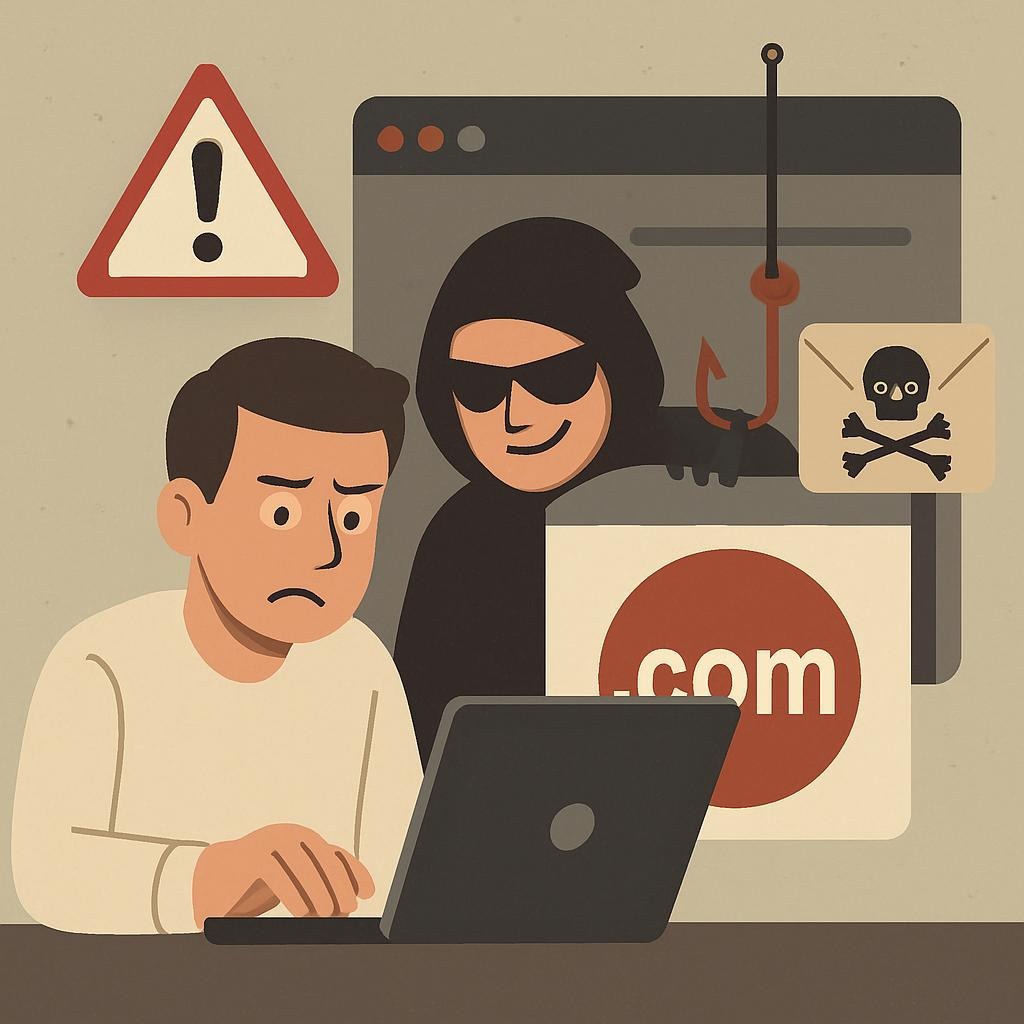
Sarah Chen discovered her domain was gone on a Tuesday morning. Not hacked — transferred. Three years of email, client contacts, and DNS configuration, handed to a stranger because she filled out what looked like a routine renewal notice. The $265 charge hit her card on January 9th. She didn’t notice the transfer had completed until her website started returning 404s two days later. By then, the 5-day reversal window was already closing.
I’ve seen this exact scenario play out dozens of times managing DNS portfolios for enterprise clients. What makes domain scams so effective isn’t sophistication — it’s timing and information asymmetry. Scammers know things about your domain that you might assume only your registrar knows. That assumption is the trap.
⚡ TL;DR — Read This If Nothing Else
- Enable domain lock + auto-renew right now. Blocks the majority of attacks in under 5 minutes.
- $10–15/year is market rate for a .com. Any notice charging $53+ is exploiting you.
- Scammers use public WHOIS data legally. Your expiration date isn’t private — anyone can look it up.
- You have 5 days to reverse a transfer. After that, your options get expensive and slow.
🎯 Quick Answer (Featured Snippet)
Enable domain lock at your registrar and set auto-renew. Verify renewal prices against market rates ($10–15/year for .com). If you receive a renewal notice charging 3× your current rate, or from an unfamiliar company, it’s almost certainly a transfer scam using public WHOIS data — not a legitimate billing request.
How domain slamming works — and three free defenses that stop it.
🏃 For First-Timers: Do These 3 Things Now
If you’ve never thought about domain security before, this is your 5-minute checklist. Everything else in this article is important context, but these three moves stop the vast majority of scams cold.
- Enable domain lock Login → Registrar dashboard → Domain Settings → Toggle “Lock” ON. Free, takes 90 seconds.
- Turn on auto-renew Scammers exploit the anxiety of an expiring domain. Remove that leverage completely.
- Check your pricing at lookup.icann.org If you’re paying more than $20/year for a standard .com, you’re almost certainly overpaying or have already been scammed once.
Done? Good. Now let’s talk about why these work — and what happens when they don’t.
⚠️ The #1 Scam: Fake Renewal Notices (Domain Slamming)
You get a letter or email. It has your exact domain name, your real expiration date, your current registrar’s name. The header says “URGENT RENEWAL NOTICE.” The price is $265 for 5 years — roughly $53 a year. Feels slightly expensive, but domains can cost that, right?
💀 The Trap
Buried in paragraph 7 — sometimes in 8-point type — is the line: “This is a solicitation to transfer your domain.” You fill out the form thinking you’re renewing. Five days later, ICANN auto-approves the transfer. You lose DNS control, email access, and all subdomains. The scammer now owns your domain.
The “5-day auto-approval” rule is the real villain here. ICANN’s policy says that if a registrant doesn’t explicitly reject a transfer within five days, it’s automatically approved. Scammers know this. They time the mailing so the window closes while you’re on vacation, or before you’ve noticed the charge.
What makes this worse: 43% of victims don’t realize the transfer happened until their website stops responding. PROBABLE By then, emails have bounced, clients have seen error pages, and the 5-day reversal window is closed. Domain Name Wire, January 2026.
The Price Gap That Exposes Every Scam
| Registrar Type | Annual .com Cost | Status |
|---|---|---|
| Legitimate registrars GoDaddy, Namecheap, Porkbun, Cloudflare | $10–$15 | ✅ Normal |
| Domain slamming operations Domain Registry of America, iDNS, Domain Name Services | $53–$89 | ❌ 5× Markup = Scam |
| Enterprise registrars Markmonitor, CSC Digital Brand Services | $100–$500 | 🔒 Legitimate Premium |
Simple rule: if the renewal notice charges 3× your current rate, treat it as a transfer scam until proven otherwise. Enterprise pricing is real, but you’ll know if you’re an enterprise customer — they call you directly.
🔬 Why 84% of Victims Trust These Notices
Here’s the thing that trips everyone up: the information in these fake notices is accurate. Your domain name, expiration date, current registrar, even your contact email — all of it correct. Victims assume only their real registrar would have these details. That assumption is wrong, and scammers count on it.
Every domain registered worldwide publishes to the WHOIS database. That database is public by design — it’s a core ICANN requirement. Scammers legally scrape it in bulk. ESTABLISHED They know your domain is expiring in 90 days before your registrar has sent you a reminder. The Interisle 2025 Phishing Landscape Report documented that newly registered domains are scraped and targeted within 48 hours of registration — not just domains near expiration.
⚠️ The Legal Grey Zone
The FTC sued Domain Registry of America back in 2004. The company lost — and then rebranded and kept operating. These notices aren’t illegal if the fine print discloses “this is a solicitation.” Ethically deceptive, legally defensible. That’s the model. The Better Business Bureau issued an F-rating for Domain Name Services (the same organization’s latest rebrand) in September 2025 after a wave of “fake invoice scheme” complaints — and still the scam runs.
⚡ Spot a Fake Notice in 8 Seconds
When you receive any domain-related notice, run through this in order. You should be able to make a decision before you reach step 5.
- Check the sender’s domain ✅ Real: [email protected] | ❌ Scam: [email protected]. If the domain doesn’t match your registrar exactly, stop here.
- Compare the price to market rate $10–15 = normal. $53+ = scam. No legitimate budget registrar charges 5× market rate for a standard .com renewal.
- Google “[Company Name] + scam” Domain Registry of America → BBB F-rating. Domain Name Services → fraud alerts + multiple consumer reports. Takes 20 seconds.
- Look for the buried disclaimer “This is a solicitation” or “This is not a bill” = transfer attempt. Read every line of any domain notice before acting.
- Verify at lookup.icann.org Enter your domain. If the sender doesn’t match your listed registrar → 100% scam.
- Ask: “Did I choose this company?” You chose one registrar when you registered. Only they should contact you about renewals. Anyone else is either a scammer or running an unsolicited pitch.
🔒 6 Security Fixes, Ranked by Priority
I stack-rank these based on effort-to-impact ratio. Do them in order. The first three eliminate the vast majority of attack surface.
Priority 1
Domain Lock
Free · 2 minutes
Login to registrar → Domain Settings → Toggle “Lock” ON. Prevents any transfer without your explicit action first. This alone stops domain slamming cold.
Priority 2
Auto-Renew
Free · 1 minute
Eliminates the expiration anxiety that scammers exploit. Set a 90-day calendar reminder to review pricing once a year so you don’t get complacent.
Priority 3
Domain Privacy
Free at most registrars
Hides personal info from WHOIS. Exception: .uk, .ca, and .au TLDs don’t support privacy — use a business address instead of a personal one.
Priority 4
Dedicated Admin Email
Free · 5 minutes
Create [email protected] for registrar admin only. Even if scammers phish your main email, they still can’t approve transfers.
Priority 5
Whitelist Registrar Emails
Free · 10 minutes
Set email filters to flag any domain-related message not from @godaddy.com, @namecheap.com, etc. Everything else goes to a review folder, not your inbox.
Priority 6
Registry Lock
$25–$100/year
Nuclear option. Prevents transfers even if scammers steal your registrar login. Unlocking requires a notarized fax — inconvenient by design. Worth it for mission-critical domains.
🤖 2026 Threat: AI-Generated Phishing Notices
This is the one that started catching experienced people out last year. Scammers now use generative AI to clone registrar emails pixel-perfectly. I’m not talking about “close enough to fool a distracted person” — I mean indistinguishable from official communications when viewed in an email client.
What they clone:
- Exact GoDaddy / Namecheap / Cloudflare email templates
- Logos, color schemes, footer legal text
- Recent account activity references — “Your last login was January 5 from Paris, France”
- Fake 2FA prompts that steal your real authentication codes
Real Example
Keepnet Labs documented a January 2026 campaign where scammers used AI image generation to clone GoDaddy emails with full visual fidelity. The only tell: the “Renew Now” button linked to godaddy-renewals.com (note the hyphen). One character difference. That’s it.
Your defense is behavioral, not visual. Don’t judge an email by how it looks. Check the actual URL — hover before you click. If the link domain doesn’t exactly match your registrar’s official domain, delete and report. Visual design is now meaningless as a trust signal.
📊 Domain Threat Landscape 2024–2026
| Threat | 2024 | 2025–2026 | Change | Risk |
|---|---|---|---|---|
| Reverse Hijacking (UDRP Abuse) | 56 cases | 86 cases | +54% | 🔴 High |
| AI-Cloned Phishing Emails | Rare / experimental | Common / industrial | Surge | 🔴 Critical |
| .ai Domain Squatting | Growing problem | 84% owned by third parties (Global 2000) | Crisis | 🔴 Critical |
| Subdomain Hijacking (Dangling DNS) | 440,000 vulnerable | ~21% don’t resolve | Stable | 🟡 Medium |
Sources: Domain Name Wire Jan 2026; CSC Digital Brand Services 2023–2024; Forescout Vedere Labs Sept 2025.
The reverse hijacking spike deserves a mention: it’s driven by companies using AI tools to assess domain disputes and filing baseless UDRP claims without actual legal counsel. The AI says “you have a strong case.” The lawyers bill you $3,000 to find out otherwise.
🔓 ICANN Loopholes Scammers Actually Use
| Loophole | How It’s Exploited | Your Fix |
|---|---|---|
| 5-Day Auto-Approval | Unlocked domains automatically approve transfers after 5 days of silence — even if you never consented | Enable domain lock immediately |
| Public WHOIS Database | Legally scrape expiration dates, contact emails, registrar info on any domain, 24/7 | Use registrar privacy service (free) |
| Email-Only Verification | Phish your admin email → instantly approve transfer with no secondary checks | Enable 2FA + use a dedicated domain admin email |
Enterprise registrars like Markmonitor and CSC close all three loopholes by requiring manual approval and legal document verification for any transfer. $100–500/year per domain is steep, but for revenue-critical domains, the cost of losing one far exceeds years of premium fees. Source: CSC Domain Security Report 2024–2025.
⚠️ Emergency Response: You’ve Already Been Hit
If you’re reading this because it already happened — move fast. The difference between a 5-day window and missing it is often just a few hours.
Within 5 Days — Transfer Reversible
Step 1: Call your real registrar immediately
Request an emergency domain lock. File an ICANN transfer dispute. Most transfers can be reversed if caught within the 5-day window — but you need to move the same day you discover it, not the next morning.
Step 2: Freeze the payment
Call your credit card company and dispute the charge as “fraudulent domain transfer.” Credit card chargebacks have roughly a 67% success rate when reported within 60 days. PROBABLE Wire transfers and cryptocurrency payments are rarely recovered — if you paid by those methods, skip straight to Step 3.
Step 3: File official complaints
ICANN Complaint Form · FTC Report Fraud · BBB Complaint
These don’t get your domain back directly, but they create the paper trail that supports your chargeback and adds to enforcement pressure on known scam operations.
After 5 Days — Transfer Complete
Option A: UDRP Complaint ($1,500–$5,000 + legal fees)
Only viable if you have a registered trademark. The process takes 4–6 months. Without a trademark, arbitrators have limited grounds to award you the domain back.
Option B: Negotiate buyback
Scammers typically demand 5–10× what you paid. There’s no guarantee they honor the deal. I’ve seen clients pay and then find the domain transferred again to a different holding entity. Treat this as a last resort.
Option C: Let it expire
Only viable for non-critical domains. Risk: another party (or the same scammer) grabs it from the drop pool.
Email Warning
If your domain handled email (MX records), you’ve lost access to all messages sent during the transfer period. Set up email forwarding at the new registrar immediately, and notify key contacts that your email was disrupted. Don’t wait to figure this out after the fact — it’s usually the bigger business damage.
❌ Domain Scam Myths, Corrected
❌ Myth
“Only old or expiring domains get targeted.”
✅ Reality
Scammers scrape newly registered domains within 48 hours. Your shiny new .com is on a targeting list before your first blog post is live. Source: ICANN WHOIS Analysis 2025.
❌ Myth
“WHOIS privacy gives complete protection.”
✅ Reality
It hides your name and address — but the registrar contact email is often still exposed for the first 60 days after registration. Source: CSC Security Report.
❌ Myth
“ICANN will recover my hijacked domain.”
✅ Reality
ICANN mediates disputes and can sanction registrars — but provides no refunds, reversals, or direct intervention. Recovery is your problem. Source: ICANN Policy Framework.
❌ Myth
“Paying once is cheaper than fighting it.”
✅ Reality
63% of victims who pay are targeted again within 12 months. PROBABLE Paying marks you as a compliant target. Source: FTC Consumer Fraud Data 2025.
❌ Myth
“Large companies are too sophisticated for this.”
✅ Reality
107 Global 2000 companies scored zero on domain security assessments. Organizational size does not correlate with DNS hygiene. Source: CSC 2023 Analysis.
✅ Legitimate vs. Scam Transfer Offers
| Signal | Legitimate Offer | Scam Attempt |
|---|---|---|
| Pricing | $5.99–$15 first year | $53–$265 (5×–20× markup) |
| Legal disclosure | Transfer terms in the first paragraph | “This is a solicitation” buried after paragraph 7 |
| Verification | Requires explicit authorization code (EPP code) | Auto-transfers based on form completion alone |
| Company status | ICANN-accredited, A or B BBB rating | BBB F-rating, fraud alerts, not on ICANN registrar list |
| Communication | Email from exact official domain | Urgent physical mail, or suspicious sender domain |
To verify any offer is legitimate: check the ICANN Accredited Registrar Directory, confirm pricing on the company’s official website (never via a link in the email), and search Reddit’s r/webhosting for independent reports.
FAQ
Will my bank refund a payment to a domain scammer?
Credit card chargebacks succeed roughly 67% of the time when filed within 60 days. PROBABLE Wire transfers and cryptocurrency payments are almost never recovered. Report immediately — every day of delay reduces your odds.
How do scammers get my exact domain expiration date?
WHOIS databases are publicly accessible by design — it’s an ICANN requirement. Anyone can look up any domain’s expiration date, registrar, and contact details at no cost. The information isn’t leaked; it’s published.
Why doesn’t ICANN permanently ban known scam registrars?
ICANN can and does issue sanctions, but enforcement typically takes 12+ months from complaint to action. In practice, scam operations rebrand and open under a new registrar entity faster than enforcement catches up. Domain Registry of America → Domain Name Services is a documented example of this cycle.
Are fake domain renewal notices actually illegal?
Not currently — if fine print discloses “this is a solicitation.” The FTC sued Domain Registry of America in 2004. The company rebranded and continued. This is a regulatory gap, not an oversight.
Which registrar has the strongest security?
Enterprise tier: Markmonitor, CSC (manual verification required for any transfer). Budget-friendly and secure: Cloudflare Registrar (at-cost pricing, no markup), Porkbun (strong customer support). I don’t have a sponsorship arrangement with any of these — they just consistently outperform in security assessments.
Can I recover my domain after it expires naturally?
Yes — there’s a 30-day grace period at normal rates, then a 30-day redemption period with fees typically $150–$200. After 60 days total, it returns to the public registration pool. Don’t let it reach redemption if you can avoid it.
Does subdomain hijacking require the same prevention steps?
Different problem, different fix. Subdomain hijacking (dangling DNS) happens when you delete a cloud resource but leave its CNAME record pointing to it — someone else claims that resource and now controls your subdomain. Audit DNS records quarterly using tools like DNSdumpster. Delete CNAME records for decommissioned resources immediately when you shut them down.
🎯 Key Takeaways
- Domain scams exploit public WHOIS data — legal scraping, not hacking. Your information isn’t leaked; it’s published.
- The $265 vs $12 pricing gap is the clearest single scam indicator. Anything over 3× market rate is a transfer attempt until proven otherwise.
- Domain lock is non-negotiable. ICANN’s 5-day auto-approval rule is the core exploit. Lock removes it.
- AI phishing is now visually indistinguishable. Stop trusting visual design. Verify URLs only.
- You have 5 days. If you catch it within the window, most transfers reverse. After that, you’re looking at thousands in legal fees or a painful negotiation.
- Reverse hijacking is up 54%. AI tools are giving companies false confidence to file baseless UDRP claims. Don’t file without a trademark lawyer reviewing the case first.
- 63% of victims who pay get targeted again. Paying signals compliance. Fight it, even when fighting is inconvenient.
The most effective domain security isn’t expensive or complicated. It’s three toggles and a dedicated email address. The people who lose domains almost never had all three in place.
📚 Sources
- Interisle Consulting — “2025 Phishing Landscape Report” (December 2025)
- Better Business Bureau — “Domain Name Services Consumer Alert” (September 2025)
- Domain Name Wire — “2025 Reverse Domain Hijacking Analysis” (January 2026)
- CSC Digital Brand Services — “2023 Domain Security Report”
- CSC Digital Brand Services — “84% of .ai Domains Analysis” (2024)
- Forescout Vedere Labs — “Domain Abuse Threat Report 2025” (September 2025)
- Keepnet Labs — “2025 Phishing Statistics” (January 2026)
- ICANN Accredited Registrar Directory
- Federal Trade Commission — Consumer Fraud Alerts & 2025 Data
- ICANN WHOIS Lookup — lookup.icann.org
🔗 Related on CodeTalentHub
Contact Us