
Upwork Alternatives for Senior Freelancers: What Actually Changes Your Take-Home Pay in 2026
Since May 1, 2025, Upwork has charged freelancers a variable 0–15% service fee per contract instead of the old tiered 20/10/5% model, and Upwork’s own Help Center still lists that as the active rate card in August 2026, with most freelancers landing around 10%. That change moved real money, and a second, smaller fee introduced the same year gets misreported constantly. This guide rechecks every number against each platform’s own pricing pages, compares real take-home pay across the eight platforms that matter once you’ve outgrown the open marketplace, hands you an original cost-per-client formula and a Platform Fit Score you won’t find anywhere else, and corrects a few claims — including one full company mix-up — that are currently circulating as fact.
The best Upwork alternatives for senior freelancers in 2026 are Toptal and Arc.dev (both 0% freelancer fee, human- or AI-vetted, enterprise-grade clients), Contra and Braintrust (0% commission, best used as low-cost infrastructure once you already have demand), and Guru (5–9%, the lowest fee among open marketplaces). Upwork itself still charges a variable 0–15% fee, averaging around 10%, and remains the best option purely for discovery volume — not for margin.
Most senior freelancers do better running two or three platforms at once rather than picking one winner: one for discovery, one for premium retainers, one as fee-free payment rails for clients they already have.
In a hurry? Skip straight to the 30-day migration plan or the Platform Fit Score — everything above them is the sourced evidence behind those two sections.
Executive Summary: What’s Actually True Right Now
- Upwork’s freelancer service fee is still a variable 0–15% per contract as of August 2026 — the May 2025 change stuck. Upwork’s own Help Center confirms the rate is set when you submit a proposal or accept an offer, locks for the life of that contract, and averages around 10% for most freelancers. A handful of 2026 blog posts claim Upwork quietly moved to a flat 10%; that isn’t what Upwork’s own documentation says, and we’re flagging it here because it’s spreading.
- The rate isn’t random — it’s partly a loyalty discount you’re not told about upfront. Multiple 2026 fee-tracking analyses of Upwork’s model describe the per-contract percentage as weighted by your billing history with that specific client: a brand-new client relationship tends to start near the top of the 0–15% band, while a client you’ve billed repeatedly can drift toward the low end, occasionally to 0%. Upwork doesn’t publish the exact formula, so treat this as a directional pattern rather than a guarantee — but it changes how you should think about “reapplying” to the same client through Upwork versus moving them to direct billing.
- The “$49/month per direct contract” fee is real, but it’s charged to clients, not freelancers. It applies specifically to Business Plus clients who use Client-Initiated Direct Contracts to pay freelancers they sourced outside Upwork — confirmed directly on Upwork’s pricing and Business Plus pages. It’s also a different $49 from the $49.99/month Business Plus membership fee itself; people conflate the two constantly. Freelancer-Initiated Direct Contracts still carry a flat 5% freelancer fee, unchanged.
- Upwork also sells a way out of the percentage fee — but only on one contract type. The $19.99/month Freelancer Plus membership’s own page states 0% freelancer service fees specifically on earnings through Direct Contracts (versus the 5% Basic-plan Direct Contract rate). Standard Talent Marketplace contracts — the ones most freelancers actually win through proposals — still carry the regular variable 0–15% fee regardless of membership tier. The workaround is real, but it’s narrower than “0% on everything,” and it’s worth confirming against Upwork’s current membership page before assuming it applies to a given contract.
- Two unrelated companies are both named “Braintrust,” and 2026 coverage keeps mixing them up. The freelance talent network at usebraintrust.com (0% freelancer fee, 15% client fee, the BTRST token) is a completely different company from Braintrust Data Inc. at braintrust.dev, an AI observability startup that raised an unrelated $80 million Series B in February 2026 at an $800 million valuation, led by ICONIQ Capital. If you see that funding round cited as evidence the freelance platform is thriving, it’s the wrong company. The freelance platform’s own, separate momentum — a May 2026 G2 Leader designation and a spot on TIME’s first “America’s Top WorkTech Companies” list — is real and independently checkable.
- Contra’s 0% freelancer commission isn’t a new 2026 feature — it’s been the model since the platform launched in February 2021. What changed over time is the client-side fee: Contra’s own pricing page currently describes a flat contract fee starting at $19, while several third-party trackers still describe an older tiered $2–$29 per-payment scale. Either way, the freelancer keeps 100% of the agreed rate; only the client-side mechanics are in flux.
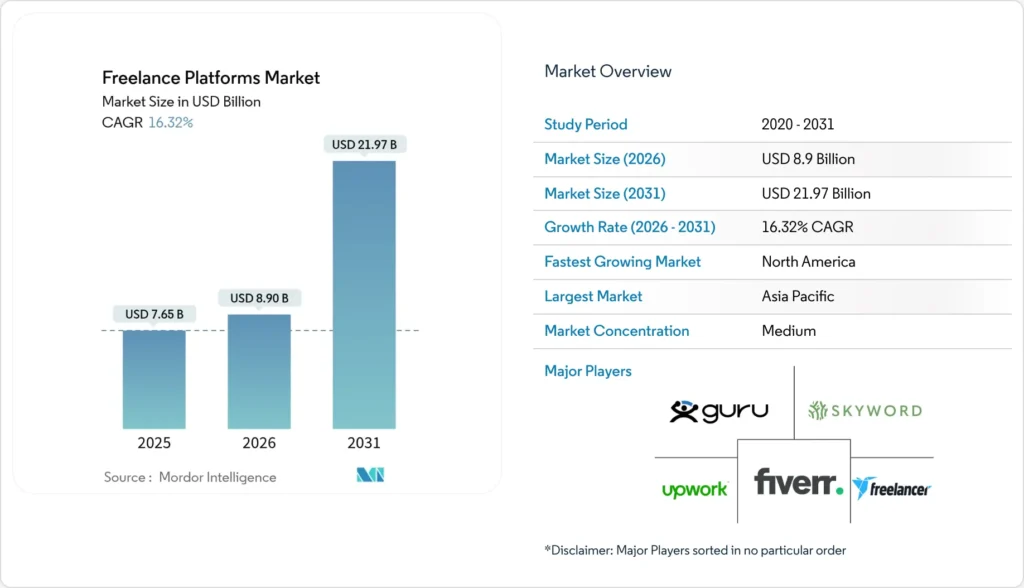
- Market-size estimates for the freelance platform industry disagree by 25%+ depending on the research firm — Grand View Research says $7.3B for 2026, Mordor Intelligence says roughly $8.9B, Research and Markets says $9.91B. All three are legitimate; they simply scope “freelance platform” differently. Treat any single figure as directional.
The Platform That Taught Experts the Wrong Habits
There’s a specific kind of senior freelancer — ten years deep, strong portfolio, international clients — who has watched Upwork slowly rearrange the incentives against them. The bidding system was always noisy but tolerable when it converted. The Connects currency was annoying but manageable. The old 20/10/5% tiered structure at least rewarded long-term client relationships: the more you billed a single client over your lifetime with them, the less Upwork took.
Then came the May 2025 restructure. Upwork retired the tiered model entirely and replaced it with a variable service fee of 0% to 15% per contract, set by factors Upwork doesn’t fully publish — category, competition, and history with that specific client all appear to matter. In practice, most freelancers still see an effective rate clustering around 10%. The rate locks in once a contract starts, but you don’t know the exact number until you’re looking at a proposal or an offer.
A line that keeps circulating in freelancer forums says Upwork now charges freelancers “$49/month per direct contract.” That’s not accurate as written, and it’s actually two separate Upwork fees getting mashed into one. The $49.99/month fee is what a client pays to access the Business Plus tier at all. Separately, if that same Business Plus client uses a Client-Initiated Direct Contract to pay a freelancer they found outside Upwork, they’re billed an additional $49/month for each active contract of that type — also a client cost, confirmed on Upwork’s own pricing and Business Plus pages. Neither charge touches freelancer earnings. Freelancer-Initiated Direct Contracts — the kind a freelancer sets up themselves — still carry a flat 5% freelancer service fee, unchanged by any of this.
Where the fee change genuinely bites is the stack: the 0–15% variable rate, plus Connects at $0.15 each (roughly 2–16 Connects per proposal depending on competition), plus a withdrawal fee on some payout methods, plus a currency-conversion markup for freelancers billing outside the U.S. Independent fee-tracking sites that model the full stack — not just the headline percentage — put the realistic all-in cost closer to 11–20% of gross contract value for an actively-bidding freelancer, and agency-side analyses modeling labor overhead, Connects spend, and withdrawal costs on top of that report a real “tax” as high as the low-to-mid 30s. The honest range is wide because it depends entirely on how much you’re paying in Connects to win each contract, which nobody standardizes.
Upwork’s own Freelancer Plus page states 0% freelancer service fees on Direct Contracts for the $19.99/month tier — up from the 5% Basic-plan Direct Contract rate. Direct Contracts are the arrangement where a freelancer and client who found each other outside Upwork still route payment through it; they are not the standard proposal-won Talent Marketplace contracts most freelancers actually work under, which keep the usual variable 0–15% fee no matter your membership tier. So the workaround genuinely helps if a meaningful share of your income already flows through Direct Contracts — do the arithmetic on that slice specifically, not your whole Upwork income — and it’s worth confirming the current scope directly on Upwork before assuming it covers a given contract, since membership perks are exactly the kind of detail platforms revise without much notice.
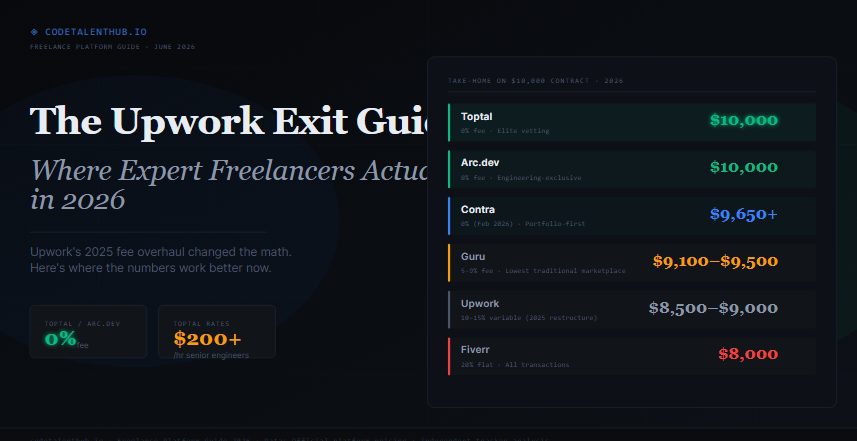
On a $10,000 contract at a 10% effective Upwork fee, a freelancer keeps roughly $9,000 before Connects and withdrawal costs. The same $10,000 routed through Toptal, Arc.dev, Contra, or Braintrust — all genuinely 0% to the freelancer — keeps the full $10,000. Over a $120,000 annual billing base, that 10-point gap is $12,000 a year before compounding. The ten-year, 7%-return compounding figure a few sections below is a simplified illustration built on that same $12,000/year gap held constant — treat it as directional math, not a forecast, since real billing volume, fee rates, and returns all move around over a decade.
None of this makes Upwork obsolete for experts. It remains the largest-volume marketplace in the category by active client count, and it dominates raw discovery. But volume was never the constraint for senior freelancers. Conversion is. The platforms below are built specifically for that problem, each with real tradeoffs the marketing pages leave out.
An Original Framework: The Real Cost-Per-Client Formula
Every platform publishes a headline fee. Almost none of them make it easy to calculate what a specific client relationship actually costs you once acquisition spend is included. That’s the number that should drive a platform decision, not the percentage on the pricing page. We built a simple formula that any freelancer can run in under a minute.
Run this per client, not per platform — the same platform can produce wildly different real costs depending on how many proposals it took you to win the work.
Apply it to two realistic scenarios on Upwork. Scenario A: a $10,000 contract won on the third proposal at 6 Connects each (18 Connects total, $2.70), at a 10% service fee. Real cost: $1,002.70, or about 10.03% — barely different from the headline rate, because the contract size dwarfs the acquisition cost. Scenario B: a $600 contract won on the eighth proposal at 8 Connects each (64 Connects, $9.60), at a 12% service fee because it’s a brand-new client relationship. Real cost: $81.60, or 13.6% — and that’s before counting the unpaid time spent writing seven losing proposals. Small, competitive contracts are where the headline fee understates reality the most; large, low-competition contracts are where it’s nearly accurate.
Several 2026 fee-tracking analyses of Upwork’s per-contract percentage note it appears to reward billing history with a specific client — new relationships start high in the 0–15% band, established ones can drift toward the low end. Upwork doesn’t publish the formula, so this is a pattern, not a promise. But it implies a concrete tactic: the second and third contract with the same repeat client is where moving them to a direct-billing platform like Contra starts to pay off, since that’s typically when Upwork’s own fee on that relationship is already falling and the marginal benefit of leaving shrinks — while the marginal benefit of leaving is highest on brand-new, small, high-competition contracts, which is exactly where our formula above shows the real cost running highest.
The 2026 Freelance Market, Honestly Sized
Before choosing a platform, it helps to know the shape of the market — and to know that “market size” figures for this category disagree with each other more than most SEO content admits.
Grand View Research puts the global freelance platforms market at $7.3 billion in 2026, growing to $24.2 billion by 2033 at an 18.6% CAGR, up from $6.4 billion in 2025. Mordor Intelligence estimates roughly $8.9 billion for 2026. Research and Markets puts 2026 at $9.91 billion, projecting $20.12 billion by 2030. The spread exists because firms define “platform” differently — some count only pure marketplace commission revenue, others fold in adjacent staffing-tech and project-management spend. We lead with Grand View Research’s numbers because their public methodology (component, end-use, and regional segmentation, cross-checked against named market players including Toptal, Braintrust, Guru, PeoplePerHour, and Upwork) is the most transparently documented of the three.
What’s more consistent across every source than the topline dollar figure is the direction of skill demand — and 2026 produced the clearest data point yet on that front. Upwork’s Future Workforce Index 2026, released July 14 and based on a survey of 2,400 U.S. skilled knowledge workers plus Upwork’s own marketplace data, found that 38% of skilled U.S. knowledge workers now freelance, up sharply from 28% just one year earlier. Separately, 58% of full-time employees say they’re actively considering freelancing, up from 36%. That’s a genuinely large one-year jump, and Upwork’s data suggests AI is a direct driver: freelancers who use AI in their work earn about 34% more per hour than those who don’t, but the gains aren’t evenly spread. Simple, execution-only AI tasks are growing fast in volume while their pay per hour is compressing, while complex, judgment-heavy AI-augmented work saw freelancer earnings rise 45% year-over-year.
Upwork frames the winners of this shift as “AI Orchestrators” — professionals who connect AI tools to real workflows and apply judgment on top, rather than just using AI to execute faster. Stanford economist Nick Bloom, who sits on Upwork’s Economic Advisory Council, is quoted in the report making a point worth sitting with: broad AI adoption alone doesn’t show up as broad productivity gains in the data — the payoff is concentrated specifically in work where people are layering expertise and business context on top of the tools, not simply in how many people are using them. That’s a useful frame for a senior freelancer deciding whether a vetted, premium platform is worth the application effort: the entire pitch of Toptal, Arc.dev, and similar platforms is that they filter for exactly the judgment-heavy profile Upwork’s own research says is pulling away from the pack.
The Platforms That Actually Change the Math
Seven vetted or fee-favorable platforms, evaluated on what actually matters for a senior freelancer’s positioning decision — not the feature list lifted from the about page, but the dynamics that determine whether you earn more, convert faster, or get stuck in a different kind of queue. Fiverr appears in the fee table further down for completeness, but its packaged-gig model is a different game than the one this guide is written for.
Toptal’s vetting is genuinely difficult and human-led rather than purely automated: a language and communication screen, a live technical interview, and a project-based evaluation reviewed by senior practitioners. Founded in 2010 by Taso Du Val and Breanden Beneschott, the network has since grown to a self-reported 20,000+ vetted professionals drawn from a much larger applicant pool — one 2026 secondary comparison puts that pool at roughly 1.6 million applications over the platform’s history, which is where the “top 3%” framing comes from. None of these figures are independently audited, so treat “top 3%” as Toptal’s own marketing framing rather than a verified statistic. Toptal charges freelancers 0%; its margin comes from a markup on the client-facing rate instead, which clients pay alongside a $500 refundable deposit and a $79/month subscription fee.
The concierge matching model — where Toptal’s team finds you a client rather than you bidding — means a slower time-to-first-contract (commonly 1–4 weeks after acceptance, sometimes longer for niche specializations) but longer average engagements. This is a platform built for six-month-plus retainers, not one-off gigs.
- 0% fee to freelancer, no service-fee math to manage
- Enterprise clients, longer engagements
- No cold pitching once accepted
- “Toptal-vetted” is a recognizable credibility signal
- Most applicants don’t pass on the first try
- Slower time-to-first-dollar than open marketplaces
- Limited to dev/design/finance/PM-adjacent niches
- No control over which clients you’re matched with
Arc.dev sits alongside Toptal in the zero-fee, vetted tier, but its screening runs AI-first: resume parsing, automated technical assessment, and a shorter live step, typically completing in days rather than weeks through its HireAI engine. Arc.dev advertises a “top 2%” acceptance claim against a network several secondary 2026 trackers estimate at roughly 450,000 developers — neither figure independently audited, and the 2%/450,000 math (~9,000 people) is arithmetic on top of two unverified inputs, so read it as a rough order of magnitude rather than a precise count. What the comparison is still useful for: it’s a meaningfully broader pool than Toptal’s smaller, more tightly human-vetted one. (Arc.dev itself has also cited a much larger 20-million-strong global sourcing pool in some materials; the 450,000 figure independent reviewers use appears to describe the narrower, actively vetted network rather than that broader top-of-funnel number.) That’s not automatically a downside — it’s a different tradeoff between speed and selectivity.
For freelancers, the pitch is straightforward: 0% commission, access to U.S.-rate projects, and no proposal-bidding wars. It’s the more achievable entry point for strong mid-to-senior engineers who haven’t cleared Toptal’s human screen yet, and a reasonable one to apply to in parallel with Toptal rather than instead of it.
- 0% fee, U.S.-market rates
- Fast, AI-assisted matching cuts cold outreach
- More accessible entry point than Toptal
- Strong demand specifically for AI/ML engineers
- Developers only — no design, writing, or marketing
- Vetting is broader than “top 2%” framing implies
- Client volume smaller than Upwork
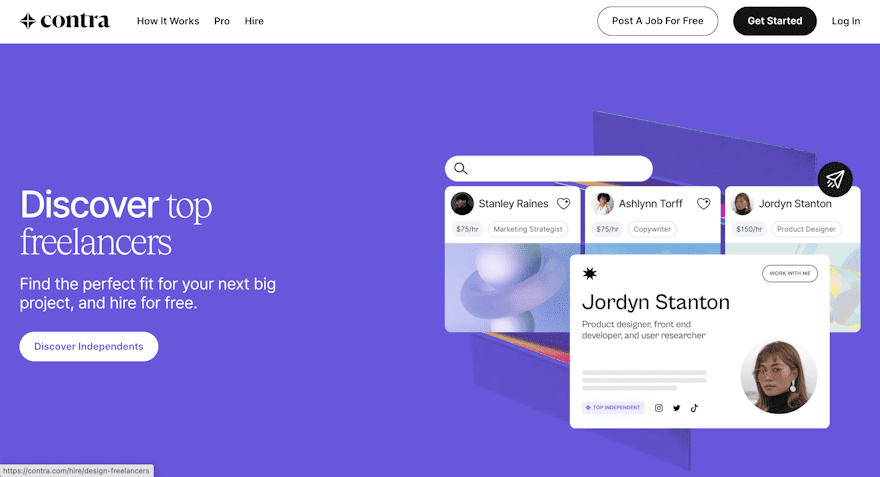
Contra has been commission-free for freelancers since its February 2021 launch (a $14.5M Series A led by Unusual Ventures followed the same month) — this is a core design choice, not a new 2026 rollout. The one thing worth double-checking before you budget around it: Contra’s own site currently describes a flat client-side contract fee starting at $19 (or $19/month per contractor for ongoing work), while several 2026 fee-tracking sites still describe an older tiered scale of roughly $2 to $29 depending on payment size. Contra’s pricing has moved before, so verify the live number on contra.com rather than trusting any single article — this one included. What doesn’t appear to be in dispute anywhere: freelancers keep 100% of the agreed rate either way.
There’s no Toptal-style vetting test. Contra’s filter is social: visibility depends on portfolio quality and, bluntly, whether you bring your own audience. Freelancers with an existing following convert well here — Contra becomes low-cost payment infrastructure for work they were already winning. Freelancers with no inbound demand find a smaller discovery surface than Upwork.
- No percentage commission on your rate, ever
- Portfolio pages double as a personal site
- Built-in contracts, invoicing, milestones
- Higher-quality client base than Fiverr-style volume marketplaces
- Native job discovery volume is still thin
- Client-side fee structure has changed before — verify current terms
- Works best if you already have inbound leads
Braintrust is structurally unlike everything else on this list: a user-owned network partly governed through the BTRST token, where the client — not the freelancer — pays the platform fee. As of August 2026, Braintrust’s own payments documentation states that fee plainly: a flat 15% charged to the client on every invoice, down from the wider “10–15%” range often quoted historically. That’s the mechanism that lets Braintrust genuinely offer 0% to freelancers while still running a real business. Founded in 2018 by Adam Jackson and Gabe Luna-Ostaseski, the platform reports 400,000+ approved talent within a broader community north of 600,000 members, and lists enterprise clients including Nestlé, Porsche, Nike, Goldman Sachs, and Atlassian.
You may see headlines about “Braintrust” raising an $80 million Series B in February 2026. That funding — led by ICONIQ Capital, announced February 17, 2026 at an $800 million valuation, with participation from Andreessen Horowitz, Greylock, Elad Gil, and Basecase Capital — went to Braintrust Data, Inc. at braintrust.dev, an unrelated AI observability and evaluation platform founded by Ankur Goyal, with customers including Notion, Vercel, Cloudflare, and Dropbox. It has nothing to do with the freelance talent network covered here. Several 2026 review and comparison sites now carry explicit warnings about this exact mix-up, which tells you how often it happens. The freelance platform’s real, separate 2026 news is its May 2026 G2 Leader designation for its AIR product (58 G2 Leader badges across categories including AI Recruiting, AI Interview Agent, and Video Interviewing, per Braintrust’s own awards page) and a spot on TIME and Statista’s first-ever “America’s Top WorkTech Companies” list, published June 9, 2026.
Braintrust’s AIR product — an AI-driven interview and screening tool, launched April 2024 — reports usage north of 1 million interview-minutes in a single 90-day window and 367,000+ completed AI voice interviews, self-reported figures worth reading as vendor claims rather than audited benchmarks. AIR is aimed at helping clients hire talent from the Braintrust network faster, which is a meaningfully different thing from the freelancer-facing fee structure, but it’s part of why enterprise interest in the platform has held up through 2026.
- 0% fee, genuine community-ownership model
- Real Fortune 1000 clients on the network
- Token rewards for network contributions
- Independently confirmed 2026 momentum (G2, TIME)
- Token/governance layer adds conceptual overhead
- Smaller active job volume than Upwork
- Easy to confuse with an unrelated company of the same name
Guru’s WorkRoom is its real differentiator — a shared project space where freelancer and client manage deliverables, milestones, and communication together, closer to a lightweight project tool than Upwork’s bare contract view. For agencies and freelancers juggling multi-deliverable, multi-month engagements, that matters. The 5–9% freelancer job fee (lower on the $8.95–$49.95/month paid membership tiers) is the lowest of any traditional open marketplace on this list, and clients separately pay a 2.9% handling fee that’s waivable via eCheck or wire transfer.
- Lowest fee among traditional open marketplaces
- Strong built-in project-management tools
- Less crowded than Upwork
- Long operating history and stable infrastructure
- Smaller client pool than Upwork or Fiverr
- Less brand recognition among clients
- Skews mid-market, not enterprise
For marketing freelancers — growth strategists, paid acquisition specialists, SEO leads, content directors — MarketerHire functions as the vertical equivalent of Toptal for marketers, with a widely cited but platform-sourced acceptance rate around 5% that we haven’t seen independently audited. The platform vets talent specifically for marketing roles and matches to client briefs through a dedicated Growth Manager rather than open bidding, with a two-week trial and free rematching if the fit is wrong. Its client roster reportedly includes names like Netflix, Lyft, Coinbase, Shopify, and HelloFresh, which is a reasonable proxy for the caliber of budget you’re matched against.
- Niche focus means less irrelevant competition
- Matching replaces proposal-writing
- Growth-stage clients tend to have real budgets
- Marketing only — no crossover to dev or design
- A vetting screen is still required
PeoplePerHour punches above its global visibility specifically in European markets — the UK, Germany, and the Gulf region in particular, with a buyer base skewing 60–65% UK/EU by most estimates. Its freelancer fee tiers by cumulative lifetime billing with a given client — roughly 20% on the first ~£500, dropping to 7.5% up to £5,000, then 3.5% above that — and resets to 20% for every new client relationship, which is the trap first-time users tend to miss. For freelancers targeting European businesses, or wanting to diversify away from a U.S.-only client base, it fills a geographic gap Upwork doesn’t naturally cover.
- Strong EU/UK client base
- “Hourlies” enable passive discovery without active bidding
- Fee drops sharply as a client relationship matures
- 20% fee resets with every new client
- Smaller global volume than Upwork
The developer-hiring space has kept adding human-vetted, dev-only alternatives to Arc.dev and Toptal. Lemon.io is the one that comes up most in 2026 comparisons: a reported 1.2% acceptance rate, fully human vetting across four stages, and a network that reportedly expanded beyond its original Eastern Europe base into the US, EU, and Latin America during 2026, with published rates from roughly $55 to $200+/hour. We haven’t verified Lemon.io against as many independent sources as the platforms above, so treat it as a lead worth your own due diligence rather than a full recommendation.
The Fee Table Worth Printing Out
Platform pricing pages are designed to obscure. Here’s the clearest comparison of what a senior freelancer actually keeps in 2026, on equivalent contracts — before taxes, and using each platform’s most commonly reported effective rate rather than best-case marketing numbers.
| Platform | Freelancer Fee | Take-home on $10K | Vetting Barrier | Best Fit |
|---|---|---|---|---|
| Toptal | 0% | $10,000 | ~3% acceptance | Senior dev/design/finance with a strong portfolio |
| Arc.dev | 0% | $10,000 | ~2% acceptance (AI-screened) | Engineers seeking enterprise rates, faster onboarding |
| Braintrust | 0% | $10,000 | Portfolio + community | Tech freelancers comfortable with Web3-adjacent governance |
| Contra | 0% commission | $10,000 | Portfolio quality | Freelancers with existing inbound leads |
| Guru | 5–9% | $9,100–$9,500 | Low | Mid-market, complex multi-milestone work |
| PeoplePerHour | 3.5–20% (tiered) | $8,000–$9,650 | Low | EU/UK-focused freelancers |
| Upwork | 0–15% (typically ~10%) | $8,800–$9,000 | Low–medium | Volume-dependent, all categories |
| Fiverr | 20% flat | $8,000 | None | Packaged gigs, discovery-first |
A senior developer billing $120,000/year on Upwork at a 10% effective fee loses roughly $12,000 annually to platform fees. The same billing routed through Toptal, Arc.dev, Contra, or Braintrust loses $0 to freelancer-side fees. Invested annually at a conservative 7% return, that $12,000/year gap compounds to roughly $166,000 over ten years. Platform choice is a financial-planning decision as much as a workflow preference.
An Original Framework: The Platform Fit Score
Fee percentage is the number everyone fixates on, but it’s a poor single-axis way to choose a platform. A 0% fee is worthless if the platform can’t get you in front of a client at all, and a mid-tier fee is a bargain if it comes bundled with matching, payment protection, and clients who don’t ghost. We built a simple scoring framework — our own editorial synthesis, not a third-party index — across five dimensions that actually predict whether a senior freelancer will be glad they joined a given platform six months later. Each is scored 1 (weak) to 5 (strong) based on the sourced data above.
| Platform | Take-Home Efficiency | Vetting Signal | Client Caliber | Time-to-First-Dollar | Discovery Volume |
|---|---|---|---|---|---|
| Toptal | 5/5 | 5/5 | 5/5 | 2/5 | 2/5 |
| Arc.dev | 5/5 | 4/5 | 4/5 | 4/5 | 3/5 |
| Braintrust | 5/5 | 3/5 | 4/5 | 3/5 | 3/5 |
| Contra | 5/5 | 1/5 | 3/5 | 4/5 | 1/5 |
| MarketerHire | 4/5 | 4/5 | 4/5 | 5/5 | 2/5 |
| Guru | 4/5 | 1/5 | 2/5 | 3/5 | 3/5 |
| PeoplePerHour | 2/5 | 1/5 | 2/5 | 3/5 | 3/5 |
| Upwork | 2/5 | 1/5 | 2/5 | 4/5 | 5/5 |
How to read this: Take-Home Efficiency reflects freelancer-side fee burden. Vetting Signal is how much the platform’s brand independently vouches for you to a new client. Client Caliber reflects typical budget and seniority of buyers on the platform. Time-to-First-Dollar reflects realistic speed from signup to a paid contract. Discovery Volume reflects how much inbound opportunity exists without you supplying your own audience. No platform wins on all five — that’s the point. A freelancer with strong inbound already should weight Take-Home Efficiency and discount Discovery Volume; a freelancer starting from zero should do the opposite.
The Question Nobody Asks: What Type of Freelancer Are You, Actually?
Platform choice is a positioning decision, not a feature comparison. Before comparing fee structures, answer this honestly.
The freelancer who needs volume is not the same person as the freelancer who needs margin. They keep recommending the wrong platforms to each other.
The Visibility-Seeker (0–3 years independent)
You need discovery. Clients don’t know you exist yet, inbound is low, and you’re building case studies. Upwork, despite the fee changes, is still the most efficient client-acquisition engine for this profile — sheer volume means there’s still opportunity even with competition. Fiverr suits packaged, productized services. Guru is a lower-friction alternative with fewer competitors per category.
The Rate-Optimizer (3–7 years, established reputation)
You have social proof and clients find you. You’re now paying a 5–20% tribute for leads you could largely convert without the platform. This archetype is best served by shifting part of the pipeline to Contra or Braintrust — keep the platforms where you already have reputation for discovery, then move payment to lower-fee infrastructure. Arc.dev and Toptal applications make sense here as an upgrade path, and if AI implementation work is part of your specialty, the Future Workforce Index data above suggests this is a good year to lean into that positioning specifically.
The Retainer-Builder (7+ years, senior expertise)
You want two or three long-term clients, not thirty short gigs. Toptal is built for this profile. So is MarketerHire, for marketers specifically. The strict vetting exists precisely to deliver this kind of client relationship.
Answer Honestly. Where Should You Be?
The Multi-Platform Strategy Most Experts Ignore
The counterintuitive move — one that several 2026 freelance-agency analyses converge on — is running three to four platforms simultaneously rather than one. The logic: each platform surfaces a different client archetype. The Upwork client who found you through proposal search is a different buyer than the Toptal client matched to you by a concierge team. Different budget expectations, different project lengths, different propensity to convert.
Freelancers who track their pipeline across platform tiers frequently report meaningfully higher close rates on premium vetted platforms versus open marketplaces, though exact multipliers vary by category and aren’t independently standardized — treat any specific “2–3x” claim from a single vendor with appropriate skepticism. The consistent signal across sources is directional, not a precise multiplier.
The insight the chart is meant to illustrate: the highest-revenue segment often involves the fewest clients and the least administrative overhead. Two long retainers can outproduce eight short-cycle projects, each with its own onboarding, contract, and revision loop — for freelancers who’ve cleared the vetting bar to access that tier.
Algorithm changes on any single platform — visibility scoring, ranking logic, fee structure — can affect a freelancer’s pipeline overnight through no change in their output quality. This has happened on Upwork and other marketplaces before. Running profiles across two or three platforms means one algorithmic shift doesn’t zero out your entire pipeline at once. It’s also worth keeping half an eye on the EU’s Platform Work Directive, covered in the timeline below, since it could reshape how some of these platforms operate for European clients starting in December 2026.
The 30-Day Platform Migration Plan
Reading a comparison is easy. Actually diversifying off a single platform, without torching your existing pipeline, takes a sequence. This is the order we’d recommend to a senior freelancer who’s decided Upwork alone isn’t working anymore — not a switch to flip overnight, but a four-week on-ramp that keeps income flowing the whole way through.
- WEEK 1 Run the real-cost formula above on your last five Upwork contracts. If your real cost is clustering above 15%, your priority is a 0%-fee platform; if it’s closer to 10%, focus on Client Caliber and Discovery Volume instead.
- WEEK 1 Apply to Toptal and/or Arc.dev immediately if you’re a developer, designer, PM, or finance specialist — the vetting queue itself can take 1–4 weeks, so start it before you need it, not after.
- WEEK 2 Build a Contra profile and move any existing direct or referral clients to it for invoicing, even before new leads arrive — it costs nothing to have live and immediately removes Upwork’s fee from relationships you already have.
- WEEK 2 Keep bidding on Upwork for repeat clients only where your billing history is already established and the fee is likely trending toward the low end of the 0–15% band; deprioritize cold proposals to new Upwork clients during the transition.
- WEEK 3 If you cleared vetting, negotiate your first Toptal/Arc.dev engagement as a smaller trial project rather than a full-time retainer, to validate the client-matching quality before committing your calendar.
- WEEK 3 Calculate your Freelancer Plus break-even on Direct Contracts specifically ($19.99/month vs. the 5% Basic-plan Direct Contract fee you’d otherwise pay on that slice of income) — not your whole Upwork billing, since standard Talent Marketplace contracts still carry the regular 0–15% fee regardless of membership.
- WEEK 4 Set a quarterly revenue-mix target across your active platforms (for example: 50% vetted/retainer, 30% direct/Contra, 20% Upwork for discovery) and revisit it every 90 days rather than reacting platform-by-platform.
Mistakes to Avoid When Switching Platforms
2024–2026 in the Freelance Platform Industry: What Actually Happened
Glossary: Terms That Actually Matter Here
Myth vs. Fact: The Claims Worth Double-Checking
What Changes When You Apply to a Vetted Platform and Fail
This happens more than platform success stories admit. Most applicants to Toptal and Arc.dev don’t pass on the first attempt. The reason is rarely that the person isn’t skilled.
The most common failure mode isn’t technical — it’s communication clarity under time pressure. Toptal’s live screen, in particular, tests how you think out loud under cognitive load, which mirrors real client calls more than it mirrors a take-home assignment. A developer who ships excellent code but can’t narrate their reasoning in real time often doesn’t pass, regardless of portfolio strength.
The fix is almost never “get more senior.” It’s usually: practice explaining your approach while solving problems out loud, record yourself, and watch it back critically. The screen rewards confident articulation of uncertain reasoning, not a perfect final answer. Coaches who specialize in this kind of prep commonly suggest waiting a few months between a first rejection and reapplying, using the time to ship one more credible public project — an open-source contribution or a documented case study with real metrics.
If you’re evaluating your positioning as a technical expert, the CodeTalentHub platform covers the broader landscape of software talent connecting directly with clients — worth exploring alongside the platforms listed here.
The Rate Gap Nobody Publishes
Platform rate pages exist to attract clients, not to inform freelancers. Below is a directional rate landscape as of mid-2026, aggregated from platform disclosures and independent tracker analysis. Treat exact figures as ranges, not guarantees — actual rates vary by skill depth, geography, and client budget.
The gap between Upwork-level rates and vetted-platform rates for senior developers often runs $30–80/hour. At 25–30 billable hours a week, that difference compounds into tens of thousands of dollars a year in gross billing potential — before even accounting for the fee-percentage gap covered earlier. Together, the two effects are why the vetting screen is one of the higher-leverage moves a senior freelancer can make with their time.
Questions That Come Up in Every Platform Comparison
Methodology: Every fee figure in this guide was checked against each platform’s own pricing, Help Center, or payments documentation as of early August 2026, and cross-checked against independent 2026 fee-tracking sites (including GoLance, Corcava, Getmany, GigRadar, Jobbers, and South) to confirm the 0–15% Upwork range is still active, that the effective rate for most freelancers still clusters near 10%, and that the per-contract percentage appears weighted by client billing history rather than assigned at random. Contra’s commission-free pricing page, Braintrust’s payments and awards-and-recognition pages, and Toptal, Guru, MarketerHire, and PeoplePerHour’s public pricing and support pages were checked directly. Where official documentation didn’t specify an exact figure, we cross-referenced against multiple independent 2026 analyses (including Second Talent, Tecla, EarnifyHub, Highcircl, HeroHunt.ai, Jobbers.io, and South) and flagged any remaining disagreement in the text rather than picking a number silently. The real cost-per-client formula and the Platform Fit Score are original CodeTalentHub Editorial frameworks, built from the sourced figures throughout this guide rather than drawn from any single third-party index. Upwork’s Freelancer Plus membership page was checked directly to confirm its 0% freelancer service fee applies specifically to Direct Contracts, not to standard Talent Marketplace contracts generally — an earlier draft of this guide stated that benefit too broadly, and it’s scoped correctly throughout this version. Acceptance-rate and network-size figures for Toptal, Arc.dev, and MarketerHire remain platform-disclosed or secondary-tracker estimates, not independently audited, and are flagged as such wherever they appear.
Market-size figures are drawn primarily from Grand View Research’s 2026 freelance platforms market report, with alternate estimates from Mordor Intelligence and Research and Markets noted where they diverge meaningfully. Workforce statistics come from Upwork’s Future Workforce Index 2026 (published via GlobeNewswire and Upwork’s investor relations site, July 14, 2026). The EU Platform Work Directive details are sourced to Directive (EU) 2024/2831 itself and multiple 2026 employment-law analyses. The Braintrust/Braintrust Data Series B was independently confirmed across multiple February 2026 sources (SiliconANGLE, Pulse2, FinSMEs, TechFundingNews, TheSaaSNews), all describing an AI observability company, not a freelance marketplace, before being included here. Acceptance-rate claims (Toptal, Arc.dev, MarketerHire) are platform-disclosed or independently estimated figures, not independently audited, and are presented as such throughout.
All figures reflect publicly available information as of early August 2026 and are subject to change — verify current terms directly with each platform before making financial or career decisions.
Where to Go Next
Direct links to the platforms and primary sources referenced in this guide. No affiliate codes — these are the actual application and research pages.
Disclaimer: All links open in new tabs. CodeTalentHub has no affiliate relationships with any platform listed. Fees and policies change frequently — verify current terms directly with each platform before making financial decisions.
Where to Go Next
Direct links to the platforms and data sources referenced in this guide. No affiliate codes — these are the actual application and research pages.
Disclaimer: All links open in new tabs. CodeTalentHub has no affiliate relationships with any platform listed. Fees and policies change frequently — verify current terms directly with each platform before making financial decisions.