



Careers · Freelancing · Last updated March 2026
How to Become a Freelancer in 2026: The Part Most Guides Skip
Most freelancing guides answer the wrong question. “Can I freelance?” is easy to answer. “Can I survive month four?” is the one that matters — and this is the guide that answers it honestly.
Roughly 76.4 million Americans now do some form of freelance work — up from 73.3 million in 2023, according to figures aggregated from Upwork’s Freelance Forward survey. That number needs a disclosure before it does any analytical work: Upwork runs the platforms that benefit when freelancing sounds attractive. The count is directionally plausible; treat the precision as commercial rather than scientific.
The more useful number sits two paragraphs lower in the same source. It doesn’t make headlines. It should anchor the decision you’re trying to make.
This guide is for career-changers with a marketable skill who are weighing the leap — not students looking for side income, not people already freelancing who want optimization tips. The question you need answered isn’t “can I freelance?” It’s “Can I survive month four?” Those are different questions, and most guides only answer the first one.
What Freelancing Actually Pays in 2026
Here’s an honest snapshot: while 60% of US freelancers report earning more than in their previous jobs, 55% earn under $50,000 per year, and the median hourly rate sits around $28. Both figures aggregate Upwork survey data — the same commercial-interest caveat applies; treat as directional.
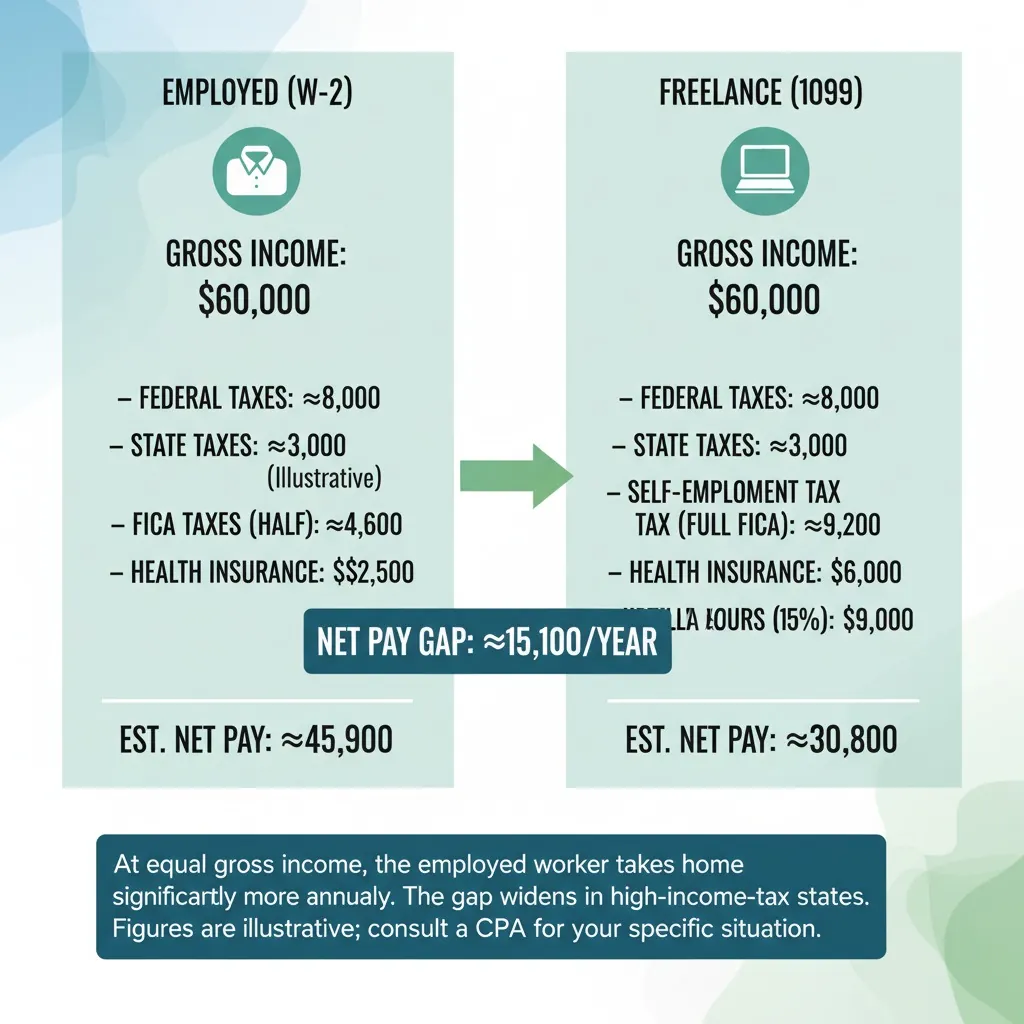
At 40 billable hours per week, $28/hour is roughly $58k gross annually. Before the self-employment tax. Before health insurance. Before the 10–15 unpaid business hours most full-time freelancers absorb weekly. Before the dry spells.
First-year net — for a full-time starter who manages the finances correctly — typically lands closer to $38–42k. That’s an analyst synthesis, not a measured statistic from peer-reviewed research. But the mechanism is tractable. And it surprises almost everyone who’s done the employed version of this math.
This isn’t a reason not to freelance. Many previous jobs were also underpaid. It is a reason to do the math before you resign rather than after.
“Gross revenue numbers are marketing. Net cash in your bank account is survival.”
Tom Morgan, drawing on aggregated US freelance data, 2025The Real Take-Home Math: What $80k Gross Actually Becomes
Most “success stories” proudly announce “I made $80k my first year freelancing!” Here’s what that headline number actually looks like once reality hits.
| Starting Point | Amount | Notes |
|---|---|---|
| Gross Billed Revenue | $80,000 | What clients actually pay you |
| Platform Commission | –$8,000 to –$16,000 | 10–20% typical (Upwork/Fiverr); zero on direct client relationships |
| After Platform Fees | $64,000 – $80,000 | |
| Self-Employment Tax (15.3%) | –$9,800 to –$12,200 | IRS requirement on net earnings — you pay both halves |
| Federal + State Income Tax | –$14,000 to –$18,000 | Avg. 22–28% effective bracket; depends on state and deductions |
| Health Insurance (solo) | –$4,800 to –$7,200 | $400–$600/month with no employer subsidy — a planning figure, not a precise quote |
| Business Expenses | –$6,000 to –$10,000 | Tools, software, marketing, accounting, professional development |
| Actual Take-Home Pay | $36,000 – $48,000 | Often closer to $42,000 in year one |
That’s a 40–55% haircut from the headline number. Add the classic income cliff at months 3–4 — 30–60 days payment lag plus ramp-up time — and you can easily burn through 2–3 months of runway before the first consistent check arrives. This is why the 90-day survival framework exists: not to scare you, but to prevent the most expensive mistake new freelancers make.
90-Day Runway Calculator
Formula: (monthly expenses + health insurance) × months + (projected monthly gross × 27.5% tax set-aside × months). This is illustrative — consult a tax professional for your specific situation.
Niche Selection Is a Survival Decision — Not Just a Preference
Every guide tells you to pick a niche you enjoy. Necessary, but no longer sufficient. In 2026, niche selection is also a risk decision — because AI has already changed the demand curve unevenly, and picking the wrong category means competing with tools that cost clients $20 per month.
The clearest evidence comes from a peer-reviewed study published in the Journal of Economic Behavior and Organization. Researchers analyzed job postings on a major freelance platform before and after ChatGPT’s launch and found demand for writing and translation — historically the most accessible entry point for new freelancers — fell 20–50% relative to the counterfactual trend. The Brookings Institution replicated the analysis in July 2025 and reached consistent conclusions. The same study found ML gigs grew 24% and AI-powered chatbot development nearly tripled.
Stanford’s Digital Economy Lab published a large-scale analysis in August 2025 — Brynjolfsson, Chandar, and Chen — drawing on ADP payroll records across millions of workers. They found a 13% relative employment decline for early-career workers aged 22–25 in AI-exposed occupations. Software developers aged 22–25 specifically saw nearly 20% employment decline from the late-2022 peak. Workers over 30 showed stable or growing employment — the paper explicitly attributes this to tacit experiential knowledge that AI doesn’t yet replicate.
One clarification before drawing the obvious inference: the Stanford paper studied employed workers, not freelancers. The bridge to the freelance market is one analytical step, not a direct finding. The step is defensible — the same skills facing displacement in salaried roles face the same displacement in freelance demand — but it’s a step, and you should know you’re taking it.
| Niche Category | AI Pressure | Signal for New Starters |
|---|---|---|
| Entry-level / boilerplate writing, translation | High | Demand down 20–50% (peer-reviewed, JEBO 2024). Avoid as primary income — specialize into strategy or shift category. |
| General software development (junior) | High | 13% relative employment decline (Stanford/ADP, Aug 2025). Move toward architecture, code review, or AI-tooling integration. |
| Strategic UX / product consulting | Low | Growing — clients need human accountability. AI cannot provide it credibly. |
| AI implementation / LLM engineering | Complement | Demand growing. Barrier is demonstrable outcomes, not credentials. |
| Video production / narrative editing | Moderate | AI assists in assembly; judgment on story and tone is still human territory. |
| Fractional executive roles (CMO, CFO, CTO) | Very Low | Highest rates; requires verifiable track record. Fastest-growing for experienced hires. |
The Financial Math Before You Resign
Most career-change guides tell you to save 3–6 months of expenses. Right ballpark, wrong reasoning. The actual calculation has a number in it that surprises almost every first-time freelancer: the self-employment tax.
In the US, self-employed workers pay both the employee and employer portions of Social Security and Medicare — 12.4% Social Security (on earnings up to $176,100 for tax year 2025) plus 2.9% Medicare, totaling 15.3% on net self-employment income, on top of regular federal and state income tax. Employed workers pay half of this invisibly — their employer absorbs the other half. Freelancers pay all of it, visibly, quarterly.
The IRS requires quarterly estimated tax payments for most self-employed workers earning more than $1,000 annually — due April 15, June 15, September 15, and January 15 for the prior quarter. Missing these triggers a penalty. Set calendar reminders before you resign, not after your first big invoice.
Monthly personal expenses + 25–30% tax set-aside on projected monthly gross + health insurance, multiplied by four months. Not three. Client payments lag 30–45 days. Month one is rarely fully booked. Month four is when the income cliff arrives if the pipeline wasn’t built before resignation.
If your monthly expenses are $4,500, you should have at minimum $18,000–$22,000 in dedicated runway plus a 25–30% tax bucket you never touch for living costs. Anything less dramatically raises the probability you’ll be forced back into employment — or into a destructive underpricing spiral.
Non-US: UK freelancers face National Insurance Class 2 and Class 4 contributions and a different income tax structure. EU rules vary by country. The runway math principle applies universally; the specific percentages do not.
The 6-Step Launch Sequence
Most guides organize this by platform: set up Upwork, set up Fiverr, repeat. That’s backwards. A platform is a distribution channel. Distribution without a positioned product is just noise in a saturated market.
A note on sequencing: anchor client before resignation, then platform, then brand. Reversing this order — building a brand while still employed, then looking for an anchor — is possible but structurally harder. The anchor gives you the financial footing to be selective about everything that follows.
US freelancers: California’s Freelance Worker Protection Act (effective January 2025) and New York’s Freelance Isn’t Free Act (expanded statewide August 2024) provide legal recourse. Look up your state’s equivalent before your first invoice goes overdue.
The Minimal Viable Operating System
You’ve locked your niche, built your 3-piece portfolio, set your rate floor. Now you need infrastructure that prevents the four failure patterns before they start. Here’s what most surviving freelancers actually run. It takes 4–6 hours to set up. Costs under $50/month at the beginning.
Total monthly cost at launch: $0–$39 (Notion free + Bonsai Starter or equivalent). Time saved per month: 8–12 hours (no more chasing invoices in email or rebuilding proposals from scratch).
What Goes Wrong — and What It Actually Costs
Every competing article in this category either skips this section or compresses it to a bullet list. Finance and career content that omits failure modes is a sales pitch, not a guide. These are the four failure patterns with costs attached — not just narrative.
The most common pattern: a new freelancer gets enough work in months one and two on network activation and initial momentum. Month three, warm leads are exhausted. Cold outreach hasn’t built a pipeline. Savings are running low.
This is the income cliff, and it’s survivable with an anchor client in place and four months of runway. Without either, it’s where most freelancing attempts end — which is why 66% of freelancers report struggling to find consistent work, a number that stops looking like a coincidence once you understand the month-three dynamic.
Starting low to build reviews creates a client base priced at low rates. Raising prices with existing clients is structurally harder than setting the right rate on day one — most clients anchor to what they originally paid and treat a rate increase as a renegotiation, not a correction.
The “build a portfolio, then raise rates” strategy that most guides recommend works in theory. In practice, it locks many freelancers into a tier they can’t exit without losing their client base and restarting acquisition from scratch.
In my B2B SaaS sample, this is the most common reason experienced freelancers plateau. The exit cost is real and rarely quantified: figure 2–4 months of reduced income while rebuilding the client base at the corrected rate — essentially running the launch sequence again, except with the added drag of managing wind-down conversations with underpriced existing clients while simultaneously pitching at a higher rate. The opportunity cost of the spiral, modeled out over 12 months, almost always exceeds the benefit of the early reviews. (Practitioner observation from my sample — not survey-validated; treat as directional.)
Platform algorithms determine who gets visible. Accounts in good standing have lost ranking through policy changes, increased competition from lower-cost markets, and algorithmic shifts with no explanation. This has happened repeatedly across all major platforms.
Build direct relationships before you need them — not as a backup plan, but as the primary structure.
Most of the optimistic income statistics in this article trace to Upwork’s Freelance Forward survey — a company with a direct commercial interest in positive freelancing narratives. The picture in other markets is less encouraging: the UK saw full-time freelancer numbers drop from over 5 million in 2020 to around 4.39 million by 2024. Germany’s freelance workforce contracted 7% over a similar period. The US growth numbers may partially reflect economic necessity rather than preference.
Treat income projections in this article — and every freelancing guide you read — as illustrative ranges built on commercially motivated data, not as targets.
“The underpricing spiral’s exit cost is real and rarely quantified: figure 2–4 months of reduced income while rebuilding the client base at the corrected rate — essentially running the launch sequence again.”
Tom Morgan, practitioner observation, B2B SaaS sampleWhat the Combined Evidence Implies for 2027
Read together, three datasets point toward something the individual sources don’t state: a structural sorting event in the freelance market over the next 18–24 months.
The JEBO peer-reviewed data shows output-focused freelance demand already contracting 20–50% in writing and translation. The Stanford ADP analysis shows the same displacement mechanism operating on employed workers in AI-exposed roles, with a critical detail: experienced workers with tacit knowledge are not being displaced; it’s the entry-level and output-focused cohort absorbing the decline. And the macro freelance participation figures, once adjusted for the commercial-interest caveat on Upwork data and cross-checked against UK and German government counts, suggest the aggregate growth story is softer than the headline numbers imply.
The dynamic these three datasets jointly imply: the freelance market is not simply shrinking. It is bifurcating — rapidly — into a commoditized tier where AI tools set the effective price floor, and a judgment tier where the value proposition is accountability, tacit knowledge, and outcomes AI cannot credibly guarantee. The commoditized tier will continue to contract. The judgment tier is defensible, but entry is becoming harder as experienced professionals displaced from employment arrive there first.
One acceleration mechanism worth naming: if AI capability plateaus in 2027 rather than 2030, the political and market conditions for valuing human judgment could shift faster than the base case assumes. That path is narrow. Its timeline is not fixed.
The positioning question in 2027 will not be “am I better than my human competitors?” It will be “am I clearly different from the $20/month AI alternative?” Those require different answers — and a different kind of portfolio. The freelancers who solve that question before they resign will be the ones still freelancing in 2028.
Frequently Asked Questions
Verified Sources
- IRS Self-Employment Tax (Social Security and Medicare) — definitive US SE tax reference
- IRS Form 1040-ES: Estimated Tax for Individuals — quarterly payment mechanics
- Peer-reviewed Journal of Economic Behavior and Organization — Winners and Losers of Generative AI in Freelance Markets (2024) — AI demand shifts by skill category
- Research Brookings Institution — Is Generative AI a Job Killer? (July 2025) — replication analysis, no paywall
- Research Stanford Digital Economy Lab — Canaries in the Coal Mine (August 2025) — ADP payroll data, millions of workers; Brynjolfsson, Chandar, Chen
- Dataset Remote.com — Reversing Late Payment Culture (February 2025) — 100,000-payment dataset. Commercial interest: Remote sells contractor payment services.
- Survey MBO Partners — State of Independence Report — annual independent worker survey. Commercial interest: MBO operates freelance management platforms.
- Survey Upwork — Freelance Forward — participation and income survey. Commercial interest: Upwork operates freelance platforms. Treat figures as directional.
- Gov IPSE — UK Self-Employment Data — UK freelancer population trends, 2020–2024
- Law New York — Freelance Isn’t Free Act — expanded statewide August 2024
[card url=”https://www.codetalenthub.io/go-to-freelancer/”]
[card url=”https://www.codetalenthub.io/hustling/”]
[card url=”https://www.codetalenthub.io/portfolio-change/”]