
The Advice That Got Developers Hired
Why did the standard playbook cease to function—and what is its replacement?
Ilyas, a front-end developer with 8+ years of experience and a master’s in computer science, spent 18 months trying to land a remote developer job. Dozens of interviews. Repeated rejections. He could solve complex problems, but he consistently failed basic technical questions.
He wrote on freeCodeCamp that he was succeeding despite being unable to solve complex algorithm problems or build features under pressure. “I was struggling with basic technical questions that I had previously learned.” These were not hard questions. They were things I had learned before. But during interviews, under pressure, I just couldn’t recall.”
His story isn’t unique. This has become the new standard.


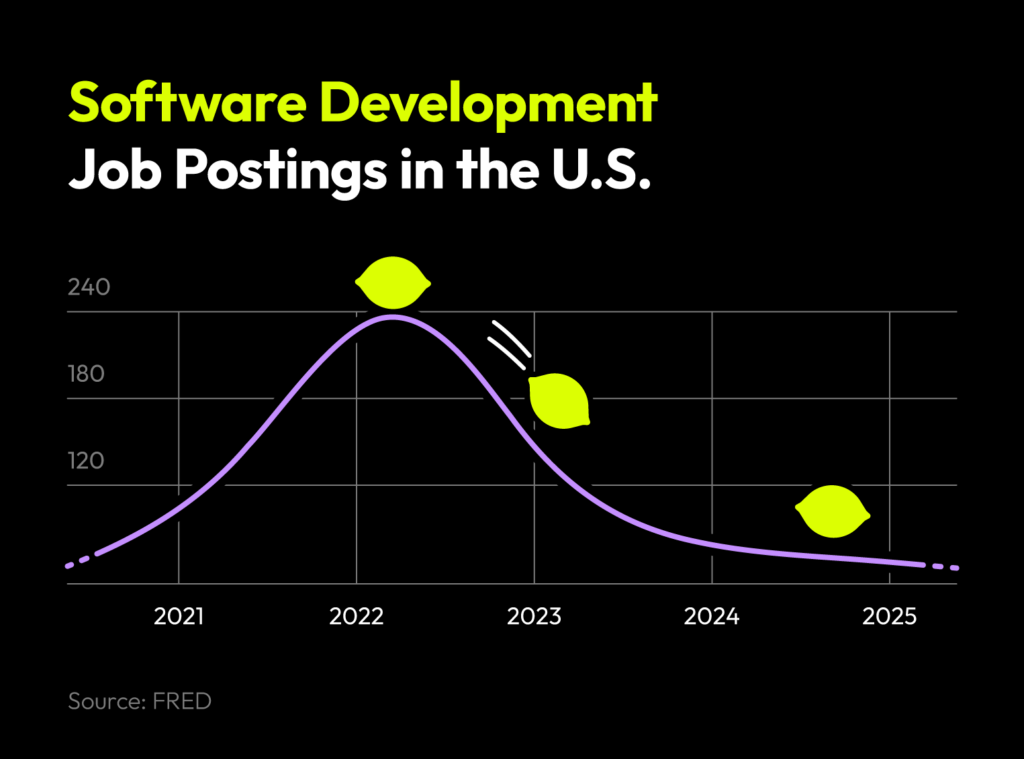
Job postings for entry-level developers have dropped roughly 40% compared to pre-2022 levels, according to data tracked by FinalRound AI. Meanwhile, the number of CS graduates and bootcamp grads has increased. The numbers are stark: an increase in candidates, a decrease in available positions, and a hiring process that has changed in tandem with most job-seekers’ tactics.
What follows are eight approaches that reflect how the 2026 hiring market actually works—not how career advice from 2022 assumed it would.
1. The LeetCode Paradox
Here’s the uncomfortable reality: grinding hundreds of LeetCode problems may be making candidates worse at interviews, not better.
Companies now deploy AI proctoring tools—Sherlock AI, Polygraf, and HackerEarth’s detection systems—with vendors claiming detection accuracy above 95%. Whether those numbers hold in practice is debatable, but the direction is clear: detection is improving faster than evasion. According to a Dobr.AI industry report, nearly 48% of candidates surveyed admitted to using unauthorized AI tools during interviews. The arms race is real, and companies are responding.
But the overprepared grinders face a different problem. HelloInterview, a platform that’s observed tens of thousands of engineering interview journeys, published a 2025 analysis noting that “expectations have become significantly more demanding. Companies are simply setting a higher standard for what constitutes a passing performance.” What was considered “hard” in 2021 has now become the baseline.
More tellingly, hiring managers report they can identify pattern-matched solutions within seconds. A senior engineering manager quoted in Dice’s technical interview breakdown: “It may seem like a small thing, but when some candidates stop writing code, they just stand at the board. It seems like they are waiting for a prompt from me, which makes me question their confidence.”
The problem isn’t knowing the answer. It looks like you’ve memorized it.
What works instead: demonstrating authentic problem-solving. When stuck, saying, “I don’t immediately see the optimal approach—let me try X and see what breaks” shows the kind of debugging instinct that AI tools still can’t replicate.
A hiring manager quoted in Course Report’s 2025 technical interview panel put it directly: “Don’t say, ‘I’m working on something but not ready to show it yet.’ Show your work, even if it’s unfinished. That sets you apart.”
The bar for “correct solution” is increasingly met by AI. AI is increasingly meeting the criteria for determining a person’s potential fit.
A caveat: This shift is most visible at US-based companies with modern hiring practices. Plenty of firms—especially outside the US, in enterprise environments, or at companies with rigid HR processes—still run algorithmic rounds where speed and correctness are all that matter. Know your target. The “show your thinking” approach works best where interviewers have latitude to evaluate process, not just output.
2. Ask What’s on the Test
Most candidates treat interviews as mysteries to solve. They prepare for everything, master nothing, and hope the questions align with what they studied.
Ilyas took a different approach for the application that finally worked: “The HR specialist told me to strongly prepare for CSS—especially Flexbox and Grid. This made sense, as the position was for an HTML markup developer. Therefore, I thoroughly studied every aspect of these topics, including the less common ones.
He asked what to study. They told him. He got the job.
This method isn’t cheating—it’s professional communication. Recruiters’ success metrics depend on filled positions. They want candidates to succeed. Yet most applicants never think to ask.
The script: After scheduling an interview, send a simple message: “To ensure I’m as prepared as possible, could you share what technical areas or frameworks the team focuses on?”
The candidates getting hired aren’t necessarily the smartest. They’re the ones extracting useful information before walking in.
3. Portfolio Projects That Actually Matter
According to Stack Overflow’s 2024 Developer Survey, 73% of hiring managers consider a strong portfolio more important than a perfect resume. But portfolios built from tutorials—to-do apps, weather dashboards, e-commerce clones—no longer differentiate.
The problem isn’t just that these projects are common. It’s that AI can generate them faster than you can explain them. A to-do app in React? Claude writes it in under a minute. Tutorial projects prove that someone can follow instructions. They don’t prove someone can ship.
But here’s what most portfolio advice misses: hiring managers aren’t just evaluating code quality. They’re trying to answer a specific question—”Will this person be able to contribute on day one?”
Dice’s technical interviewer breakdown quoted a senior engineering manager on what separates candidates: “Ninety-five percent of candidates can produce code that works, so that’s not a differentiator. The real test is, can you make it better, especially the first time around?”
The same principle applies to portfolios. Working code is essential. What matters is evidence of iteration, constraint management, and impact measurement.
What hiring managers actually look for, according to multiple 2025 hiring reports:
Outcomes over features. “Cut onboarding time by 27% in 3 weeks” lands harder than “Built a React app with authentication.” The first proves you understand why software exists. The second proves you can type.
Visible constraints. “Solo project; 6 hrs/week; 12 test users; mobile web” proves the ability to ship under real conditions, not tutorial conditions. Constraints reveal judgment—the thing that’s hardest to evaluate from code alone.
Working demos. Data from Hakia’s 2025 portfolio guide indicates 84% of employers want to see live applications, not just repositories. If your demo link returns a 404, you’ve answered the question, “Will this person be able to contribute on day one?” in the worst possible way.
Evidence of real users. A tool that even five people use is more impressive than thousands of lines of code that no one has touched. The portfolio that lands interviews includes the phrase “used by” followed by a number.
You should aim to complete three to five projects at the most. Each one is structured as a case study: what problem existed, what constraints applied, and what changed because the project shipped. If there’s no answer to “Who used this and what improved?” the project isn’t portfolio-ready.

4. The Referral Reality Nobody Talks About
Here’s a number that should change how you spend your job search time: according to Second Talent’s 2026 tech hiring statistics, 68% of tech roles are filled through employee referrals.
Let that sink in. More than two-thirds of positions go to people who knew someone inside.
The Pragmatic Engineer’s 2025 hiring manager survey reinforced these findings from the other side: “Honestly, references are still the best channel to hire from, in terms of quality. This is because the people who are referring know the context of the company and how we operate.”
Meanwhile, hiring managers describe inbound applications as increasingly useless. One engineering manager said, “With so many applicants, you’d think there’d be some gems, but that hasn’t been my experience this year.” Many people who look appealing on paper won’t pass the screening call.”
The math, according to The Interview Guys’ 2025 research report, is that one referral is worth approximately 40 cold applications.
What this means practically
Most job seekers spend 90% of their time on activities that produce 30% of hires (job boards, cold applications). The highest-ROI activities—building relationships with people who can refer you—get almost no time.
This isn’t about “networking” in the LinkedIn-connection-request sense. It’s about:
- Contributing to communities where engineers from target companies participate is the focus. These communities include Reddit engineering subreddits, Discord servers, and open-source projects. Developers should focus on being useful rather than asking for jobs.
- Reaching out to former colleagues first. The Pragmatic Engineer survey noted that hiring managers are actively trying to bring former colleagues to their current teams.
- These are informational interviews that do not involve asking for jobs. Ask about the role, the team, and the challenges. Let them offer to refer you—don’t ask.
The candidates getting hired aren’t necessarily better than those getting rejected. They’re better connected. And connections, unlike algorithms or interview performance, compound over time.
5. The Middle Market Advantage
The conventional path points toward FAANG—Google, Meta, Amazon, Apple, and Netflix. The data points elsewhere.
Big Tech companies hired just 7% new graduates in 2025, down 25% from 2024, according to the analysis of the software developer market. Startups increasingly want senior engineers who can contribute immediately; AI handles tasks that junior developers used to own.
But there’s another problem with the FAANG path that doesn’t show up in statistics: team matching.
HelloInterview’s 2025 analysis documented how Meta overhauled its hiring process, eliminating most aspects of its longstanding “bootcamp” program. In its place, candidates must now secure a team match before receiving a final offer. The outcomes have been problematic: “One staff engineer we worked with waited four months in team match limbo after passing all technical rounds at Meta with strong, positive feedback.” All their competing offers had expired by the time the team match concluded.
You can pass every interview and still not be hired.
Meanwhile, mid-sized companies and enterprises outside pure tech are actively hiring with simpler processes. Robert Half’s 2025 technology hiring report found 89% of tech companies planned to increase headcount through 2026. The strongest demand came from business services, manufacturing, and financial services—industries that use technology rather than build it.
Aura Intelligence’s 2025 hiring data showed unexpected growth in specific sectors: investment banking (+91%), industrial automation (+73%), and information services (+60%). The opportunities exist—they’re just not where everyone’s looking.
The Pragmatic Engineer’s 2025 market analysis highlighted specific examples: IBM reached a $295B valuation while hiring heavily for backend, AWS DevOps, and SAP roles. Anduril, a defense tech company, was hiring at volumes comparable to Meta. Secondary tech markets like Austin and Denver showed 26% faster job growth than established hubs, according to CBRE’s Tech Talent Report.
The prestige calculus has shifted. Having two years of experience at a “boring” enterprise provides more opportunities than prolonged unemployment while waiting for a FAANG callback, particularly when that callback could potentially result in four months of team-matching limbo.

6. The Negotiation Gap
Those who do see an average of an 18.8% salary increase. Some achieve increases as high as 100%. Those who do see an average of an 18.8% salary increase. Some achieve increases as high as 100%.
The median software developer salary in 2026 hovers around $130,000, according to FinalRound AI’s market data. An 18% increase on that baseline represents over $23,000 annually—money left on the table because asking felt uncomfortable.
an 18.8% The psychological barrier is that candidates assume negotiating will jeopardize the job offer. The reality: when a company extends an offer, they’ve already decided. They’ve spent weeks interviewing and screening. Starting over costs them significantly more than a modest salary bump.
What works:
When you receive a job offer, avoid responding immediately. Ask, “Could you share the salary range for this role?” Let them anchor first.
Then: “Based on my research and the value I’ll bring to [specific area], I was hoping for [X]. Is there flexibility to move closer to that number?”
If base salary won’t move: “Would you be open to a signing bonus / remote work stipend / additional PTO / professional development budget?”
According to Aurora University’s 2025 graduate salary report, 42% of new hires received signing bonuses, and nearly 70% of employers offered voluntary benefits. There’s almost always room to negotiate beyond base salary.
One consistent finding across negotiation research: the person who speaks least tends to achieve better outcomes. Make the request, then wait. Silence is uncomfortable—but the other party typically fills it.
7. AI as Prep Tool, Not Performance Tool
The distinction matters enormously in 2026.
Companies are increasingly detecting the use of AI during interviews. CNBC reported in March 2025 that Google moved toward in-person interviews specifically because AI cheating tools had become nearly undetectable in remote settings. While there’s no industry-wide blacklist, individual companies and recruiting platforms do flag candidates—and reputations travel faster than resumes in tight professional networks.
Using AI before interviews is a unique approach.
Ilyas described his preparation system: “I used ChatGPT to generate flashcards for each topic and reviewed them daily. One important thing I learned: AI can be wrong occasionally. To reduce mistakes, I started adding links to official documentation in my prompts so the answers were grounded in reliable sources.”
The system:
- Get the topic list from HR (see section 2)
- Generate flashcards with a prompt like “Create 10 interview questions [topic] with answers based on [official docs link].” Include one edge case question.”
- Review 15-20 minutes daily for a week before the interview
- Record practice answers on video. Watch for filler words, hesitation, and unclear explanations.
The core problem most developers face isn’t a lack of knowledge—it’s the inability to recall under pressure. Spaced repetition addresses this. AI makes the preparation efficient. But the recall must be genuine, because in the interview room, external assistance will be detected.
8. The Timing Advantage
Most career advice suggests applying “when ready.” Market data suggests the opposite.
According to Full Scale’s developer hiring analysis, 67% of senior engineers receive multiple offers before posting resumes publicly. Top candidates get locked in during Q4. By January, when most job-seekers begin their “new year” search, the strongest positions are filled.
Candidates applying in January aren’t competing for the best roles. They’re competing for what remains—alongside every other developer who made job hunting a New Year’s resolution. Full Scale’s data indicated compensation requirements in the January run were 25–40% above November rates, as companies bid against each other for remaining talent.
The adjusted timeline:
- Month 1: Portfolio updates, skill gap identification, and target company research. Begin conversations with recruiters “for future opportunities.”
- Month 2: Active applications, interview preparation, and initial phone screens.
- Month 3: Final rounds, offers, and negotiation.
To start a new role in March, applications should begin in December. For September, June. The market rewards early positioning over last-minute urgency.

What This Won’t Fix
These approaches work for developers who have skills and struggle to demonstrate them effectively. They don’t substitute for competence.
For new graduates targeting Big Tech, the math involved in securing a position remains challenging. 7% of hires are made from new graduates, among millions of applicants. Alternative paths, such as mid-market companies, contract work, and technology-driven industries, often provide access to FAANG opportunities more quickly than direct applications.
For developers without AI/ML exposure: The lane is narrowing in certain segments. Python dominates AI work, and according to FinalRound AI’s analysis, AI/ML-adjacent job postings have grown significantly since 2023. This doesn’t mean every developer needs to become an ML engineer—but conversational familiarity with AI tooling is increasingly expected, especially for roles involving product development or data-adjacent work. Backend, infrastructure, embedded, and enterprise legacy roles still operate largely outside this requirement.
For developers who aren’t actively building: No interview tactic can compensate for a lack of activity on GitHub. The market rewards demonstrated shipping ability. If the last meaningful commit was months ago, that’s the problem to solve first.
Where This Advice Fails
No framework works universally. Here’s where these approaches break down:
These approaches are not suitable for high-frequency algorithmic shops. Quantitative trading firms, some game studios, and companies with genuinely algorithm-heavy work still want LeetCode speed. “Show your thinking” matters less when the job literally requires optimizing hot paths. If you’re targeting Jane Street, practice differently.
Visa-dependent candidates. The “target mid-market” advice assumes flexibility. Candidates who need H-1B sponsorship have a much smaller pool of viable employers, and many mid-sized companies don’t sponsor—the calculus changes.
Non-US markets. Hiring cycles, negotiation norms, and interview formats vary dramatically by country. The Q4 timing advantage is US-centric. The negotiation scripts assume American directness. Localize accordingly.
Career changers without adjacent experience often face challenges. These tactics help developers who have skills but struggle to demonstrate them. They’re less useful for bootcamp grads with no professional experience competing against CS graduates. The portfolio advice is still relevant, but the standards have become more stringent.
The Unchanged Fundamentals
The 2026 developer job market is harder than the 2022 one. Entry-level positions have contracted. AI is reshaping what companies need. Competition has intensified.
But the core economics haven’t changed. According to CompTIA’s 2025 State of the Tech Workforce report, tech workers earn a median wage 127% higher than the national median. Companies still need people who can build things that work.
Ilyas eventually got hired. Not through some secret trick—through systematic preparation that addressed his actual failure mode: recall under pressure. He asked HR what to study. He built flashcards grounded in documentation. He practiced until the answers came automatically.
“If you’re struggling with interviews right now,” he wrote, “especially as a junior, mid-level, or self-taught developer, don’t assume you’re poor at what you do. In my case, the problem wasn’t a lack of effort or talent. It was preparation and approach.”
The tactics have changed. The fundamentals haven’t. Developers who adapt to the current market—rather than the market they wish still existed—are the ones getting hired.
Sources
- Final Round AI: Software Engineering Job Market 2026
- freeCodeCamp: How to Prepare for Technical Job Interviews
- The Pragmatic Engineer: State of the Software Engineering Job Market in 2025
- The Pragmatic Engineer: What Hiring Managers See in 2025
- HelloInterview: The Reality of Tech Interviews in 2025
- CNBC: How Google is Responding to AI Cheating in Coder Interviews
- Robert Half: 2025 In-Demand Technology Roles and Hiring Trends
- Course Report: Technical Interviews in 2025
- Stack Overflow Developer Survey 2024