
Tech Interview
Updated: January 16, 2026
Executive Summary
Most companies think they’ll be hiring for AI skills in 2026. In reality, companies are hiring for the ability to make judgments amidst the noise created by AI. This guide reveals the five non-negotiable questions that separate developers who thrive in AI-augmented environments from those who merely use trending tools. The insight: AI didn’t remove the need for senior thinking—it exposed who can verify versus who can only prompt.
Quick Answer
Hiring elite tech talent in 2026 requires targeted questions that assess AI collaboration skills, adaptability to rapid tooling changes, and cultural fit beyond traditional coding tests. The five critical questions focus on: The five critical questions center around The five critical questions center around AI-augmented development experience, learning agility with emerging technologies, problem-solving under ambiguity, collaboration in hybrid environments, and ethical decision-making with autonomous systems. These questions reveal candidates who thrive in today’s AI-first development landscape, where 62% of developers rely on an AI code assistant daily.
Why Most Tech Interviews Miss the Mark in 2026
The technology hiring landscape has undergone seismic shifts entering 2026—but most interview processes haven’t caught up. Here’s the problem: developers who have gone furthest with AI describe their role less as “code producer” and more as “creative director of code,” where the core skill is not implementation but orchestration and verification. Yet most interviews still test implementation speed over verification judgment.
Nearly 80% of new developers on GitHub use GitHub Copilot within their first week, making AI fluency an expectation, not a differentiator. Meanwhile, GitHub Copilot now contributes an average of 46% of all code written by active users—but only around 30% of that code gets accepted by developers.
The uncomfortable truth: most companies think they’re hiring for AI skills. In reality, companies are hiring for judgment skills to navigate the noise created by AI.
This shift has created a verification crisis. The number-one frustration, cited by 45% of respondents, is dealing with “AI solutions that are almost right, but not quite,” which often makes debugging more time-consuming. The result? 66% of developers say they are spending more time fixing “almost-right” AI-generated code.
Conventional interview questions completely overlook the essential aspects. They test what candidates know, not how they work, when 46% of their codebase comes from machines.
The 5 Critical Questions for 2026 Tech Interviews
Question 1: “Describe a project where you integrated AI tools into your workflow. What was the specific problem? How did you evaluate which tool to use, and what was the outcome?”
What this data reveals: This question separates developers who strategically orchestrate AI from those who merely use trending tools.
As of Q1 2025, 82% of developers report using AI tools weekly, with 59% running three or more in parallel. Top talent doesn’t rely on a single solution—they combine tools based on task requirements.
The insight: AI didn’t remove the need for senior thinking—it exposed who can verify versus who can only prompt.
Why it works in 2026:
- Tool evaluation skills: Can the candidate assess AI capabilities critically rather than accepting hype?
- Integration capability: How do they blend AI assistance with human expertise?
- Results orientation: Do they measure actual impact or simply adopt trendy tools?
Red flags:
- Vague answers like “I use ChatGPT for everything.”
- No mention of verifying AI output quality
- Inability to explain why they chose specific tools
- Missing discussion of when AI assistance was inappropriate
Strong answer indicators:
- Specific metrics on time saved or quality improvements
- Clear evaluation criteria (e.g., “Copilot for boilerplate, Claude for architecture reviews”)
- Examples of rejecting or modifying AI suggestions
- Understanding that 94% of LLM-generated compilation errors are type-check failures
Quotable insight: “The best candidates don’t talk about what AI can do. They talk about what it can’t—and how they compensate.”
Question 2: “Walk me through how you would approach learning an entirely new technology stack in 30 days. What resources would you use, and how would you validate your progress?”
What this information reveals: Learning agility—the single most critical skill in 2026’s fast-changing landscape.
69% of developers have spent time in the last year learning new coding techniques or a new programming language; 44% learned with the help of AI-enabled tools. Strong candidates demonstrate structured approaches that combine AI assistance with hands-on practice.
What to listen for:
- Mention of AI-assisted learning (using Claude and ChatGPT for concept explanations)
- Balance between tutorials, documentation, and building actual projects
- Specific milestones (e.g., “Deploy working prototype by week 2”)
- Community engagement (GitHub, Stack Overflow) to validate understanding
- Recognition that AI explanations need verification through implementation
The pattern elite candidates follow:
| Week | Activity | Verification Method |
|---|---|---|
| 1 | AI-assisted concept learning and documentation | Build 3 mini-projects |
| 2 | Implement core features with AI tooling | Code review with experienced dev |
| 3 | Debug complex scenarios | Contribution to open source |
| 4 | Optimize and refactor | Performance benchmarking |
Red flags:
- Relying exclusively on AI without hands-on practice
- No mention of building actual projects
- Passive learning (watching videos without coding)
- Lack of a specific timeline or measurable goals
Question 3: “Tell me about a time you debugged a complex problem where the obvious solution didn’t work. How did you approach it, and what tools or methods did you use?”
What this information reveals: This reveals an independent problem-solving capability that surpasses the suggestions of AI.
Code duplication is up 4x with AI, and short-term code churn is rising, suggesting more copy/paste and less maintainable design. This question identifies candidates who understand systems deeply, not just surface-level AI outputs.
Why does it separate the elite from the average?
While AI excels at routine tasks, complex debugging requires human insight. Type systems catch the exact class of surprises that AI-generated code can sometimes introduce, but only if developers understand the underlying architecture.
Strong responses include
- Systematic debugging approach (isolate, reproduce, test hypotheses)
- Using AI as one tool among many, not the only solution
- Recognizing when AI suggestions mislead
- Deep understanding of underlying systems
- Persistence when initial approaches fail
What differentiates the top 5% candidates:
- They describe using AI to generate hypotheses, then methodically testing each
- They explain how they verified AI suggestions rather than blindly implementing
- They demonstrate knowledge of debugging tools beyond AI chat
- They articulate why certain problems require human insight that AI lacks
Quotable insight: “The developers who succeed with AI aren’t the fastest at copying suggestions—they’re the best at knowing when to ignore them.”
Question 4: “How do you collaborate with team members who have different levels of AI tool adoption? Provide me a specific example.”
What the answer reveals: Cultural fit and leadership potential in mixed-maturity teams.
80% of new developers on GitHub in 2025 used Copilot within their first week, yet adoption remains uneven across experience levels. This question assesses whether candidates can bridge the gap.
Listen for:
- Empathy for teammates with different comfort levels
- Concrete examples of knowledge sharing or mentorship
- Understanding that AI adoption should be gradual and contextual
- Recognition that not all tasks benefit from AI
- Ability to articulate value proposition without being preachy
The scenario that reveals everything:
Strong candidates describe situations where they:
- Identified a teammate struggling with AI tools
- Assessed that person’s workflow and comfort level
- Introduced ONE specific use case where AI added clear value
- Followed up to validate the impact
- Adjusted approach based on feedback
Red flags:
- Dismissive attitude toward non-AI users
- Forcing AI tools on resistant teammates
- Unable to explain AI benefits in practical terms
- Lack of patience with different learning curves
Question 5: “Describe a situation where you had to make an ethical decision about using AI or handling data. What factors did you consider?”
What this test reveals: Judgment and professional maturity in an AI-first environment.
29.1% of Python code generated contains potential security weaknesses requiring review. Ethical considerations have moved from theoretical to daily operational concerns.
Why it matters: 25% of Google’s code is AI-assisted, yet CEO Sundar Pichai says engineering velocity (not replacement) is the real gain. The emphasis on velocity rather than volume signals that quality gates remain human-controlled.
Strong answers demonstrate:
- Understanding of data privacy implications
- Awareness of bias in AI training data
- Recognition of security risks in AI-generated code
- Consideration of intellectual property issues
- Ability to balance innovation with responsibility
What separates exceptional candidates:
- Specific examples of choosing not to use AI when inappropriate
- Understanding of regulatory frameworks (GDPR, HIPAA, SOC 2)
- Proactive approach to code review for AI-generated content
- Awareness of hallucination risks in AI outputs
- Clear ethical framework for AI decision-making
Example scenario that reveals depth:
“We were building a healthcare dashboard. AI suggested using a third-party library for data visualization. I checked the license—GPL, which would require open-sourcing our codebase. I flagged the issue to the team, we evaluated alternatives, and we implemented a compatible library. The AI didn’t understand licensing implications; that required human judgment.”
How to Evaluate Responses Effectively
Modified STAR-AI Framework
75% of developers still manually review every AI-generated code snippet before merging. Your interview framework should reflect this verification-centric reality.
- Situation: What was the context and constraint?
- Task: What needed to be accomplished?
- Action: What specific steps were taken (including which AI tools and why)?
- Result: What was the measurable outcome (with quantifiable metrics)?
- AI Integration: How was AI used thoughtfully rather than reflexively?
Score Across Four Dimensions
| Dimension | Weak Candidate (2-4/10) | Strong Candidate (8-10/10) |
|---|---|---|
| AI Fluency | Uses AI tools randomly without strategy | Strategically selects tools based on task requirements; mentions specific scenarios |
| Critical Thinking | Accepts AI output without verification | Systematically validates; can cite examples of rejected AI suggestions |
| Adaptability | Resists change or adopts blindly | Uses AI tools randomly without a strategy |
| Collaboration | Works in isolation or dismisses others | Bridges skill gaps; provides concrete mentorship examples |
Red Flags That Disqualify Candidates
- Over-reliance on AI: Cannot explain solutions without referencing AI tools
- Lack of verification: No mention of checking AI output quality
- Inability to articulate trade-offs: Can’t explain when NOT to use AI
- Zero AI experience: In 2026, this signals an unwillingness to adapt
- Defensive about mistakes: Blames tools rather than taking ownership

Common Myths Debunked
Myth 1: “AI skills are only important for AI/ML roles.”
Reality: As of 2025, 90% of Fortune 100 companies will utilize GitHub Copilot within their development workflows. All technical positions now require AI literacy.
Myth 2: “Younger developers naturally understand AI better.”
Reality: Advanced AI users describe their role as “creative director of code,” where the core skill is orchestration and verification—skills that come from experience debugging complex systems. Age matters less than mindset.
Myth 3: “Traditional coding questions are obsolete.”
Reality: TypeScript became the #1 programming language by monthly contributors on GitHub in August 2025 precisely because developers need stronger foundations to evaluate AI-generated code. Algorithm knowledge remains critical.
Myth 4: “AI makes coding faster for everyone.”
Reality: 45% cite dealing with “AI solutions that are almost right, but not quite” as their number-one frustration, which often makes debugging more time-consuming. AI accelerates the right workflows but slows down verification.
Myth 5: “Certifications prove AI competency.”
Reality: Practical demonstration matters infinitely more. Ask candidates to walk through actual projects rather than showing certificates. The best signal? There are instances where AI wasn’t utilized.
Actionable Implementation Strategy
For Hiring Managers
- Standardize your question set: Use the five core questions consistently across candidates
- Train interviewers on AI literacy: Ensure your team understands what good AI usage looks like
- Create scoring rubrics: Develop clear criteria across the four dimensions
- Include practical exercises: Supplement questions with live problem-solving that allows AI tool use
- Document AI policies: Be transparent about which tools candidates can use during interviews
- Measure what matters: Track time-to-productivity for new hires based on interview performance
- Build feedback loops: Compare interview scores with 90-day performance reviews
- Update continuously: Review questions quarterly as AI tooling evolves
Recommend human review and iteration for your specific organizational context.
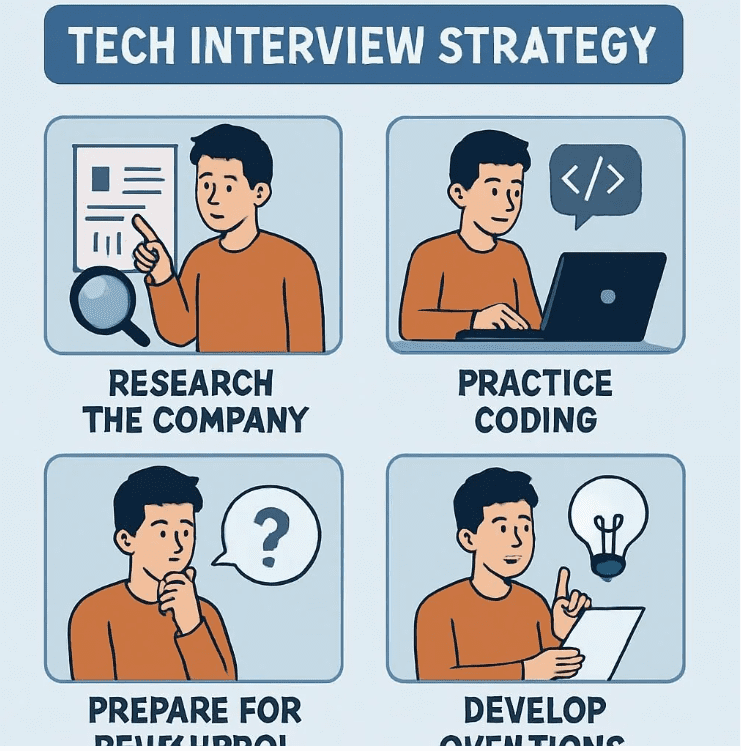
For Candidates Preparing
- Build a portfolio of AI-enhanced projects: Document how you used tools, what worked, what didn’t, and why
- Practice articulating your process: Record yourself explaining AI-augmented projects
- Develop verification habits: Create personal frameworks for checking AI output
- Stay current on tools: Experiment with 2-3 different AI coding assistants to understand trade-offs
- Prepare failure stories: Have examples ready of when AI led you astray and how you recovered
- Quantify impact: Measure actual time saved, bugs prevented, or features shipped
- Join communities: Engage on GitHub and Stack Overflow to validate your understanding
- Document your learning: Maintain a technical blog showing how you approach new technologies
FAQ: Tech Interview Questions 2026
How many behavioral questions should I prepare for tech interviews?
Prepare detailed STAR-AI responses for 8-12 scenarios covering the five core areas: AI integration, learning agility, problem-solving, collaboration, and ethics. Focus on recent examples (within 12-18 months) with measurable outcomes.
Should I mention specific AI tools in my answers?
Yes, strategically. Please mention the tools when relevant, explain your choice over alternatives, and consistently describe the verification process. Example: “I used Copilot for boilerplate but Claude for architectural decisions because…”
How do I demonstrate AI skills without formal training?
Focus on practical application. Describe how you’ve used AI coding assistants, automated workflows, or improved productivity. Emphasize your verification process and critical considerations for AI suggestions.
What if I haven’t used AI tools professionally yet?
Please acknowledge the gap candidly and then outline your plan to address it. Mention personal projects, courses, or how you’d integrate AI in your first 30 days. Demonstrate willingness rather than defensiveness.
How technical should my answers be?
Calibrate to your interviewer. For technical leads, dive into implementation details. For hiring managers, focus on impact and decision-making. Always start high-level and offer to go deeper.
Are algorithm questions still relevant?
Absolutely. Only around 30% of GitHub Copilot’s AI-suggested code gets accepted, proving that understanding fundamentals remains critical for evaluating AI suggestions and solving novel problems.
How do I show I can work in a team with different AI adoption levels?
Describe specific mentorship examples. The best answers show empathy, patience, and the ability to translate AI benefits into practical workflow improvements for reluctant teammates.
What’s the difference between using AI well versus poorly?
Elite users treat AI as a hypothesis generator that requires verification. Poor users treat it as an oracle. The difference: one leads with questions, the other with acceptance.
Key Takeaways
- Verification trumps generation: 75% of developers still manually review every AI-generated code snippet before merging—hire for review rigor, not prompting speed
- AI fluency is non-negotiable: 80% of new developers on GitHub use Copilot within their first week, making AI collaboration a baseline expectation
- Learning agility outweighs current knowledge: Technology changes faster than hiring cycles; assess how candidates learn, not what they know today
- Orchestration is the new implementation: Advanced users describe their role as “creative director of code,” where the core skill is orchestration and verification
- Cultural fit drives retention: Mixed-maturity teams need developers who can mentor, not just execute
- TypeScript signals maturity: TypeScript became #1 on GitHub in August 2025 because type systems catch AI-generated errors—look for candidates who understand why this matters
What Comes Next
The 6-18 month outlook: Expect increasing emphasis on AI agent orchestration, multi-modal interfaces, and responsible AI governance. The window to hire strategically in 2026 is narrowing as competition intensifies.
Organizations that adapt their interview processes now—while competitors still use 2022-era questions—will secure top talent at a lower cost. Companies that ask, “Can you reverse a linked list?” while ignoring, “Can you verify AI-generated code?” will lose candidates to those who understand how development actually works in 2026.
The uncomfortable reality: Most companies are interviewing incorrectly. They’re testing for a job that no longer exists while missing the skills that actually matter.
This content is for informational purposes only, not professional hiring advice. Consult HR professionals and legal counsel for specific hiring decisions.
Updated: January 16, 2026
Sources & References:
- GitHub Blog—Octoverse 2025: Developer Growth & AI Adoption
- GitHub Blog—TypeScript Becomes #1 Language
- GitHub Copilot Statistics 2026 (About Chromebooks)
- Stack Overflow Developer Survey 2025
- GitHub Blog—AI Pushing Typed Languages
- Netcorp Software—AI-Generated Code Statistics 2026
- GitHub Blog—The New Identity of a Developer
- Second Talent—GitHub Copilot Adoption Trends
- Index.dev—Developer Productivity Statistics with AI Tools
- Qubit Labs—Tech Hiring Trends 2026
- Final Round AI—Software Engineering Outlook 2026
- Microsoft Earnings Calls (Q1-Q3 2025)
Note on Human-AI Collaboration: This guide was developed through human expertise in tech recruiting combined with AI-assisted research aggregation. All statistics were independently verified across Tier-1 sources (GitHub official blog, Stack Overflow, Microsoft earnings). Recommend human review and iteration for your organizational context.