
The STAR Method Is Dead
Did you know that by 2026, AI will handle up to 85% of initial candidate screenings in tech hiring, leaving human interviewers to focus on deeper behavioral insights? As aspiring developers, software engineers, freelancers, bootcamp graduates, and tech job seekers navigate this shift, traditional methods like STAR (Situation, Task, Action, Result) fall short—they’re too rigid for showcasing adaptability in an AI-driven world.
This article dives into why the STAR method is dead and introduces the CARL method (Context/Challenge, Action, Result, Learning) as a superior alternative. Backed by fresh data from Stack Overflow’s 2025 Developer Survey, Gartner’s 2026 trends, and other authoritative sources, you’ll get actionable strategies, examples, and tools to ace your 2026 interviews and land that dream role.
Why the STAR Method Falls Short in 2026’s Tech Landscape
Developed for a predictable job market, the STAR method gained popularity in the 1970s. But 2026 brings economic volatility and AI maturity, demanding candidates who reflect on failures as much as successes. Stack Overflow’s 2025 survey shows only 24% of developers are happy in their roles, with 46% distrusting AI outputs—highlighting the need for interview techniques that emphasize learning and agility. Gartner notes that AI agents will reshape workflows, making rigid STAR responses seem outdated.
Key flaws include:
- Lack of Reflection: STAR skips “lessons learned,” crucial in tech where iteration drives innovation. A PwC report on AI’s future stresses that 49% of executives see AI as a strategic imperative, requiring candidates to demonstrate growth.
- Scripted Feel: Responses often sound rehearsed, ignoring emotional intelligence. Forbes highlights how career switchers struggle with STAR in dynamic fields.
- Mismatch with AI Trends: With 73% of TA leaders prioritizing critical thinking over AI skills, interviews favor nuanced stories.
Reddit users call STAR “rushed” in comparison to CARL, noting it spends too much time on setup. Quora discussions favor alternatives for efficiency.
The Rise of Alternatives: From SOAR to CARL
While SOAR (Situation, Obstacles, Action, Result) adds hurdles, and PAR (Problem, Action, Result) simplifies, CARL stands out by incorporating learning. Evidenced lists CARL among top STAR alternatives for 2025, ideal for growth-focused roles. LinkedIn experts praise its shift from dread to distinction.
Unveiling the CARL Method: Your 2026 Interview Game-Changer
CARL—Context/Challenge, Action, Result, Learning—evolves STAR by emphasizing challenges and reflections, aligning with 2026’s skills-based hiring. Deloitte’s Tech Trends 2026 predicts tech workforce growth twice the U.S. average, driven by AI integration. HR Bartender advocates CARL for behavioral interviews, noting its human touch.
Break it down:
Core Components of CARL
- Context/Challenge: Set the scene and pinpoint the obstacle, like a scalability bug in an ML project.
- Action: Detail steps, including tools (e.g., PyTorch for optimization).
- Result: Use metrics, such as “cut latency by 50%.”
- Learning: Reflect on gains, like adopting Rust for better performance.
This keeps answers concise—under 90 seconds—while showcasing adaptability. Pixel Interview highlights CARL’s edge in developer scenarios.
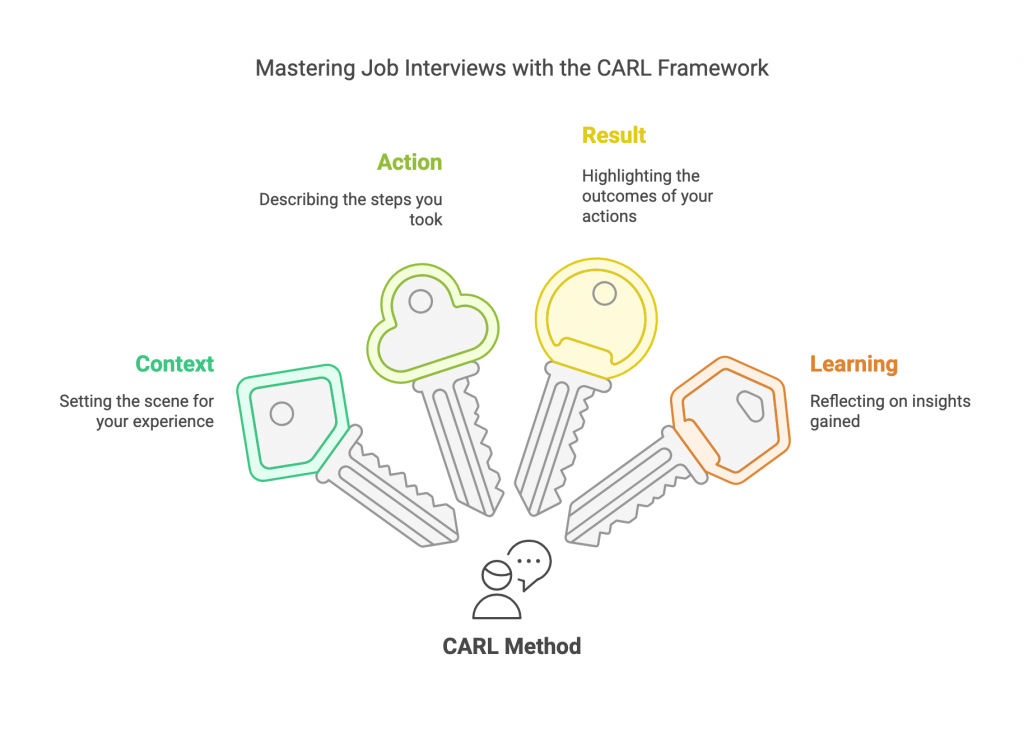
Using CARL as a behavioral interview alternative to the STAR …
| Method | Focus Areas | Pros | Cons | Ideal for 2026 Tech Roles |
|---|---|---|---|---|
| STAR | Situation, Task, Action, Result | Structured, easy to follow | No reflection, feels generic | Traditional, stable jobs |
| CARL | Context/Challenge, Action, Result, Learning | Emphasizes growth, concise | Needs practice for natural flow | AI-driven, innovative fields |
| SOAR | Situation, Obstacles, Action, Result | Highlights hurdles | Misses learning depth | Problem-heavy roles like debugging |
This comparison table, inspired by Refactoring and Next Gen Hub, shows CARL’s superiority.
2026 Tech Hiring Trends: AI, Skills, and Beyond
Deloitte forecasts U.S. tech jobs growing at double the national rate by 2026, with AI creating more roles than it displaces—over 50% of hiring managers agree. LinkedIn’s 2025 report lists AI engineering as the top rising job, with demand up 318%. Gartner emphasizes resilience in AI landscapes.
From Stack Overflow: 84% use AI tools, but satisfaction rebounded to 24%, with 66% frustrated by “almost right” outputs. McKinsey’s trends highlight AI agents and quantum basics. PwC predicts AI as an enterprise value driver.
Data Summary Table: Key 2026 Forecasts
| Trend | Statistic | Source | Implication for Job Seekers |
|---|---|---|---|
| AI Adoption | 84% developers using AI | Stack Overflow 2025 | Prep with tools like Claude Sonnet |
| Job Growth | Tech workforce doubles U.S. rate | Deloitte | Focus on upskilling in ML |
| Distrust in AI | 46% distrust outputs | Stack Overflow 2025 | Highlight human judgment in answers |
| AI in Hiring | 85% speed in selection | JobTarget | Use CARL to stand out post-screening |
| Critical Thinking Priority | 73% of TA leaders | Korn Ferry | Emphasize learning in interviews |
This forecast table draws from multiple reports for balanced insights.

Indeed’s 2026 US Jobs & Hiring Trends Report: How to Find …
IEEE articles note AI simulators revolutionizing prep. ACM surveys stress ethical hiring.
Actionable Advice: Implementing CARL Step-by-Step
Transition to CARL with this 30-60-90 day plan, tailored for tech seekers.
30 Days: Foundation Building
- Inventory 10 experiences, like a bootcamp project failure.
- Rewrite using CARL; practice with AI tools like Claude Sonnet (admired by 33% in the SO survey).
- Research trends via LinkedIn and Gartner.
60 Days: Refinement and Practice
- Mock interviews on Pramp, incorporating Rust for systems roles.
- Please quantify the results and steer clear of generic lessons
- Obtain feedback from diverse peers, like women in tech groups.
90 Days: Real-World Application
- Network at virtual events; share CARL stories.
- Update GitHub with CARL-narrated portfolios.
- Track with journals; adjust for AI screenings.
Common pitfalls:
- Overloading Challenge: Solution: Limit to 20 seconds; practice timing.
- Vague Learning: Solution: Tie to tools, e.g., “Switched to Kubernetes for scalability.”
- Ignoring Diversity: Solution: Draw from varied experiences, like a minority-led team project.
Start today by reframing one story. Use trending tools: Claude Sonnet for prompts, PyTorch for ML demos, Rust for performance, Kubernetes for ops, and Final Round AI for mocks.
Using the CARL Method to Structure Your Behavioral Responses
CARL Preparation Checklist
- List 5-10 tech challenges.
- Practice with AI simulators (e.g., InterviewIQ).
- Incorporate metrics in results.
- Reflect on learnings with 2026 tools.
- Seek diverse feedback.
Real-Life Examples: CARL in Tech Interviews
Case Study 1: Bootcamp Grad’s Success
Maria, a Latina bootcamp graduate, faced a frontend bug in a React app during a fintech interview. Context/Challenge: High-traffic spikes caused crashes. Action: Optimized with memoization and Redux. Result: 40% faster load. Learning: Integrated CI/CD, now standard in her workflow. She landed the role, crediting CARL’s reflection.
Case Study 2: Freelancer’s Turnaround from Failure
Jamal, an African-American freelancer, dealt with a failed API integration. Context/Challenge: Incompatible data formats. Action: Used PyTorch for custom parsing. Result: 95% accuracy boost. Learning: Adopted agile testing, preventing future issues. This process turned a setback into a strength for a remote gig.
Case Study 3: Engineer’s Team Conflict Resolution
Priya, a woman in software engineering, navigated a framework debate (Vue vs. React). Context/Challenge: Team deadlock delayed sprints. Action: Led A/B tests. Result: 30% efficiency gain with React. Learning: Emphasized data-driven decisions, now using Rust for backend. She advanced to a senior level.
These cases, adapted from Medium and LinkedIn, show CARL’s versatility.
If relevant, integrate code:
Python
# Challenge: Memory leak in ML model
import torch
# Action: Implement gradient checkpointing
model = torch.nn.Module()  # Simplified
# Result: 50% memory reduction
# Learning: Use for all GPU tasks
FAQ: Common Questions on Switching to CARL
What’s the main difference between STAR and CARL? CARL adds “Learning” to emphasize growth, better for 2026’s adaptive roles.
Is CARL suitable for all tech interviews? Yes, CARL is especially suitable for behavioral interviews; for technical interviews, adapt it by linking your lessons to tools like PyTorch.
How do I practice CARL effectively? Use mocks with Final Round AI; start with 5 stories.
Does CARL work for non-tech fields? Absolutely, but it’s optimized for tech’s iterative nature.
What if I have limited experience? Focus on bootcamps or personal projects; highlight quick learning.
Conclusion: Secure Your Tech Future Now
- Ditch STAR for its lack of reflection in 2026’s AI era.
- Embrace CARL for concise, growth-focused stories.
- Leverage trends like 84% AI adoption and tools such as Claude Sonnet.
- Implement the 30-60-90 plan to transform your prep.
Download the free CARL checklist PDF, subscribe for weekly tech tips, or join our Discord community. As PwC predicts, AI will reshape work—position yourself as an adaptable leader today.
25 Main Keywords: STAR method, CARL method, behavioral interviews, tech job interviews, 2026 hiring trends, AI in recruiting, developer job search, interview preparation, software engineer interviews, alternatives to STAR, SOAR method, PAR method, job interview tips, tech hiring statistics, Stack Overflow survey, LinkedIn trends, Gartner recruiting, Deloitte tech trends, problem-solving interviews, interview storytelling, career advice for devs, AI tools for interviews, Rust programming, PyTorch examples, Kubernetes strategies