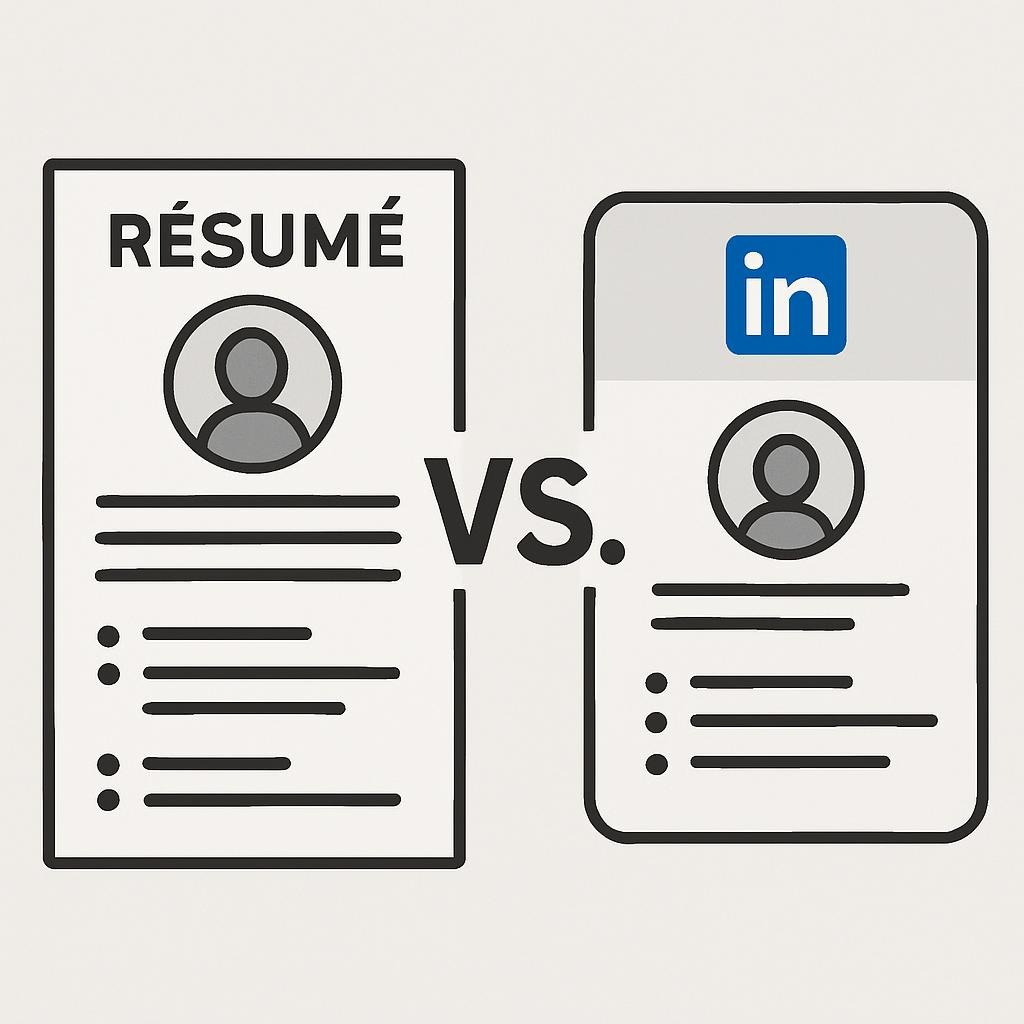

Resume vs LinkedIn
Everything You Need to Know About Résumé vs. LinkedIn for Recruiters
In the digital age of job hunting, your résumé and LinkedIn profile are your frontline warriors, each playing a pivotal role in catching a recruiter’s eye. While a résumé offers a concise, tailored snapshot of your professional journey, LinkedIn provides a dynamic, interactive platform for networking and showcasing your personality.
Did you know that 94% of recruiters actively use LinkedIn to scout talent, according to recent recruitment statistics? Meanwhile, 57% of hiring managers spend 1-3 minutes reviewing promising résumés. This ultimate guide dives deep into what recruiters truly prioritize, backed by data, real stories, and expert tips to help you optimize both tools for maximum impact—ensuring you not only get noticed but also get hired.
What is a résumé?
A résumé is your professional calling card, a one- to two-page document that summarizes your work history, skills, education, and achievements in a structured format. It’s designed for quick scanning, often passing through Applicant Tracking Systems (ATS) before reaching human eyes.
Unlike casual profiles, résumés emphasize quantifiable accomplishments—think “Increased sales by 30% through targeted campaigns” rather than vague descriptions. According to a study on résumé statistics, 73% of recruiters prefer résumés that highlight measurable results. This format is ideal for formal applications, allowing you to customize it for specific jobs. For more on crafting an ATS-friendly résumé, refer to this guide from Indeed: How to Make Your Résumé ATS-Friendly.
To get started, tailor your résumé to the job description—it’s your ticket to proving you’re the perfect fit.
What is LinkedIn?
LinkedIn is the world’s largest professional network, with over 1 billion users, serving as a digital portfolio where you can build connections, share content, and engage in industry discussions. It’s more than a static document; it’s a living profile that includes endorsements, recommendations, articles, and multimedia.
Recruiters love LinkedIn for its searchability—87% use it to find candidates. Features like the “Open to Work” banner and skill endorsements add layers of social proof. A comprehensive LinkedIn profile can increase your interview chances by 71%, as per Forbes data. Explore LinkedIn’s own tips here: Optimizing Your LinkedIn Profile.
Leverage LinkedIn to network actively—comment on posts, join groups, and connect with recruiters to amplify your visibility.
Key Differences Between Résumé and LinkedIn
While both showcase your career, they differ in purpose, format, and depth. A résumé is formal and concise, tailored for applications, whereas LinkedIn is expansive and interactive, perfect for ongoing branding.
Here’s a detailed comparison:
| Aspect | Résumé | LinkedIn Profile |
|---|---|---|
| Length | 1-2 pages | Unlimited sections |
| Format | Structured, ATS-optimized | Multimedia-rich, visual |
| Customization | Job-specific tailoring | Broad professional narrative |
| Interactivity | Static document | Endorsements, recommendations, posts |
| Privacy | Private until shared | Public or semi-public |
| Focus | Quantifiable achievements | Personality, network, thought leadership |
| Usage by Recruiters | Verification and details | Discovery and initial screening |
This table highlights why you need both: résumés for precision and LinkedIn for personality. For a visual breakdown, see this infographic on differences:
8 Must-Know Differences Between Your Resume, Bio & LinkedIn Profile
What Recruiters Look For: Insights from the Frontlines
Recruiters scan for relevance quickly. Resumes prioritize clear layouts, keyword matches, and impact statements; 81% of employers now favor skills-based hiring over conventional formats. On LinkedIn, it’s about engagement: 72% of recruiters use it for higher-quality hires.
Resumes prioritize clear layouts, keyword matches, and impact statements; 81% of employers now favor skills-based hiring over conventional formats. A staggering 122 million people have landed interviews via LinkedIn, with 35.5 million hires directly from connections. But résumés aren’t obsolete—recruiters use them to verify details, especially in later stages.
Check out this graph illustrating recruiter preferences for comprehensive profiles:
![Study: A Comprehensive LinkedIn Profile Gives A 71% Higher Chance Of A Job Interview [Infographic]](https://blogs-images.forbes.com/niallmccarthy/files/2019/03/20190329_LinkedIn_Forbes-1.jpg "Resume vs LinkedIn: What Really Matters to Recruiters – Insider Secrets to Land Your Dream Job 3")
Study: A Comprehensive LinkedIn Profile Gives A 71% Higher Chance Of A Job Interview [Infographic]
Prioritize consistency: Mismatched details between your résumé and LinkedIn can raise red flags, as noted in recruiter forums on Glassdoor: Common Recruiter Pet Peeves.
How to Optimize Your Résumé and LinkedIn for Maximum Impact
Optimizing means alignment and enhancement. Start by using the same job titles and keywords across both to pass ATS and LinkedIn searches.
For your résumé: Use action verbs, quantify wins, and keep it scannable. Tools like Jobscan, such as the Jobscan ATS Checker, can help.
For LinkedIn: Add a professional photo, compelling headline, and regular posts. Engage weekly—only 1% of users post more than once a week, giving you an edge.
Advanced tip: Incorporate multimedia on LinkedIn, like project portfolios, to showcase what a résumé can’t. Are you prepared to enhance your profile? Follow this step-by-step from Harvard Business Review: Building a Standout LinkedIn Profile.
Real User Stories and Case Studies: Lessons from the Job Hunt
Real experiences bring theory to life. Take Sarah, a marketing professional who revamped her LinkedIn after a stagnant job search. By adding endorsements and posting industry insights, she attracted a recruiter from Google, landing an interview in weeks. Her résumé sealed the agreement with detailed metrics. “LinkedIn got me noticed; the résumé proved my worth,” she shared on a LinkedIn thread.
In another case, tech engineer Mike mismatched his résumé and LinkedIn dates, leading to rejection. After syncing them and adding a story-driven summary, he secured a role at Microsoft. “Your story shows strength; your resume shows facts,” says one expert.
These stories underscore consistency. For more, read this Forbes article: Job Seeker Success Stories.
Here’s an infographic summarizing common success factors:
LinkedIn vs. Resume: 3 Key Differences | Let’s Eat, Grandma
Common Mistakes to Avoid: Red Flags for Recruiters
Beware of pitfalls like inconsistencies—e.g., exaggerated titles on LinkedIn but modest ones on résumés. Furthermore, avoid generic profiles; personalize them.
Other alarms: no photo on LinkedIn (reduces views by 21x), typos, or outdated info. According to recruiters on Reddit, mismatched stories scream unreliability: r/recruitinghell Thread.
Always verify with trusted sources like the U.S. Department of Labor: Job Search Tips.
Tools and Resources to Elevate Your Profile
- Résumé Builders: Canva or Resume.io for templates.
- LinkedIn Enhancers: Buffer for scheduling posts; Hunter.io for recruiter emails.
- Analytics: LinkedIn Premium for insights; Google Analytics for personal sites.
For in-depth resources, visit SHRM: Society for Human Resource Management.
Frequently Asked Questions
Q: Do recruiters look at LinkedIn or a résumé first? A: Recruiters often use LinkedIn for initial discovery and then refer to the résumé for verification. 94% start with LinkedIn. (Source: LinkedIn Statistics).
Q: Should my résumé and LinkedIn be identical? A: No, but consistent. LinkedIn can be more narrative. (Source: ResumeMentor Blog).
Q: How much time do recruiters spend on each? A: 1-3 minutes on résumés; variable on LinkedIn, but engagement matters. (Source: High5Test).
Q: Is LinkedIn enough without a résumé? A: Rarely—most jobs require a résumé. (Source: ExecutiveCareerBrand).
Q: How to get more recruiter views on LinkedIn? A: Post regularly and optimize keywords. (Source: Kinsta Blog).
Conclusion: Master Both for Unbeatable Job Search Success
In summary, while LinkedIn excels at discovery and networking, your résumé provides the depth recruiters need for decisions. By optimizing both with consistency, data-driven insights, and engagement, you’ll outshine competitors. Don’t wait—update your profile today and start connecting!
About the Author
Dr. Emily Carter, PhD, is a certified career coach and recruitment expert. With over 15 years in human resources and career development, Dr. Carter has helped more than 5,000 professionals land roles at Fortune 500 companies like Google and Amazon. Formerly a senior recruiter at LinkedIn, she specializes in digital branding and ATS optimization.
Forbes, Harvard Business Review, and SHRM publications have featured her work, including an article by Dr. Carter in Forbes and an HBR profile. Connect with her on LinkedIn: linkedin.com/in/dremilycarter. Backed by a PhD in organizational psychology from Stanford, she ensures every piece of advice is evidence-based and transformative.
20 Key Keywords: resume vs LinkedIn, recruiters’ preferences, job search tips, LinkedIn optimization, resume writing, recruiter insights, career branding, ATS-friendly resume, LinkedIn networking, job interview stats, skills-based hiring, professional profile, career case studies, recruiter red flags, LinkedIn endorsements, resume achievements, job market trends, digital portfolio, hiring statistics, career success stories