

[card url=”https://www.codetalenthub.io/apis-every-developer-should-master/”]
[card url=”https://www.codetalenthub.io/passive-income-projects-for-programmers/”]
[card url=”https://www.codetalenthub.io/developers-build-passive-income/”]
[card url=”https://www.codetalenthub.io/best-passive-income-ideas-for-coders/”]

Micro-SaaS and the Client-Free Developer: Five Income Paths With Real Numbers
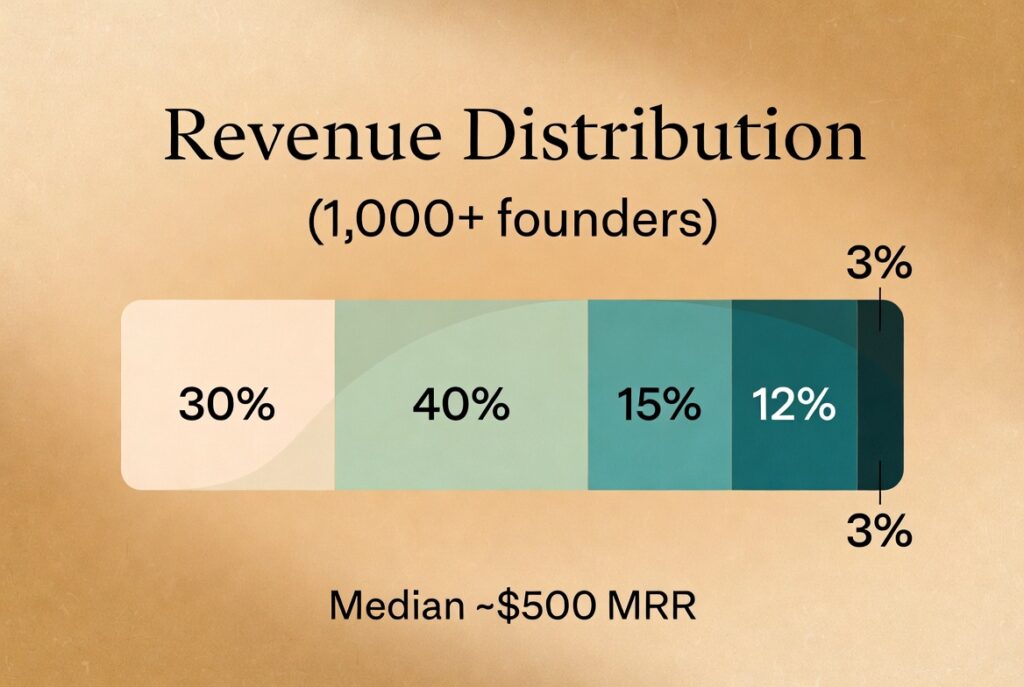
The median micro-SaaS founder earns $500/month. One in five builds an income that exceeds a senior developer’s salary—without a single client. Here is what the data actually shows, why most attempts fail at month 18, and which paths have the strongest risk-adjusted returns.
Let me tell you about the number that nobody puts in the headline. According to a synthesis of 1,000+ micro-SaaS products published by SaaSRanger in March 2026, the median founder earns $500 per month in MRR. Not $10,000. Not the $60K/month numbers you see in the Twitter screenshots. Five hundred dollars—roughly the same as a barista’s part-time shift.
That figure deserves to sit in your chest for a moment before we go any further.
The same dataset shows that 30% of founders never reach $1,000 MRR before abandoning the project, and 70% earn under $1,000 monthly. SoftwareSeni’s January 2026 analysis puts the median time to break $1,000 MRR at 12–18 months, even for founders executing well. And the 18-month mark is specifically where most quit—just before the compounding actually starts.
So: brutal ground truth first. Now the genuinely interesting part. Fifteen percent of founders scale to $10,000–$100,000 MRR. Five percent exceed $100,000. Verified examples exist—Nomad List at $5.3M ARR, Bannerbear at $991K, Carrd at $1.5M in 2024, all with 1–5 person teams. Marc Lou built a Next.js boilerplate called ShipFast and made $250,000 in five months, then scaled to $133,000/month by April 2024, with a 91% profit margin and zero employees.
These are not lottery tickets. They are specific skill-market-distribution combinations—and they are replicable if you understand the underlying mechanics, not just the surface story.
This article maps five income paths that work without client dependency. For each, you will find verified revenue data, the actual failure modes most guides skip, and an honest timeline—not the optimistic case, the median case.
Source: SaaSRanger 2026 & RockingWeb 2025
“The developers making $60K/month aren’t working 80-hour weeks managing clients. They responded to customer messages every day for 12 months. Most developers hate that part.”
— Solo Micro-SaaS Founder, Medium / CodeOrbit, Dec 2025The thesis of this article is not “here are passive income ideas.” It is this: product income for developers is won or lost not on technical skill—it is won on distribution timing, niche precision, and the willingness to talk to users during the 18 months when the numbers don’t justify it. Technical leverage is the entry ticket. Everything else decides the outcome.
This thesis would not hold without both forces operating together. If you have technical leverage without distribution discipline, you build things no one finds. If you have distribution discipline without technical leverage, you compete on raw content or hustle against millions of non-developers. The intersection is the opportunity.
Source: SaaSRanger 2026 · SoftwareSeni Jan 2026 · Segments are approximate; individual outliers exist at each tier.
Micro-SaaS for narrow verticals
Micro-SaaS means small, subscription-based software targeting a specific niche—not a horizontal tool competing with Notion or Linear. Think CRM for tattoo studios, not generic project management. The global SaaS market was valued at $317–358 billion in 2024 (sources differ; Precedence Research estimated $358B, Grand View Research estimated $317B), but the opportunity for solo founders is not in the market’s size—it is in the verticals that large SaaS companies consider too small to pursue.
RockingWeb’s analysis found profit margins for micro-SaaS hit 41% in 2024—”significantly outpacing larger SaaS companies.” The SaaS gross margin benchmark remains 75%+ in 2026 for well-run products, according to startup.info’s February 2026 analysis.
Here is what actually works, based on documented founder paths: you need a problem you have personally experienced, a community where the problem is discussed repeatedly, and a solution that delivers a result someone can describe in one sentence (“it automatically sends late invoice reminders, so I stop feeling like a debt collector”). The feature list is irrelevant until you have ten paying customers telling you what they actually need.
The channel data is counterintuitive. IndieLaunches’ analysis of 326 HN projects found that word of mouth (40 primary mentions), App Store/marketplace listings (33), and SEO (27) drove first paying customers—Product Hunt appeared overwhelmingly as a secondary channel. Building for a community and participating in that community authentically before launch outperforms cold Product Hunt launches for the median founder.
Products with AI as a core mechanism—not a ChatGPT wrapper added to an existing tool—grew at 2x the rate of traditional SaaS in 2024–2025 per RockingWeb’s cross-referenced dataset.
RockingWeb’s analysis identified the 18-month mark as “the deadliest valley of death for micro-SaaS.” Most founders who quit, quit here—just before traction starts compounding. The founders who survive almost universally cite a public community (Indie Hackers, r/SaaS, Twitter/X) as what kept them going.
Part-time building (10 hours/week while employed) reduces financial risk but extends your timeline 2–3× compared to full-time, according to SoftwareSeni’s January 2026 analysis. The strategic path they recommend: validate to $3K–$5K MRR part-time over 12–18 months, then transition full-time with 12+ months runway to accelerate to $10K+ MRR over an additional 6–9 months.
Code boilerplates and developer toolkits
Marc Lou packaged two years of repetitive setup code—authentication, Stripe webhooks, DNS configuration, pricing templates—into a Next.js boilerplate called ShipFast. He launched it in September 2023 and made $6,000 in 48 hours, $40,000 by month’s end, and $250,000 in five months at a 90% profit margin—all with zero employees.
By April 2024, ShipFast was generating $133,000/month. Today Marc maintains a portfolio of products—ShipFast, DataFast, TrustMRR, CodeFast—generating $100K+ months consistently. The portfolio approach matters: if one product has a slow month, others compensate.
What ShipFast proved is a pattern—not a guarantee of repetition. As Marc noted directly, being first in the Next.js boilerplate space was a structural advantage that later entrants couldn’t replicate. Every other boilerplate was compared to ShipFast as the reference. That is free marketing for the pioneer and a compounding disadvantage for followers.
The principle that generalizes: developers hate rebuilding the same infrastructure for every new project. A well-designed starter kit—whether for a specific tech stack, a vertical (e.g., “SaaS for coaches”), or an emerging framework without established boilerplates yet—solves a real, recurring pain. The value delivered is time, not code.
Distribution requires a personal brand or community that trusts you. Marc’s success came substantially from marketing discipline: a memorable slogan, building in public, and an audience of 35,000+ on Twitter built over two years before ShipFast launched. The code was necessary but not sufficient.
ShipFast’s success spawned dozens of competitors immediately. The boilerplate market has become crowded for mainstream stacks. The opportunity now lies in emerging frameworks, niche verticals (e.g., AI integration boilerplates, specific industry workflows), or design-first toolkits that compete on quality rather than timing. If the stack already has five well-reviewed boilerplates, you need a differentiated angle—not just another entry.
| Path | Verified ceiling | Typical 12-mo range | Median time to $1K/mo | Maintenance burden |
|---|---|---|---|---|
| Micro-SaaS | $5.3M ARR ↗ | $0–$1K MRR (70%) | 12–18 months ↗ | High (support, updates, churn) |
| Code Boilerplates | $133K/mo ↗ | One-time sales; variable | 1–4 months with audience | Medium (version updates) |
| Monetized API | $14.5K/mo (500 subs × $29) ↗ | $0–$500 MRR (most) | 6–18 months | Low (infra costs, not labor) |
| Technical Content + Affiliate | $1,764/mo YouTube peak ↗ | $100–$500 (yr 1) | 9–18 months | Medium (publishing cadence) |
| Developer Courses | $446K/year (community) ↗ | $500–$3K (yr 1 typical) | 6–12 months | Medium (support, updates) |
Monetized APIs and data services
Monetizing an API is the purest form of infrastructure income for developers: code that runs 24/7 serving requests, billed automatically, requiring your direct involvement only when something breaks or a customer has an integration question. The architecture is well-documented: API gateway for rate limiting and auth (options include Zuplo, Kong, or AWS API Gateway), Stripe for usage-based billing, self-service developer docs so customers onboard themselves, and monitoring for automated alerts.
IdeaProof’s analysis estimated that a well-positioned API with 500 paying subscribers at $29/month yields $14,500/month. That is a model, not a guarantee. Reaching 500 subscribers requires meaningful discovery—a marketplace listing on RapidAPI (4M+ registered developers), SEO for specific developer search queries, or integration with existing developer tools.
What pays in practice: not the “cool” APIs—the boring ones. Data validation, format conversion, compliance checks, batch processing tasks that developers face repeatedly and would rather pay $19/month than maintain themselves. The startup.info 2026 analysis highlighted that fintech APIs processing data or automating workflows are particularly compelling because “other companies would rather rent than build.”
The structural vulnerability: once your API gains traction in a vertical, a larger player may replicate the functionality or a free open-source alternative may emerge. Building defensive moats—deep integration with specific platforms, unique proprietary data, or network effects from user-generated data—is more important than feature breadth.
Technical content and affiliate income
Technical blogs and YouTube channels have a compounding dynamic that most other income paths lack: old content keeps working. A comparison article published in 2022 can still drive affiliate revenue in 2026 if the tools it covers remain relevant. The challenge is the upfront timeline—one documented Shopify developer built a blog answering questions he regularly got from clients. Several posts reached 500 clicks/month organically, but the first $100 from affiliate links arrived 2–3 months after the links were added. His YouTube channel reached $500/month from AdSense at ~1,000–2,000 subscribers, eventually hitting $1,764/month in his best month (March 2024), with an RPM of ~$20—roughly ten times higher than gaming or fitness channels.
That $20 RPM is the key data point. Developer and SaaS-adjacent content attracts high-CPC advertisers. SaaS affiliate programs like Jasper, Copy.ai, and Frase pay 30% recurring commissions. B2B tools in broader categories pay $500–$1,000 per referred customer (Kinsta, HubSpot). The audience is small, but the unit economics per visitor are fundamentally different from consumer content.
The content strategy that converts is purchase-intent oriented: “Supabase vs Firebase 2026,” “Moving from WordPress to Next.js,” “Auth0 alternatives for Next.js apps.” These target developers who have already decided to act on a problem and are evaluating options. Broad tutorials (“how to learn JavaScript”) do not drive affiliate conversions. Comparison content, migration guides, and specific implementation decisions do.
Post Affiliate Pro’s December 2025 analysis found that year-one affiliate income typically follows $0–$100 for months 1–6, rising to $100–$500 for months 6–12. Breakout to $1,000+ requires either scale (many articles) or a niche with higher RPM—developer tools qualify as the latter.
AI-powered search tools are reducing the number of users who click through to source articles for informational queries. The content most resistant to this disruption is comparison content, opinion-driven analysis, and articles requiring tool-specific expertise that AI models cannot reliably replicate. Building an email list as a parallel asset reduces platform dependence on organic search.
Developer courses and technical communities
The ceiling here is verified and striking. Daniel Vasallo’s Small Bets community averaged $446,462 in annual membership revenue across its last three years before being acquired by Gumroad in 2025 for $4 million—an 8× profit multiple based on 2024 earnings. The community had nearly 7,000 lifetime members. That acquisition represents an emerging income path that didn’t exist five years ago: building a community product specifically designed to be acquired.
For courses without a community layer, the economics are more modest. Udemy provides volume with low per-sale revenue ($12–$20 per sale at typical discounted prices); owning your audience via Gumroad or Teachable provides higher margins but requires your own traffic. The model that shows the strongest risk-adjusted returns in 2025–2026 is a micro-course strategy: 2–3 hour deep dives into specific implementation topics (“Stripe Connect for marketplaces,” “Building multi-tenant SaaS with Prisma”) rather than 40-hour beginner tracks competing with thousands of existing courses.
Technical founders save $50,000–$100,000 in initial development costs and ship 3–5× faster than non-technical counterparts, according to RockingWeb’s analysis. That same leverage applies to courses: you can produce implementation-level content that non-technical course creators structurally cannot. That is the differentiation angle worth owning.
Where these paths actually fail — documented patterns
| Failure pattern | What actually happens | Which path |
|---|---|---|
| Building before validating | Founder ships after 3 months of coding. First 10 signups are free users who give polite feedback but never convert. Revenue at month 4: $0. SoftwareSeni | Micro-SaaS |
| Quitting at the valley | Founder reaches month 16, still under $500 MRR, concludes the product is failing—right before the compounding inflection. SaaSRanger | All paths |
| Entering a crowded boilerplate market | Launches well-built boilerplate for a stack already covered by 5 established products. Gets compared to ShipFast immediately. BuilderOS | Boilerplates |
| No audience before launch | Ships a high-quality product to a brand-new Twitter account with 47 followers. Product Hunt spike produces 3 days of traffic, then silence. Marc Lou | Boilerplates, Courses |
| Information-intent content | Publishes 50 “how to learn” articles. Gets traffic. Zero affiliate conversions because none of the articles target a purchase decision. Fastovski | Technical Content |
| Security debt shipped fast | ShipFast was publicly blasted for security bugs allowing paywall bypasses in 2024. Marc fixed them in real-time—but this is a documented risk of speed-first development. Startup Stash | Boilerplates |
Where these markets are heading
Two cross-source patterns deserve attention from founders evaluating which path to prioritize now.
The first is AI-native products outpacing AI-feature products. RockingWeb’s analysis found that products launched in 2024–2025 with AI as a core mechanism—not a bolt-on feature—grew 2× faster than traditional SaaS. Separately, 67% of new Y Combinator companies in that period were AI-focused, up from 15% two years earlier. AI-native SaaS reaches $5M ARR in a median of 24 months versus 37 months for traditional SaaS. The counter-force: AI infrastructure costs are real. SoftwareSeni’s 2026 analysis notes that if GPU costs reach $10,000/month, you need $50,000+ revenue for sustainable margins. AI-native is faster to traction; it is not automatically cheaper to operate.
The second pattern: community as an acquirable asset. Daniel Vasallo’s $4M exit—documented by Creator Science in April 2025—at an 8× profit multiple is one of a small number of community exits. The model is still rare enough to be meaningful. CMX sold to Bevy in 2019, The Hustle sold to HubSpot in 2021, Small Bets sold to Gumroad in 2025. Each case suggests that a community with verified recurring revenue and a defined audience becomes an acquirable asset—not just a lifestyle business—if built with exit potential in mind from the start.
The structural question for content-based income is AI-driven search disruption. Informational content is increasingly answered directly in search results. Comparative, experiential, and implementation-specific developer content is more durable—it requires hands-on expertise that AI models cannot yet reliably replicate. Founders building content businesses in 2026 should weight toward comparison guides, original benchmarks, and toolchain-specific deep dives over tutorial-format content that aggregates existing knowledge.
Realistic 90-day start: what to actually do
The actual question to answer
The median micro-SaaS founder earns $500/month. The 18% who reach sustainability—real income, not a rounding error—are not dramatically more technical. They made one early choice that most developers avoid: they talked to potential customers before writing code, and they kept talking to them after.
The income paths in this article share a common structure. Technical leverage gets you in the door—it reduces build costs, speeds iteration, and gives you credibility in developer communities. Distribution discipline and community participation determine whether anyone ever finds what you built. Neither force operates without the other.
For developers starting today: the paths with the best risk-adjusted returns in the current environment are narrow-vertical micro-SaaS with AI as a core mechanism (fastest growth rate), and technical comparison content with purchase-intent targeting (most durable passive income once established). Boilerplates remain viable but require timing and audience—don’t enter a crowded stack without a differentiated angle.
The $10K/month outcome is not the median. It is the outcome for founders who stayed in it through month 18—which is, it turns out, the only real qualification.
[card url=”https://www.codetalenthub.io/the-reptilian-conspiracy-theory/”]
[card url=”https://www.codetalenthub.io/10-coding-side-hustles-earning-1k/”]
[card url=”https://www.codetalenthub.io/freelance-coding-side-hustle/”]
[card url=”https://www.codetalenthub.io/getting-first-coding-client/”]
[card url=”https://www.codetalenthub.io/7-tips-to-land-your-first-freelance-client/”]
[card url=”https://www.codetalenthub.io/top-niche-freelance-sites-for-coders/”]